Cómo escribir una Carta Formal para el C1 Advanced (CAE) [Guía 2026]
Guía completa para escribir emails formales en el C1 Advanced. Estructura, ejemplos reales y expresiones útiles.

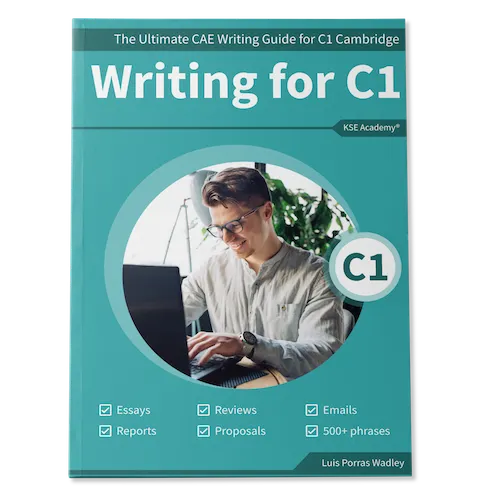
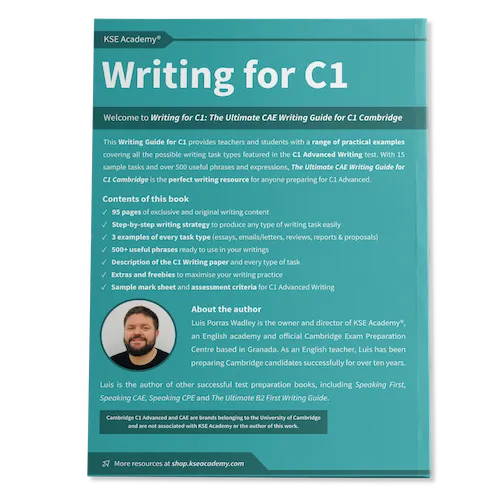
Tabla de contenidos
Si te estás preparando para el examen C1 Advanced de Cambridge, sabrás que la parte del Writing puede ser una de las más temidas, pero también una en la que es más fácil asegurar puntos si conoces bien las reglas del juego. En este artículo vamos a centrarnos en una de las opciones más comunes de la Part 2 del Writing de C1: la carta formal (o también email formal).
A diferencia del email informal, donde puedes ser cercano y expresivo, el email o carta formal de C1 requiere distancia, cortesía y un lenguaje sofisticado. Es el tipo de texto que escribirías a un director de empresa, al editor de un periódico o a una institución académica. ¿Listo para dominar este formato? Let’s get on with it!
¿Qué es un email o carta formal en el C1 Advanced?
En el examen C1 Advanced, un email o carta formal es un texto dirigido a una persona o institución con la que no tienes una relación personal cercana. El objetivo suele ser solicitar información, presentar una queja, aplicar para un puesto de trabajo, o responder a un artículo publicado en un medio de comunicación.
A efectos del examen, un email y una carta son exactamente lo mismo. No hay diferencia en el formato ni en el contenido. Cambridge utiliza ambos términos indistintamente en esta parte, así que las reglas que veremos aquí aplican a ambos formatos.
¿Cuándo te pedirán escribir una carta formal en el CAE?
Como ya sabrás, el Writing del CAE tiene dos partes. La Parte 1 es obligatoria (siempre es un essay), pero en la Parte 2 tienes que elegir una tarea de entre tres opciones. Estas opciones pueden incluir: review, report, proposal, formal email/letter o informal email/letter.
Por lo tanto, no siempre aparecerá la opción de carta formal, pero es igual de probable que aparezca que el resto de opciones. Y si aparece, es fundamental que sepas distinguirlo del informal y que apliques el registro adecuado desde la primera palabra.
Características principales de una carta formal para C1
Para conseguir la máxima puntuación, tu texto debe cumplir con ciertas expectativas de nivel y estilo:
- Propósito y contexto: Normalmente tendrás que solicitar información, quejarte de un servicio, aplicar a un puesto de trabajo, o responder formalmente a un artículo o situación. El destinatario será siempre alguien con quien no tienes confianza: un director, un editor, una institución.
- Tono y registro formal: Aquí es donde debes demostrar distancia profesional y cortesía. Debes sonar educado, objetivo y respetuoso. Nada de cercanía emocional ni expresiones coloquiales.
- Diferencias entre carta formal e informal: A diferencia del email informal, aquí debes evitar las contracciones, los phrasal verbs, los idioms coloquiales y el lenguaje emotivo. En su lugar, utilizarás vocabulario sofisticado, estructuras complejas y un tono impersonal.
Estructura de un email o carta formal para el C1 Advanced
Aunque sea formal, el texto debe estar perfectamente organizado. La claridad es fundamental en este registro. Esta es la estructura ideal:
- Saludo formal: Una fórmula de apertura apropiada según conozcas o no el nombre del destinatario.
- Párrafo introductorio: Explicas el motivo por el que escribes de manera clara y concisa.
- Párrafos principales (cuerpo del email): Aquí desarrollas los puntos que te pide la tarea. Cada idea principal debe ir en un párrafo separado, y debes ser específico y objetivo.
- Párrafo de cierre: Resumes tu petición o expectativa y agradeces al destinatario su tiempo o atención.
- Despedida y firma: Una fórmula final adecuada según el grado de formalidad.
Cómo escribir una carta email formal paso a paso
Vamos a desglosar el proceso para que sepas exactamente qué hacer en el examen:
- Paso 1: Analiza la tarea y extrae la información clave. Subraya quién es el destinatario, qué relación tienes con esa persona/institución y, sobre todo, los 3 puntos (generalmente son 3) que debes tratar obligatoriamente.
- Paso 2: Planifica tu respuesta. Decide qué vas a decir en cada punto. Piensa en argumentos sólidos y específicos. No improvises.
- Paso 3: Escribe el saludo apropiado. Si conoces el nombre: «Dear Mr/Ms [Apellido]». Si no lo conoces: «Dear Sir or Madam» o «To whom it may concern».
- Paso 4: Redacta la introducción. Debes explicar inmediatamente por qué escribes. Usa fórmulas como «I am writing with regard to…» o «I am writing to enquire about…».
- Paso 5: Desarrolla los puntos principales. Un párrafo por cada punto de la tarea. Usa conectores formales («Firstly», «Furthermore», «In addition») y asegúrate de ser específico.
- Paso 6: Cierra el email de forma apropiada. Agradece la atención del lector y expresa tu expectativa de respuesta: «I look forward to hearing from you».
- Paso 7: Elige la despedida adecuada. «Yours faithfully» si no conoces el nombre; «Yours sincerely» si lo conoces. Firma con tu nombre completo.
Ejemplo completo de email formal para el CAE
La teoría está muy bien, pero veamos cómo se aplica en la práctica con un ejemplo original creado específicamente para esta guía.
Instrucciones de la tarea
You have read the following announcement from a local environmental organisation:
«GREEN FUTURE INITIATIVE: We are seeking volunteers to help coordinate our annual environmental awareness campaign in schools across the region. Successful candidates will be responsible for organising workshops, liaising with teachers, and presenting environmental topics to students aged 12-16. We are looking for enthusiastic individuals with strong communication skills and a genuine passion for environmental issues.»
Write a formal letter of application. In your letter you should:
- Explain why you are interested in this volunteering opportunity
- Describe your relevant skills and experience
- Suggest what specific contribution you could make to the campaign
Write your answer in 220 – 260 words in an appropriate style.
Análisis de la tarea
En esta tarea, debemos escribir una carta formal de solicitud cubriendo estos tres puntos:
- Explicar nuestro interés en la oportunidad de voluntariado.
- Describir nuestras habilidades y experiencia relevantes.
- Sugerir qué contribución específica podríamos hacer a la campaña.
Respuesta modelo comentada
Dear Sir or Madam,
I am writing to express my strong interest in the volunteering position advertised for your annual environmental awareness campaign. As a qualified secondary school teacher with a longstanding commitment to environmental conservation, I believe I would be an ideal candidate for this role.
My interest in this opportunity stems from my conviction that environmental education is crucial for the younger generation. Having witnessed the devastating effects of climate change firsthand during my travels to coastal regions, I am firmly convinced that raising awareness among adolescents is one of the most effective ways to secure a sustainable future. Furthermore, working with schools would allow me to combine my two greatest passions: education and environmental protection.
As regards my qualifications, I have been teaching Science at a local secondary school for the past five years, during which time I have developed strong presentation and communication skills. Additionally, I hold a degree in Environmental Science and have recently completed a postgraduate course in Environmental Policy. I am therefore well-equipped to explain complex environmental issues in an accessible and engaging manner to young audiences.
In terms of specific contributions, I would be particularly keen to develop interactive workshops focusing on practical solutions that students can implement in their daily lives. I could also establish connections with my current school and other educational institutions in the area, thereby expanding the reach of your campaign significantly.
I would be grateful if you could consider my application. Should you require any further information, please do not hesitate to contact me.
I look forward to hearing from you at your earliest convenience.
Yours faithfully,
Catherine Morrison
¿Por qué funciona bien este email formal para el C1? Te lo explico brevemente a continuación:
- Registro consistentemente formal: No hay ni una sola contracción en todo el texto. Se utilizan verbos formales en lugar de phrasal verbs («express» en lugar de «show», «establish» en lugar de «set up»).
- Vocabulario sofisticado (C1/C2): Expresiones como «longstanding commitment», «stems from my conviction», «witnessed firsthand», «firmly convinced», «well-equipped», «accessible and engaging manner».
- Estructuras gramaticales avanzadas: Uso de voz pasiva («I am writing»), frases subordinadas complejas y conectores formales («Furthermore», «As regards», «Additionally», «In terms of», «thereby»).
- Tono distante y profesional: El texto mantiene una distancia apropiada sin resultar frío. Muestra entusiasmo pero de manera contenida y profesional.
- Estructura clara: Cada párrafo aborda un punto específico de la tarea, y la progresión lógica es evidente desde el principio hasta el final.
Lenguaje y expresiones para cartas e emails formales de nivel C1
Para conseguir un registro verdaderamente formal, necesitas dominar ciertos elementos lingüísticos que son característicos de este tipo de escritos:
Evitar contracciones y lenguaje coloquial
No escribas «I’m writing» o «I’d like». En emails formales, nunca se utilizan contracciones. Siempre debes escribir la forma completa: «I am writing», «I would like», «do not», «cannot».
Evita también palabras coloquiales como «stuff», «things», «get», «lots of». En su lugar, utiliza vocabulario más preciso y formal.
Verbos formales vs phrasal verbs
Una de las características más evidentes del registro formal es la preferencia por verbos de origen latino en lugar de phrasal verbs. Aquí tienes algunos ejemplos de transformación:
| Informal (Phrasal Verb) | Formal (Verbo simple) |
|---|---|
| find out | discover, ascertain |
| put off | postpone, delay |
| set up | establish, arrange |
| look into | investigate, examine |
| go on | continue, proceed |
| show | demonstrate, illustrate |
| get in touch | contact, reach out |
| ask for | request, enquire about |
Estructuras gramaticales avanzadas
El registro formal favorece estructuras más complejas. Algunas de las más útiles son:
- Voz pasiva: Ayuda a crear distancia y un tono más impersonal. Ej: «I was informed that…», «It has been brought to my attention that…»
- Condicionales formales: «Should you require further information…», «Were I to be selected…»
- Inversiones: «Not only did I complete the course, but I also…», «Under no circumstances would I…»
- Frases nominales complejas: «My extensive experience in project management» en lugar de «I have worked a lot in project management»
Conectores formales
Los conectores son esenciales para dar coherencia a tu texto. En emails formales, debes usar conectores sofisticados:
- Para añadir información: Furthermore, Moreover, In addition, Additionally, What is more
- Para contrastar: However, Nevertheless, Nonetheless, On the other hand
- Para secuenciar: Firstly, Secondly, Finally, In the first place, Subsequently
- Para concluir: Therefore, Consequently, Thus, Hence, As a result
- Para especificar: As regards, With regard to, Concerning, In terms of
Frases útiles para cada parte del email o carta formal
Saludos formales
- Dear Mr/Ms [Apellido], (cuando conoces el nombre)
- Dear Sir or Madam, (cuando no conoces el nombre)
- To whom it may concern, (muy formal, cuando no hay destinatario específico)
- Dear Editor, (para cartas a periódicos o revistas)
Párrafo introductorio
- I am writing with regard to…
- I am writing in response to your advertisement…
- I am writing to express my interest in…
- I am writing to enquire about…
- I am writing to complain about…
- I am writing to apply for the position of…
- I recently came across your article regarding… and I would like to…
Solicitudes y peticiones formales
- I would be grateful if you could…
- I would appreciate it if you would…
- Could you please provide me with information regarding…?
- I wonder if you would be kind enough to…
- I should be obliged if you could…
- Would it be possible for you to…?
Quejas y reclamaciones
- I am writing to express my dissatisfaction with…
- I am afraid I must complain about…
- I regret to inform you that…
- I was extremely disappointed to discover that…
- It has been brought to my attention that…
- I feel compelled to point out that…
Proporcionar información
- I should like to inform you that…
- Please note that…
- I wish to draw your attention to…
- Please find attached…
- As regards your enquiry about…
- With reference to your letter of…
Despedidas formales
- I look forward to hearing from you.
- I look forward to receiving your reply.
- I look forward to hearing from you at your earliest convenience.
- Thank you in advance for your time and consideration.
- Should you require any further information, please do not hesitate to contact me.
- I would be grateful for your prompt response.
- Yours faithfully, (si no conoces el nombre del destinatario)
- Yours sincerely, (si conoces el nombre del destinatario)
Ejemplos adicionales de tareas de carta o email formal
Para que tengas más referencias, aquí tienes otros dos ejemplos completos con sus respectivas respuestas modelo, cubriendo diferentes temáticas típicas del examen.
Ejemplo 2: Carta de queja a una compañía
Instrucciones de la tarea:
You recently purchased a high-end laptop from an online retailer for your university studies. However, when the laptop arrived, you discovered that it had several defects: the screen had dead pixels, the battery life was significantly shorter than advertised, and some of the pre-installed software was not functioning properly.
Write a formal letter of complaint to the customer service department. In your letter you should:
- Explain what problems you encountered with the laptop
- Describe how these issues have affected your studies
- State what you expect the company to do to resolve the situation
Write your answer in 220 – 260 words.
Respuesta modelo:
Dear Sir or Madam,
I am writing to express my profound disappointment with a laptop I purchased from your online store on 15th January 2026 (Order Reference: LP-2026-4873). I regret to inform you that the product delivered was significantly defective and has failed to meet the standards one would expect from such a reputable company.
Upon receiving the laptop, I immediately noticed several serious defects. Firstly, the screen displays multiple dead pixels, which is particularly problematic when working with detailed graphics and documents. Secondly, the battery life is considerably shorter than the eight hours advertised on your website; in reality, it barely lasts three hours. Finally, several pre-installed applications, including the word processing software essential for my coursework, are not functioning properly and crash frequently.
As a postgraduate student conducting research for my dissertation, I rely heavily on having a dependable laptop. These defects have severely disrupted my academic work. I have been unable to complete assignments on time and have missed important deadlines as a result. Furthermore, I have had to resort to using the university library computers, which has proven highly inconvenient given their limited availability.
In light of these circumstances, I would like to request either a full replacement with a functioning device or a complete refund. Additionally, I believe some form of compensation would be appropriate given the considerable inconvenience I have experienced.
I trust you will treat this matter with the urgency it deserves and look forward to receiving your response within seven working days.
Yours faithfully,
Thomas Bennett
Ejemplo 3: Respuesta a un artículo de periódico
Instrucciones de la tarea:
You have read the following extract in a national newspaper:
«Public libraries have become obsolete in the digital age. With unlimited information available online, maintaining physical libraries is an unnecessary expense for local councils. The buildings should be converted into more practical facilities such as community centres or commercial spaces.»
Write a letter to the newspaper editor. In your letter you should:
- Explain why you disagree with the article’s viewpoint
- Provide specific reasons why libraries remain important
- Suggest what role libraries could play in modern society
Write your answer in 220 – 260 words.
Respuesta modelo:
Dear Editor,
I am writing in response to the article published in your newspaper on 20th January regarding the alleged obsolescence of public libraries. I am afraid I must strongly disagree with the assertions made in the piece, as I believe the author has fundamentally misunderstood the role libraries play in contemporary society.
Firstly, whilst it is true that information is readily available online, access to digital resources is far from universal. According to recent statistics, approximately 15% of households in the UK lack reliable internet connectivity. For these individuals, particularly those from disadvantaged backgrounds, libraries provide essential access to information and educational resources. Without them, we would be exacerbating existing social inequalities rather than addressing them.
Moreover, libraries serve functions that extend far beyond merely housing books. They provide quiet spaces for study, which is invaluable for students who may not have suitable environments at home. Furthermore, they offer free computer access, job-seeking support, and literacy programmes for all age groups. Many elderly citizens, for instance, rely on library staff to assist them with digital technology and online government services.
Rather than closing libraries, we should be reimagining them as dynamic community hubs. They could host workshops, cultural events, and provide meeting spaces for local groups. In doing so, they would continue to fulfil their traditional role of democratising knowledge whilst adapting to the needs of modern communities.
I sincerely hope you will consider publishing this alternative perspective on such an important matter.
Yours faithfully,
Dr Eleanor Whitfield
Errores comunes al escribir emails formales (y cómo evitarlos)
- Usar contracciones: Este es el error más común y más fácil de evitar. Recuerda: trata de no usar «I’m», «don’t», «can’t» en un texto formal. Siempre escribe la forma completa.
- Ser demasiado cercano o emotivo: No uses expresiones como «I’m really excited» o «It would be amazing if…». Mantén la distancia profesional con expresiones como «I would be delighted» o «It would be beneficial if…»
- Mezclar registros: Si empiezas con un tono formal, debes mantenerlo hasta el final. No mezcles vocabulario coloquial con formal.
- No cubrir todos los puntos: Asegúrate de que has respondido a las 3 cosas que te pide la tarea. Es un error que cuesta muy caro en la nota.
- Usar phrasal verbs innecesariamente: Aunque algunos phrasal verbs neutrales son aceptables, debes priorizar verbos simples de origen latino para sonar más formal.
- Despedidas incorrectas: Recuerda la regla: «Yours faithfully» si no conoces el nombre (empezaste con «Dear Sir or Madam»), «Yours sincerely» si lo conoces (empezaste con «Dear Mr/Ms…»).
Diferencias entre emails formales e informales
Es vital no confundir estos dos tipos de escritos. Confundir el registro es uno de los errores más graves que puedes cometer en el examen. Si quieres profundizar en el otro tipo de email, echa un vistazo a nuestra guía sobre el email informal. Aquí tienes una comparativa detallada para que no cometas errores de registro:
| Aspecto | Email/Carta Formal (Jefe/Institución) | Email/Carta Informal (Amigo/Familiar) |
|---|---|---|
| Objetivo del tono | Distante, objetivo, cortés y profesional. Buscas informar, solicitar o quejarte de manera educada. | Cercano, emocional, subjetivo y relajado. Buscas conectar y mantener la relación. |
| Saludo Inicial | Dear Mr/Ms [Apellido], Dear Sir or Madam, To whom it may concern | Hi, Hey, Dear [Nombre de pila] |
| Contracciones | Prohibidas: Usar siempre la forma completa (I am, do not, will not, cannot). | Esenciales: I’m, don’t, won’t, can’t, it’s. |
| Vocabulario y Verbos | Preferencia por verbos de origen latino y vocabulario sofisticado (enquire, ascertain, establish, contact, request). | Uso frecuente de Phrasal Verbs (find out, set up, get in touch, ask for) y palabras coloquiales. |
| Estructuras Gramaticales | Voz pasiva (para ser impersonal), frases complejas y largas, preguntas indirectas (I wonder if you could…). | Voz activa, frases más cortas, preguntas directas (Can you…?), exclamaciones (!). |
| Conectores | Furthermore, Moreover, However, Nevertheless, Consequently, Therefore. | Anyway, Besides, Plus, So, But. |
| Expresiones idiomáticas | Se evitan los modismos coloquiales. El lenguaje debe ser literal, preciso y objetivo. | Se valora mucho el uso de Idioms (over the moon, give a hand, keep in touch). |
| Nivel de Personalización | Impersonal. Evitas hablar demasiado de ti mismo. Te centras en el tema o problema. | Personal. Hablas de tus experiencias, emociones y opiniones libremente. |
| Despedida | Yours faithfully (si no sabes el nombre), Yours sincerely (si lo sabes). | Best wishes, Take care, Hugs, All the best, Lots of love. |
Nota importante sobre ejemplos de transformación: Fíjate cómo cambia completamente el tono según el registro:
Ejemplo de transformación informal → formal:
| Informal | Formal |
|---|---|
| Hi John! | Dear Mr Thompson, |
| I’m writing because I want to know more about the job. | I am writing to enquire about the position advertised. |
| I’d really love to get this job! | I would be extremely interested in securing this position. |
| Can you tell me when I’ll hear back? | I would be grateful if you could inform me of your decision timeframe. |
| Looking forward to hearing from you soon! | I look forward to hearing from you at your earliest convenience. |
| Cheers, Sarah | Yours sincerely, Sarah Mitchell |
Checklist: Revisa tu carta/email formal antes de entregarlo
Antes de dar tu email por terminado, pásalo por este filtro. Hemos adaptado la lista de verificación oficial de Cambridge para el C1 específicamente para la tarea de Carta Formal. Si marcas todas las casillas, tu aprobado está mucho más cerca.
1. Contenido (Content)
- ✅ ¿He cubierto los 3 puntos de la tarea? (Asegúrate de no haber olvidado ningún aspecto solicitado).
- ✅ ¿He añadido detalles específicos y relevantes? (No respondas de manera vaga; sé concreto y preciso).
- ✅ ¿Es la longitud adecuada? (El texto debe estar entre 220 y 260 palabras).
2. Propósito y registro (Communicative Achievement)
- ✅ ¿El tono es consistentemente formal? (Debe ser cortés, distante y profesional en todo momento).
- ✅ ¿He evitado lenguaje emotivo o personal? (Mantén la objetividad y no uses expresiones demasiado emocionales).
- ✅ ¿He cumplido la función comunicativa? (Si piden solicitar, ¿he solicitado? Si piden quejarme, ¿me he quejado apropiadamente?).
3. Organización (Organisation)
- ✅ ¿Hay párrafos claros y lógicos? (Saludo + Introducción + Párrafo por idea + Cierre + Despedida).
- ✅ ¿He usado conectores formales? (Usa «Furthermore», «Moreover», «However», «In addition» en lugar de conectores informales).
- ✅ ¿La progresión de ideas es clara? (Cada párrafo debe tener un propósito claro y seguir una secuencia lógica).
4. Lenguaje (Language)
- ✅ ¿He evitado todas las contracciones? (Imprescindible: I am, do not, cannot, will not en lugar de I’m, don’t, can’t, won’t).
- ✅ ¿He priorizado verbos formales sobre phrasal verbs? (Usa enquire, establish, contact en lugar de ask about, set up, get in touch).
- ✅ ¿He usado vocabulario sofisticado? (Evita palabras simples como get, do, make; usa sinónimos más precisos).
- ✅ ¿Hay variedad gramatical? (Incluye estructuras avanzadas como voz pasiva, condicionales formales, frases subordinadas complejas).
- ✅ ¿He usado el saludo y despedida correctos? (Dear Sir or Madam / Yours faithfully o Dear Mr/Ms X / Yours sincerely).
Guía completa de Writing para el C1 Advanced
¿Quieres asegurarte el aprobado en el Writing del C1? Si te ha gustado esta explicación, te encantará mi guía completa para el Writing del C1: Writing C1: The Ultimate CAE Writing Guide for C1 Cambridge. Se trata del mejor recurso que encontrarás a la venta con ejemplos de todos los tipos de textos, listas de vocabulario avanzado, ejercicios de corrección de errores y plantillas paso a paso para que no tengas que improvisar el día del examen. Es la herramienta que usan miles de personas para triunfar en el Writing del C1 Advanced.
👉🏻 Consigue aquí el mejor libro de Writing para C1
Espero que esta guía te haya resultado útil para saber cómo escribir una carta formal o un email formal. Recuerda que puedes descargar este artículo en PDF haciendo clic en el botón de la parte superior de la página para repasarlo cuando quieras.
Y hasta el próximo artículo, don’t forget to keep smiling!