
Writing C2 Proficiency (CPE): Guía completa con ejemplos [Actualizada 2026]
Guía completa del Writing C2 Proficiency. Descubre todos los tipos de Writing del CPE con ejemplos reales, consejos y evaluación.

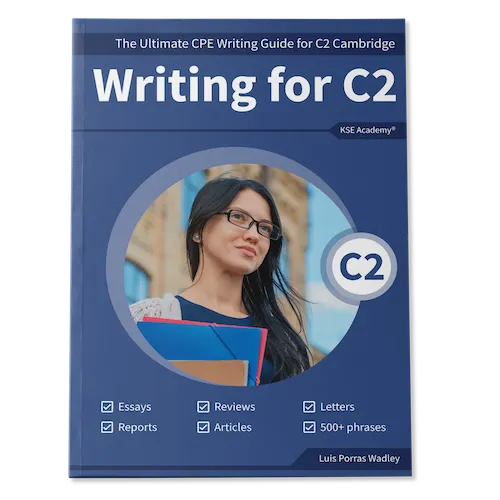
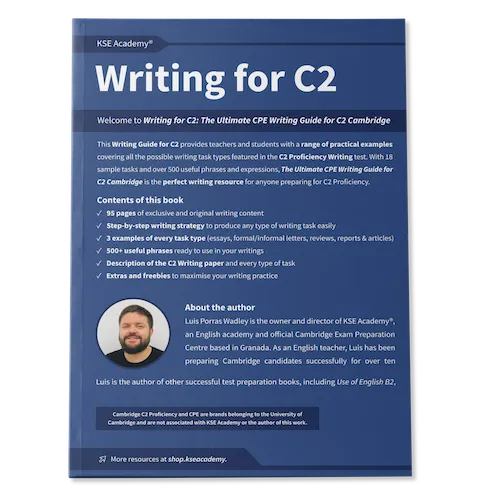
Tabla de contenidos
El Writing C2 Proficiency (CPE) es la prueba de expresión escrita del nivel más alto de los exámenes de Cambridge Assessment English. Como ya sabrás, el Writing del C2 Proficiency es solo una de las 4 partes del examen de C2 Proficiency, anteriormente conocido como CPE (Certificate of Proficiency in English). Además del Writing, para completar un examen de C2 Proficiency tienes que realizar las partes de Reading and Use of English, Listening y Speaking. Sin embargo, desde mi punto de vista como profesor de inglés y examinador oral de Cambridge Assessment English, el Writing del C2 Proficiency es una de las partes más exigentes, pero también una de las más gratificantes de dominar. Por ello, en este artículo te voy a explicar exactamente cómo es el Writing del C2 Proficiency (CPE) y te voy a mostrar ejemplos de Writing de cada tipo de tarea. ¡Vamos allá!
Writing C2: cuál es el nivel C2 de producción escrita
El nombre del examen del que estamos hablando, C2 Proficiency, especifica claramente qué nivel de inglés se espera de ti. En este caso, el nivel C2 es el nivel más alto establecido por el Marco Común Europeo de Referencia para las Lenguas (MCERL). El nivel C2 corresponde a un dominio del idioma equiparable al de un hablante nativo culto. Tal y como especifica el MCE, una persona con un nivel C2 en expresión escrita:
Puede resumir información procedente de diversas fuentes orales y escritas, reconstruyendo argumentos y hechos en una presentación coherente.
Marco Común Europeo, p. 26
A nivel general, ya apreciamos un salto cualitativo importante con respecto a niveles inferiores. Las frases «resumir información de diversas fuentes» y «reconstruir argumentos y hechos» son características exclusivas de este nivel. Es en C1, justo por debajo de C2, donde se menciona por primera vez «temas complejos», por lo que es evidente que en nivel C2 los candidatos también tratarán temas complejos en su escritura.
Si profundizamos más en la sección de expresión escrita del MCE, veremos que un candidato que demuestra un nivel C2:
- En producción escrita general:
- Escribe textos complejos con claridad y fluidez, y con un estilo apropiado y eficaz, y una estructura lógica que ayuda al lector a encontrar las ideas significativas.
- En escritura creativa:
- Escribe historias y descripciones de experiencias claras, fluidas y completamente absorbentes en un estilo apropiado al género adoptado.
- En escritura de informes y redacciones:
- Produce informes, artículos o ensayos complejos claros y fluidos que presentan un argumento o una apreciación crítica de propuestas u obras literarias. Proporciona una estructura lógica apropiada y eficaz que ayuda al lector a encontrar las ideas significativas.
Como puedes apreciar, un Writing de nivel C2 es tremendamente exigente, con unas expectativas del lector que apuntan muy alto. Este nivel representa el dominio pleno del idioma en su vertiente escrita.
El examen de C2 Proficiency de Cambridge está totalmente alineado con este nivel C2 del Marco Común Europeo, por lo que en el Writing del CPE se espera que demuestres todas estas competencias lingüísticas.
Cómo es el Writing C2 Proficiency
El Writing del C2 Proficiency sigue la línea de otros exámenes de Cambridge, aunque adaptado a las exigencias del nivel más alto. Los candidatos tienen que escribir dos textos en 1 hora y 30 minutos. El primer texto debe tener entre 240 y 280 palabras, mientras que el segundo debe tener entre 280 y 320 palabras. Estos dos textos son de tipos diferentes, como veremos más adelante, y el objetivo es que demuestres una serie de mecanismos lingüísticos escritos propios de un Writing de nivel C2.
A diferencia del B2 First y del C1 Advanced, en el C2 Proficiency la primera parte del Writing tiene una característica especial: debes leer dos textos de entrada (de aproximadamente 100 palabras cada uno) y, a partir de ellos, escribir un ensayo que resuma, evalúe e integre las ideas de ambos textos junto con tus propias reflexiones.
Ahora pasaremos a ver los diferentes tipos de Writing del C2 Proficiency (CPE) con ejemplos de cada uno de ellos.
Tipos de Writing del C2 Proficiency
Estos son los diferentes tipos de tarea que puedes encontrarte en el CPE Writing actual:
- Part 1
- Essay (obligatorio)
- Part 2 (elegir 1 de 3 opciones)
- Informal Letter
- Formal Letter
- Review
- Article
- Report
Estos tipos de Writing ya aparecían en niveles inferiores (B2 First y C1 Advanced), pero en el C2 Proficiency se espera un nivel de sofisticación lingüística, precisión y naturalidad mucho mayor. Veamos cada uno en detalle.
Writing C2 Proficiency: Part 1 – Essay
En la primera parte de este examen de Writing, tendrás que escribir un ensayo discursivo, en inglés discursive essay. En esta parte no tienes opción de elegir: todos los candidatos deben escribir un essay obligatoriamente.
Lo particular del essay del C2 Proficiency es que se te presentan dos textos de entrada (de aproximadamente 100 palabras cada uno) que ofrecen perspectivas contrastantes o complementarias sobre un tema específico. Tu tarea consiste en leer ambos textos, identificar los puntos clave de cada uno, y escribir un ensayo que resuma estos puntos, evalúe los argumentos presentados y exprese tus propias ideas sobre el tema. Se espera que demuestres un nivel C2 de competencia lingüística expandiendo e integrando el lenguaje y las ideas de los textos de entrada en tu escritura.
Un essay del C2 Proficiency es un tipo de Writing formal en el que se espera que presentes un análisis equilibrado, objetivo y sofisticado de un tema complejo, haciendo uso de estructuras léxicas y gramaticales avanzadas, así como de conectores apropiados para un nivel C2.
A continuación puedes ver cómo son las instrucciones de un essay en el C2 Proficiency:
Read the two texts below.
Write an essay summarising and evaluating the key points from both texts. Use your own words throughout as far as possible, and include your own ideas in your answer.
Write your answer in 240-280 words.
The Rise of Remote Work: A New Era of Productivity?
The shift towards remote work has been hailed as a revolutionary change in how we approach employment. Proponents argue that working from home eliminates lengthy commutes, reduces overhead costs for businesses, and allows employees greater flexibility to balance their professional and personal lives. Studies have shown that many remote workers report higher levels of job satisfaction and productivity, as they can structure their day around their peak performance hours and work in environments tailored to their preferences. Moreover, companies can tap into a global talent pool without geographical constraints, fostering diversity and innovation.
The Hidden Costs of Working from Home
Despite the apparent benefits, remote work presents significant challenges that cannot be overlooked. The blurring of boundaries between professional and personal life often leads to burnout, as employees find it difficult to «switch off» from work. The absence of face-to-face interaction can hinder collaboration, creativity, and the spontaneous exchange of ideas that often occurs in traditional office settings. Furthermore, remote work can exacerbate feelings of isolation and disconnect employees from company culture, potentially affecting team cohesion and long-term employee retention. Not everyone has access to adequate home office facilities, creating inequalities in working conditions.
Como ves, se trata de una tarea de Writing que requiere leer cuidadosamente ambos textos, identificar los argumentos clave, y luego escribir un ensayo que no sólo resuma estos puntos, sino que también los evalúe críticamente y aporte tu propia perspectiva fundamentada. Todo esto en 240-280 palabras y con un nivel de inglés C2.
Writing C2 Proficiency: Part 2
En esta segunda parte del Writing, debes escribir otro texto de 280-320 palabras, pero esta vez puedes elegir entre 3 tareas diferentes. Aunque solo aparecen 3 opciones en el examen, pueden presentarse hasta 5 tipos diferentes de Writing de C2: informal letter, formal letter, review, article o report.
Veamos un ejemplo de cada tipo de Writing del C2 Proficiency, es decir, de las instrucciones.
Writing C2: Informal Letter
Las cartas informales en el C2 Proficiency se escriben típicamente a amigos, familiares o conocidos cercanos. Aunque el tono es informal, se espera que demuestres un dominio completo del registro informal en inglés, incluyendo expresiones idiomáticas naturales, phrasal verbs apropiados y un estilo fluido y espontáneo.
A close friend from university, whom you haven’t seen for several years, has written to you saying they’re considering a major career change. They’re currently working in corporate law but are thinking about retraining as a therapist. They’ve asked for your honest opinion about whether this is a sensible decision, given their personality and circumstances.
Write a letter responding to your friend’s request.
Write your answer in 280-320 words in an appropriate style.
En este ejemplo, se te pide escribir una carta informal a un amigo cercano dándole tu opinión honesta sobre un cambio de carrera importante. Aunque es informal, debes demostrar capacidad para expresar ideas complejas de manera natural, ofrecer consejos matizados y mantener un tono apropiado para la relación y el tema delicado que se trata.
Writing C2: Formal Letter
Las cartas formales en el C2 Proficiency pueden ser cartas de solicitud, de queja, de consulta, o dirigidas a editores de periódicos, autoridades, organizaciones, etc. El lenguaje debe ser sofisticado, preciso y apropiadamente formal, demostrando un dominio completo de las convenciones del registro formal en inglés.
You recently read an article in a national newspaper arguing that governments should impose significant taxes on sugary drinks and fast food to combat obesity. While you agree that obesity is a serious public health issue, you believe the article’s proposed solution is overly simplistic and potentially counterproductive.
Write a letter to the editor presenting your perspective on this issue.
Write your answer in 280-320 words in an appropriate style.
En este caso, se te solicita escribir una carta formal al editor de un periódico presentando tu perspectiva sobre un tema de salud pública. Debes demostrar capacidad para articular argumentos complejos de manera persuasiva, mantener un tono respetuoso pero firme, y estructurar tu razonamiento de forma lógica y convincente, todo ello con un registro formal impecable.
Writing C2: Review
Una review en el C2 Proficiency consiste en evaluar críticamente un producto cultural (exposición, concierto, restaurante, aplicación, servicio, etc.). Se espera un análisis sofisticado que vaya más allá de la simple descripción, incluyendo evaluación crítica, comparaciones pertinentes y recomendaciones fundamentadas. El tono suele ser estándar o semi-formal.
An international arts and culture magazine is publishing a special edition on innovative museum experiences. They have invited readers to submit reviews of museums that challenge traditional exhibition formats or use technology in creative ways to engage visitors.
Write a review of an innovative museum you have visited, evaluating how effectively it engages visitors and whether it succeeds in making its subject matter accessible and compelling.
Write your answer in 280-320 words in an appropriate style.
Esta tarea te pide escribir una reseña de un museo innovador que hayas visitado. Debes demostrar capacidad para describir la experiencia de manera vívida y atractiva, evaluar críticamente la eficacia del museo en involucrar a los visitantes, y ofrecer una recomendación fundamentada. El lenguaje debe ser sofisticado pero accesible, con un tono que combine información y entretenimiento.
Writing C2: Article
Un artículo en el C2 Proficiency es un texto destinado a informar, entretener o persuadir a los lectores sobre un tema específico de interés. A diferencia de una review, que se centra en evaluar algo concreto, un artículo tiene un alcance más amplio y puede explorar ideas, tendencias, experiencias personales o cuestiones sociales. El registro suele ser estándar.
An international lifestyle magazine is running a series called «Life Lessons from Unexpected Places». They are looking for articles in which writers reflect on a significant life lesson they learned from an unlikely source or experience.
Write an article describing an unexpected experience that taught you an important life lesson, explaining what you learned and how it has influenced your perspective or behaviour.
Write your answer in 280-320 words in an appropriate style.
En este ejemplo, se te pide escribir un artículo reflexivo sobre una lección de vida aprendida de una fuente inesperada. Debes demostrar capacidad para narrar de manera atractiva, reflexionar con profundidad sobre el significado de la experiencia, y conectar con los lectores de forma genuina. El estilo debe ser fluido, natural y absorbente, con un equilibrio entre lo personal y lo universal.
Writing C2: Report
Un report en el C2 Proficiency es un texto formal y objetivo que analiza una situación, evalúa opciones o hace recomendaciones basadas en información factual. Los informes suelen estar dirigidos a superiores, organizaciones o comités, y deben presentar información de manera clara, estructurada y profesional, haciendo uso de secciones con subtítulos.
Your company is considering implementing a comprehensive employee wellbeing programme. As part of the human resources team, you have been asked to research different approaches to workplace wellbeing and produce a report evaluating their potential effectiveness and suitability for your organisation.
Write a report outlining different approaches to employee wellbeing, evaluating their advantages and potential challenges, and making recommendations for your company.
Write your answer in 280-320 words in an appropriate style.
Esta tarea te pide redactar un informe profesional sobre programas de bienestar laboral. Debes demostrar capacidad para presentar información de manera estructurada y objetiva, evaluar opciones críticamente, y hacer recomendaciones fundamentadas. El lenguaje debe ser formal, preciso y profesional, con una estructura clara que facilite la lectura (título, introducción, secciones con subtítulos, conclusión/recomendaciones).
Ejemplos de Writing C2 Proficiency (CPE)
En esta sección vamos a ver un ejemplo de respuesta de Writing C2 para cada tipo de tarea. El propósito es que te familiarices con cada tipo de Writing y que te hagas una idea de lo que se espera de ti en el examen. He creado estos ejemplos intentando reflejar un nivel C2 sólido, para que sepas a qué deben parecerse tus tareas de Writing como mínimo. Recuerda que estos ejemplos responden a las instrucciones que hemos visto en la sección anterior.
Ejemplo de C2 Essay
Un essay del C2 Proficiency debe resumir y evaluar los puntos clave de ambos textos de entrada, integrando estas ideas con tus propias reflexiones de manera coherente y sofisticada. A continuación tienes una respuesta al essay sobre el trabajo remoto que vimos anteriormente:
Remote Work: Striking the Balance Between Flexibility and Connection
The debate surrounding remote work encapsulates one of the most significant transformations in contemporary employment practices. While the first text extols the virtues of working from home—citing enhanced productivity, improved work-life balance, and access to global talent—the second highlights often-overlooked drawbacks, including burnout, diminished collaboration, and widening inequalities in working conditions.
Both perspectives hold considerable merit. It is undeniable that remote work has liberated many employees from the tyranny of lengthy commutes and inflexible schedules, enabling them to craft working environments conducive to their individual needs. The ability to draw upon talent regardless of geographical location has indeed fostered unprecedented diversity in many organisations.
However, the second text rightly draws attention to the more insidious consequences of this shift. The erosion of boundaries between professional and personal life represents a genuine threat to wellbeing, whilst the loss of spontaneous, face-to-face interaction can stifle the very innovation that remote work proponents champion. Moreover, the assumption that everyone possesses adequate facilities for home working reveals a troubling blindness to socioeconomic disparities.
In my view, the future lies not in wholesale adoption of either model, but in embracing hybrid approaches that harness the benefits of remote work whilst mitigating its drawbacks. Organisations must consciously cultivate connection through regular in-person gatherings, establish clear boundaries to prevent burnout, and ensure equitable access to resources. Only through such nuanced implementation can we realise remote work’s potential without sacrificing the human elements that make collaborative endeavour meaningful.
Como puedes observar, este essay presenta un análisis equilibrado de ambas perspectivas, evaluando críticamente los argumentos de cada texto e integrando una perspectiva personal fundamentada. El lenguaje es sofisticado y preciso, con estructuras gramaticales complejas y vocabulario avanzado («extols the virtues», «tyranny of lengthy commutes», «more insidious consequences», «troubling blindness to socioeconomic disparities»). La estructura es clara y lógica, facilitando que el lector siga el razonamiento.
Ejemplo de C2 Informal Letter
A continuación tienes un ejemplo de carta informal respondiendo a la tarea sobre el amigo que está considerando un cambio de carrera. Fíjate en cómo, a pesar del tono informal y cercano, el lenguaje demuestra un dominio completo del inglés y trata el tema con la sensibilidad y profundidad que requiere:
Dear Sarah,
It was absolutely lovely to hear from you after all this time, even if the circumstances are rather momentous! I’ve been mulling over your news about potentially retraining as a therapist, and I wanted to give you my honest take on it.
First off, I can absolutely see why you’re drawn to this path. You’ve always had this extraordinary ability to make people feel heard—even back at uni, you were the one we’d all turn to when things got rough. That quality is worth its weight in gold in therapy. And let’s be frank: I’ve heard you express frustration with corporate law for years now. The question isn’t whether you’d be good at therapy—I’m convinced you would be—but whether you’re prepared for what the transition entails.
Here’s where I’d urge caution. Retraining means a substantial financial investment and several years of study, all whilst your income drops significantly. Given that you’ve mentioned wanting to buy a house soon, the timing might be tricky. There’s also the emotional toll to consider. Therapy training can be gruelling, dredging up personal issues you might not be expecting to confront.
That said, life’s too short to stay in a career that’s draining your soul. If you’re seriously considering this, why not explore it further before committing? You could volunteer with a helpline, perhaps, or shadow a practicing therapist to get a realistic sense of the day-to-day realities.
Whatever you decide, you know I’m in your corner. This is ultimately about what will make you feel fulfilled, and only you can determine that. Let’s meet up soon for a proper catch-up—I’d love to hear more about what’s prompted all this.
All my love,
Rachel
Este ejemplo demuestra un dominio completo del registro informal en inglés. El tono es cálido y genuino («It was absolutely lovely», «Here’s where I’d urge caution», «life’s too short»), con expresiones idiomáticas naturales («worth its weight in gold», «let’s be frank», «I’m in your corner»). A pesar de la informalidad, el contenido trata ideas complejas con madurez y sensibilidad, ofreciendo una perspectiva equilibrada y consejos prácticos. La estructura es clara, con saludo y despedida apropiados, párrafo de apertura, desarrollo de ideas y cierre.
Ejemplo de C2 Formal Letter
A continuación tienes un ejemplo de carta formal al editor de un periódico sobre el tema de los impuestos a alimentos poco saludables. Observa el registro formal sofisticado y la estructura argumentativa clara:
Dear Editor,
I write in response to your recent article advocating substantial taxation on sugary drinks and fast food as a means of combating obesity. Whilst I wholeheartedly acknowledge the gravity of the obesity crisis, I believe the proposed solution merits more critical scrutiny than your article afforded it.
The fundamental flaw in this approach lies in its assumption that price alone drives dietary choices. In reality, food selection is influenced by a complex interplay of factors: accessibility, nutritional literacy, time constraints, and cultural norms. For low-income families already struggling financially, such taxes would constitute a regressive burden, effectively punishing those with the fewest resources and alternatives. Research consistently demonstrates that taxation without complementary measures—improved nutrition education, better access to affordable healthy options, and restrictions on junk food marketing—yields limited long-term behavioural change.
Moreover, this punitive approach risks stigmatising individuals struggling with obesity rather than addressing the systemic issues that perpetuate unhealthy diets. The food industry’s aggressive marketing, particularly to children, and the proliferation of «food deserts» in deprived areas represent structural problems demanding structural solutions.
A more effective strategy would involve redirecting any revenue from such taxes into subsidising fresh produce, funding community cooking programmes, and implementing stricter regulations on food advertising. Without these supportive measures, taxation becomes merely a revenue-raising exercise that does little to address the root causes of poor nutrition.
I urge policymakers to adopt a more nuanced, compassionate approach that empowers rather than penalises those most affected by the obesity epidemic.
Yours faithfully,
Dr. James Thompson
Esta carta formal demuestra un dominio excepcional del registro formal en inglés. El lenguaje es sofisticado y preciso («I wholeheartedly acknowledge the gravity», «merits more critical scrutiny», «regressive burden», «complex interplay of factors»). La argumentación es estructurada y convincente, presentando una posición clara respaldada por razonamientos lógicos. El tono es respetuoso pero firme, apropiado para una carta al editor. La estructura incluye saludo y despedida formales, introducción que establece el contexto, desarrollo de argumentos y conclusión que resume la posición.
Ejemplo de C2 Review
A continuación tienes un ejemplo de review de un museo innovador. Fíjate en cómo combina descripción vívida, análisis crítico y recomendación fundamentada con un tono que equilibra información y entretenimiento:
The Museum of Tomorrow: Where Technology Meets Contemplation
Rio de Janeiro’s Museum of Tomorrow (Museu do Amanhã) represents a paradigm shift in how museums engage with visitors. Rather than merely displaying artefacts, this striking waterfront building invites visitors on an immersive journey exploring humanity’s relationship with the planet and our potential futures.
What distinguishes this museum is its masterful integration of technology and narrative. Upon entry, visitors receive an electronic chip that personalises their experience throughout the five main areas: Cosmos, Earth, Anthropocene, Tomorrow, and Now. Interactive installations respond to visitors’ choices, creating a bespoke journey through complex themes including climate change, biodiversity, and technological advancement.
The Anthropocene section proves particularly compelling, employing floor-to-ceiling projections and haptic technology to convey humanity’s environmental impact with visceral immediacy. Rather than lecturing, it provokes genuine contemplation about individual and collective responsibility. The Tomorrow section challenges visitors to envision different futures based on present-day decisions—an approach that transforms passive observation into active engagement.
However, the museum’s reliance on technology occasionally overshadows content. Some installations prioritise spectacle over substance, and technical glitches can disrupt the carefully crafted narrative flow. Moreover, the personalisation feature, whilst innovative, sometimes creates bottlenecks at popular exhibits.
Nevertheless, the Museum of Tomorrow succeeds admirably in making urgent global issues accessible and compelling. Its strength lies not in providing definitive answers but in fostering the critical thinking necessary for visitors to formulate their own responses to civilisation’s most pressing challenges.
For anyone seeking a museum experience that challenges conventions and stimulates meaningful reflection rather than simply educating, this is an unmissable destination.
Esta review demuestra un análisis sofisticado y equilibrado. El lenguaje es rico y variado («paradigm shift», «visceral immediacy», «provokes genuine contemplation», «prioritise spectacle over substance»), con descripciones vívidas que dan vida a la experiencia. La estructura es clara, con un título atractivo, introducción que establece el contexto, párrafos de desarrollo que analizan diferentes aspectos, evaluación crítica de las limitaciones, y conclusión con recomendación fundamentada. El tono es informativo pero accesible, con un estilo fluido que mantiene el interés del lector.
Ejemplo de C2 Article
A continuación tienes un ejemplo de artículo sobre una lección de vida aprendida de una fuente inesperada. Observa cómo combina narración personal, reflexión profunda y un mensaje universal con un estilo fluido y natural:
What My Neighbour’s Garden Taught Me About Patience
For years, I was the epitome of impatience. Everything needed to happen immediately—career advancement, fitness goals, even friendships. I’d become so fixated on destinations that I’d forgotten how to appreciate journeys. Then I met Margaret, my eighty-three-year-old neighbour, and her extraordinary garden.
Margaret’s garden wasn’t remarkable for its size or exotic plants. What made it special was the meticulous care she lavished upon it, day after day, year after year. I’d watch her from my window, tending to seedlings that wouldn’t bloom for months, pruning trees whose benefits she might never see.
One afternoon, curiosity got the better of me. «Doesn’t it frustrate you,» I asked, «investing so much time in something with such delayed gratification?» Her response has stayed with me ever since. «My dear,» she said, «the garden isn’t the destination—it’s the companion. Each day I spend here is its own reward.»
That simple observation fundamentally altered my perspective. I’d been so focused on outcomes that I’d rendered the present merely instrumental—a means to future ends. Margaret’s garden embodied a different philosophy: one that found value in process, pleasure in care itself, and meaning in the daily ritual rather than the eventual harvest.
Since then, I’ve tried to cultivate my own version of Margaret’s patience. Rather than berating myself for not having achieved certain goals, I’ve learnt to appreciate the incremental progress. I’ve discovered that most worthwhile endeavours—mastering a skill, building relationships, personal growth—resemble gardening more than purchasing: they require sustained attention, can’t be rushed, and unfold according to their own timeline.
Margaret has since moved to assisted living, but her lesson remains rooted firmly in my life. In our culture of instant gratification, perhaps we all need a garden to tend—a reminder that some of life’s richest rewards come not from arriving quickly but from travelling attentively.
Este artículo demuestra un estilo fluido, natural y absorbente. La narración es atractiva y personal («For years, I was the epitome of impatience», «curiosity got the better of me»), con reflexiones profundas que conectan lo personal con lo universal. El lenguaje es sofisticado pero accesible («meticulous care she lavished», «rendered the present merely instrumental», «unfold according to their own timeline»). La estructura narrativa es efectiva, con una introducción que engancha, desarrollo que explora la experiencia y su significado, y conclusión que cierra con una reflexión universal. El tono equilibra lo anecdótico con lo reflexivo, creando un texto que informa, entretiene e inspira.
Ejemplo de C2 Report
A continuación tienes un ejemplo de report sobre programas de bienestar laboral. Fíjate en la estructura formal con subtítulos, el lenguaje objetivo y profesional, y la presentación clara de información y recomendaciones:
Employee Wellbeing Programme: Evaluation and Recommendations
Introduction
This report examines various approaches to workplace wellbeing programmes, evaluating their effectiveness and suitability for our organisation. The findings are based on research into current best practices and consideration of our company’s specific context and employee demographic.
Holistic Wellness Programmes
Comprehensive programmes addressing physical, mental, and financial wellbeing have demonstrated significant benefits. Companies implementing such schemes report reduced absenteeism (15-25%), improved employee satisfaction, and enhanced productivity. These programmes typically include gym memberships, mental health support, nutrition guidance, and financial literacy workshops.
However, comprehensive programmes require substantial investment—both financial and administrative—and risk overwhelming employees with options. There is also evidence that utilisation rates vary considerably, with certain demographics engaging more than others, potentially exacerbating existing inequalities.
Flexible Working Arrangements
Flexible working—including remote options, flexitime, and compressed working weeks—has emerged as one of the most valued wellbeing initiatives. Research indicates that flexibility significantly improves work-life balance and reduces stress, particularly for employees with caring responsibilities.
The challenge lies in ensuring equity across different roles, as not all positions permit remote working. There is also potential for flexible arrangements to blur boundaries between work and personal life, inadvertently increasing rather than reducing stress.
Mental Health Support
Dedicated mental health resources, including confidential counselling services and mental health first aiders, address an increasingly recognised workplace need. Such initiatives help destigmatise mental health issues and provide crucial support.
The limitation is that these are predominantly reactive rather than preventive measures, and some employees remain reluctant to utilise them due to lingering stigma.
Recommendations
Based on this analysis, I recommend implementing a phased approach combining flexible working arrangements (which involve minimal cost and deliver high value) with enhanced mental health support. Subsequently, we should introduce selected elements of holistic wellness programmes based on employee feedback gathered through surveys.
This strategy balances cost-effectiveness with impact whilst ensuring our approach remains responsive to employees’ actual needs rather than assumed preferences.
Este report demuestra una estructura profesional clara con título, subtítulos para cada sección (Introduction, secciones de desarrollo, Recommendations), y lenguaje formal y objetivo. La presentación de información es equilibrada, evaluando tanto ventajas como limitaciones de cada enfoque («However», «The challenge lies in», «The limitation is that»). El lenguaje es preciso y apropiado para un contexto profesional («substantial investment», «inadvertently increasing», «predominantly reactive rather than preventive», «balances cost-effectiveness with impact»). Las recomendaciones son específicas, fundamentadas y prácticas.
Writing C2 Proficiency (CPE): cómo se evalúa
Cualquier tarea de Writing del C2 Proficiency se evalúa en torno a 4 criterios de evaluación fundamentales, al igual que en el B2 First y el C1 Advanced. Estos son: Content (contenido), Communicative Achievement (logro comunicativo), Organisation (organización) y Language (lengua). Cada uno de estos criterios es evaluado por examinadores entrenados de Cambridge English, y se utiliza una escala de bandas que va de 0 a 5. Veamos en qué consiste cada criterio:
- Content (Contenido): En este apartado se evalúa si has completado la tarea satisfactoriamente, es decir, si has hecho todo lo que se pedía. En el caso del essay de la Parte 1, esto significa que has resumido adecuadamente los puntos clave de ambos textos, has evaluado los argumentos presentados, y has incluido tus propias ideas de manera relevante. En la Parte 2, significa que has abordado todos los puntos especificados en las instrucciones y que el contenido es apropiado para el propósito y el lector objetivo. Para obtener una buena puntuación, tu contenido debe ser relevante, desarrollado completamente e informar adecuadamente al lector.
- Communicative Achievement (Logro comunicativo): Este criterio evalúa cómo de apropiado es tu Writing con respecto a la tarea propuesta, particularmente en términos de registro y tono. Los examinadores consideran si has utilizado un lenguaje adecuado para el propósito específico y la audiencia de la tarea. Por ejemplo, si estás escribiendo una carta formal al editor de un periódico, el registro debe ser formal y el tono respetuoso pero firme. Si es una carta informal a un amigo, el lenguaje debe ser natural y cercano pero sin dejar de demostrar un nivel C2. En este nivel se espera un control completo de las convenciones del género (essay, letter, review, article, report) y un uso sofisticado del lenguaje para lograr el efecto deseado en el lector.
- Organisation (Organización): Este apartado evalúa cómo has estructurado tu Writing y si presenta una progresión lógica y coherente. Los examinadores analizan si tu texto está bien organizado en párrafos apropiados, si las ideas fluyen de manera natural y lógica, y si has utilizado mecanismos de cohesión apropiados (conectores, referencias, sustitución léxica, etc.) para enlazar oraciones y párrafos. En el nivel C2 se espera una organización impecable que facilite la comprensión del lector, con una estructura lógica efectiva que ayude al lector a identificar los puntos significativos. Los textos deben fluir de manera natural y sofisticada, con transiciones suaves entre ideas.
- Language (Lengua): En esta sección se evalúa tu gramática, vocabulario y precisión lingüística. Los examinadores analizan el rango y la complejidad de las estructuras gramaticales que utilizas, la riqueza y precisión de tu vocabulario, y el grado de corrección en tu uso del idioma. En el nivel C2 se espera un dominio consistente de estructuras gramaticales complejas, un vocabulario amplio, preciso y sofisticado, y errores poco frecuentes que, cuando ocurren, apenas afectan a la comunicación. El lenguaje debe ser natural, idiomático y apropiado para el nivel C2, demostrando un control del idioma equiparable al de un hablante nativo educado.
El sistema de puntuación utiliza bandas que van del 0 al 5, donde:
- Banda 0: Se asigna cuando la respuesta no cumple ninguno de los requisitos de la tarea.
- Bandas 1 y 2: Indican que la respuesta no refleja la competencia esperada de un nivel C2 Proficiency.
- Banda 3: Puede considerarse un rendimiento de nivel umbral que cumple los criterios mínimos para aprobar.
- Bandas 4 y 5: Representan un rendimiento bueno y excelente respectivamente, demostrando un dominio sólido o excepcional del nivel C2.
Las puntuaciones se asignan como números enteros, sin la posibilidad de medias bandas. Cada criterio se evalúa de manera independiente, por lo que es posible obtener diferentes bandas en cada uno de los cuatro criterios.
Consejos para el Writing C2 Proficiency (CPE)
Como en otras partes del C2 Proficiency, para el Writing existen estrategias esenciales que te ayudarán a que tu escrito cumpla los requisitos que los examinadores están buscando. Sin embargo, dado que estamos hablando del nivel más alto de certificación de Cambridge, estos consejos van más allá de lo básico. A continuación te presento mis recomendaciones fundamentales:
- Lee los textos de entrada del essay múltiples veces y con atención analítica. En la Parte 1 del Writing, tienes que resumir, evaluar e integrar ideas de dos textos. No te precipites. Lee cada texto al menos dos veces: primero para captar la idea general, y luego para identificar los argumentos específicos y el tono. Subraya o anota los puntos clave. Recuerda que no se trata simplemente de parafrasear los textos, sino de sintetizar sus ideas, evaluarlas críticamente y añadir tu propia perspectiva fundamentada. La capacidad de análisis crítico es fundamental a este nivel.
- Planifica meticulosamente antes de escribir. A nivel C2, la planificación es absolutamente crucial. Dedica al menos 5-10 minutos a planificar cada tarea. Para el essay, decide qué puntos clave de cada texto vas a incluir, cómo los vas a relacionar, y qué perspectiva propia vas a aportar. Para las tareas de la Parte 2, esquematiza la estructura completa: introducción, desarrollo (con los puntos específicos que debes cubrir) y conclusión. Una buena planificación garantiza coherencia, equilibrio entre párrafos, y que no te olvides de ningún punto requerido. Además, te ayudará a mantenerte dentro del límite de palabras.
- Domina el registro y las convenciones de cada tipo de texto. A nivel C2, no basta con escribir bien en inglés; debes demostrar un control completo de las convenciones de cada género. Un essay debe sonar académico y objetivo; una carta informal debe ser natural y espontánea pero sofisticada; una carta formal debe ser cortés, precisa y apropiadamente distante; un report debe ser estructurado y profesional; un article debe ser atractivo e informativo; y un review debe equilibrar descripción, análisis y recomendación. Lee ejemplos de cada tipo para internalizar sus características. Los examinadores valoran especialmente la capacidad de adaptar tu estilo al contexto específico.
- Demuestra rango y sofisticación lingüística, pero sin artificialidad. En C2 se espera que uses vocabulario preciso y variado, estructuras gramaticales complejas (inversión, hendidas, pasivas complejas, modales avanzados, etc.), y conectores sofisticados. Sin embargo, el lenguaje debe sonar natural, no forzado. No uses palabras oscuras solo por usar vocabulario difícil; usa el lenguaje más preciso y apropiado para expresar exactamente lo que quieres decir. La sofisticación real se demuestra en la precisión, la naturalidad y la eficacia comunicativa, no en el uso de palabras rebuscadas que no encajan en el contexto.
- Desarrolla tus ideas con profundidad y matices. A nivel C2 no basta con presentar ideas; debes desarrollarlas completamente, con matices, ejemplos relevantes, y consideración de diferentes perspectivas cuando sea apropiado. Evita afirmaciones simplistas o generalizaciones sin fundamento. Por ejemplo, en lugar de decir «Remote work is good because people can work from home», un escritor de C2 diría: «While remote work offers undeniable advantages in terms of flexibility and reduced commuting time, its benefits are unevenly distributed and depend significantly on individual circumstances, adequate home facilities, and the nature of one’s work.» La capacidad de expresar ideas complejas con precisión y matiz es una característica definitoria del nivel C2.
- Gestiona tu tiempo sabiamente. Tienes 90 minutos para dos tareas. Una distribución razonable sería: 40-45 minutos para la Parte 1 (incluyendo lectura, planificación, escritura y revisión) y 45-50 minutos para la Parte 2 (incluyendo planificación, escritura y revisión). No dediques demasiado tiempo a una tarea a expensas de la otra. Si te quedas atascado en una idea, déjala temporalmente y continúa; puedes volver después si te sobra tiempo. Lo importante es completar ambas tareas a un buen nivel.
- Revisa meticulosamente. Reserva al menos 5 minutos al final de cada tarea para revisar. Lee tu texto como si fueras el examinador. Busca errores de concordancia, tiempos verbales incorrectos, errores de ortografía, puntuación inadecuada, y frases que no tienen sentido o están incompletas. Comprueba también que has cubierto todos los puntos requeridos, que la estructura es lógica, que has utilizado conectores apropiados, y que el registro es consistente y apropiado. A nivel C2, los errores deben ser escasos, así que cada revisión puede marcar la diferencia entre una banda 3 y una banda 4 o 5.
- Lee extensivamente en inglés para absorber modelos de escritura sofisticada. El mejor modo de mejorar tu Writing a nivel C2 es leer constantemente textos bien escritos en inglés: artículos de calidad en periódicos como The Guardian, The Economist o The New York Times; ensayos académicos; novelas de autores reconocidos; reviews profesionales. Presta atención a cómo estos escritores estructuran sus argumentos, cómo desarrollan ideas complejas, qué vocabulario usan, cómo varían la estructura de sus oraciones. La exposición constante a inglés de alta calidad es fundamental para desarrollar la sensibilidad lingüística necesaria para el nivel C2.
Guía para el C2 Proficiency Writing con ejemplos y expresiones útiles
Si quieres llevar tu preparación del Writing del C2 Proficiency al siguiente nivel, te recomiendo encarecidamente el libro de Writing de C2 Proficiency que he escrito específicamente para estudiantes que se están preparando este examen.
Writing C2: The Ultimate CPE Writing Guide for C2 Cambridge es una guía completa de más de 90 páginas que cubre todos los tipos de Writing que aparecen en el examen: essays, formal/informal letters, reviews, reports y articles. En ella encontrarás:
- Descripción detallada de la Parte 1 y Parte 2 del C2 Writing
- Descripción completa de cada tipo de tarea de Writing
- 3 ejemplos de cada tipo de tarea (essays, formal letters, informal letters, reviews, reports y articles), todos con un nivel auténtico de C2
- Más de 500 expresiones útiles listas para usar en tus writings, organizadas por tipo de tarea y función comunicativa
- Una estrategia paso a paso para abordar cualquier tarea de Writing con confianza
- Explicación de cómo se evalúa el Writing y una hoja de evaluación de muestra que puedes fotocopiar y usar para evaluar tus propios writings o los de tus compañeros
- Extras y recursos adicionales para maximizar tu práctica de Writing
Esta guía está diseñada tanto para estudiantes que se preparan de forma autodidacta como para profesores de inglés que buscan materiales de calidad para sus alumnos de C2. Los ejemplos que encontrarás en el libro son auténticos, originales y representan fielmente el nivel de sofisticación que se espera en el C2 Proficiency.
Idealmente, deberías usar los ejemplos del libro como modelos para tus propias tareas de Writing, haciendo uso de las expresiones útiles que se proporcionan al final de cada sección. Con práctica regular usando esta guía, estarás mucho mejor preparado para afrontar el Writing del C2 Proficiency con confianza y obtener la puntuación que necesitas.
Resumen de los tipos de Writing del C2 Proficiency
Para terminar, aquí tienes una tabla resumen con las características principales de cada tipo de Writing del C2 Proficiency. Esta tabla te servirá como referencia rápida cuando estés preparando el examen:
| Estilo | Propósito | Título | Subtítulos | Párrafos | Temas comunes | |
|---|---|---|---|---|---|---|
| Essay | Formal | Informar Discutir Debatir Evaluar |
✓ | ✗ | 4-5 | Cuestiones medioambientales Temas financieros Amigos y familia Educación Trabajo y economía Entretenimiento Tecnología y sociedad |
| Letter | Formal o Informal | Reaccionar Solicitar Quejarse Recomendar Informar Decidir |
✗ | ✗ | 3-4 + fórmulas |
Carta a un amigo Carta de solicitud Carta de consulta Carta de queja Carta al editor |
| Review | Estándar | Informar Entretener Describir Recomendar Persuadir |
✓ | ✗ | 4-5 | Reseña de película Reseña de libro Reseña de restaurante Reseña de concierto Reseña de evento Reseña de museo |
| Article | Estándar | Informar Entretener Recomendar Persuadir |
✓ | ✗ | 4-5 | Experiencias personales Asuntos de actualidad Cuestiones sociales Descubrimientos científicos Tendencias culturales |
| Report | Formal | Informar Proponer Decidir |
✓ | ✓ | 4-5 | Programa de aprendizaje Programa de prácticas Entorno laboral Experiencia de intercambio Evaluación de servicios |
Pues bien, después de este extenso artículo ya deberías tener una idea bastante más clara de cómo es el Writing del C2 Proficiency y qué se espera de ti en cada tipo de tarea. Recuerda que alcanzar el nivel C2 es un logro extraordinario que requiere dedicación, práctica constante y exposición regular al inglés de alta calidad. Pero con la preparación adecuada, es un objetivo perfectamente alcanzable.
Si tienes alguna duda sobre el Writing del C2 Proficiency, no dudes en dejarme un comentario más abajo. Estaré encantado de ayudarte en lo que pueda.
¡Mucho ánimo con tu preparación y don’t forget to keep smiling!