
Table of contents
If you are preparing for the Duolingo English Test (DET), Writing is probably the section that worries you most. And I understand why: here it is not enough to recognise words or pick the right option. You have to write in English, against the clock and with no way of going back, knowing that one of your texts will be read by the universities you send your results to.
The good news is that DET Writing is very predictable. The tasks are always the same, the marking criteria are public and, with a clear method, you can improve a great deal in just a few weeks. In this guide I am going to walk you through every Writing task on the exam (Write About the Photo, Interactive Writing and the Writing Sample, plus the writing task hidden inside the Listening section), with model answers written at different levels, an analysis of why they work and a plan to prepare. Let’s get started!
If you are not yet familiar with the exam as a whole, I recommend starting with my complete Duolingo English Test (DET) guide, where you will find the format, the rules and the scoring system.
What does the DET Writing section assess?
The Writing section of the Duolingo English Test measures your ability to communicate in written English clearly, in an organised way and in a style that suits the task. It is not just about avoiding mistakes: a text with no errors but few ideas, or one that keeps repeating itself, will not get a high score.
More specifically, your texts are judged on:
- Answering the question: every part of it, without going off topic, and with ideas developed through details and examples.
- Being clear and well organised: ideas in a logical order, connected with linking words and pronouns, and with a recognisable structure.
- Varied and accurate grammar: a mix of simple and complex sentences, the right tenses and good punctuation.
- Wide and precise vocabulary: no constant repetition, natural collocations and correct spelling.
These are, in fact, the four official criteria Duolingo uses: Content, Discourse Coherence, Grammar and Lexis. I explain them in detail further down, because understanding them is the best way to know what you need to practise.
General features of DET Writing
Before looking at each task on its own, it helps to be clear about a few things the three main Writing tasks have in common:
- They come in the second half of the exam: after the adaptive section come the production tasks (Writing and Speaking), and the Writing Sample appears near the very end, just before the Speaking Sample.
- They are not adaptive: unlike Reading or Listening, Writing questions do not get harder or easier depending on your answers. Every candidate gets the same types of task.
- They are marked by artificial intelligence: Duolingo uses its own model (the Duo Writing Scorer), trained on thousands of answers previously marked by human examiners. According to Duolingo, it agrees with the human mark around 85% of the time, roughly the same as two human examiners agree with each other.
- Always write in a formal register: there are no informal writing tasks on the exam, so it is best to avoid contractions (do not rather than don’t) and slang or colloquial expressions.
- British or American English are both fine: either spelling is accepted (colour or color). Just try to be consistent within the same text.
- No bullet points: always write in continuous prose, in full sentences. Lists with dashes or bullets count against your structure.
- You cannot go back: once you click Next, your answer is submitted. That is why it is so important to save a few seconds to check your work.
Which tasks count towards your Writing score?
Your Writing subscore (from 10 to 160) comes from four tasks. Three of them are pure writing tasks and the fourth is part of Interactive Listening:
| Task | How many | Time | Recommended length |
|---|---|---|---|
| Write About the Photo | 3 photos | 1 minute per photo | At least 30-40 words |
| Interactive Writing | 1 task in 2 steps | 30 s preparation + 5 min + 3 min | 120-130 words + 70-80 words |
| Writing Sample | 1 | 30 s preparation + 5 min | 120-130 words |
| Summarize the Conversation (within Interactive Listening) | 2-3 | 75 seconds | One short paragraph |
The lengths in the table are the ones Duolingo itself recommends in its preparation handbook. There is no compulsory minimum, but writing much less usually means you have not developed your ideas, and that shows in your Content score.
Remember too that the DET gives you combined subscores: your Writing score is averaged with Reading to calculate Literacy, and with Speaking to calculate Production. If your university asks for a minimum in either of those, your Writing counts in both.
Write About the Photo: describe a photo in one minute
How does Write About the Photo work?
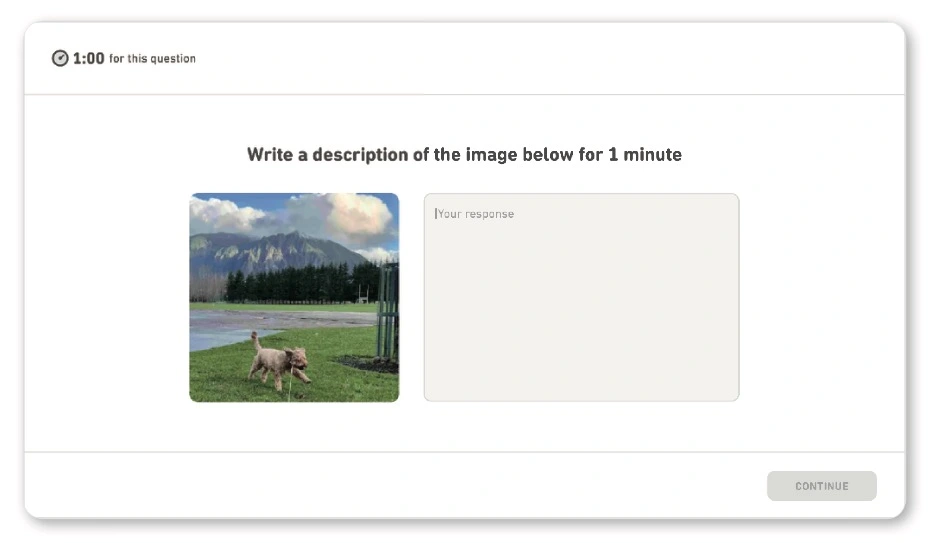
A real photograph appears on screen (it can show people, animals or objects in any situation) and you have exactly 1 minute to write a description of what you see. The photo stays on screen while you write, so you do not need to memorise it.
- Time: 1 minute per photo, with no preparation time
- Number of photos: 3, one after another
- Recommended length: at least 30-40 words
- Adaptive: no
- Paragraphs: not assessed in this task; one well-written block of text is enough
A minute flies by, so the key here is not to write something brilliant but to have an automatic method, so you do not waste a single second wondering where to start.
How to structure your answer: from the big picture to the details
The structure that works best (and the one Duolingo itself recommends) has just two steps:
- An overview sentence: who or what matters most in the photo and what is happening. For example: A young man is fixing a bicycle in a small garage.
- Details: what the people are doing, where they are, what they are wearing, what the place looks like, what is in the background. Move through the image in order: from the main subject to the surroundings, or from front to back (in the foreground, in the background, on the left, on the right).
If you have a few seconds left, you can add a reasonable inference about the situation (It looks like a weekend morning, They seem to be celebrating something). The official descriptors reward logical inferences at the higher score bands, as long as you do not invent a story that is not in the photo.
Write About the Photo example
Imagine this photo appears: an elderly woman is selling fruit at a stall in an outdoor market, smiling at a young man who is paying with his phone, while other people walk between colourful awnings in the background.
First, an answer that falls short. It is the kind of text many B1 students write:
There is a woman in a market. She is selling fruit. There are oranges and apples. A man is buying fruit. He has a phone. There are many people and the market is very nice.
There are no serious mistakes, but it simply labels what can be seen: short sentences that nearly all start the same way (There is, There are), very basic vocabulary and no connection between ideas. Now look at the same photo described at a higher level:
An elderly woman is selling fruit at a busy outdoor market. She is standing behind a wooden stall piled high with oranges and apples, smiling at a young man who is paying with his phone. In the background, several shoppers are browsing stalls under colourful awnings.
Notice what changes:
- It opens with an overview that already sums up the scene (An elderly woman is selling fruit at a busy outdoor market) and then moves on to the details.
- It follows a clear order: first the stallholder, then her interaction with the customer and, finally, the background (In the background).
- It combines ideas into complex sentences: a participle clause (smiling at a young man) and a relative clause (who is paying with his phone) instead of five separate sentences.
- It uses precise vocabulary and natural collocations: elderly, outdoor market, wooden stall, piled high with, browsing stalls, colourful awnings.
- It is 46 words long: a realistic length for one minute and above the recommended 30-40.
The second version is written to simulate a score of 130-150 (C1 level), without reaching 155-160. The first would be closer to the 60-95 band (B1).
Strategies for Write About the Photo
- Do not write empty introductions such as This picture shows a situation that might be happening in everyday life… Duolingo warns against this specifically: you use up seconds and words without describing anything.
- Describe it as if you were telling someone who cannot see the photo: what would they need to know to picture it?
- Master the present continuous and present simple: they are the tenses of any description (is holding, are walking, looks).
- Have a bank of place expressions ready: in the foreground/background, on the left/right, in the middle of, next to, behind, in front of.
- If you do not know a word, talk around it: if awning does not come to mind, write a piece of fabric that protects the stall from the sun. That is better than inventing a word or leaving out something important.
- Save the last 10 seconds to check your spelling, your articles (a/the) and your full stops.
Interactive Writing: two questions on the same topic
How does Interactive Writing work?
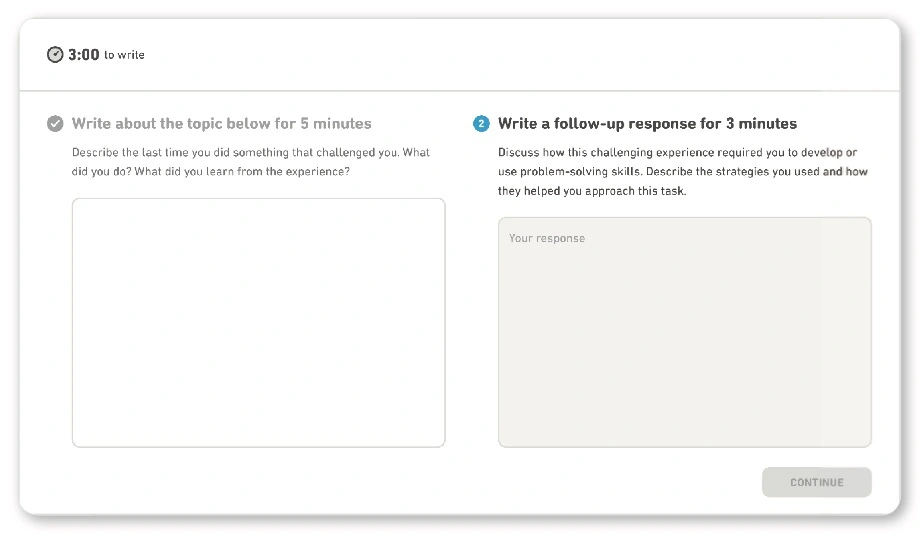
This is the longest Writing task on the exam and the one that asks you to write the most. It works in two steps:
- Preparation (30 seconds): you read the first question and plan.
- Step 1 (5 minutes): you answer the initial question. Duolingo recommends around 120-130 words.
- Step 2 (3 minutes): a follow-up question appears on the same topic, but about an aspect you did not cover in your first answer. There is no preparation time. Recommendation: 70-80 words.
While you write Step 2, you can still see the initial question and your first answer. The two parts are marked together, as a single piece of writing, and the questions can ask for your opinion (argumentative) or for an experience (narrative).
How to approach Step 1
A three-part structure works well here, the same one you would use in a short essay:
- Introduction: one or two sentences that answer the question directly and make your position clear (In my view…, I strongly believe that…).
- Development: one or two paragraphs with your reasons, each explained and supported with a specific example. If you can, briefly acknowledge the opposing view and respond to it.
- Conclusion: a sentence that wraps up and restates your position (For these reasons…, All things considered…).
A tip I always give my students: during the 30 seconds of preparation, think of more ideas than you are going to use. The Step 2 question will ask for another angle on the topic and, if you already have a couple of spare ideas, you will save a lot of time.
How to tackle Step 2 without repeating yourself
The most common Step 2 mistake is saying the same thing again in different words. The follow-up question is designed precisely so that you expand: another aspect of the topic, another perspective, a specific experience or a consequence. You can refer to what you said in Step 1, but without repeating the same idea, argument or example.
Watch out for the opposite extreme too: according to Duolingo’s scoring guide, Step 2 answers that change focus or bring in unrelated ideas may receive lower scores. Ideally, your first sentence should link the two parts and answer the new question directly.
Interactive Writing example
Step 1 (initial question):
Many schools focus mainly on academic subjects. Should they also teach practical skills, such as managing money? Explain your opinion.
Model answer (Step 1):
In my view, schools should definitely make room for practical skills, and managing money is probably the most urgent of them.
The main reason is that young people are expected to make financial decisions long before they are taught how to do so. Many students sign their first phone contract or open a bank account at sixteen, yet they have never learnt what interest is or how to plan a monthly budget. As a result, some of them fall into debt because nobody explained the basics to them.
Admittedly, timetables are already full, and teachers might worry that academic standards would drop. However, financial skills could easily be built into existing subjects, such as maths, by using real bills and salaries as examples.
For these reasons, I believe that a little practical knowledge would benefit every student.
Step 2 (follow-up question):
If schools do not have enough time, who should be responsible for teaching these skills? Explain your view.
Model answer (Step 2):
Even if schools lack time, families cannot carry this responsibility alone. Many parents never received any financial education themselves, so they may simply pass on the same mistakes they made. A shared approach would work better. Schools could offer short workshops run by banks or local experts, while parents reinforce the lessons at home, for instance by letting teenagers manage a small monthly allowance. In this way, young people would learn the theory and then put it into practice in real life.
Let’s look at why it works:
- It answers directly from the very first sentence: the reader knows the writer’s position without having to guess (In my view, schools should definitely make room for practical skills).
- Each paragraph has a job: position → main reason with an example and a consequence → objection and response → conclusion. It is a simple structure, but a very clear one.
- It acknowledges the opposing view (Admittedly, timetables are already full…) and answers it (However…). This shows mature argument and adds to your Content score.
- Step 2 repeats nothing: Step 1 argued that the skill should be taught; Step 2 answers a different question (who should teach it) and offers a new solution with a new example (the monthly allowance).
- Varied, well-placed linkers: The main reason is that, yet, As a result, Admittedly, However, For these reasons, Even if, so, while, for instance, In this way.
- Varied grammar: passives (are expected to, are taught, could be built into), conditionals with would, a reduced participle clause (workshops run by banks) and clauses of time and concession.
- No contractions and a formal register, as Duolingo recommends.
- Length: around 140 words in Step 1 and around 80 in Step 2.
Here are the useful expressions you can take from this model for your own answers:
- make room for something (find space or time for it)
- long before (a long time earlier than)
- fall into debt (start owing money you cannot easily repay)
- be built into something (become part of something that already exists)
- carry the responsibility (be the one who is responsible)
- pass on mistakes (teach others the same errors you made)
- a shared approach (a solution in which several people or groups take part)
- put something into practice (use in real life what you have learnt)
This text is written to simulate a score of 130-150 (C1 level), without reaching 155-160 (C2): the ideas are well developed and the grammar is varied and accurate, but the vocabulary does not reach the level of sophistication and nuance expected in the top band.
Common Interactive Writing topics
Duolingo publishes an indicative list of the subject areas that tend to come up. It is worth having ideas and vocabulary ready for each one:
- Technology and society: the internet, artificial intelligence, social media, video games
- Personal growth: challenges, experiences that changed you, important decisions
- Cultural exchange: traditions, travel, cultural events
- Education and learning: education systems, ways of learning, the value of studying
- Social issues: the environment, volunteering, individual and collective responsibility
- Work and careers: goals, job satisfaction, professional development
- Travel and exploration: destinations, the benefits and difficulties of travelling
- Creativity: art, music, literature and the importance of self-expression
- Ethics and values: moral dilemmas, personal principles
- Community and relationships: friendship, teamwork, getting involved in your community
Writing Sample: the text universities will read
How does the Writing Sample work?
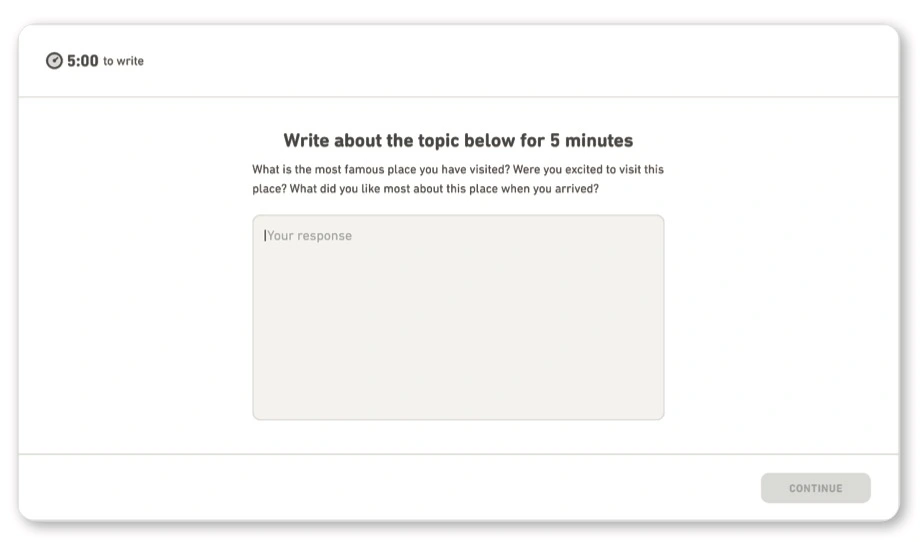
It comes near the end of the exam, just before the Speaking Sample. You read a question, have up to 30 seconds to think and then 5 minutes to write. Duolingo recommends around 120-130 words.
What makes this task special is that, as well as counting towards your Writing subscore, it is sent as it is to the institutions you share your results with: they will see the question and your answer. Many universities use it to get to know you a little better as a candidate and to check your writing for themselves. Institutions only see the Writing Sample from the test you send them, not from other attempts.
My advice: write it as if someone on the admissions committee were going to read it. Imagine you are answering a question in a university class.
Types of Writing Sample question
The questions will basically ask you to do one of these three things (or a combination):
- Describe something: a place, a tradition, a meal, an invention, a character
- Recount an experience: a memory, an achievement, a challenge, a decision, a person who has influenced you
- Argue a point of view: on sport, social media, travel, education or any general topic
Writing Sample example
Question:
Describe a skill you learned outside school that has been useful in your life. How did you learn it, and why has it been important?
Model answer:
One skill that I learned outside school and that has been really useful is cooking.
I started when I was seventeen because my parents worked late and I was often alone at dinner time. At first, I could only make pasta, but then I began to watch videos online and try a new recipe every weekend. My grandmother also taught me some traditional dishes, which was a great way to spend time with her.
This skill has been important for two reasons. Firstly, when I moved to another city to study, I could eat well without spending too much money. Secondly, cooking helped me to make friends, because I often invited my flatmates to dinner.
In conclusion, learning to cook has made me more independent and more confident.
Analysis of the answer:
- It answers all three parts of the question: which skill (cooking), how it was learnt (videos, recipes, a grandmother) and why it has been important (two reasons).
- Very clear structure: a one-sentence introduction, one paragraph on how, another on why, and a conclusion.
- Simple but effective linkers: because, At first, but then, also, Firstly, Secondly, In conclusion.
- Accurate and fairly varied grammar: past simple, present perfect (has been, has made), a relative clause (which was a great way to…) and clauses with when and because.
- Everyday, accurate vocabulary, with some natural collocations (spend time with, make friends, eat well), but no particularly precise words.
This text is written to simulate a score of 100-125 (B2 level), which is the band a great many universities ask for. It is clear and accurate, but it lacks the lexical and grammatical range that would take it to C1.
So what would it take to raise it? Look how a single sentence changes:
- B2: Firstly, when I moved to another city to study, I could eat well without spending too much money.
- C1: Firstly, when I moved away to university, being able to cook allowed me to eat healthily on a tight budget.
The same content, but with a more complex structure (being able to cook as the subject) and more precise vocabulary (eat healthily, on a tight budget). That is exactly what the scorer looks for in the higher bands.
Specific tips for the Writing Sample
- Use the 30 seconds to decide on your main idea and your two examples. Do not start writing without knowing how you are going to finish.
- Write a clear introduction and conclusion, even if each is just one sentence. The official descriptors mention this specifically at the higher bands.
- Organise the text into paragraphs. In a 120-130-word text, three or four short paragraphs read much better than one block.
- Be specific: a place, an age, a person, a situation. Generic answers get the lowest Content scores.
- Keep the last minute to check spelling, grammar and punctuation.
Summarize the Conversation: the Writing task hidden in Listening
Many people do not realise it, but inside Interactive Listening there is a task that also counts towards your Writing score. After taking part in a conversation (by choosing the right replies), you have 75 seconds to write a short summary of what was said.
It is marked with the same four criteria as the other Writing tasks. The difference is that the content score also counts towards your Listening (because it shows you understood the conversation), while coherence, grammar and vocabulary count only towards your Writing.
To do it well, explain who is speaking, what about, the main ideas and how the conversation ends, in full sentences and without bullet points. You can write in the third person (Two students are discussing…) or the first (I asked my professor…), and you are allowed to reuse words from the conversation. I explain it in detail, with strategies and phrases to start your summary, in my DET Listening guide.
How DET Writing is marked
All Writing tasks are marked with the same four criteria. Knowing them tells you exactly what to work on:
| Criterion | What is assessed | How to score highly |
|---|---|---|
| Content | Whether you answer every part of the question, use an appropriate register and develop your ideas with details and examples | Answer directly, cover everything you are asked and support each idea with a specific example |
| Discourse Coherence | Clarity, how ideas are connected, logical order and the structure of the text (introduction, body, conclusion; prose rather than bullet points) | Organise the text into clear blocks and use linkers and pronouns to join your ideas |
| Grammar | The range and accuracy of your structures, how flexibly you combine them and your punctuation | Mix simple and complex sentences (relative clauses, conditionals, passives, concession) and take care with punctuation |
| Lexis | The range and precision of your vocabulary, word formation and spelling | Avoid repeating words, use natural collocations and check your spelling |
And this is what, according to Duolingo’s official descriptors, sets apart a text in each score band:
| DET score | Approximate CEFR level | What the text is like |
|---|---|---|
| 60-95 | B1 | Answers part of the question with simple, underdeveloped ideas. Uses basic linkers (and, but, because, so) and limited vocabulary that gets repeated. |
| 100-125 | B2 | Answers the question and presents the main idea, though it does not always develop it fully. Uses structures such as conditionals, relative clauses and modals fairly accurately. |
| 130-150 | C1 | Answers clearly with well-developed ideas and a complete structure. Uses advanced structures (passive, inversion, conditionals) and a wide vocabulary with collocations and idioms. |
| 155-160 | C2 | Answers fully and is very well organised. Grammar is very varied and precise, and vocabulary is broad, precise and idiomatic. |
Now, a fact that reassures my students a lot: you do not need to write a perfect text to get a high score. Among the marked answers Duolingo publishes, there are texts with the odd spelling mistake, a tense error or even a sentence left unfinished that still score 135, 140 and even 150 for Writing. What makes the difference is answering the question well, developing your ideas and showing range. One slip will not sink you; a weak text will.
Five techniques to make your Writing sound more advanced
These are the techniques that raise Writing scores fastest, in both Interactive Writing and the Writing Sample. None of them needs unusual vocabulary, just practice.
1. Swap all-purpose verbs for precise ones
Verbs such as do, make, get, have and go work for almost anything, and that is exactly why they sound weak. Look for the verb that says exactly what you mean:
- We had a discussion about the problem → We discussed the problem
- I got better at English → My English improved
- She was very angry and left → She stormed out
- I made a decision to change jobs → I decided to change jobs
2. Add nuance to your claims
Absolute statements (Social media is bad for teenagers) sound simple and are easy to argue against. Adding nuance shows control of both the language and the argument:
- Soften how strong the claim is: Social media tends to affect teenagers’ sleep.
- Limit who or when it applies to: For younger teenagers in particular, social media can be harmful.
- Mention an exception: Although it can help shy students make friends, it often…
- Acknowledge another opinion: Some people would argue that… Having said that…
3. Give specific examples and say what they show
A good example has three parts: you introduce it (From my own experience…, A common situation is when…), you make it specific (who, where, when) and you explain what it shows (This shows that…, This is why…). Almost everyone skips that last step, and it is the one that links the example to your argument.
4. Combine ideas into complex sentences
A string of short sentences sounds like B1. Join them with subordinate and relative clauses:
- I moved to Madrid. I did not know anyone. It was difficult. → When I moved to Madrid, I did not know anyone, which made the first months difficult.
- The course was expensive. It was worth it. → Although the course was expensive, it was worth every penny.
5. Vary your linkers
If every paragraph starts with Also or And, the scorer notices. Build a repertoire for each function: adding (In addition, Moreover), contrasting (However, On the other hand, Admittedly), giving examples (For instance, Such as), showing results (As a result, Therefore) and concluding (All things considered, For these reasons). You will find full lists in my posts on B2 connectors in English and C1 linkers.
One warning, though: learn phrases and linkers, not whole texts. Duolingo is very clear about this: copying or memorising complete answers from other sources can get your test disqualified.
Comparison: the DET Writing tasks
To give you the full picture, here are the three main Writing tasks side by side:
| Feature | Write About the Photo | Interactive Writing | Writing Sample |
|---|---|---|---|
| Time | 1 minute per photo | 30 s + 5 min + 3 min | 30 s + 5 min |
| Frequency | 3 photos | 1 task in 2 steps | 1 |
| Recommended length | 30-40 words or more | 120-130 + 70-80 words | 120-130 words |
| Type of text | Description | Opinion or narrative, with a follow-up question | Description, experience or opinion |
| Paragraphs | Not assessed | Recommended | Recommended |
| Seen by universities | No | No | Yes |
| Key to a high score | Overview + details in order | A clear position and a Step 2 that expands without repeating | Answering every part with specific examples |
| Most common mistake | Listing objects without connecting them | Repeating Step 1 in Step 2 | Generic answers with no examples |
Study plan to improve your DET Writing
Writing is the skill where regular practice shows most. These are the guidelines I follow with my students.
General preparation tips
- Write with a timer from day one. On the DET, time matters as much as content, and the only way to get used to it is to practise with the real timings.
- Improve your typing speed. If you type slowly, you will not reach 30-40 words in a minute. Practise on the same kind of keyboard you will use on the day.
- Prepare ideas by topic. Take the list of common Interactive Writing topics and note down two or three arguments for and against each one, with a specific example.
- Build your bank of phrases for giving your opinion, contrasting, giving examples and concluding. Phrases, not full texts.
- Check your texts against a checklist: have I answered everything? Are there examples? Have I varied my grammar? Have I repeated words? Have I checked my spelling?
- Get feedback. Writing a lot with nobody pointing out your mistakes means you keep repeating them. A teacher or, at the very least, a correction tool will help you see what you cannot see yourself.
- Use Duolingo’s free official practice to get used to the interface and the timings.
Most common mistakes in DET Writing
- Using contractions and informal expressions (gonna, kids, stuff) on an exam where every task is formal.
- Writing with bullet points or dashes instead of continuous prose.
- Starting the photo description with an empty introduction that describes nothing.
- Repeating Step 1 ideas in Step 2, or drifting to an unrelated topic.
- Falling short on words because of poor planning or slow typing.
- Not answering every part of the question, especially when it has two or three parts (How did you learn it, and why…?).
- Memorising whole texts to adapt on the day, at the risk of having the test disqualified.
- Not checking at the end, leaving spelling, capital letter or article mistakes that ten seconds would have fixed.
Preparation timetable
Depending on how much time you have and your starting level, here is a suggested plan:
If you have 2 months:
Weeks 1-3 – Foundations:
- Write a short text every day (100-150 words) on common exam topics
- Revise verb tenses, relative clauses and conditionals
- Start your bank of linkers and useful phrases
- Practise typing for 10 minutes a day
Weeks 4-6 – Targeted practice:
- Describe 3 photos a day, 1 minute each (photos from the news or social media work well)
- Do 3 Interactive Writing tasks a week with the real timings, making up your own follow-up question
- Write 2 Writing Samples a week
- Check each text against the checklist and rewrite your weakest sentences
Weeks 7-8 – Mock exams:
- Do at least one full mock exam a week under real conditions
- Work out which criterion costs you most points and focus on it
- The week before the exam: write less and spend more time reviewing your usual mistakes
If you have 2 weeks:
- Focus on the format: practise each task with the real timings at least five times
- Learn the structure of each task (overview + details; introduction, development and conclusion)
- Prepare 15-20 linkers and phrases and use them in every practice
- Do one full mock exam a few days before the test
Frequently asked questions about DET Writing
How many words should I write for each task?
There is no compulsory minimum, but Duolingo recommends at least 30-40 words for Write About the Photo, 120-130 words for Step 1 of Interactive Writing and 70-80 for Step 2, and 120-130 words for the Writing Sample. What matters is writing as much as you can accurately and without going off topic.
Can I use templates or memorised answers?
You can (and should) learn useful structures and phrases, but not whole texts. Duolingo warns that copying or memorising complete answers from other sources can get your test disqualified. Besides, a memorised answer rarely fits the question well, and that costs you in Content.
Can I use contractions such as don’t or it’s?
They are not forbidden, but they are not recommended. Since there are no informal writing tasks on the exam, Duolingo recommends writing without contractions (do not, it is). This only applies to the Writing tasks; in Speaking you can talk naturally.
Does it matter whether I use British or American English?
No. Both spellings are accepted in the Writing tasks (organise or organize, colour or color). My advice is simply to be consistent and not mix the two in the same text.
Who marks the Writing: a person or artificial intelligence?
Artificial intelligence: the Duo Writing Scorer, trained on thousands of answers previously marked by human examiners. According to Duolingo, it agrees with the human mark around 85% of the time, a similar rate to two human examiners marking the same answer. It assesses the same four criteria: Content, Discourse Coherence, Grammar and Lexis.
Can universities read what I write in the exam?
Only the Writing Sample. The institutions you share your results with receive the question and your answer, and they only see the one from the test you send them. The other Writing tasks count towards your score but are not shared.
Conclusion
DET Writing can feel daunting at first because you have to write quickly and without a safety net, but it is one of the sections where a clear method makes the biggest difference. Remember the keys: in Write About the Photo, an overview followed by details in order; in Interactive Writing, a clear position and a Step 2 that expands without repeating; and in the Writing Sample, answering every part of the question with specific examples, bearing in mind that your future university will read it.
Practise with a timer, check your texts against the checklist and do not obsess over perfection: a well-organised text with developed ideas and some range scores very well even with the odd mistake. If you want to explore the rest of the exam, you also have my guides to DET Reading and DET Listening, as well as the complete Duolingo English Test guide.
Feeling ready? You can register for the Duolingo English Test through this link and take the exam whenever you like, from home, with no date to book:
Register for the Duolingo English Test →
And until the next article, don’t forget to keep smiling! 🙂
