

Table of contents
If you’ve ever hesitated between I always go and I go always, or written I don’t never eat meat because a double negative sounds perfectly natural in your language, you’re not alone. Adverbs of frequency are among the first words we learn in English, but their position in the sentence and a couple of traps with negatives keep catching learners out for years.
Don’t worry, because the rules are few and very mechanical. In this guide I explain what they are, give you the full list from most to least frequent, show you where to put them in positive sentences, negatives and questions, how to talk about exact frequency (once a week, twice a month, three times a year), how to ask and answer How often questions, and the mistakes I see most often in class. At the end there are thirty practice sentences with answers. Let’s get started! 🙂
What are adverbs of frequency?
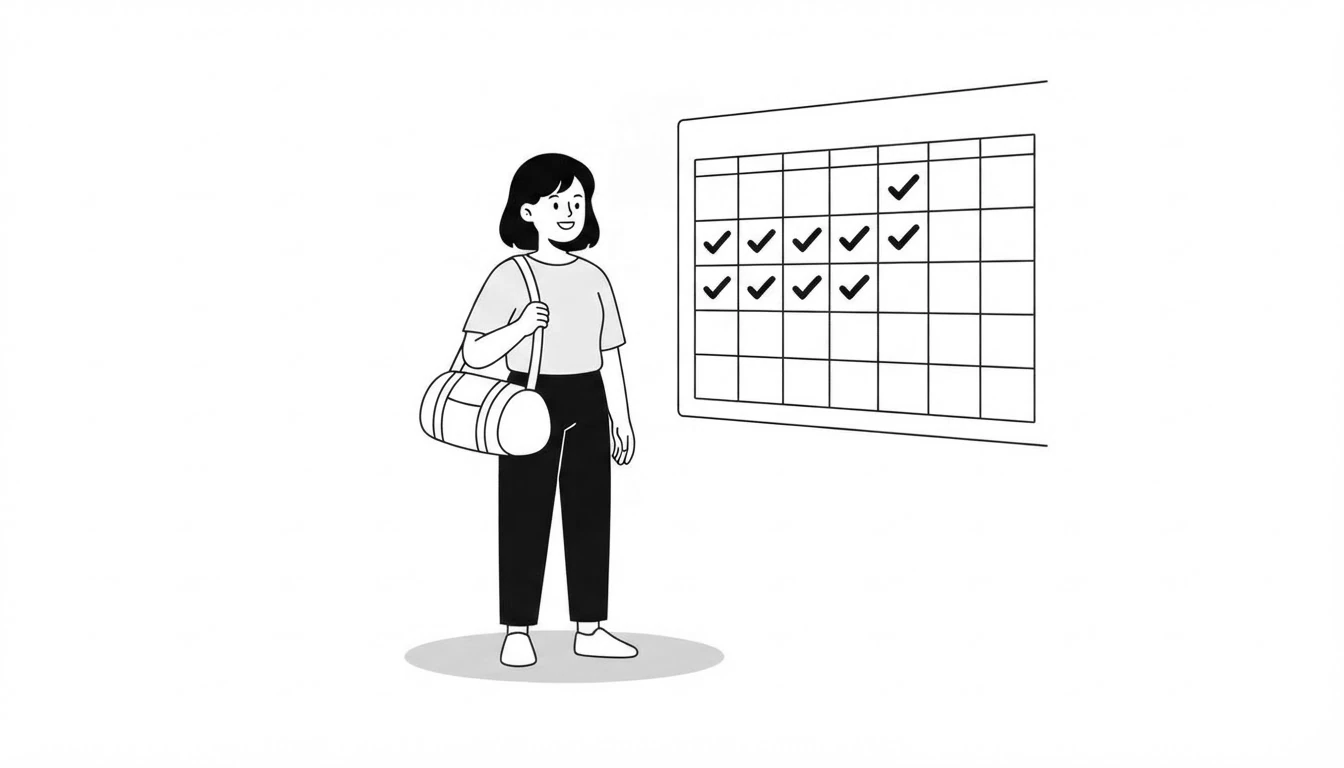
Adverbs of frequency tell us how often something happens or somebody does something. They answer the question How often…? There are two groups:
- Indefinite frequency: they don’t give an exact number, only a rough idea. always, usually, often, sometimes, rarely, never.
- Definite frequency: they give a precise frequency. every day, once a week, twice a month, three times a year, daily, weekly.
The two groups go in different places in the sentence, so it’s worth keeping them apart. We’ll start with the indefinite ones, which are the most common.
List of adverbs of frequency in English
This is the list I recommend learning, from always to never. The percentages are only a rough guide (there’s no official figure), but they help you see the scale:
| Approx. frequency | 🇬🇧 English | 🇪🇸 Spanish | Example |
|---|---|---|---|
| 100% | always | siempre | I always brush my teeth before bed. |
| ~90% | usually | normalmente, por lo general | She usually takes the bus. |
| ~80% | normally, generally | normalmente, en general | We normally have dinner at nine. |
| ~70% | often, frequently | a menudo, con frecuencia | He often forgets his keys. |
| ~50% | sometimes | a veces | Sometimes I work from home. |
| ~30% | occasionally | de vez en cuando | They occasionally eat out. |
| ~10% | rarely, seldom | rara vez, casi nunca | I rarely drink coffee at night. |
| ~5% | hardly ever | casi nunca | She hardly ever watches TV. |
| 0% | never | nunca | My brother never cooks. |
A few points worth knowing:
- Usually and normally are almost synonyms. Generally is slightly more formal.
- Rarely and seldom mean the same, but seldom is more formal and less common. In conversation, rarely or hardly ever are the usual choices.
- Frequently is a more formal version of often, and occasionally is gentler than sometimes.
Where do adverbs of frequency go in a sentence?
Position is the part that causes most of the trouble, because in many languages these adverbs move around freely. In English, the position of indefinite adverbs of frequency follows a very clear pattern.
Before the main verb
The basic rule: the adverb goes before the main verb, between the subject and the verb.
- I always drink tea in the morning.
- She usually walks to work.
- They never eat meat.
The most common mistake is to put it after the verb: ❌ I go always to the gym → ✅ I always go to the gym. And never split the verb from its object with the adverb in the wrong place: ❌ I drink always coffee → ✅ I always drink coffee.
After the verb to be
With the verb to be the position changes: the adverb goes after am / is / are / was / were.
- He is never late.
- I am usually at home on Sundays.
- They were always kind to me.
If you need to revise this verb, have a look at my guide to the verb to be. And watch out for a common trap: ❌ I usually am late → ✅ I am usually late (or I’m usually late).
Between the auxiliary and the main verb
When there’s an auxiliary or modal verb (have, can, will, must, should…), the adverb goes between the auxiliary and the main verb:
- I have never been to Scotland.
- You can always call me if you need help.
- He has often said that.
In negative sentences
In negatives, usually, often, always, normally and frequently go after the negative auxiliary (don’t / doesn’t / didn’t):
- I don’t usually eat breakfast.
- She doesn’t often go out on weekdays.
- We don’t always agree.
Watch the meaning: I don’t always eat meat means that sometimes I do and sometimes I don’t, which is not the same as I never eat meat.
And here comes the big trap: never, hardly ever, rarely and seldom are already negative, so they don’t combine with not. Standard English doesn’t allow the double negative:
- ❌ I don’t never eat meat. → ✅ I never eat meat.
- ❌ She doesn’t hardly ever call. → ✅ She hardly ever calls.
In questions
In questions, the adverb goes between the subject and the main verb, that is, after the auxiliary and the subject:
- Do you often go to the cinema?
- Does he usually work late?
- Are you always this tired? (With to be, after the subject.)
To ask «at any time?» we use ever, an adverb that only appears in questions and negatives, never in positive statements: Do you ever play tennis? / Have you ever been to London? ❌ I ever go to the gym → ✅ I hardly ever go to the gym.
At the beginning or the end of the sentence
Some adverbs are more flexible and can also go at the beginning or at the end of the sentence, especially for emphasis or contrast: sometimes, usually, normally, often, occasionally, frequently.
- Sometimes I walk to work. = I sometimes walk to work. = I walk to work sometimes.
- Usually we eat at home. = We usually eat at home.
- I go there quite often. (With often at the end, it normally comes with very or quite.)
The ones that don’t normally go at the beginning or the end in everyday English are always, never and hardly ever: ❌ I go to the gym always, ❌ Never I eat meat.
A note for advanced learners: never, rarely, seldom and hardly ever can go first in formal or literary writing, but then the subject and the verb are inverted: Never have I seen such a beautiful place. This is called inversion, and I explain it in my post on inversions.
Definite frequency: once a week, twice a month, three times a year
When you want to give an exact frequency, you use expressions of definite frequency. They normally go at the end of the sentence (and sometimes at the beginning, for emphasis):
| 🇬🇧 Expression | 🇪🇸 Meaning | Example |
|---|---|---|
| every day / week / month / year | todos los días / semanas / meses / años | I go for a run every day. |
| daily, weekly, monthly, yearly | diario, semanal, mensual, anual | The magazine is published monthly. |
| once a week | una vez a la semana | We have English class once a week. |
| twice a month | dos veces al mes | She visits her parents twice a month. |
| three times a year | tres veces al año | I go to the dentist three times a year. |
| every other day | un día sí y otro no | He goes to the gym every other day. |
| every two weeks | cada dos semanas | They clean the flat every two weeks. |
| on Mondays / at weekends | los lunes / los fines de semana | I play tennis on Mondays. |
Three things to remember:
- For one time and two times we say once and twice. From three onwards, number + times: three times, four times, ten times.
- «Per week», «per month» and «per year» are a week, a month, a year (or per week, which is more formal): twice a week, not ❌ twice at week.
- Definite expressions do not go between the subject and the verb: ❌ I once a week go swimming → ✅ I go swimming once a week.
If you’d like to revise the time prepositions that go with these expressions (on Mondays, at the weekend, in the morning), see my post on prepositions of time.
How often: asking and answering questions about frequency
How often is the question that goes with all these adverbs. It’s built like any other wh- question: How often + auxiliary + subject + verb.
- How often do you go to the gym?
- How often does she visit her grandparents?
- How often are you late for work? (With to be, no do.)
- How often is the bus? (How frequently does it run?)
The main verb stays in the base form, and the third-person -s goes on the auxiliary, not on the verb: ❌ How often does he plays tennis? → ✅ How often does he play tennis? It’s also very common to forget the auxiliary altogether: ❌ How often you go? → ✅ How often do you go? You can revise question structure in my guide to yes/no and wh- questions.
To answer, you have two options: an indefinite adverb or a definite expression.
| Question | Possible answers |
|---|---|
| How often do you go to the gym? | Every day. / Three times a week. / I go twice a week. / Almost every day. |
| How often do you eat out? | Hardly ever. / Once a month. / Not very often. / Quite often, actually. |
| How often does he call you? | Never. / Sometimes. / Every other day. / All the time. |
A natural alternative is How many times a week/month/year…?, which asks for an exact number: How many times a week do you go to the gym? «Three.» In more formal contexts you may also hear How frequently…?.
Common mistakes with adverbs of frequency
- ❌ I go always to bed late. → ✅ I always go to bed late. (Before the main verb.)
- ❌ She usually is tired. → ✅ She is usually tired. (After to be.)
- ❌ I don’t never watch TV. → ✅ I never watch TV. (No double negative.)
- ❌ I have been never to Rome. → ✅ I have never been to Rome. (Between the auxiliary and the participle.)
- ❌ I ever go to the cinema. → ✅ I hardly ever go to the cinema. (Ever doesn’t go in positive sentences.)
- ❌ Always I drink coffee. → ✅ I always drink coffee.
- ❌ I once a week go swimming. → ✅ I go swimming once a week.
- ❌ How often you go to the gym? → ✅ How often do you go to the gym?
- ❌ He goes two times a week. → ✅ He goes twice a week. (More natural: two times is understood, but twice is the normal choice.)
Adverbs of frequency with other tenses
Although we associate them with the present simple, adverbs of frequency work with any tense and follow the same position rules:
- Past simple: When I was a child, I often played in the street.
- Present perfect: I have never eaten sushi.
- Future: I will always remember this day.
There’s also a special use with the present continuous: always + be + -ing expresses that something annoys you because it happens too often: He’s always losing his keys! It’s the best-known exception to the idea that adverbs of frequency go with the present simple. To understand when to use each one, my post on the difference between present simple and present continuous explains it in detail, and the present simple is the foundation for all of this.
Adverbs of frequency in the Cambridge exams
This is basic content, but it’s used at every level and worth mastering:
- Speaking. In the first personal questions you’re very likely to be asked about your routine or your hobbies, and How often…? comes up again and again. Answering with a full, varied sentence (I usually play football twice a week, but I hardly ever go on Sundays) sounds much better than a single Sometimes.
- Writing. In B1 and B2 emails and articles, using a range of frequency expressions (occasionally, every other day, once in a while) instead of repeating often and sometimes helps you show a wider vocabulary.
- Reading and Use of English. Recognising the position of these adverbs, and knowing that never and hardly ever already contain a negative, saves you from mistakes in grammar and gap-fill tasks.
To see them in a description of a routine, have a look at my post on daily routines vocabulary.
Summary table: position of adverbs of frequency
| Situation | Position | Example |
|---|---|---|
| Normal verb | Before the verb | I always drink tea. |
| Verb to be | After to be | She is never late. |
| Auxiliary or modal | Between the auxiliary and the verb | I have never been there. |
| Negative | After don’t / doesn’t | I don’t usually eat breakfast. |
| Question | After the subject | Do you often go out? |
| Sometimes, usually, normally | Also at the beginning or the end | Sometimes I walk. |
| Definite frequency | At the end of the sentence | I swim twice a week. |
Frequently asked questions about adverbs of frequency
What are the main adverbs of frequency in English?
The six most common are always, usually, often, sometimes, rarely and never. To extend your range, add normally, frequently, occasionally, seldom and hardly ever.
Where do you put an adverb of frequency in a sentence?
Before the main verb, after the verb to be, and between the auxiliary and the main verb. Sometimes, usually and normally can also go at the beginning or the end.
Can you say «I don’t never»?
No. Never is already negative, so correct English is I never…. The double negative is a typical learner error.
What’s the difference between «hardly ever» and «never»?
Never is zero, 0%. Hardly ever means «almost never»: it happens very rarely, but it does happen.
What does «How often» mean?
It asks how frequently something happens. You answer with an adverb of frequency (sometimes) or with a definite expression (twice a week).
Is it «twice a week» or «two times a week»?
The natural choice is twice a week. From three times onwards, use number + times: three times a week.
Adverbs of frequency exercises
Thirty sentences to check you’ve got it. Below you’ll find three interactive exercises that mark themselves, so you’ll know straight away how you did.
And if you prefer a version in text that you can copy and paste, you have it down here 👇
Exercise 1: choose the correct sentence
Choose the correct option in each sentence.
- She _______________ (always is / is always) happy on Fridays.
- I _______________ (usually walk / walk usually) to work.
- He _______________ (never eats / eats never) meat.
- We _______________ (have never / never have) been to Scotland.
- Do you _______________ (ever / never) go skiing?
- I _______________ (hardly ever / don’t hardly ever) watch TV.
- I _______________ (go often / often go) to the gym.
- You _______________ (can always / always can) call me if you need help.
- She _______________ (is not never / is never) rude.
- How _______________ (often / many often) do you play tennis?
Show answers
- is always
- usually walk
- never eats
- have never
- ever
- hardly ever
- often go
- can always
- is never
- often
Exercise 2: where does the adverb go?
Choose the sentence in which the adverb in brackets is in the correct place.
- I drink coffee after lunch. (usually)
a) I usually drink coffee after lunch.
b) I drink usually coffee after lunch.
c) I drink coffee usually after lunch. - My mother is angry. (never)
a) My mother never is angry.
b) My mother is never angry.
c) My mother is angry never. - Have you been to Paris? (ever)
a) Have ever you been to Paris?
b) Have you been ever to Paris?
c) Have you ever been to Paris? - Does he play football? (often)
a) Does he often play football?
b) Does often he play football?
c) Does he play often football? - They don’t eat out. (always)
a) They always don’t eat out.
b) They don’t always eat out.
c) They don’t eat always out. - She can sleep for ten hours. (always)
a) She always can sleep for ten hours.
b) She can sleep always for ten hours.
c) She can always sleep for ten hours. - I watch TV on weekdays. (hardly ever)
a) I hardly ever watch TV on weekdays.
b) I watch hardly ever TV on weekdays.
c) Hardly ever I watch TV on weekdays. - Are you tired in the morning? (always)
a) Always are you tired in the morning?
b) Are you always tired in the morning?
c) Are you tired always in the morning? - Tom goes to the gym. (twice a week)
a) Tom twice a week goes to the gym.
b) Tom twice goes to the gym a week.
c) Tom goes to the gym twice a week. - I visit my grandparents. (every Sunday)
a) I visit my grandparents every Sunday.
b) I every Sunday visit my grandparents.
c) I visit every Sunday my grandparents.
Show answers
- a) I usually drink coffee after lunch.
- b) My mother is never angry.
- c) Have you ever been to Paris?
- a) Does he often play football?
- b) They don’t always eat out.
- c) She can always sleep for ten hours.
- a) I hardly ever watch TV on weekdays.
- b) Are you always tired in the morning?
- c) Tom goes to the gym twice a week.
- a) I visit my grandparents every Sunday.
Exercise 3: right or wrong?
Decide whether each sentence is correct. If it’s wrong, correct it.
- How often you go to the gym?
- How often does he plays tennis?
- I go always to bed at eleven.
- She doesn’t never call me.
- They are usually at home on Sundays.
- How often is the bus?
- I have often visited Rome.
- Never I eat fast food.
- We meet once a week.
- I ever go to the cinema on Mondays.
Show answers
- Wrong: How often do you go to the gym?
- Wrong: How often does he play tennis?
- Wrong: I always go to bed at eleven.
- Wrong: She never calls me.
- Right.
- Right.
- Right.
- Wrong: I never eat fast food.
- Right.
- Wrong: I hardly ever go to the cinema on Mondays. (or: I never go…)
Conclusion
To sum up in three ideas: the adverb of frequency goes before the main verb, but after to be and between the auxiliary and the verb; never, hardly ever and rarely are already negative, so they never take don’t; and exact frequencies (once a week, twice a month) go at the end of the sentence and answer How often…?.
If you want to keep going with this topic, the natural next step is the present simple and then the difference between present simple and present continuous.
Did you find this post useful? Share it with other students and English teachers. And if you’d like more content like this, subscribe to my newsletter and follow me on Facebook, Twitter, Pinterest, Instagram and YouTube.
See you in the next post. Until then, don’t forget to keep smiling! 🙂
