
Cambridge Assessment English
¿Quieres conocer Cambridge Assessment English mejor? En este artículo te cuento lo que necesitas saber.

Table of contents
What is Cambridge English
Cambridge Assessment English, commonly known as Cambridge English, is part of the prestigious University of Cambridge, and its main purpose is the teaching, learning, and assessment of English as a language worldwide.
History of Cambridge English
Cambridge English began its journey back in 1913, that is, over 100 years ago. At that time, they created and implemented their first English language certification exam, called the Certificate of Proficiency in English (CPE), which still exists today. That first exam, very different from today’s C2 Proficiency, lasted 12 hours and, as expected, all candidates failed.
The first Cambridge exam took place in 1913: it lasted 12 hours and all candidates failed
Since 1913, Cambridge English has evolved greatly and has made some of the biggest contributions to the field of English as a foreign language. Since then, it has developed countless teaching and learning resources, qualifications, and certifications. Among all of them, today we can highlight the following exams and certificates:
- Young Learners Exams:
- Pre-A1 Starters
- A1 Movers
- A2 Flyers
- Main Suite Tests:
- A2 Key (KET) – formerly known as Key English Test (KET)
- B1 Preliminary (PET) – formerly known as Preliminary English Test (PET)
- B2 First (FCE) – formerly known as First Certificate in English (FCE)
- C1 Advanced (CAE) – formerly known as Certificate in Advanced English (CAE)
- C2 Proficiency (CPE) – formerly known as Certificate of Proficiency in English (CPE)
- Business Tests:
- B1 Business Preliminary – formerly known as BEC Preliminary
- B2 Business Vantage – formerly known as BEC Vantage
- C1 Business Higher – formerly known as BEC Higher
- Other important exams:
- Linguaskill
- IELTS
Why choose Cambridge English
Today, Cambridge boasts some staggering statistics:
- It examines more than 5.5 million candidates per year.
- It is present and growing in 130 countries worldwide.
- It has more than 2,800 examination centres.
- It has more than 50,000 preparation centres.
In addition, Cambridge certificates are officially accepted by more than 20,000 organisations worldwide. And some of them – from B2 and above – are valid for applying for work and immigration visas.
On the other hand, apart from English exams, Cambridge English has «the largest research team dedicated exclusively to the development and quality of our exams.«
Cambridge English and the Common European Framework
The Common European Framework of Reference for Languages, abbreviated as CEFR or MCER (Common European Framework) in English, is a document whose aim is to define language competence.
Today, it is used worldwide, especially in Europe, as it establishes standardised levels of language proficiency according to the language skills of speakers. Thus, speakers with the most basic level start at level A1, and those with the highest proficiency are at level C2.
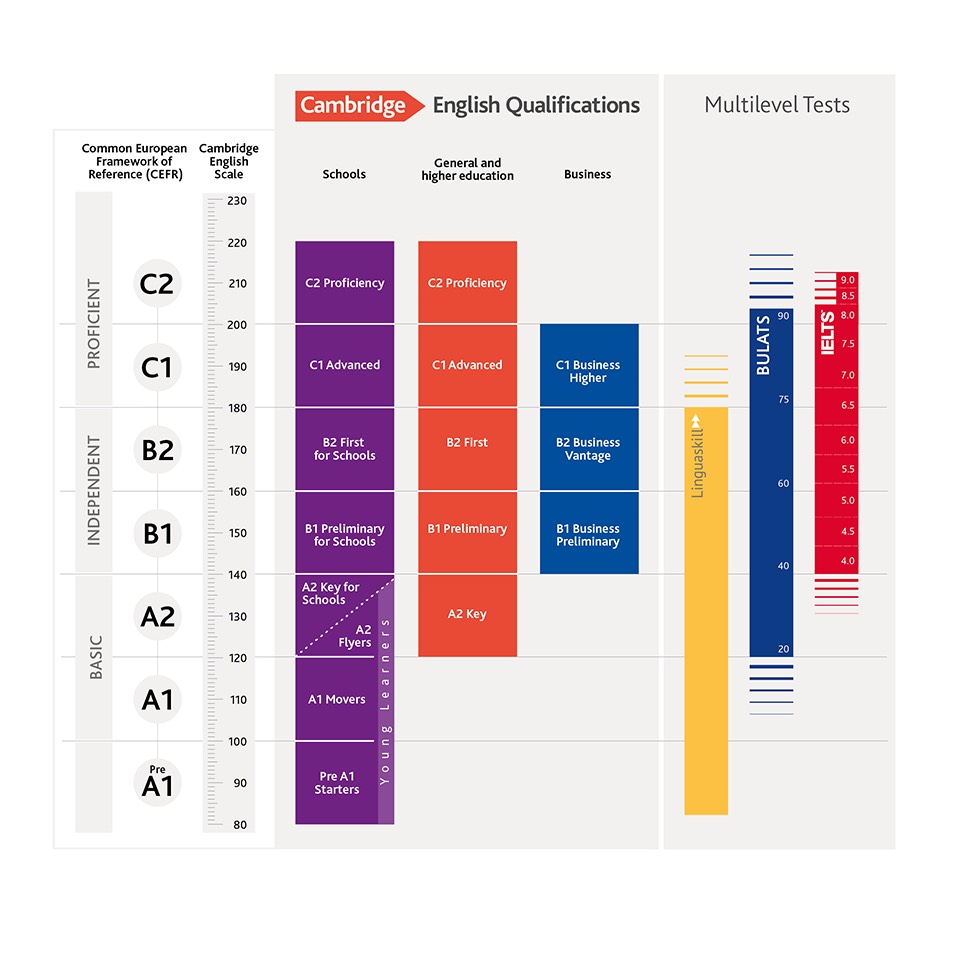
Although Cambridge exams have always been perfectly aligned with the CEFR, in recent years their names have also changed to reflect the level they certify. For example, the Preliminary English Test became B1 Preliminary. This way, it is much easier to understand how the exams work and which exam each candidate should take according to their goal. Below you can see which level each exam corresponds to.
Frequently Asked Questions
Do Cambridge English certificates expire?
No, except for IELTS, Cambridge certificates do not expire. Unlike certificates such as TOEFL or IELTS, whose main purpose is to access a foreign university and/or a higher education program and expire after 2 years, the main Cambridge exam certificates do not expire. For example, if a candidate obtains the B2 First certificate, they should know that it will not expire.
How can you check if a Cambridge certificate is real?
Cambridge English, unlike other certifying entities, offers institutions and candidates a platform where they can verify the results obtained. This way, any company or institution can check whether the Cambridge certificate presented by an applicant is real or not.
Does my university, company, or institution accept Cambridge certificates?
Cambridge certificates are a guarantee of quality and, today, are the most widely accepted worldwide. To check if your university or the institution you want to work for or be admitted to accepts Cambridge certificates, you can do so on this page on the Cambridge website.
Can I take my Cambridge exam on a computer?
Yes, for several years now, you can take almost any Cambridge exam on a computer. In fact, I encourage you to do so, as in my opinion, it has quite a few advantages. However, don’t think that being able to do it on a computer means you can take it from home. No, Cambridge Computer-based exams are taken at authorised centres, under strict supervision. To take an official English exam from home, you need to take an online exam from LanguageCert.