
LanguageCert: Complete Guide with Sample Tests
LanguageCert ESOL International are the new English exams recognised internationally. And you can take LanguageCert online from home. Let me tell you all about it!

Table of contents
The youngest English exams on the market now have a name: LanguageCert International ESOL. And they’re making a strong entrance, partly due to the quarantine period declared in many countries. In fact, LanguageCert is, as of today, the only internationally recognised exam you can take from the comfort of your own home. And in this article, I explain absolutely everything. As always. 🙂
What is LanguageCert?
LanguageCert is not technically an exam itself, but rather a recognised organisation dedicated to the assessment and certification of language skills. In fact, LanguageCert is part of a larger entity called PeopleCert, which is a leading organisation in the certification industry. They issue millions of certificates annually in over 200 countries around the world.
This is how they define themselves:
LanguageCert is an Ofqual-regulated Awarding Organisation responsible for the development and award of language qualifications. LanguageCert’s mission is to offer high-quality language qualifications that are fit-for-purpose for the candidates they serve.
LanguageCert Qualification Overview Handbook
LanguageCert International ESOL
The term LanguageCert International ESOL covers a group of certified English exams, at all levels (from A1 to C2), designed, according to them, to the highest standards of quality and reliability.
While all organisations of this kind claim this, in this case I am inclined to believe it. If you are a reader of this website, you will already know that I am a big fan (and expert) of Cambridge exams. Well, one of the main people responsible for the success and well-deserved reputation of Cambridge English is one of the people behind LanguageCert. And the truth is, after seeing how it works and speaking with an official exam centre, I see those values reflected in these exams (unlike Aptis, Trinity or even Oxford).
How does LanguageCert work?
To understand LanguageCert, there are several things to bear in mind. And since I love to break everything down to understand it in detail, I’ll explain them below.
- There are 2 formats:
- Face-to-face: taken on paper (paper-based) or on computer (computer-based)
- Online: obviously taken on computer (computer-based) and only from B1 level upwards, and not in all exam suites.
- Each level has 2 exams:
- Written Exam: Includes Listening, Reading and Writing.
- Spoken Exam: Only Speaking.
- There are different English exam suites within LanguageCert:
- LanguageCert International ESOL: Exams designed to certify language proficiency levels. These are the equivalent of the traditional Cambridge exams, and there are 6 main certifications/levels:
- A1 Preliminary
- A2 Access
- B1 Achiever
- B2 Communicator
- C1 Expert
- C2 Mastery
- LanguageCert Young Learners ESOL: Exams designed for children.
- Fox (Pre-A1)
- Owl (A1)
- LanguageCert SELT: Exams designed to obtain visas to live, work, and study in the UK. The following exams are available:
- SELT A1 (Speaking & Listening)
- SELT A2 (Speaking & Listening)
- SELT B1 (Listening, Reading, Writing, Speaking)
- SELT B1 (Speaking & Listening)
- SELT B2 (Listening, Reading, Writing, Speaking)
- SELT C1 (Listening, Reading, Writing, Speaking)
- SELT C2 (Listening, Reading, Writing, Speaking)
- LanguageCert enPro: Aimed at people who need to demonstrate their level of English in academic and business environments.
- enPro A1-B1
- enPro A1-C2
- LanguageCert International ESOL: Exams designed to certify language proficiency levels. These are the equivalent of the traditional Cambridge exams, and there are 6 main certifications/levels:
- Exams are on demand, especially the online format.
Understanding these basics, we already know that:
- With LanguageCert you can choose different skills depending on your interest and the exam you decide to take. This can be useful depending on your needs for an English certificate.
- In the LanguageCert International ESOL series, which is the one that mainly concerns us, each level has 2 exams:
- Written Exam: Includes Listening, Reading and Writing.
- Spoken Exam: Only Speaking.
- There are 6 levels, perfectly mapped to the Common European Framework of Reference for Languages (CEFRL).
- You can choose when to take the exams, especially with the online format, making it much more flexible than traditional Cambridge or Trinity exams.
- Although there are
What recognition does LanguageCert have?
Recognised by Ofqual
Ofqual, which stands for the Office of Qualifications and Examinations Regulation, recognises the certificates awarded by LanguageCert. This body regulates many international exams, including Cambridge English exams, and in the case of language exams like LanguageCert, it does so in its section on Languages, literature and culture of the British Isles. You can search and check it yourself here.
This means that LanguageCert International ESOL certifications are valid certificates of English language proficiency for:
- UK companies.
- International or UK universities.
Recognition of LanguageCert in Spain
LanguageCert certifications are recognised in Spain through:
- ACLES (Association of Language Centres in Higher Education): This reputable association recognises levels A2, B1, B2, C1 and C2.
- CRUE Universidades Españolas (formerly the Conference of Rectors of Spanish Universities): Recognises all levels, from A1 to C2.
Is LanguageCert valid for public sector exams?
Yes, it is. LanguageCert confirms this in its official documentation. In fact, it states the following:
Teachers who need to prove their English language competence in all four skills in order to work in public schools in Spain can rely on LanguageCert International ESOL qualifications. They must hold both Written (Listening, Reading, Writing) and Spoken (Speaking) certificates on the same level.
LanguageCert Recognition, page 15.
That is, they are valid for public sector exams, but be careful! You must take both exams (Written and Spoken) to certify all four skills at the same level.
As of today, the official authorities in the different regions that recognise these exams are as follows.
| REGION | COMPETENT AUTHORITY | LANGUAGECERT LEVELS |
|---|---|---|
| Andalucía | Junta de Andalucía | B2 – C2 |
| Aragón | Ministerio de Educación, Cultura y Deportes | A1 – C2 |
| Cataluña | Generalitat de Catalunya | B1 – C2 |
| Navarra | Departamento de Educación del Gobierno de Navarra | B1 – C2 |
| País Vasco | Consejería de Educación | B2 – C2 |
And without doubt, this list will keep growing. 🙂
Other official bodies
Aside from Ofqual, which is the most important body in these cases, LanguageCert exams are also officially recognised by governmental and non-governmental regulatory bodies such as Qualification Wales, UCAS (Universities and Colleges Admissions Service) and BAC (British Accreditation Council).
The recognition of LanguageCert is not yet the same as Cambridge, but it is constantly growing. For this reason, I recommend that, apart from what I explain here, you also check the official LanguageCert website, where you will find up-to-date information on which organisations worldwide recognise the exam.
How much does LanguageCert cost?
As with the entire English exam industry, the price of the exam itself depends on several factors, starting with the organisation (in this case LanguageCert) and ending with the registration centre (in this case, for example, KSE Academy). In this case, the prices are roughly in line with Cambridge prices, which, given the quality they are demonstrating, makes a lot of sense.
Below you can find tables with LanguageCert prices. Please note that these prices are indicative and may vary depending on the exam centre or other factors.
LanguageCert Price: Paper-based & Computer-based
| LEVEL | WRITTEN | SPOKEN | TOTAL |
|---|---|---|---|
| A1 Preliminary | 50,00 € | 50,00 € | 100,00 € |
| A2 Access | 50,00 € | 50,00 € | 100,00 € |
| B1 Achiever | 62,50 € | 62,50 € | 125,00 € |
| B2 Communicator | 75,00 € | 75,00 € | 150,00 € |
| C1 Expert | 85,00 € | 85,00 € | 170,00 € |
| C2 Mastery | 95,00 € | 95,00 € | 190,00 € |
LanguageCert Price: Online
| LEVEL | WRITTEN | SPOKEN | TOTAL |
|---|---|---|---|
| A1 Preliminary | 54,00 € | 54,00 € | 108,00 € |
| B1 Achiever | 70,00 € | 70,00 € | 140,00 € |
| B2 Communicator | 82,50 € | 82,50 € | 165,00 € |
| C1 Expert | 92,50 € | 92,50 € | 185,00 € |
| C2 Mastery | 102,50 € | 102,50 € | 205,00 € |
LanguageCert Price: YoungLearners
| LEVEL | WRITTEN | SPOKEN | TOTAL |
|---|---|---|---|
| Fox (Pre-A1) | 20,00 € | 20,00 € | 40,00 € |
| Owl (A1) | 25,00 € | 25,00 € | 50,00 € |
KSE Academy is a Registration Centre for LanguageCert
For the past few months, KSE Academy has been an official LanguageCert Registration Centre, attached to the official exam centre (Approved Test Centre) in Granada, Language Exams Granada. You can see our certificate here.
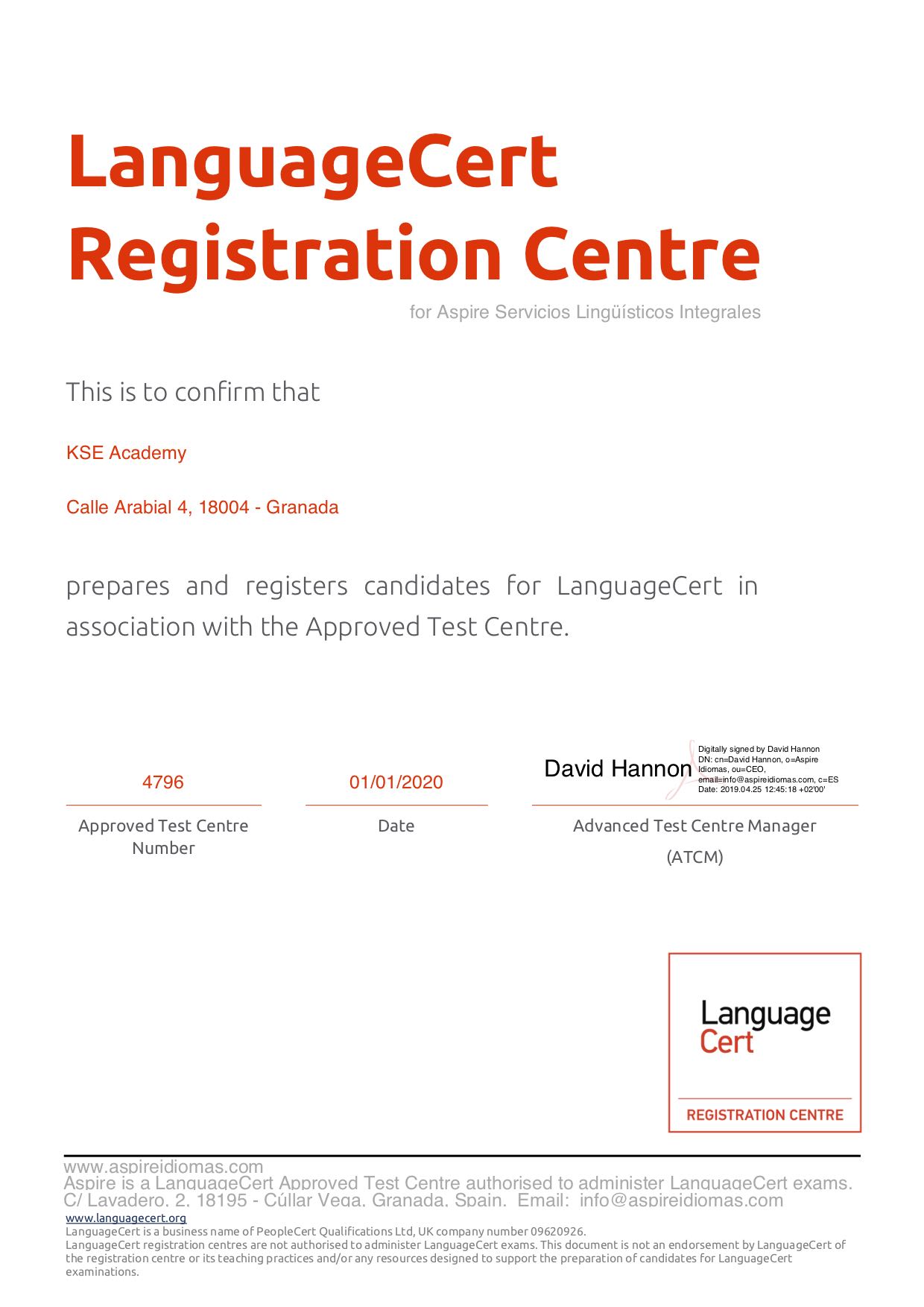
For this reason, we are authorised to register candidates for both face-to-face exams in Granada and the online format of LanguageCert, wherever you are.
Would you like to register for LanguageCert Online? Get in touch with us.
LanguageCert Exams in PDF
While I will talk in more detail about all the LanguageCert exams in other articles, I think it’s a good idea to leave LanguageCert exams in PDF here so you can see exactly what they are like. You can also download them from the official LanguageCert website, but here you have all the links on one page. 🙂
Download LanguageCert A1 Preliminary exams in PDF
- A1 Preliminary Paper 1
- A1 Preliminary Paper 2
- A1 Preliminary Paper 3
- A1 Preliminary Paper 6
- Answer Sheet
Download LanguageCert A2 Access exams in PDF
Download LanguageCert B1 Achiever exams in PDF
Download LanguageCert B2 Communicator exams in PDF
- B2 Communicator Paper 1
- B2 Communicator Paper 2
- B2 Communicator Paper 3
- B2 Communicator Paper 6
- B2 Communicator Paper 7
- Answer Sheet
Download LanguageCert C1 Expert exams in PDF
Download LanguageCert C2 Mastery exams in PDF
- C2 Mastery Paper 1
- C2 Mastery Paper 2
- C2 Mastery Paper 3
- C2 Mastery Paper 6
- C2 Mastery Paper 7
- Answer Sheet
Advantages of LanguageCert over other exams
Overall, I have to say I quite like LanguageCert. I can see plenty of positive aspects and some advantages over other exams.
- The exams are rigorous and always have the same sections and structure, unlike exams such as TOEFL.
- The level is appropriate, unlike the Aptis exams, which are pathetic. Sorry, but that’s what I think.
- It offers a valid and recognised certificate, and is not just a level test like the Oxford Test of English or Linguaskill.
- You can take it face-to-face or online, unlike Cambridge exams.
- Exam dates are almost on demand, so you don’t have to wait long for sessions and you’ll get your certificate when you need it.
The only disadvantage at the moment is that it’s a new exam that not many people know about, so it will take a while for everyone to recognise and accept it. But I’m sure that time will come. 🙂