How to describe a photo in English for the B1 Preliminary (PET)
Here I will show you exactly how to describe an image to succeed in the B1 Preliminary (PET) from Cambridge, and we will look at examples of pictures to describe.


Table of contents
As I explained in the updated megaguide of the Speaking of Cambridge B1 (2020 changes), the Speaking exam of the PET consists of 4 well-defined parts, and among them is part 2, in which you must describe a photo in English. This is relatively easy, but it often happens that candidates initially do not know how to describe a photo even in their own language, let alone in English if their level is around B1, that is, an intermediate or low-intermediate level.
That’s why, in this post, I will teach you exactly how to describe an image to succeed in the Speaking of the B1 Preliminary (PET), along with a bunch of tricks and expressions in English that will be very useful for doing so.
How is Part 2 of the B1 Speaking
The first thing you need to know is what to expect in this part of the exam. As you can read in the guide I linked at the beginning of this article, the interlocutor (examiner) will ask you to describe an image, and they will do this as follows:
Now I’d like each of you to talk on your own about something. I’m going to give each of you a photograph and I’d like you to talk about it.
Candidate A, here is your photograph. It shows people at a party.
Candidate B, you just listen.
Candidate A, please tell us what you can see in the photograph.
And at that moment, the candidate has 1 minute to describe the image. So let’s see how they should describe it, the steps and the strategy they should follow. To do this, we will base it on the image above to construct a complete description from start to finish.
How to Describe a Photo in English
Structure for Describing Any Photo
Describing a photo is not difficult, but only if you know how. In this regard, the most important thing is to always have a fixed structure that allows you to describe any image. And although there is no correct and incorrect structure, I can tell you that what works best is a description that goes from the most general to the most specific. For this reason, I recommend the one I use to prepare my students and that works wonders. This is divided into the following parts:
- Brief global description: we talk about the scene itself, without focusing on any particular detail.
- Long description: we focus on the details, always from the more general to the more specific.
- Speculation: we infer ideas about things we see in the image.
- Less relevant details
And although I divide the long description and speculation into different parts, it is more natural for them to mix together.
How to Start a Description of a Photo
The first thing you need to be clear about is how to start describing a photo, whichever it may be. And I always recommend starting with a single sentence that answers the following questions:
- Who?
- Doing what?
- Where?
- When? (optional)
For example:
- Who: an Asian family
- Doing what: having lunch
- Where: in their garden
- When: a beautiful sunny day
And to introduce this sentence, you can always use one of the following expressions:
- In this picture, I can see…
- This picture shows…
You don’t need to complicate it any further. Just memorise one of those expressions and always do it in the same way. So, in this case, our description would start in the following manner:
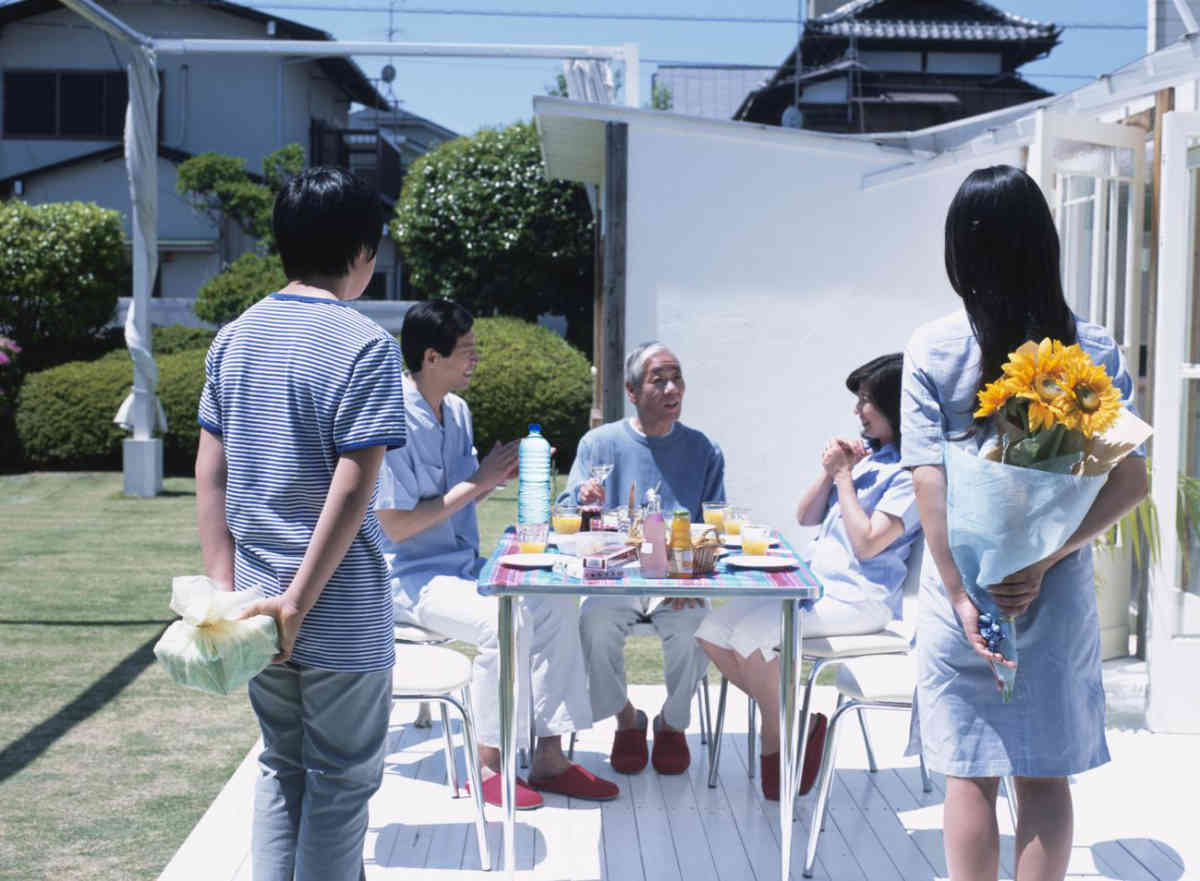
In this picture, I can see an Asian family having lunch in their garden. And it’s a beautiful sunny day.
BOOM! We now have the first sentence. And this type of introduction can be used with ALL images that may appear in B1 of Cambridge. I promise!
How to Describe the Details of a Photo
As I mentioned earlier, the important thing is that our speech goes from the most general to the most specific. Therefore, now you need to ask yourself what is the most important.
For instance, in the photo we have below, what is more important: is it the family or the trees in the background? Are they sitting around a table or does the woman have a bouquet of flowers? Depending on how you answer these questions in your head, your description will be more or less logical.
I suggest the following long description:
There are five people in the picture: three of them are sitting around a table and two of them are standing up. They all seem very happy.
On the table, there are plenty of dishes with food and some glasses with orange juice. I can also see a bottle of water on the left.
With this, we have practically described the main scene, so now we will speculate about things we can deduce from some elements in the photo.
How to Speculate About a Scene
To speculate, in this case, simply means to draw ideas from things that may be happening in a photo. For example, here we could say something like:
The man in the middle looks older than the others, so he might be a grandfather and the other people could be his children and grandchildren.
The man on the left is holding a present and the woman on the right is holding some flowers, so I believe it might be someone’s birthday or anniversary. That’s probably why they are all so happy.
Less Relevant Details
Finally, if you have already fully described the main scene and speculated about what might be happening, you can also talk about other less important details, such as:
- The weather
- The background of the photo
It must be summer or spring, because it’s really sunny and the family are all wearing short sleeves.
In the background, I can see some grass, a few trees and the neighbour’s houses.
And that’s it, we now have a complete description of this image. See, explained and broken down like this, it seems much easier!
Now let’s look at a great list of vocabulary for describing images. The one I use with my students. 🙂
Tips and Expressions for Describing a Photo in English
Next, I have compiled a series of tips, techniques and useful expressions for describing a photo for the PET Speaking. You will find them divided into the following categories:
- Structure: always use the same structure. This way, you won’t have to think about how to describe a photo, just about what vocabulary to use.
- Verb tenses: to describe a photo in a basic way, you only need two verb tenses:
- Present simple: This picture shows a family…
- Present continuous: They are having lunch in the garden…
- Useful verbs: the following verbs can almost always be used.
- There is/are…: There’s a lot of food on the table.
- is/are holding: The man on the left is holding a present.
- is/are standing: The woman is standing on the right.
- is/are sitting: … three of them are sitting around a table.
- is/are lying: There’s a woman lying on the sofa.
- Descriptive adjectives: a beautiful sunny day sounds much better than a sunny day.
- Avoid long pauses: try saying something like let me think or let me see when you need some time to think.
- Verbs and expressions for speculating:
- look/seem + adjective: They look quite happy.
- look/seem like + noun: They seem like a family.
- seem to be doing: They seem to be celebrating a birthday or anniversary.
- maybe/probably: Maybe/Probably it’s the grandfather’s birthday.
- could/may/might be: The man in the middle might be the grandfather.
- must be: It must be someone’s birthday or anniversary.
- I think/believe: I think they are celebrating someone’s birthday or anniversary.
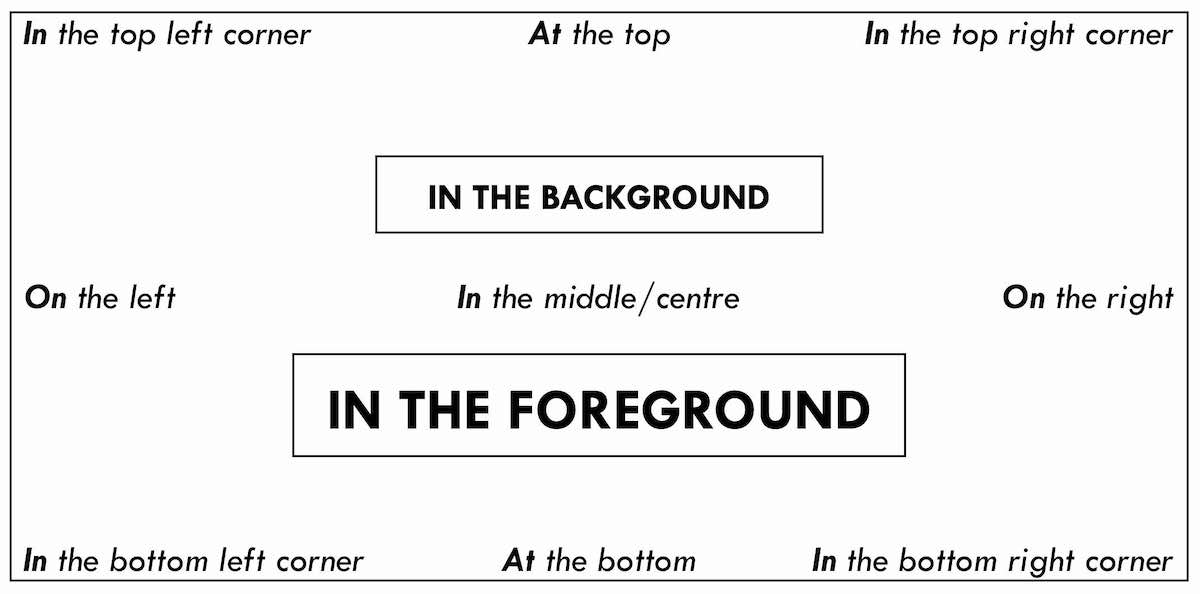
- Basic location prepositions:
- on / in / under
- next to / behind / in front of / opposite
- over / above / below
- Useful random expressions: in this subsection, I will give you a few expressions that are generally quite useful because you can use them in almost any description.
- a group of people
- sitting around a table
Now that you know the basic tricks for being able to describe a photo properly, let’s see some examples.
Examples of Photo Description for the PET
As we have already seen how to describe an image step by step, let’s now look at several examples of photo descriptions so that you can better understand how to do it yourself. In fact, I encourage you to try describing them before reading the description I have written myself. And if you want more, here’s a bunch of images to describe.

Notice how the expressions I have highlighted in bold are expressions I provided in the list from the previous section. 🙂
This picture shows a group of young people (who?) having a meeting (doing what?) in an office (where?).
There are four women and three men. Three of them are sitting down on a sofa and three of them are standing up behind it. In the centre, there is a beautiful woman explaining something, and the other people seem to be listening to her. Maybe she’s the boss and the others are her employees.
In front of her, there’s a table with a laptop, a pen and some paper. The woman on the right, in the foreground, might be taking some notes.
In the background, on the right, I can see a large piece of furniture with some small plants. There’s also a glass wall and a door.
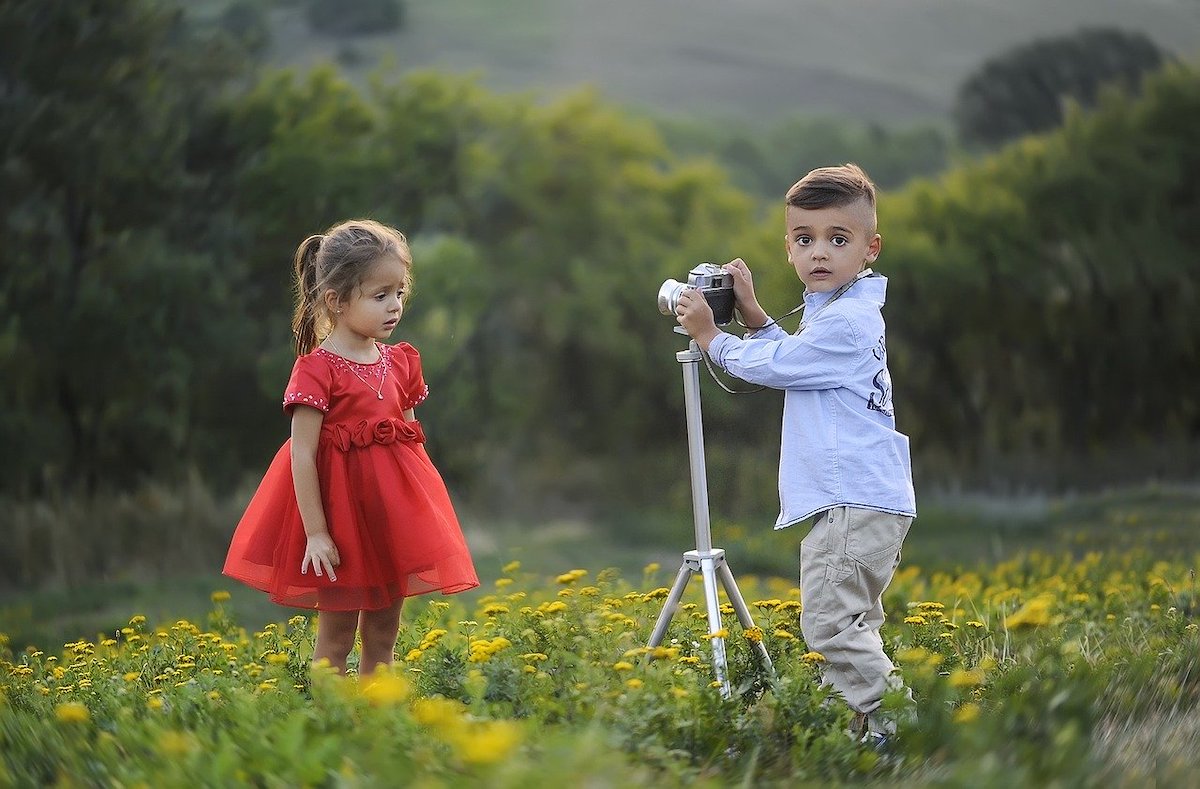
In this picture, I can see two children taking a photo in the countryside.
There’s a boy and a girl, who might be brother and sister or just friends. He is standing on the right and he’s holding a camera, which is on a tripod. The girl is standing on the left, probably posing for the picture. They are very young children, maybe around 5 or 6 years old.
The boy is wearing a light grey shirt and a pair of beige trousers, and the girl is wearing a beautiful red dress.
The scene is lovely, because the ground is full of small, yellow flowers, and in the background there are many tall trees. It must be a forest.
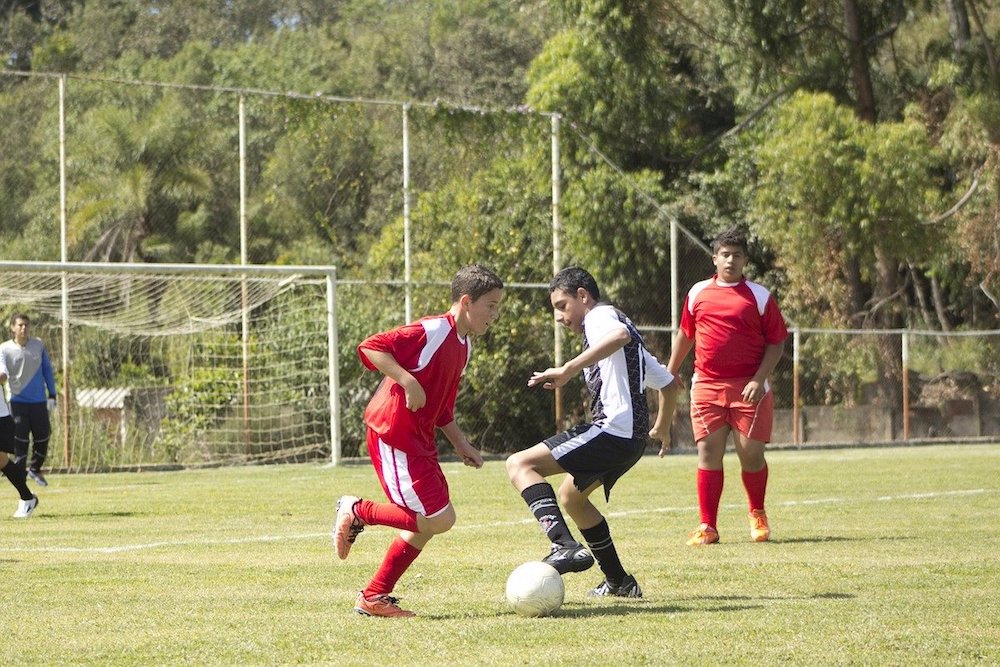
This picture shows a group of teenagers playing soccer on a football pitch on a sunny day.
I can see 4 or 5 teenage boys, divided into two teams. One team is wearing red and white T-shirts and shorts, whereas the other team’s kit is black and white.
In the centre of the picture, there are two boys fighting for the ball, and behind them there’s another player looking at them. He’s a little chubby. They are all playing on a grass pitch.
In the background, I can see the goal and the goalkeeper, as well as a lot of vegetation, especially trees. It’s a beautiful sunny day, but I think it must be too hot to play football, because it’s probably summertime.
What did you think of this post? Interesting, right? The truth is that my students really appreciate this kind of advice and material, as they feel that with this type of preparation they already have a solid enough foundation on which they can describe any image they encounter in the exam.
And what do you think? Leave me a comment and let me know. And if you have any questions, don’t hesitate to ask.
Until then, don’t forget to keep smiling!