
B1 Preliminary (PET)
The B1 Preliminary (PET) is the Cambridge English exam to certify a B1 level. In this article, I present the most popular exam from Cambridge.

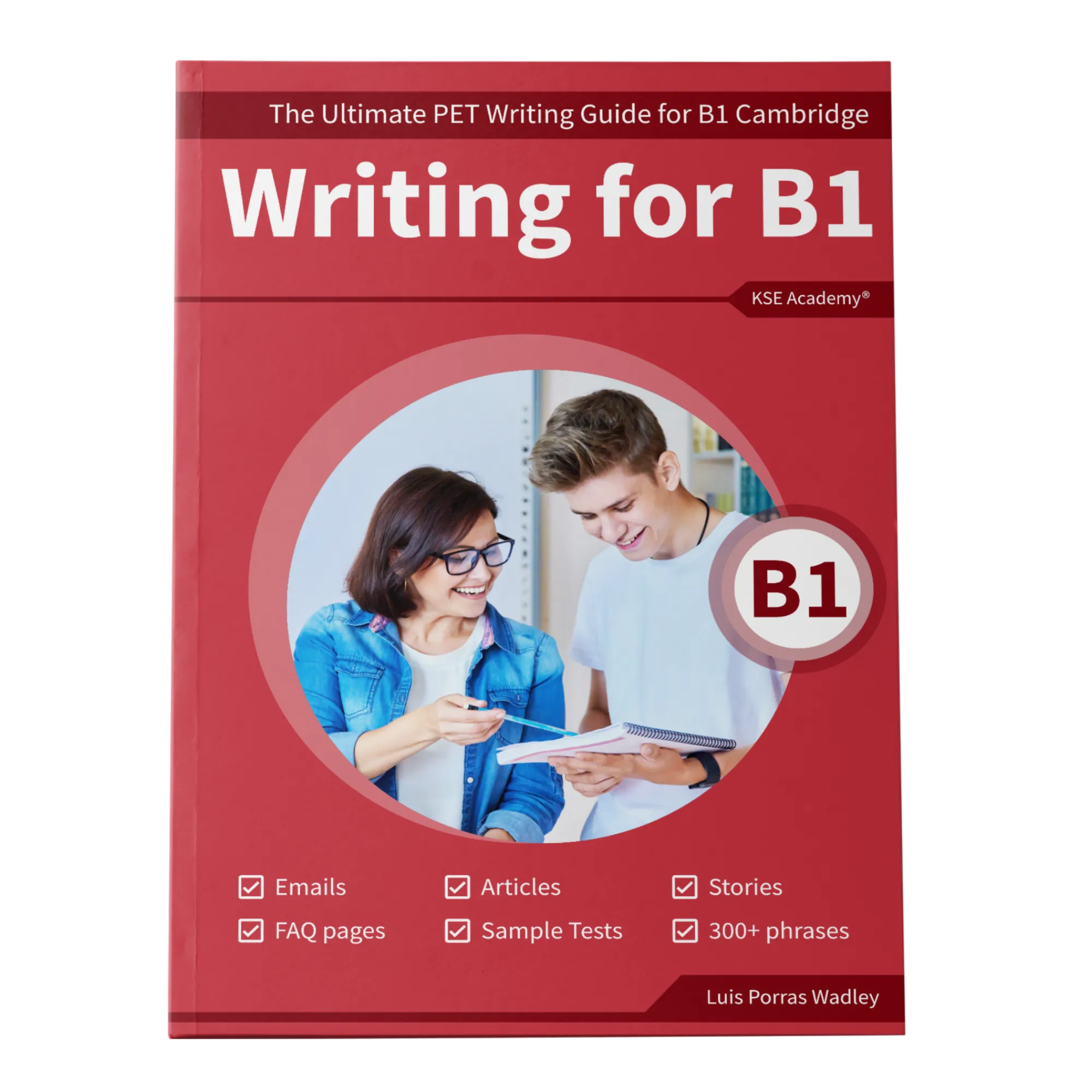
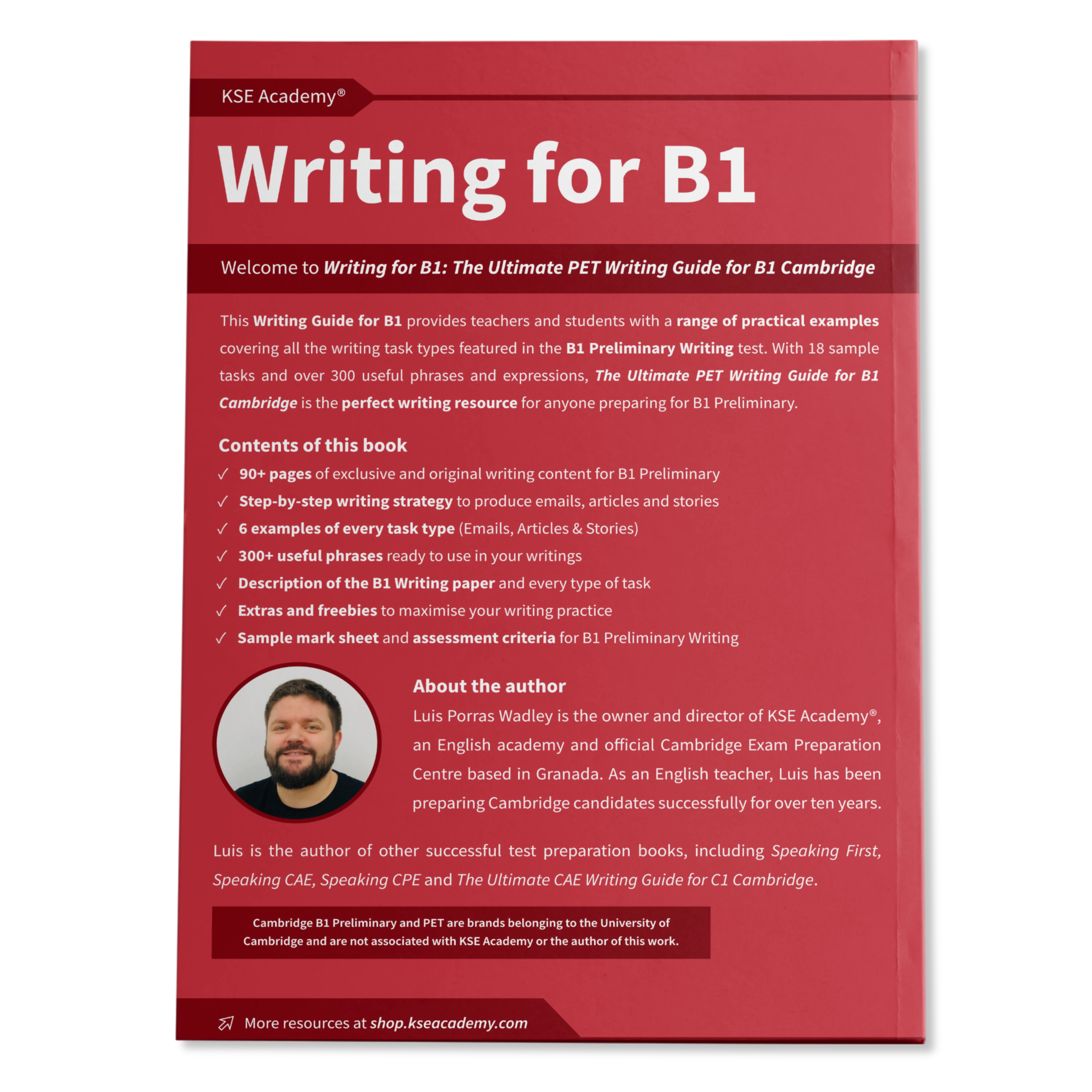
Table of contents
The B1 Preliminary (PET) is the Cambridge English exam used to certify a level of proficiency in English equivalent to a B1, as described by the Common European Framework of Reference for Languages (CEFR).
Before 2015, this test was called the Preliminary English Test, so it is still common to refer to it colloquially as PET, despite it being several years since the change.
In general, this exam aims to certify the ability of a speaker to communicate comfortably in everyday situations, but not as simply or limited as an A2 level. That is to say, at a B1 level, you already know and master the basics of English to communicate without problems in your daily life.
What is the B1 Level
According to the Common European Framework of Reference, a speaker of a language at the B1 level is already capable of managing effectively in situations that require a higher command than A2. Therefore, according to the CEFR, a person with a B1 level:
– Is capable of understanding the main points of clear texts in standard language when they are about familiar subjects, whether in work, study, or leisure contexts.
Common European Framework of Reference for Languages (CEFR), p. 26.
– Can handle most situations that may arise during a trip to areas where the language is spoken.
– Is able to produce simple and coherent texts on familiar topics or subjects of personal interest.
– Can describe experiences, events, desires, and aspirations, as well as briefly justify their opinions or explain their plans.
What Parts Does the B1 Preliminary (PET) Have
Like the A2 Key, the Cambridge PET consists of 4 parts, each corresponding to one of the basic skills of any language:
Before continuing to read, please remember that this article has been updated for the 2020 changes.
B1 Preliminary (PET): Reading
- Tasks: 6 parts
- No. of items: 32
- Duration: 45 minutes
Candidates must understand the main points of signs, newspaper articles, magazines, etc. They must also be able to use vocabulary and structures appropriately.
The Reading of the PET is divided into the following parts:
- Part 1:
- No. of questions: 5
- Description: short messages are shown in the form of signs, text messages, notes, etc., and the correct option (A, B, or C) must be chosen for each one.
- Part 2:
- No. of questions: 5
- Description: the descriptions of 5 people or groups of people wanting to do something are shown. Then there are 8 paragraphs describing possible places or events that the 5 people could go to. The correct paragraph (A – H) must be chosen for each person (1 – 5).
- Part 3:
- No. of questions: 5
- Description: there is a medium-length text and 5 multiple-choice questions (A, B, C, or D).
- Part 4:
- No. of questions: 5
- Description: there is a medium-length text with 5 sentences (1 – 5) missing. The text must be completed using the correct phrases (A – H).
- Part 5:
- No. of questions: 6
- Description: there is a short text with 6 words or expressions missing. For each gap, the correct word or expression (A, B, C, or D) must be chosen.
- Part 6:
- No. of questions: 6
- Description: there is a short text with 6 words or expressions missing. For each gap, a word or expression that fits correctly both grammatically and semantically must be written.
B1 Preliminary (PET): Writing
- Tasks: 2 parts
- Duration: 45 minutes
- No. of items: 2
In the Writing section of the B1 Preliminary, candidates must respond to an email appropriately and choose between writing an article or a story.
- Part 1:
- No. of questions: 1
- Description: an email with notes is presented, to which candidates must respond by writing around 100 words.
- Part 2:
- No. of questions: 2 (choose one)
- Description: candidates must write an article or a story in around 100 words. For the article, a situation is presented, while for the story, the exam provides a given phrase to start with.
B1 Preliminary (PET): Listening
- Tasks: 4 parts
- No. of items: 25
- Duration: 30 minutes (approx.)
Candidates must demonstrate that they can understand and follow a series of audio recordings featuring announcements, conversations, monologues, etc., from everyday situations.
The Listening of the B1 Preliminary (PET) is divided into the following parts:
- Part 1:
- No. of questions: 7
- Description: 7 different extracts of conversations or monologues are heard, and for each one, the correct answer (A, B, or C) must be chosen for a question. The answers are presented in the form of images.
- Part 2:
- No. of questions: 6
- Description: 6 different extracts of conversations or monologues are heard, and for each one, the correct answer (A, B, or C) must be chosen for a question. The answers are presented in the form of text.
- Part 3:
- No. of questions: 6
- Description: a person is heard talking about a topic, and a summary of the talk must be filled in with 6 gaps. In each gap, one or two words, a number, a date, or a time must be written.
- Part 4:
- No. of questions: 6
- Description: an interview or interaction between two people is heard, and the correct answer (A, B, or C) must be chosen for 6 questions.
B1 Preliminary (PET): Speaking
- Tasks: 4 parts
- Duration: 12 – 17 minutes
The Speaking exam of the B1 Preliminary (PET) takes place in pairs or threes, and candidates must interact with each other or with the interlocutor (examiner).
The 2020 PET Speaking exam is divided into the following parts:
- Part 1: part 1 consists of a series of personal questions that the examiner asks the candidates. It is divided into two phases:
- Phase 1: the interlocutor asks the candidates their names, where they are from, and what their profession or occupation is.
- Phase 2: in this phase, the interlocutor asks further questions to the candidates about their preferences, hobbies, etc.
- Part 2: in this part, candidates must describe a photo in approximately 1 minute. Each candidate has a different photo, and the theme is also different.
- Part 3: in part 3, candidates must interact with each other. The interlocutor presents a situation to the candidates and provides a set of images to help the conversation flow. Candidates must talk and decide on the best option for the given situation. Reaching an agreement is not required.
- Part 4: in this part, the interlocutor will ask questions to the candidates arising from the theme in part 3. They may ask independent questions to each candidate or request that they talk to each other.
PET Sample Test / PET Exam in PDF
Next, you can download a PET exam in PDF completely updated to the 2020 format.
DOWNLOAD SAMPLE TEST – B1 PRELIMINARY (PET)
I recommend that you leave the exam practice until you know that you are prepared for level B1. Otherwise, it may be a bit frustrating, and you will be wasting the material.
PET Vocabulary List / PET Vocabulary List
Like at the lower level, there is also a vocabulary list for the B1 Preliminary (PET). It is quite extensive, but it can be useful when preparing for the exam.
DOWNLOAD VOCABULARY LIST – B1 PRELIMINARY (PET)
This is the last level for which there is an official vocabulary list from Cambridge. For exams at higher levels, such as B2 First or C1 Advanced, there are no lists since the vocabulary is too extensive to be encompassed in a list.
How the B1 Preliminary (PET) is Scored
If you are an English teacher or are preparing for B1 on your own, you should know how to score the PET using the 2020 format. So pay attention:
- Reading: has 32 items and each item is worth 1 point. Up to 32 points can be achieved.
- Writing: has 2 tasks and each task is worth 20 points. A maximum of 40 points can be achieved.
- Listening: has a total of 25 items and each item scores 1 point. At most, 25 points can be achieved.
- Speaking: the entire Speaking part is worth up to 25 points.
Remember that to calculate the score, you cannot add the points from different parts. What you need to do is calculate the percentage of each part and then average the 4 percentages.
How to Calculate the Score for Your B1 Preliminary (PET) Exam
To know how to calculate the score for the B1 Preliminary (PET), you simply need to watch the video below or follow the instructions in this article.