
How to write a Report for the C1 Advanced (CAE) [Guide 2025]
En este artículo te enseño cómo escribir un report para el CAE Writing de Cambridge. Además, te traigo una guía para el C1 Advanced (CAE) Writing que te ayudará a mejorar tu writing.

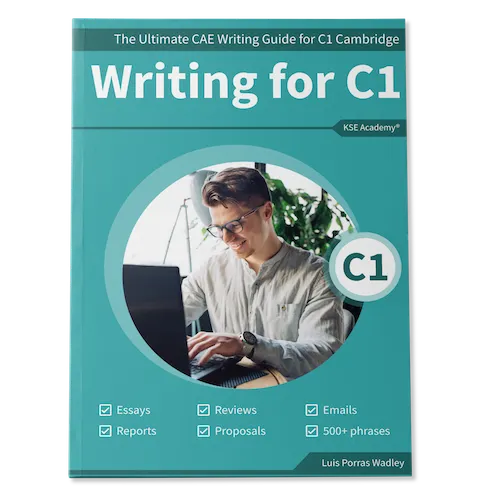
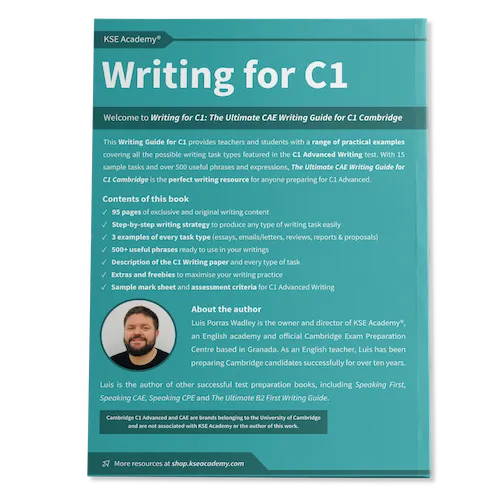
Table of contents
As we have seen on numerous occasions, and will continue to do so, the C1 Advanced (CAE) is divided into components, one of which is the Writing paper. The CAE Writing paper has two parts. In Writing Part 1, as we saw, you always have to write an Essay. However, in C1 Writing Part 2, you will have the option to choose from several task types, one of which might be a report. Therefore, in this article, I am going to explain exactly **how to write a Report for the CAE**.
Keep reading, because what follows is pure gold… 😂
What are the parts of the C1 Writing paper?
The C1 Advanced (CAE) Writing paper, as mentioned above, is made up of **2 parts**, and for each one, you must write a text according to the exercise instructions. Let’s look at how the tasks are distributed:
- Writing Part 1: Here you will always be asked to write an essay. You will not be able to choose another option. If you are interested in *essays*, click here to learn how to write an essay for the CAE.
- Writing Part 2: In this part, you will have to choose from 3 options. For these options, the types of writing that may appear are the following:
- Formal letter/email
- Informal letter/email
- Review
- Report
- Proposal
Each writing piece you produce should be between 220 and 260 words, approximately, and, as they are different types of writing, you should consider the specific features of each in terms of structure, register, grammar, and vocabulary, etc.
So let’s begin with the one that concerns us in this article: Reports!
What is a C1 report?
In the C1 Writing Part 2 exam, a report refers to a type of formal and objective writing used to present detailed information on a specific topic. Generally, reports present information clearly and in an organised manner. As a candidate, you will need to be able to structure the report logically, presenting information coherently and in a way that is easy for the reader to follow. Furthermore, as we will see later, you will have to use formal language appropriate to the context, avoiding colloquial or informal forms.
In summary, a report for the CAE is a formal and objective form of writing that requires candidates to present detailed information clearly and in an organised way, using appropriate language and demonstrating analytical and evaluative skills.
How to write a Report for CAE Writing
Below we will look at the main characteristics of a C1 level Report for you to consider when writing:
- Purpose: Reports are generally written to analyse a previous experience you have had, such as a trip or a place you have visited recently. They usually address something that has already happened, which you must analyse and then make some recommendations for improvement. You will not only be asked to describe a situation but also to evaluate the extent to which a specific objective has been achieved, or suggest an alternative course of action.
- Tone and register: A report can be written for a superior (e.g. a manager or school principal) or for a group of peers (e.g. club members or colleagues). For this reason, the language in a report is expected to be formal and objective. You should avoid including yourself or your opinions in most of your sentences to make them sound more objective. However, you must give your opinion in the conclusion or recommendations paragraph. The content of a report is relatively factual, but there will be space for you to use your own ideas and experiences.
- Structure: A report is a type of text that typically has a title at the beginning (obviously!) and various subheadings that separate the different sections of information. Each paragraph should have a subheading that summarises its main topic. Furthermore, the introduction can always be titled «Introduction» and the conclusion, «Conclusion» or «Recommendations».
- Opinion: There are two main ways to express your opinion in a C1 Advanced report. You can leave it until the end of each paragraph, explaining how you would resolve or improve each aspect. Or you can wait until the final paragraph, where you can summarise how you would resolve or improve each aspect in a single paragraph. There isn’t one correct way to do it, so you will have to find your style or adapt depending on the topic.
- Common topics for reports: Some common topics for reports are visits to museums, local businesses, trips and excursions, work experience programmes, important events, among others. And they are almost always presented as opportunities to describe what the experience was like and what could be done to improve it in the future.
Example of a CAE Writing Report
Now that we have looked at the main characteristics of a report for the Cambridge Advanced (CAE) Writing paper, let’s look at a good example of a C1 level report, examining both the example instructions and a possible answer.
C1 Report Instructions
In the text box below, you can see an example taken from the Cambridge website.
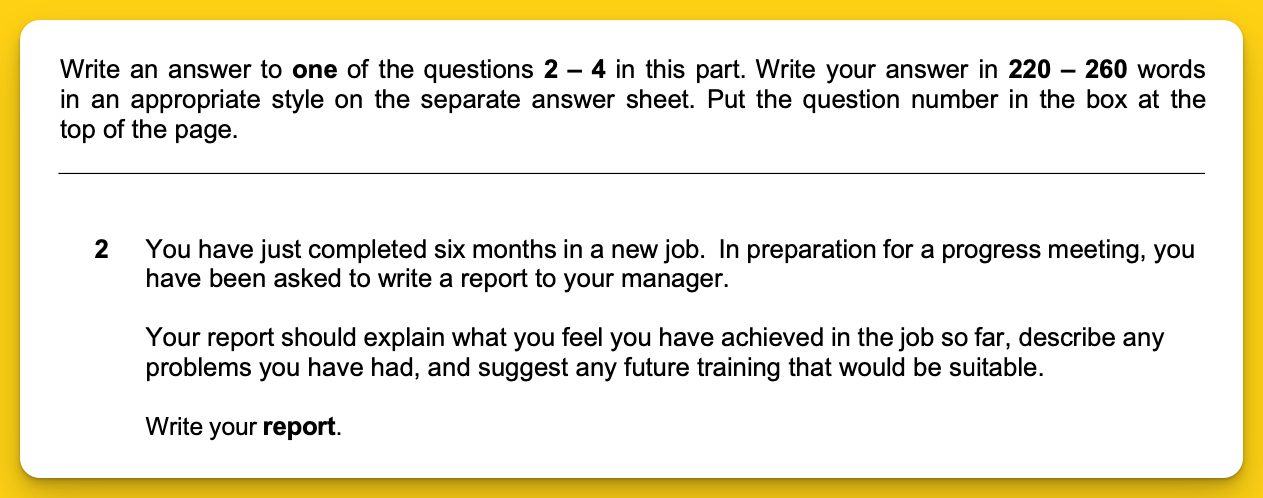
From these instructions, we must always extract the essentials:
- Topic: six months in a new job → preparation for a progress meeting
- Target reader: your manager
- Points to cover:
- Explain what you feel you have achieved in the job so far
- Describe any problems you had
- Suggest any future training that would be suitable
- Essential instructions:
- Choose only one of the Writing tasks. That is, if you choose the report, you should not do any other task from Writing Part 2.
- Write the report using 220-260 words, approximately.
Example C1 Report Answer
According to the task model presented above, we can structure the C1 report as follows:
- Introduction
- Professional achievements
- Problems I encountered
- Recommendations
Although it is not set in stone, it is most common to have 4-5 sections. So now let’s look at an example Report for the CAE Writing paper:
| Progress Report Introduction The aim of this report is to provide an overview of my first semester at work. I will discuss my professional achievements during this period, any problems I have faced, and suggest some future training both suitable for myself and other new employees. Professional achievements During the first six months at work, I have achieved several key goals. Firstly, I have been able to meet all the deadlines assigned to me. Secondly, I have contributed to various projects and provided valuable inputs that have led to positive outcomes. And lastly, I have managed to build a great rapport with my colleagues, which has facilitated teamwork and collaboration. Professional challenges Despite my achievements, I have encountered two main challenges during this time. One of the biggest challenges was the lack of clarity in the job description regarding my responsibilities. Unfortunately, this led to some initial conflicts with my colleagues. Additionally, I have been finding it difficult to manage my workload at times, especially when assigned multiple projects simultaneously. Recommendations To address the aforementioned problems, I would like to put forward several recommendations for future training. Firstly, I would recommend holding an initial training workshop for newly hired employees. I am certain that this would have helped me understand my role and responsibilities better from the get-go. And secondly, I would also suggest providing some training on time management and task prioritisation, which would help me manage my workload more effectively. I am confident that with the suggested training, not only will I be able to overcome these challenges, but also to continue to be a valuable asset to the company. |
With a simple glance, we can see that this C1 Report has a title and 4 clearly differentiated sections in a very visual way. Let’s look at this in more detail:
- Title: The title generally covers the topic of the report. As it is a report, we don’t have to be very creative with the title, as it is objective and, to be honest, it doesn’t matter if it is boring. Remember that if it were a Review, the tone and style of the title would be completely different.
- Sections: Each section is introduced by a subheading that summarises the content. Generally, given the limited word count, each section will have one or two paragraphs at most. In this case, one paragraph was sufficient. Based on the example above, let’s look at the function of each section:
- Introduction: Here we state why we are writing the report (i.e.: the aim of this report is to…) and what points we are going to cover (i.e.: achievements, problems and future trainings).
- Professional achievements: Here we mention the achievements we have made in the first six months of work (i.e.: deadlines, valuable inputs and rapport).
- Professional challenges: Here we deal with the second point to cover, the problems we have had. In this case, we have discussed lack of clarity in the job description and manage my workload.
- Recommendations: In this last section is where we propose solutions to the problems previously described. Therefore, we propose an initial workshop for newly hired employees and training on time management and task prioritisation.
- Connectors: Throughout the report, we have used connectors that help the text have a clear progression and good coherence: firstly, secondly, unfortunately, additionally, etc. It is not a text that requires a very complex structure, so the connectors and discourse markers are relatively simple, although appropriate for a C1 level.
- Language:
- We do not use contractions or vague words (e.g. things).
- We use appropriate terms and expressions for a C1 level:
- provide an overview of
- key goals
- meet all the deadlines
- provided valuable inputs
- led to positive outcomes
- build a great rapport
- I have encountered
- lack of clarity
- manage my workload
- to address the aforementioned problems
- put forward several recommendations
- holding an initial training
- newly hired employees
- from the get-go
- time management and task prioritisation
- I am confident that
- overcome these challenges
- a valuable asset to the company
- Although grammar in a report is not usually what stands out the most, it is also advanced (e.g. Not only will I…, but also…)
In short, this is a good example of a Report for the CAE Writing paper, with all the characteristics that a good report should have.
Now let’s move on to one of the most common questions of all time!
Will I be penalised if I write fewer than 220 or more than 260 words?
This is the most typical question in this part of the exam, and the answer is: yes and no. Let me explain. The examiners do not count words and penalise you solely and exclusively based on the word count. There is a rumour circulating among candidates and teachers that you lose points for every 10 words, but that is not true. However, consider that if you have exceeded the limit by 50 or 100 words, or more, you are probably including information that is not very relevant to the task, and that is indeed penalised. Similarly, if you write less than 220 words, you are probably missing important information or are not covering it with the detail required.
Therefore, I always recommend exceeding the limit by no more than about 20 words. That way, you probably won’t lose points unnecessarily if the task covers the aspects required. 🙂
Guide to C1 Advanced Writing with examples and useful expressions
Although I will publish more articles explaining how to do each task type for C1 Advanced, the best thing you can do to have plenty of information and practice is to acquire the official KSE Academy guide for CAE Writing. In this guide, you will find the following:
You can also 👉🏻 View sample or Buy on Amazon
I hope this article on the C1 Writing Report has been very useful to you. In that case, don’t forget to share it with your friends and family.
See you in the next post. Until then, don’t forget to keep smiling! 🙂