
Writing C1 Advanced (CAE): Complete Writing Guide with Examples
Do you want to sit the CAE but still don’t know what the Writing C1 Advanced is like? Here’s all you need to know about the Writing section of the CAE.

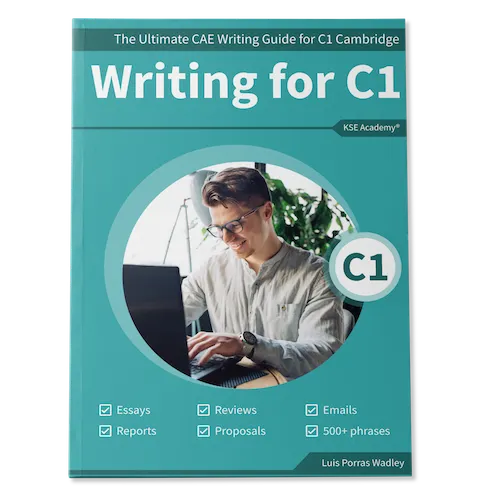
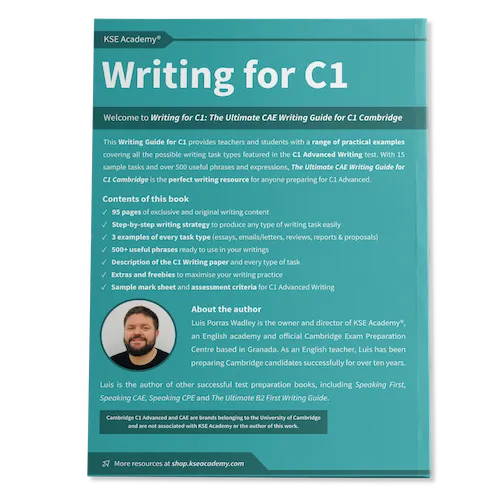
Table of contents
The Writing C1 Advanced (CAE) is the first Writing exam considered to be at an advanced level, and is part of the Cambridge C1 Advanced exam, also known by its old name CAE (Certificate in Advanced English).
As with other exams (B2 First and C2 Proficiency), the C1 Advanced Writing is just one part of the 5 that make up the C1 Advanced. And as I have said before, based on my experience as an English teacher, the C1 Writing is a difficult part, but one of the easiest to improve through studying.
For this reason, in this article I am going to explain exactly what the C1 Advanced (CAE) Writing is like and I am going to show you an example of each CAE Writing task. Here we go!
Writing C1: what is the C1 level
As Cambridge started doing in 2015, the name of the C1 Advanced exam clearly specifies the level it refers to, that is, a C1 level according to the Common European Framework of Reference for Languages (CEFR). The C1 level is the first band of linguistic competence that defines an advanced level. As specified by the CEFR, a person with a C1 level in written competence:
Can produce clear, well-structured and detailed texts on subjects of some complexity, showing correct use of organisational, articulatory and cohesive mechanisms in the text.
Common European Framework, p. 26
At a general level, we already notice a change compared to lower levels, and that is the use of the words «subjects of some complexity», whereas at B2 level only «diverse subjects» and «general subjects» were specified.
If we analyse the CEFR written expression section further, a candidate with a written C1 level:
- In general:
- Writes clear, well-structured texts on complex subjects, highlighting main points, expanding at some length and defending their points of view with appropriate supplementary ideas, reasons and examples, and concluding appropriately.
- In creative writing:
- Writes clear, detailed and well-structured descriptions and imaginative texts, with a convincing, personal and natural style, appropriate to the intended readership.
- In report and essay writing:
- Writes clear, well-structured expositions on complex subjects, highlighting the main points.
- Expands at some length and defends points of view with appropriate supplementary ideas, reasons and examples.
As you can see, a C1 level Writing is already a complex level, with reader expectations that are also quite high.
And now that we know how advanced the C1 Writing level is, let’s look at what the CAE Writing is like, by looking at examples of C1 Writing exercises and the instructions.
What the C1 Advanced Writing is like
The CAE Writing follows the pattern of other Cambridge exams since 2015, therefore, candidates have to write two texts of 220 – 260 words in 1 hour and 30 minutes. These two texts are of different types, as we will see in the next section, and the objective is for you to demonstrate a series of written linguistic mechanisms appropriate to a C1 level Writing.
Now we will look at the different types of C1 Advanced (CAE) Writing tasks and examples of each one.
Types of C1 Writing Tasks
These are the different types of task you may encounter in the current CAE Writing:
- Part 1
- Essay
- Part 2
- Email (informal or formal) or letter (informal or formal)
- Review
- Report
- Proposal
These types of Writing tasks have been present since B2 First, except for the proposal, which is a new type of Writing task introduced at CAE (C1 level), and which replaces the article, which disappears at this level.
Writing C1 Advanced: Part 1 – Essay
As in other Cambridge main suite exams, the first part of this Writing exam consists of writing an essay. Unlike the second part, in this one you only have one option, so you have to write an essay compulsorily.
As you will already know, an essay is a very common C1 Writing task at an academic level, this being one of the main objectives of this English exam. Obviously, in this case we cannot write too many words (around 260 maximum), but rather it is about demonstrating that you are able to comfortably cope when writing on academic subjects. Furthermore, to make things easier, this task always presents the instructions in the same way and with the same number of points.
Below is a screenshot for you to see what the instructions for a CAE essay are like:
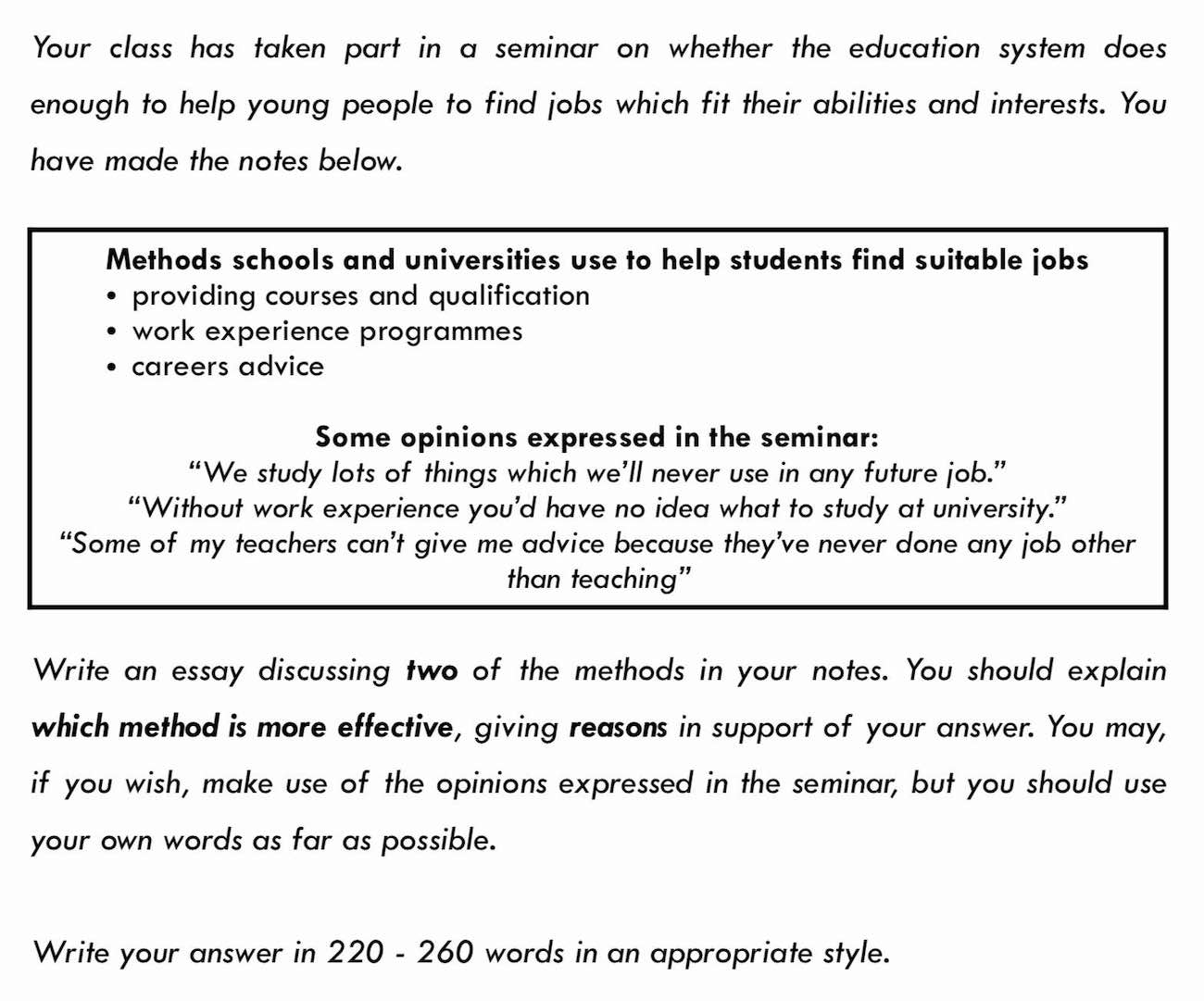
As you can read in the image above, the idea is that there has been a seminar in which your class participated, the theme of which was the effectiveness of the educational system in helping young people find work. It is a complex subject and of an academic level. Below you have a series of notes: first you have the points covered by the seminar and then a series of quotes about opinions expressed during the seminar. If you look closely, each opinion corresponds to one of the points discussed.
Next, you must write a C1 level essay discussing 2 of those points and deciding which is the most appropriate. And all of this in 220 – 260 words. Click here to see exactly how to write an Essay for the C1 Advanced (CAE).
Let’s now move on to the second part.
Writing C1 Advanced: Part 2
In this part, you must write another writing of 220 – 260 words, but unlike Part 1, here you can choose between 3 different tasks. But don’t be mistaken, because although there are only 3 tasks, up to 7 types of C1 Writing can appear, as we saw earlier: review, formal letter/email, informal letter/email, report, or proposal.
Let’s look at an example of each type of C1 Advanced Writing task, that is, the prompt.
Writing C1 Advanced: Review
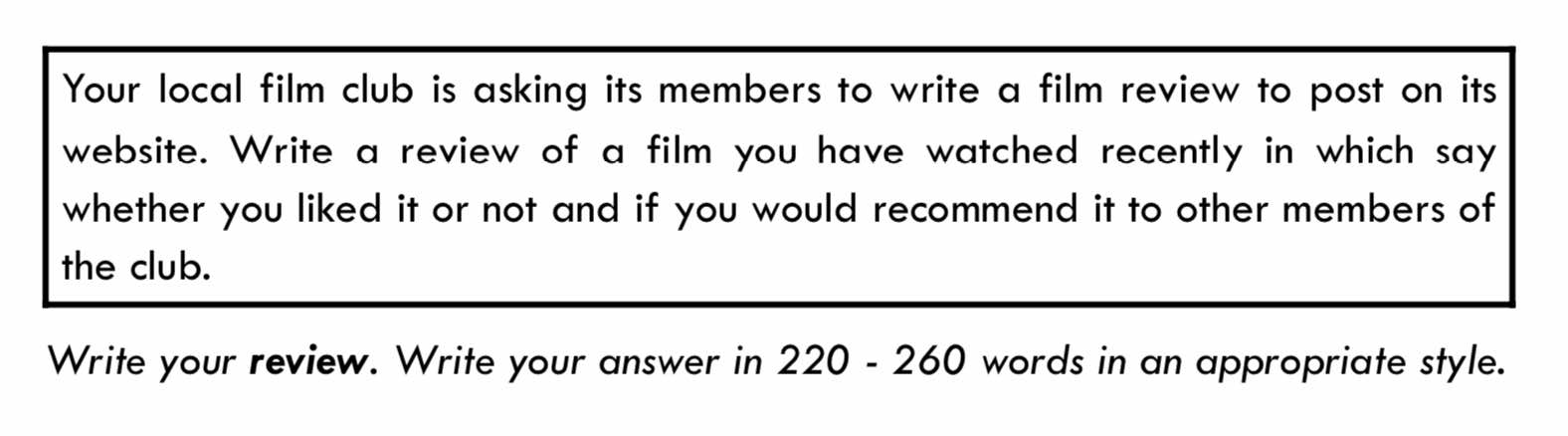
One of the types of Writing task that may appear in the C1 Advanced is the review. This task is usually quite complicated, from my point of view, as it is a very specific type of Writing. And the problem is that you may be asked to write a review about a film, a book, a series, an object, a website, a television programme, etc. In this case, we are going to look at an example of instructions for a film review.
Writing C1 Advanced: Report
The report is one of the simpler C1 Writing tasks, in my opinion. Why? Because from my point of view, it is one that requires the least creativity and, generally, this tends to make it easier and gives us more opportunity to focus on our written English.
A report is simply an account, that is, a piece of writing in which we analyse something that has already happened or that already exists. For example, you might be asked to write a report about a visit, an exchange programme, a company, the situation of something in your country, etc.
Click here to find out how to write a C1 report.
In the case we have below, it is about writing a report on the influence that English-language television programmes have on your country. Read the task carefully:
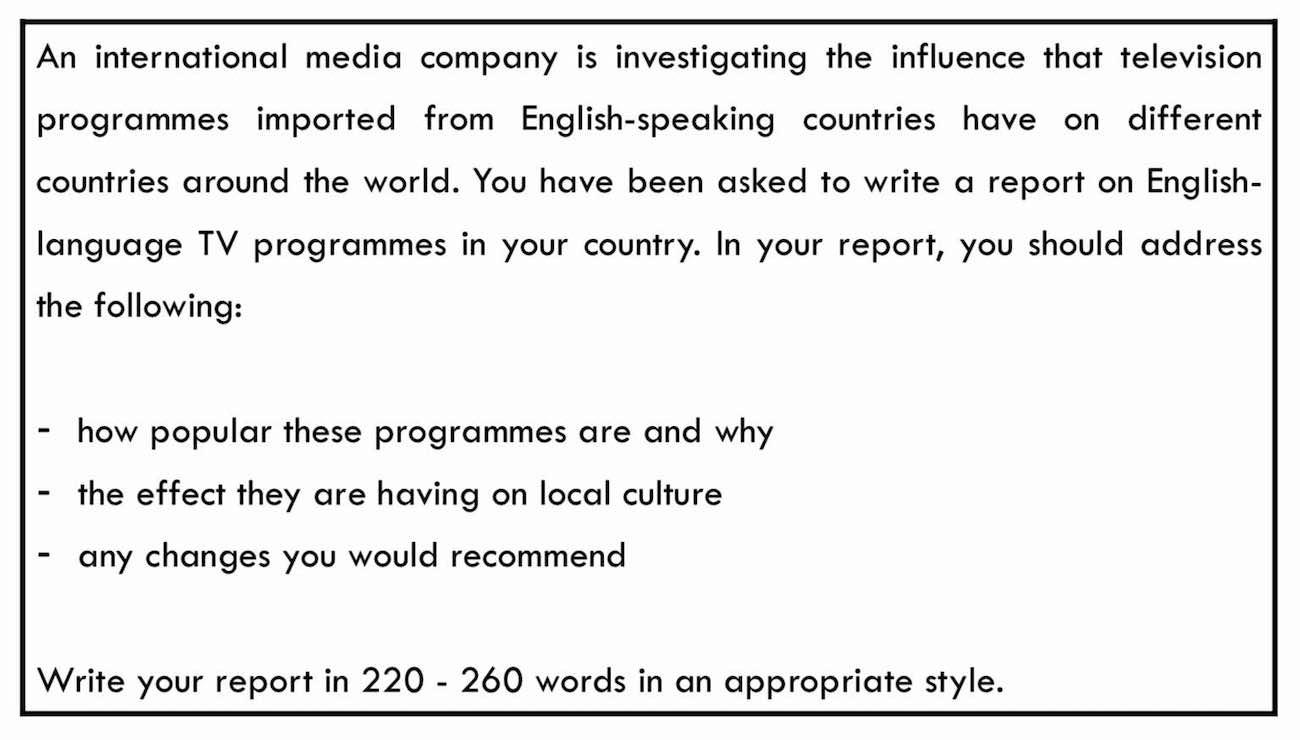
As you can see, it is a Writing task that requires a very formal tone, as it is addressed to an international company and is a thorough analysis of the situation. Later we will look at a sample report answer.
Writing C1 Advanced: Proposal
Now let’s look at the instructions for a C1 Advanced proposal, a new type of Writing introduced specifically at this level. The purpose of this type of Writing is to make a proposal on a subject they ask us about. A very typical theme is being a student or employee of a faculty that has received some sort of financial grant, so you are asked to make a proposal on how to invest said money.
Although that theme has nothing to do with the one we are going to see in the following proposal instructions:
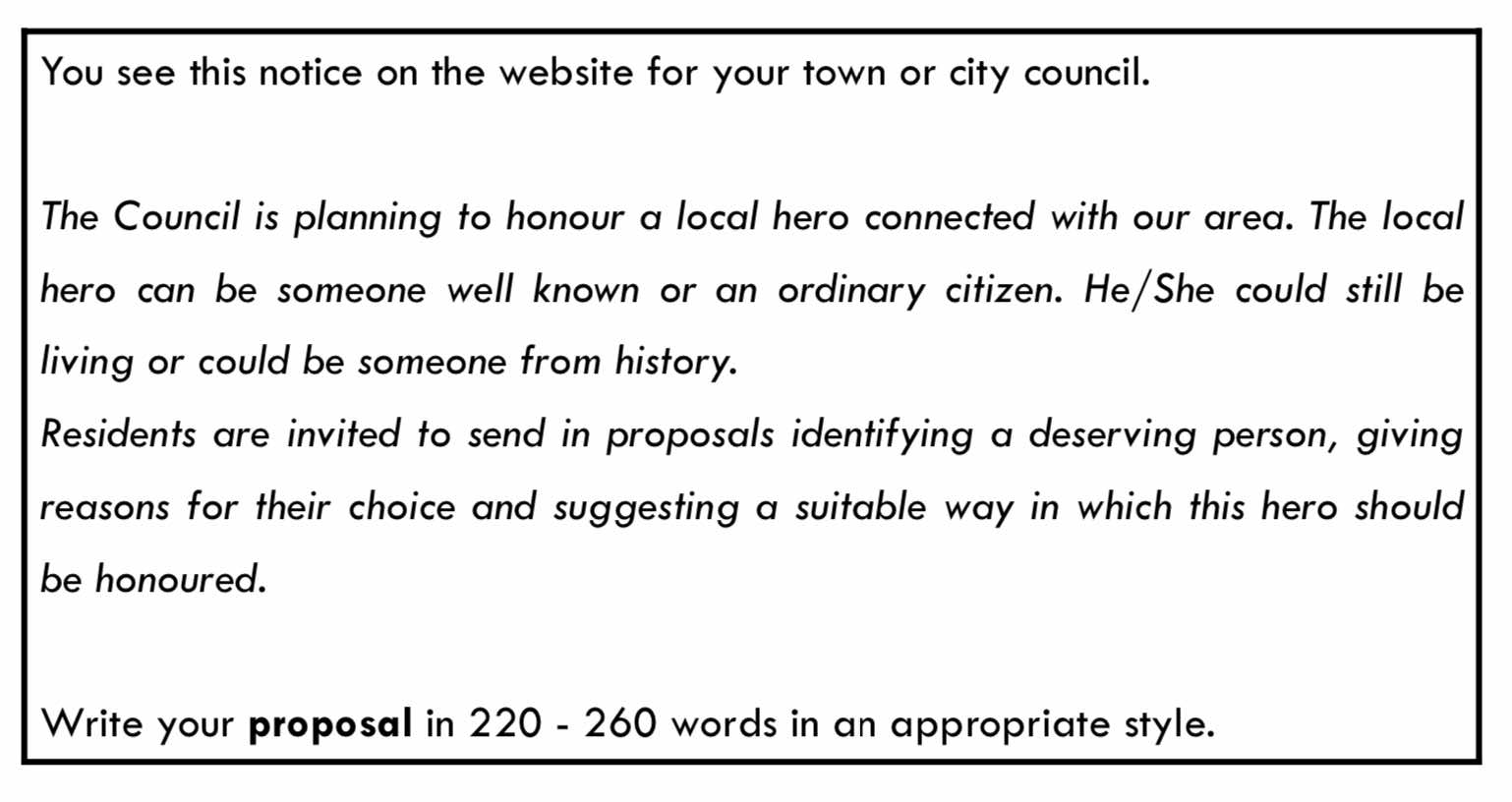
The format of the text, as we will see later, is very similar to that of a report, but while a report focuses on something that has already happened (to make suggestions for improvement), a proposal focuses on something for the future.
Writing C1 Advanced: Informal Email or Letter
An email and a letter are the same in terms of format. That is why I will treat both equally in this section. And, in this case, I am going to show you an example of an informal email for C1 Advanced, although it could also be a formal email or letter.
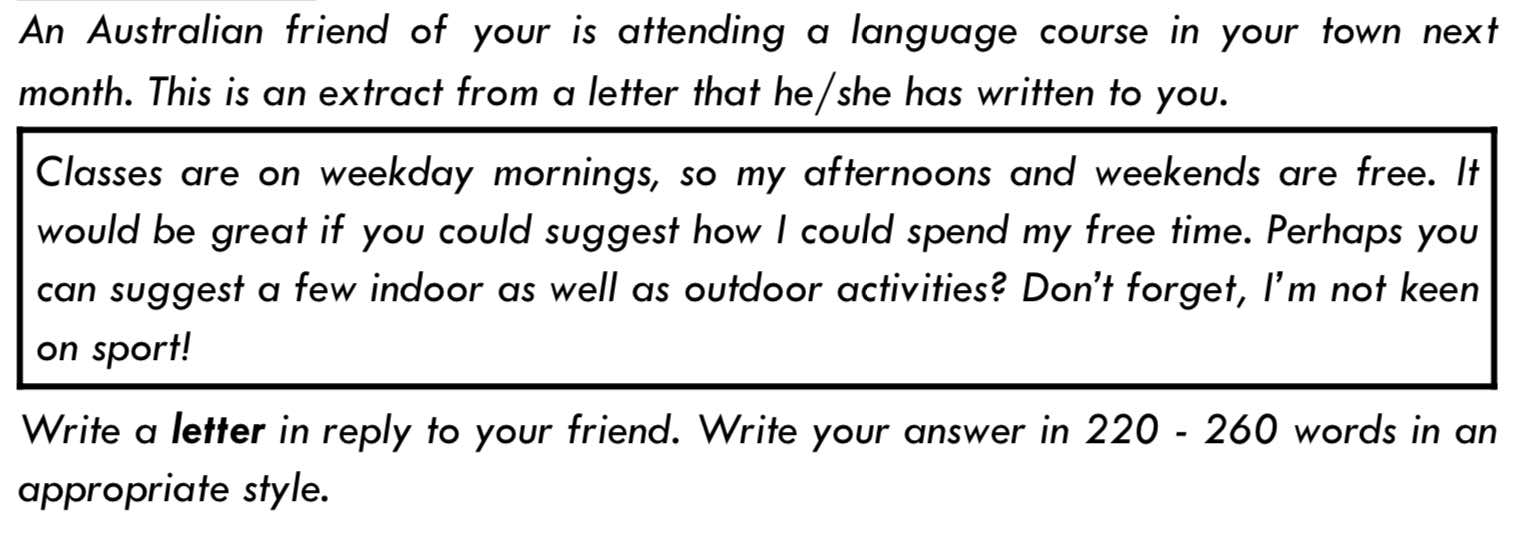
Here is a typical example of a C1 email Writing task in which you are asked to write to a friend.
Writing C1 Advanced: Formal Email or Letter
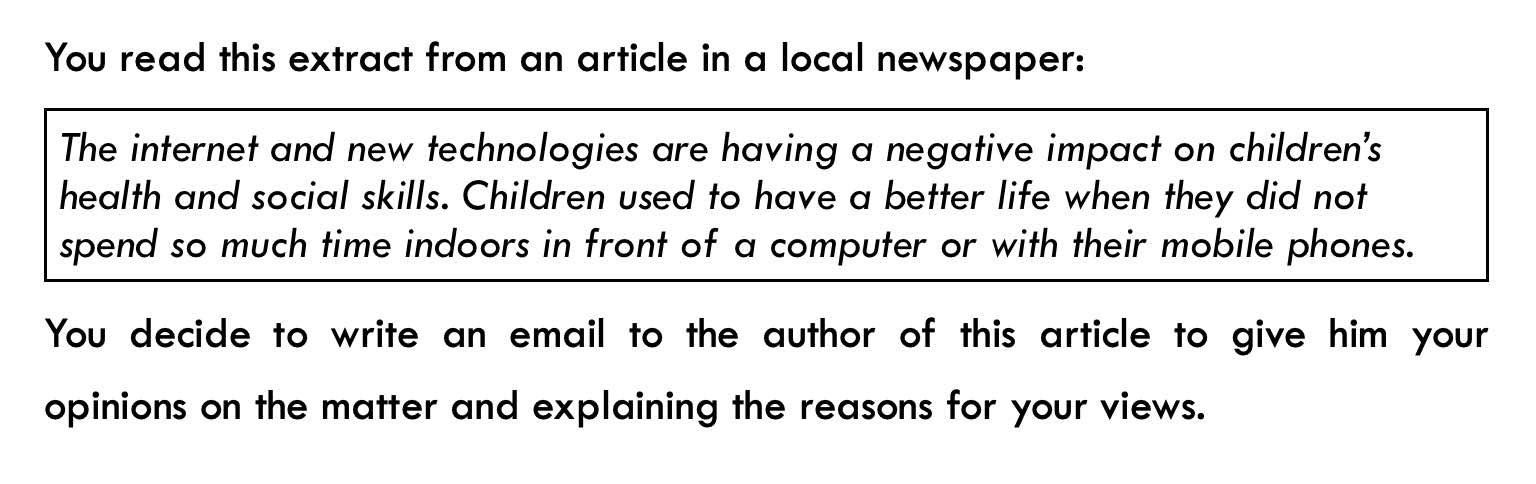
And below you have an example task for writing a formal email for C1. As you can see, it is a letter written to the author of a newspaper article, so the tone must be formal, as should the vocabulary and grammar used.
Now that we have seen examples of each type of task, let’s look at an example of each type of C1 writing, that is, appropriate answers for the writing tasks.
Examples of C1 Advanced (CAE) Writing
In this section we are going to look at a C1 Writing example for each type of task. The purpose of this is for you to familiarise yourself with each type of Writing and to get an idea of what is expected of you in the exam. Furthermore, I have tried to simulate a C1 level, neither too strong nor too weak, so you know what your Writing tasks should resemble, at a minimum. Let’s begin.
C1 Writing Essay Example
An essay, as we saw before, is a formal Writing task in which you must discuss 2 ideas (out of 3 provided in the instructions) and from which you must choose one as the best option, always justifying your opinions. To express your ideas, you must demonstrate a C1 level through vocabulary, grammatical structures, appropriate language for the context, formulas, etc.
Below is an answer to the task presented earlier:
Helping students find suitable jobs
Nowadays, there seems to be a serious problem with our education system. A growing number of youngsters are finding themselves stuck in jobs that have little or nothing to do with their degrees. As a consequence, frustration and unemployment are on the rise, as young workers eventually tend to resign. But is there something to be done about this? Experts believe so.
On the one hand, it is believed that when choosing a degree, students are not mature enough. Therefore, they lack the necessary experience to know what they really desire for their future. If they were to have more experience, they would choose more wisely. In turn, there would be fewer college dropouts and more fulfilled young workers. For this reason, experts claim that embarking on a work experience programme would be truly beneficial.
On the other hand, recent research points out that students lack appropriate careers guidance. Not only are teachers not qualified for this task, but also they lack the resources to provide students with guidance. Thus it is of utmost importance to hire professional careers counsellors, who can help students develop more accurate expectations of their careers and professional opportunities.
In conclusion, I hold the view that if we were to tackle these two issues, our education system would become more effective in aiding students to become satisfied workers after finishing their university studies. However, implementing work experience programmes would bring about greater benefits for youngsters than seeking profesional counselling. This is so because I believe that our own experience is more valuable than someone else’s professional opinion.
This example, which I wrote myself, is a good essay example for the C1 Advanced (CAE). In this case, I cover 2 of the points given to me (paragraphs 2 and 3) and provide a good introduction (paragraph 1) and a good conclusion (paragraph 4). Also note how the paragraphs are separated and the type of connectors, vocabulary, and grammar I use.
C1 Writing Review Example
The following example is a film review that I wrote for my C1 students. As you can see, it is about a real film (Room) and in it I discuss several essential elements in any film, book, or series review: plot, characters/actors, recommendation, theme, why I like it, etc.
Room
There are films which represent a turning point in the life of every film buff, whether it be for the plot, the actors or the themes. In my case, this came about when I watched Room, a heartbreaking yet inspiring production directed by Lenny Abrahamson.
Set in present-day Canada, the plot of this human drama revolves around the story of a young woman, Ma, who was kidnapped 7 years ago and has been locked up ever since in a minute back-garden shed – referred to as “room” throughout the whole film. After regular forced, sexual encounters with her kidnapper, Ma has given birth to Jack, who is now 6 years old. During this time, room is the only world he knows, thus being completely unaware of what lies beyond those four walls. However, Ma will do everything in her power to break free and put an end to their ordeal.
The characters are wonderfully played by all the actors, who put in an exceptional performance, especially the young, child actor who plays Jack. He really provides the part with a lot of personality and wins the viewers’ sympathy from the outset.
What made me fall in love with this film was that it deals in an extremely realistic way with major themes like violence, motherly love and depression. However, the icing on the cake is how this picture gives us hope to overcome severe difficulties.
If you’re keen movie lover and enjoy thought-provoking stories, I wouldn’t hesitate to log on to Netflix and watch it straightaway. You will always remember it as one of the best films you ever saw.
If you have noticed, you will see that this type of Writing is very demanding in terms of vocabulary, as they are very descriptive and require extensive use of powerful adjectives (heartbreaking, thought-provoking, exceptional, etc.). Furthermore, the vocabulary must be very specific, especially given that it is a C1 level.
C1 Writing Report Example
In this section you have a report example for the CAE. As before, it is the answer to the Writing task presented in the previous section about the impact of English-speaking television on my country.
As you will have immediately noticed at a glance, the structure of a report is very special. Apart from the title, each paragraph or idea is actually a sub-section introduced by a sub-heading. Furthermore, the register must be quite formal, as you will be able to read below:
English-language TV Programmes in Spain
Introduction
The aim of this report is to analyse the introduction of English-language TV programmes to Spanish television. In doing so, this document will focus on the popularity of such programmes, the effect they have on local culture and how they could be improved by making some minor changes.
Popularity
According to the latest research, English-language TV programmes have increased in popularity in Spain during the last decade as a result of new television features like TV on demand. The main issue seems to be that most viewers are watching a dubbed version of these shows. However, as English language fluency increases within the country, more and more viewers tend to choose the original version of these shows with the intention of boosting their fluency even more.
Effects on local culture
While the impact on Spanish culture is not as great as on other cultures, due to relatively scarce differences between American or English societies, some changes have been registered. Firstly, national TV productions are struggling to compete with American programmes, which have a more generous budget. Secondly, according to sociologists, language learners are benefiting not only from language input, but also from a broader cultural awareness.
Recommendations
In order for English-language shows to have a more positive impact on our society, I would recommend not dubbing them. Consequently, viewers would be somewhat obliged to watch these programmes in English, hence improving their English language skills. Furthermore, as a teacher, I would suggest Spanish TV channels provide viewers with online educational resources and support so that they would be able to make the most of watching shows in the original version.
C1 Writing Proposal Example
The structure of a proposal, as you can observe, is (or can be) exactly the same as that of a report. It is not obligatory, but it is recommended.
In the C1 Writing proposal exercise we saw earlier, I was asked to propose a person to be honoured in my city, which is Granada. So here is the proposal example with my nomination of a hypothetical José Pérez:
Granada’s Most Committed Teacher
Introduction
The aim of this proposal is to suggest honouring a local figure who I believe is worthy of the city’s respect and admiration. The person I have chosen is José Pérez, a renowned educator, who sadly passed away last year, at the age of 73.
Achievements
Born and raised in Granada, Mr Pérez is famous in this city for his work as educator. In his early years, he started working in a secondary school in an extremely run-down area, thus dealing with extremely troublesome students and families. However, instead of giving in to difficulties, he managed to increase dramatically the number of high school graduates. Furthermore, seeing how uneducated families in this area were, he set out to found a local charity which teaches youngsters and adults alike. These are the main reasons why I believe Mr Pérez should be honoured by the local council.
Tribute
The best way in which Mr Pérez should be honoured is by renaming the school where he used to work after him. I believe he would have been deeply grateful for this. However, I would also like to propose paying him homage by holding a local holiday on 10th March, coinciding with his birthday. On this day, schools would be expected organise especial events in his memory.
Conclusion
On the whole, I believe that I am not alone when I say that Mr Pérez’s work has had an impact on the city which no other person has achieved in the last 100 years. For this reason, I truly hope you consider this proposal, as it would make many people happy.
C1 Writing Informal Email Example
Here is an informal letter or email responding to «my Australian friend» Mike. The essential point, as you will see now, of any email or letter, apart from being well-written and in an appropriate register, is the structure. Notice how I divide this email into:
- greeting
- opening paragraph
- paragraphs with main ideas
- closing paragraph
- sign-off
- signature
In this case, as it is an example of a C1 informal email, the language is veeeery informal. In fact, I have exaggerated it quite a bit to make a point and show that I master the informal register. Perhaps I would recommend that, if you write an informal email, you don’t go quite as far as I have, hehe.
Hi Mike!
How’s it going, bro? Things are just swell over here: the weather’s great and I’ll be off work soon for a couple of weeks. So it’s absolutely fantastic that you’re doing that course you told me about here in Granada. So here’s a few things to keep you busy in your spare time, which, BTW, you’ve got tons of, haven’t you?
If the weather’s not that great when you’re here – though I doubt it! –, you might wanna make the most of the cafés and tea rooms in Granada. Tea rooms are a great part of social life here and you can find a bunch of them around Elvira Street. They all serve super tasty Muslim-style tea and some even have stand-up performances on weekends. Make sure you check’em out!
However, the weather’s most definitely gonna be great at some point during your stay – remember, this is Andalusia! – so walking up and down the city is the best way to get to know the city. Besides, walking will help you get rid of those extra kilos you put on over Xmas, haha! So I recommend that you pick a few spots you’d like to visit, and check them out with your classmates after your lessons. IMO, you can’t miss the Alhambra, the greatest ancient Muslim palace in the world; or St Nicholas Viewpoint. They’re simply two of the best things you’ll come across in Granada. Seriously!
Anyways, mate, I’d better get going. I’ve got tons of things to do before my holidays. Let me know if there’s anything else I can give you a hand with.
Take care, bro!
Luis
LOL. I crack up reading my own email.
C1 Writing Formal Email Example
Below is an example of a formal email for the CAE. It is the answer to the task presented in the previous point, regarding the newspaper article with which I disagree. Notice the register used and you will see how formal it sounds and how much more imposing a formal tone is than an informal one.
Dear Sir,
My name is Luis, I am a child psychologist and I am writing with regards to your latest article about the effect of new technologies on our children, which was recently published in our local newspaper. I am afraid that, although I understand why you may hold such views, I disagree with most of the points you put forward.
To begin with, you categorically claim that children’s lives are worse now than they used to be in the past. However, not a single scientific paper published in the last 10 years regarding our infants’ well-being supports this claim, which clearly suggests that it is biased and unfounded. I am a child psychologist, currently conducting relevant research in this field, so I am well-informed and know what I am talking about.
Furthermore, in your article you place all the blame on new technologies and the internet, as if these were directly responsible for children’s lack of a healthy lifestyle. No reference do you make, whatsoever, to parents’ responsibility in the matter, which, from my point of view, makes all the difference. The use our children make of the internet is entirely dependent upon how and for how long their parents allow them to use it. It can be a fantastic tool if used responsibly, or a terribly dangerous one if used carelessly.
As an expert in the matter, I would be more than willing to contribute with my expertise to further articles dealing with children’s psychology and well-being, which you or the newspaper may wish to publish in the future.
Yours faithfully,
Luis
Writing C1 Advanced (CAE): how it is assessed
Any CAE Writing task is assessed based on 4 fundamental assessment criteria, just like B2. These are: Content, Communicative Achievement, Organisation, and Language. Let’s now look at what each one consists of so you get an idea of how to read your Writing once completed:
- Content: The purpose of this criterion is to assess how well you have completed the task and responded to everything that was asked for. In this regard, it is important that you respond to each point proposed in the exercise (in this case they ask for 2) and that the information you write covers each point and the task in general well, so that the reader is well-informed regarding the objective of the prompt.
- Communicative Achievement: This assessment section aims to determine how appropriate your Writing is with respect to the proposed exercise. In this regard, the style and register in which you have written are particularly important. That is, if you write to your Australian friend Mike starting with Dear Sir, you will lose points. Similarly, if you use many contractions in an application letter, whose register is supposed to be formal.
- Organisation: Does your writing have a logical progression and is it correctly structured? Perfect. Then you will probably get a good mark for this criterion. Generally, any C1 Writing should be separated into coherently interconnected paragraphs, with coherent and well-cohesive sentences, offering a logical progression that is easy to follow. To do this, you must use a series of advanced connectors and cohesive grammatical structures typical of a C1 level, i.e., advanced expressions that do not usually appear at lower levels.
- Language: In this section, obviously, you must try to ensure that your grammar and vocabulary are at a C1 level (which is not easy) and that you do not make linguistic errors. At this advanced level, you are not supposed to make mistakes. You won’t fail if you make them, but depending on how serious the error is, you could lose more or fewer points.
Tips for the C1 Advanced (CAE) Writing
Like every part of the C1 Advanced, for the Advanced Writing there are many important strategies that will help you meet the requirements that the examiners are looking for. Generally, I always recommend doing the following:
- Plan what you are going to write before you write. Never, I repeat, never start writing without knowing what you are going to talk about. Not even if you have thought about it. Making notes on how you are going to organise your Writing is fundamental to making it coherent and easy for the reader to follow. Furthermore, you will avoid exceeding the word count and having one paragraph much longer than another, resulting in an unbalanced Writing. The ideal is always to create an outline with the main ideas, and start from there.
- The reader is more important than your grandmother. Look, your grandmother is very important, but I don’t think she is going to mark your exam. So think, who is going to read my Writing?. For example, if you are going to write a review for an online magazine, the tone you should use will be standard or informal, but if it is a letter to apply for a job, you will have to be more serious and formal. Therefore, always consider who your reader will be and adapt to them.
- Write a draft and keep improving it. Writing everything perfectly first time is very difficult. That is only within the reach of a few like me (Ha! ha!). For this reason, your writing process should always include a first draft, which you will then rewrite two hundred thousand times (Wax on, wax off, as Miyagi would say). In this way, you will improve different aspects of your Writing such as vocabulary and grammar, connectors, etc. Furthermore, you will avoid silly and common mistakes and errors and will see if it is coherent or not, and a long etcetera of useful things. This is essential, I’m telling you seriously.
- Clearly define the paragraphs of each Writing task. I know it may seem trivial, but defining the paragraphs of a Writing task makes the text, apart from being organised, visually appealing. This can work in your favour to create a good impression on the reader (examiner).
- Write with knowledge. Look, you are in an English exam where you have to show what you know. That is, when you write, try to show off by deliberately using certain structures. You have studied conditionals, right? Then include a conditional. And comparatives? Also, then include a comparative sentence. Do you remember that environmental topic you saw with your English teacher? Great, then include words like greenhouse effect, acid rain, etc. Try to show off, damn it, that’s what we’re here for! xD
- Review before finishing. Obviously, never submit a Writing exercise without reviewing it. You have to act as a self-proofreader, looking for possible typos, spelling mistakes, agreement errors, etc. By reviewing, you will avoid very silly and common errors that could negatively affect your mark. Remember, wax on, wax off.
Well then, after this megapost you should now have a much clearer idea of what the C1 Advanced Writing is like. But hey! If you still have any doubts, feel free to leave me a comment and ask me anything you want, because that’s what I’m here for, my young padawan.
May the force be with you and don’t forget to keep smiling!