
How to write an article for the Writing paper of the B1 Preliminary (PET)
Discover how to write an article for the Writing B1 Preliminary Part 2, the new part of the Writing paper of the Cambridge PET.

Table of contents
As I mentioned in the post about the B1 Writing, the new B1 Preliminary exam, also known as PET, has undergone a series of significant changes, coming into effect in 2020. In fact, the parts that have changed the most are Reading, Writing, and Speaking, especially the latter two. One of the major innovations has been the introduction of an article for the PET Writing. Therefore, I am writing this post for you, who are preparing this part, to teach you how to write an article for the B1 Preliminary (PET) that will be truly top-notch.
How to write an article for the B1 Preliminary (PET)
If you want to write a good article for the PET, just like for the email or the story tasks, it is important to start by knowing exactly what an article is, what the B1 Writing task is like, and what is expected of you. Therefore, let’s delve a bit deeper into all this step by step.
What is an article?
An article, or at least this type of article, is a text in which you must talk about a topic you like or in which you are an expert. But don’t worry, as we are talking about a B1 level, an intermediate-low level, you are not expected to speak about anything in an advanced way, even if you are an expert in the field. Additionally, another vital characteristic is that an article must be entertaining for the reader. But I tell you the same thing, no one at a B1 level is going to write for Forbes magazine, so you don’t have to worry too much about this aspect either.
In general, in an article, you will have to talk about a topic you like. That’s it. Now that we know what an article is, let’s move on to see what the B1 article task looks like.
Instructions for Writing B1 Preliminary Part 1: Article
As I mentioned earlier, it is essential to know what is expected of you as a candidate when doing a B1 Writing task. Therefore, you need to know how the instructions for this type of task will be perfectly. To do this, we’ll take the example from the free exam provided by Cambridge on their website, which I already discussed in the mega post about Writing for the PET.
As with the other part or tasks of the B1 Writing, here you also have to write the article in around 100 words.
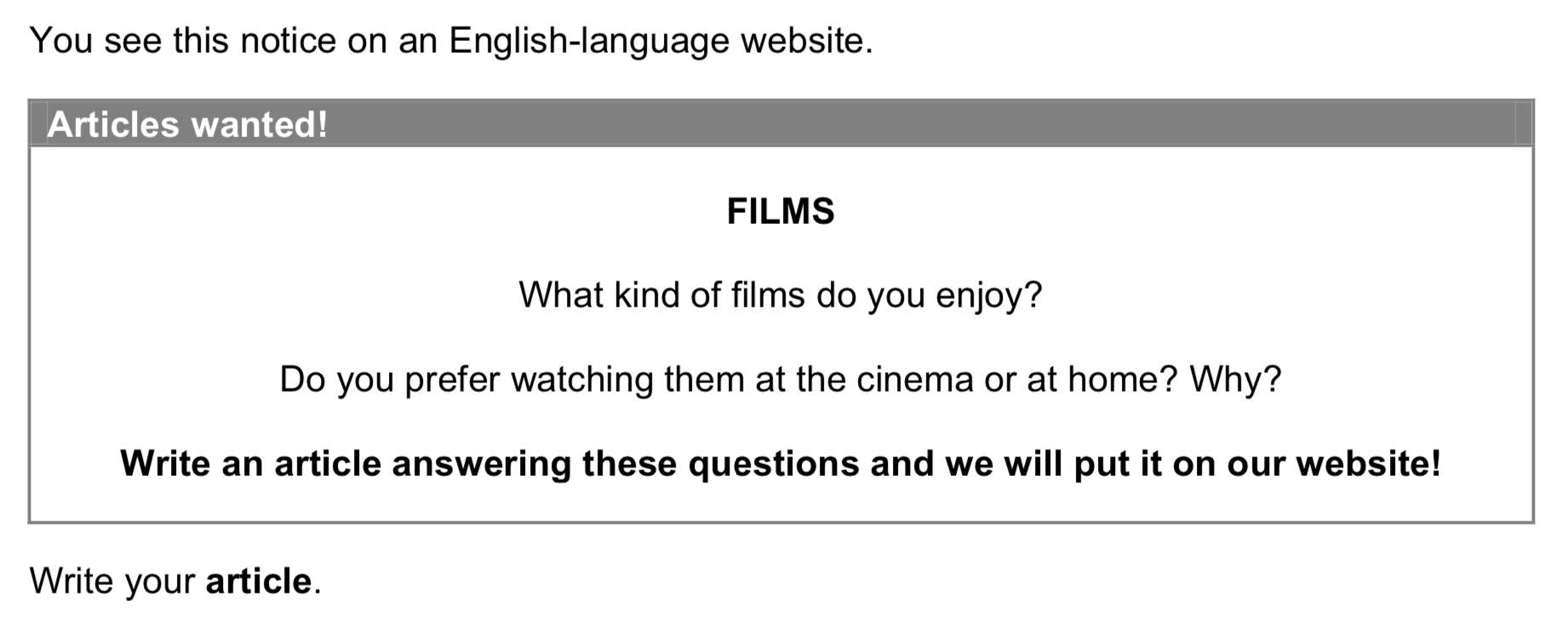
For this particular part, you need to write an article about the type of films you like to watch, also talking about whether you prefer watching them at home or at the cinema. As you can see, it is not a very complex theme.
Structure of a B1 article
If there is something important in any Writing, regardless of the level, it is that its structure is well defined, both semantically and grammatically, as well as visually. At least, as a teacher and examiner trainer for Cambridge, I consider this essential.
In general, an article should always have the following parts:
- Title
- Introduction
- Development of idea 1
- Development of idea 2 (if any)
- Conclusion/Recommendation/Closure
In fact, this type of structure is repeated in many types of Writings at higher levels, with some slight changes, of course.
Example of an Article for the PET Writing
Now that we know what an article is and how its structure should be, let’s look at an example written by me of a B1 level article with an appropriate structure, taking into account the previous task:
- It is for an English website.
- We need to say what type of films we like.
- If we prefer to watch them at the cinema or at home.
Here we go:
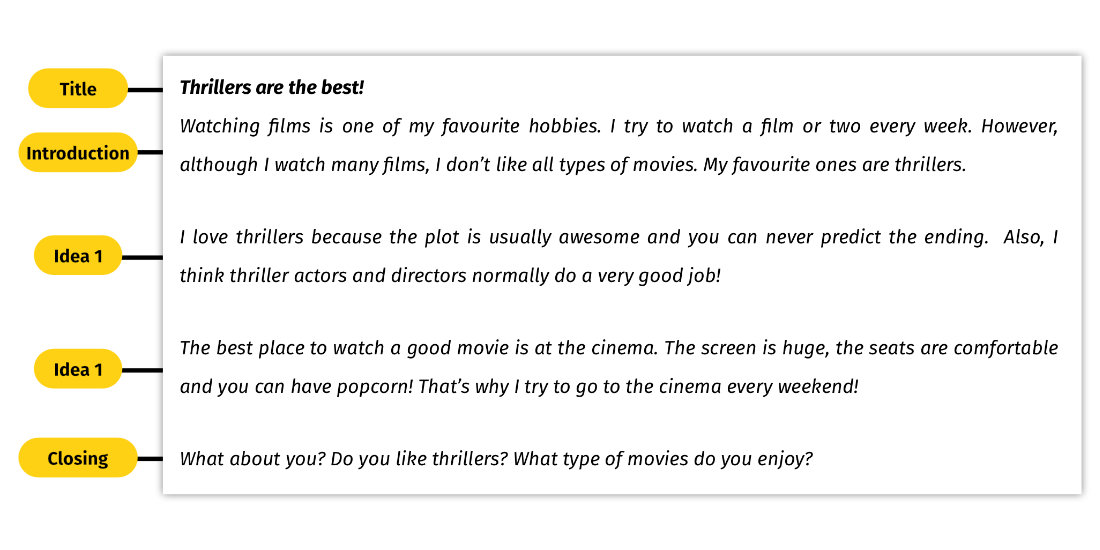
In this example, it is clear how the article is divided. Note, I chose to structure it this way, but it is by no means the only correct way. In fact, notice that the conclusion is simply a series of questions in one line. That is risky, but as this is for a website and is an article (a post, so to speak), I thought it was normal to have a comments section, so I found it appropriate to finish the article by throwing a question at the reader. This is something I would genuinely recommend.
Expressions to use in any B1 article
Next, I am going to give you a series of expressions that might be useful for writing an article for the PET. Obviously, there are many more, and it is impossible to list them all, but I will make a selection of some that I think are especially useful.
To start an article
- Have you ever…?
- Do you ever wonder…?
- What do you think about…?
- Are you one of those people who…?
To introduce and separate ideas
- First,
- In the first place,
- Second,
- Finally,
- As for,
- In addition,
- Moreover,
- However,
To engage the reader
To engage the reader, there are countless strategies, but among them, we can highlight the use of exclamations and questions, as well as the way to address the reader in the second person and even with imperatives. Let’s look at some examples
- Don’t worry! (exclamation, imperative)
- Keep on reading! (exclamation, imperative)
- Imagine that… (imperative)
- What about you? (second person question)
- Isn’t that great? (question)
To conclude
- In conclusion,
- To sum up,
- On the whole,
The idea of this type of expression list is for you to make your own list with expressions that sound good and make sense to you. This way, you’ll improve your writing and gain more confidence when tackling the PET Writing.
Another example of an article for the PET Writing
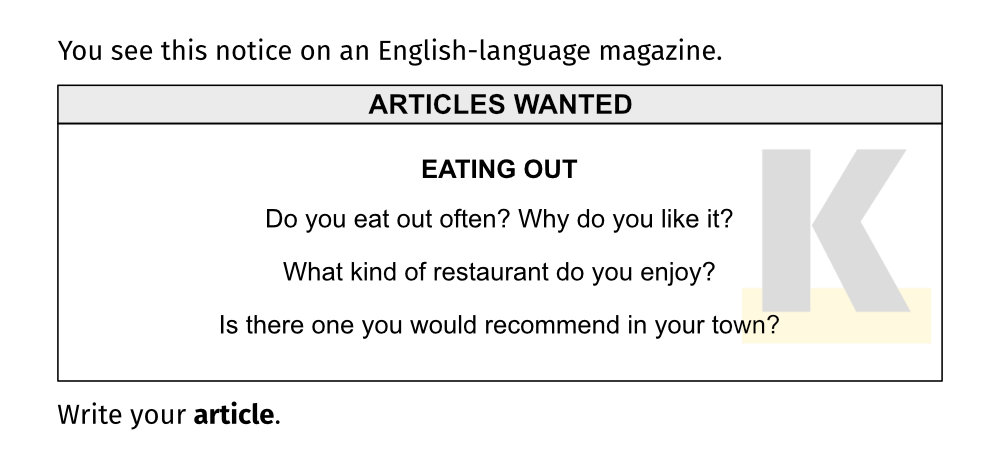
Now, to wrap up this post, let’s look at another task example and a response example, but this time with a different theme: eating out. I hope you find it useful.
Don’t you enjoy eating out?
Do you ever get tired of laying the table? Do you enjoy washing the dishes? I really don’t. That’s why I believe eating out is great.
I know that eating out is expensive, but do it a couple of times a week. Instead of spending money in nightclubs or clothes, I’d rather spend money in a good restaurant, because the food is nice and it’s convenient.
My favourite restaurants are usually Italian (I love pasta!), but my favourite restaurant in my city is a Japanese restaurant called «Kirin». They serve the best sushi!
If you’re ever in my city, I recommend you go to Kirin or any of the Italian restaurants in the centre. You won’t regret it!
Notice that this article covers all the points requested in the task:
- Eating out often and why
- Type of restaurant
- Favourite restaurant and recommendation
So that’s basically what you need to do in any article you write for B1.
5 tips for the PET B1 Writing article
- Memorise and use some expressions. Before you sit for the exam, make sure you know some expressions by heart and that you can use them in your articles. This way, you will make fewer mistakes and your article will be better. Moreover, if you can, use specific vocabulary related to the theme.
- Write a well-structured and visually appealing article. One of the things that examiners will pay attention to is the organisation of your article, so try not to make it incoherent or visually organised as one large paragraph. That is always a bad idea. Remember: one idea per paragraph.
- Think and take notes before writing. Before you start writing the article, jot down some ideas about what you are going to write. You can also write specific vocabulary you want to use in each paragraph, grammatical structures, connectors, etc.
- Review, edit, and improve. Don’t write the whole article at once and then switch to something else. When you think you have finished your article, make sure to review it properly and look for errors and ways to improve it (adding adjectives, etc.). This is a very simple way to avoid losing points unnecessarily.
- Experiment at home, not in the exam, and practice a lot. Homework is the best opportunity to get creative and take risks with certain expressions and structures. Make sure to try to improve as much as possible with your teacher, so that when you go to the exam, you don’t have to take risks with new words or expressions. So in the exam, use what you are sure of.
So, how was that? Did you find this post about how to write an article useful? I think I’ve done a good job explaining it to you, to be honest. 😅 If you agree with me, feel free to comment and let me know what you think. And if you like KSE Academy, follow me on Facebook, Twitter, or YouTube, and don’t miss anything I publish.
Oh, and don’t forget to keep smiling!