
Writing B1 Preliminary (PET): Complete Guide and Examples [Updated 2025]
If you still don’t quite know what the B1 Preliminary Writing is like, read this post. I’ll explain everything you need to know about the Writing section of the PET, with examples and all!

Table of contents
The B1 Preliminary (PET) is currently the most popular exam from Cambridge Assessment English in Spain. As you may know, the B1 Writing of the PET is only one of the four parts of the B1 Preliminary exam, previously known as PET. This B1 exam consists of four distinct parts: Reading, Writing, Listening, and Speaking. In today’s post, I will focus on what the Writing of Cambridge B1 is like, since in my experience as a Cambridge Assessment English exam trainer, the Writing of the B1 Preliminary (PET) is one of the easiest parts to master ahead of the exam in relatively little time. So pay attention, because if you want to pass the PET, it is advisable to score the maximum mark in the B1 Preliminary Writing.
Writing B1: what is the level
As the name of the exam indicates, B1 Preliminary, this exam from Cambridge Assessment English expects an intermediate level, as defined by the Common European Framework of Reference for Languages (CEFR). According to the CEFR, commonly known as the Reference Framework (RF), a candidate at the B1 level in their Writing:
Is capable of producing simple and coherent texts on familiar topics or topics of personal interest.
If we look more closely at the section on written expression, we can see that the RF specifies that a student with a B1 level:
- In general:
Writes simple and cohesive texts on a variety of everyday topics within their field of interest linking a series of different brief elements in a linear sequence.
- In creative writing:
– Writes simple and detailed descriptions about a variety of everyday topics within their specialty.
– Writes accounts of experiences describing feelings and reactions in simple and structured texts.
– Is capable of writing a description of a specific event, a recent trip, whether real or imagined.
– Can narrate a story.
- In report writing and essays:
– Writes short and simple essays on topics of interest.
– Is able to summarise, convey, and offer their opinion with some confidence on specific facts relating to everyday matters, whether common or not, relevant to their specialty.
– Is capable of writing very brief reports in a conventional format with information on common events and the reasons for certain actions.
As you can see, a B1 Writing should not be too complicated to carry out, but everything is relative, of course.
Now that we know the level a B1 Writing should have, let’s move on to see what the Writing of B1 Preliminary looks like, and let’s look at some examples of Writing exercises for the PET taken from the Cambridge Assessment English website itself.
What is the B1 Preliminary Writing like
In the Writing section of the PET, candidates must complete two parts, which must be completed in a total of 45 minutes. Both parts are more or less traditional writing tasks, as you can see below:
- Writing Part 1: Email
- Writing Part 2: Article or story
With these tasks, you are expected to demonstrate a B1 level through the use of grammatical and lexical structures typical of a B1 Writing.
Next, we will look at the two parts that make up the Writing of the B1 Preliminary (PET).
Types of B1 Writing
Writing B1 Preliminary: Part 1 – Email
In the first part of this Writing exam, you have to write an email of around 100 words. And what does «around 100 words» mean? Well, what I recommend to my students is that «around» means plus or minus 20 words, that is, between 80 and 120 words, but you really shouldn’t worry about that. What you have to do is:
- Respond to an email with some notes that you supposedly made yourself.
- Word count: 100
To write an email in your B1 exam, it is important that you are familiar with the type of task you will encounter. Therefore, let’s now look at an example task to see what the instructions are like for a email for the PET version 2020.
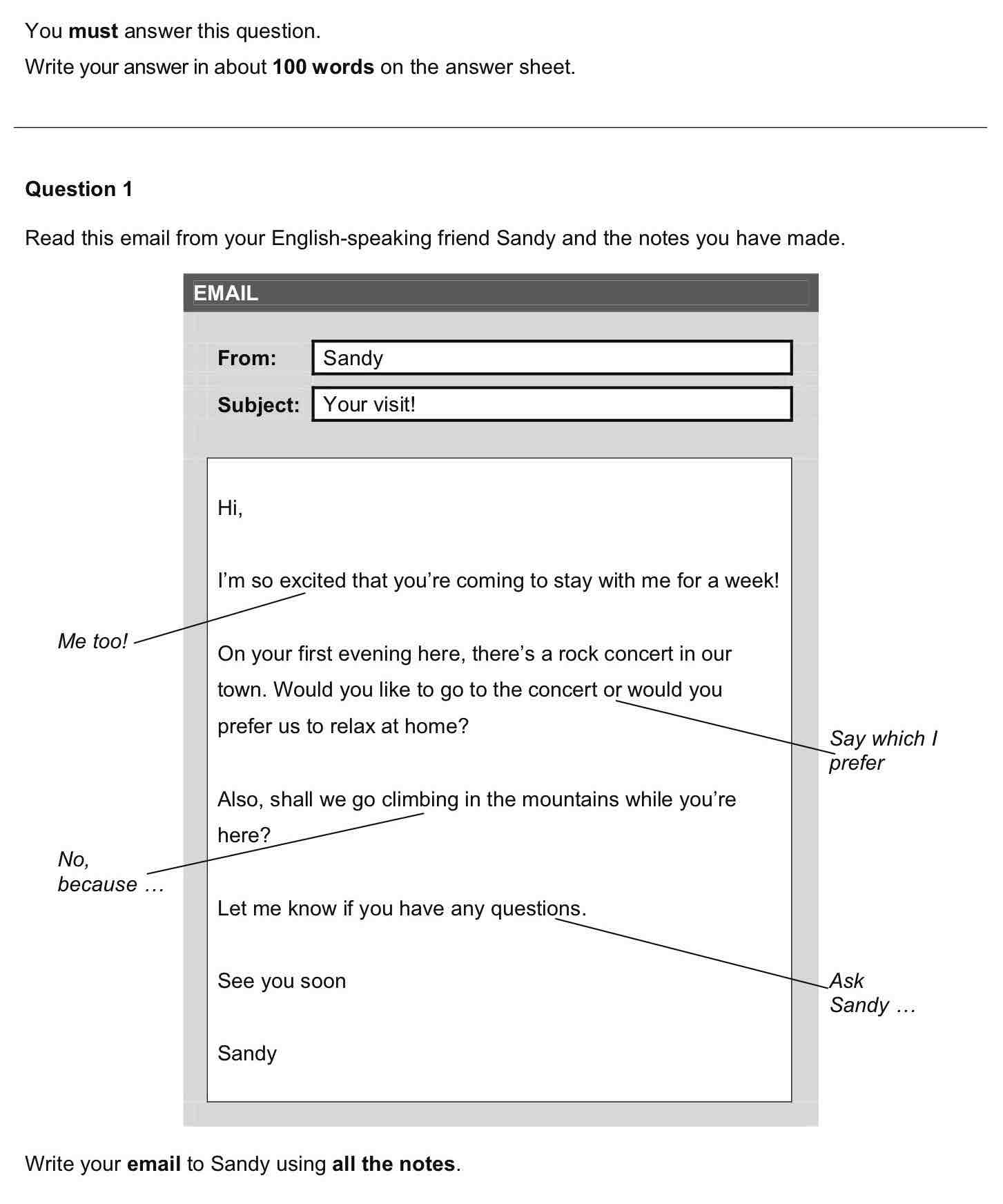
If we look at this type of task, we can highlight the following aspects:
- At B1 level, they will always ask you to write to a friend or relative, so this is an informal email, which means you don’t have to worry about making your email sound formal or anything like that.
- The notes tell us what we have to do/say (Say which I prefer…, Ask Sandy…, etc.), so it is impossible for us not to know what to say in our email. However, it is advisable to say all of that using different words whenever possible.
- It is necessary to respond to all the notes (Write your email to Sandy using all the notes.)
Great. Later we will see an example of a response to this task.
For now, let’s move on to the second part of the Writing of the B1 Preliminary, previously known as PET.
Writing B1 Preliminary: Part 2
In this part, as a candidate, you have to write another text of around 100 words, but this time you can choose between two types of Writing:
- Article (article)
- Story (story)
Previously, you had to write a short message, but this is no longer the case. So let’s see a example of each type of Writing for the B1 Preliminary, that is, an example of the prompt for each type of Writing.
Writing B1 Preliminary: Article (Article)
This format is particularly novel in the Writing of the PET, as previously the article was only introduced at B2 level, but since the changes of 2020, the Writing of B1 does include an article as a task option in part 2.
However, you shouldn’t worry about this, as having a new type of Writing does not mean that the level is more difficult, as remember, the PET is a B1 level exam, and that hasn’t changed with the new updates.
But I won’t ramble on, let’s now see what the instructions for the article of the B1 Writing Part 2 are like:
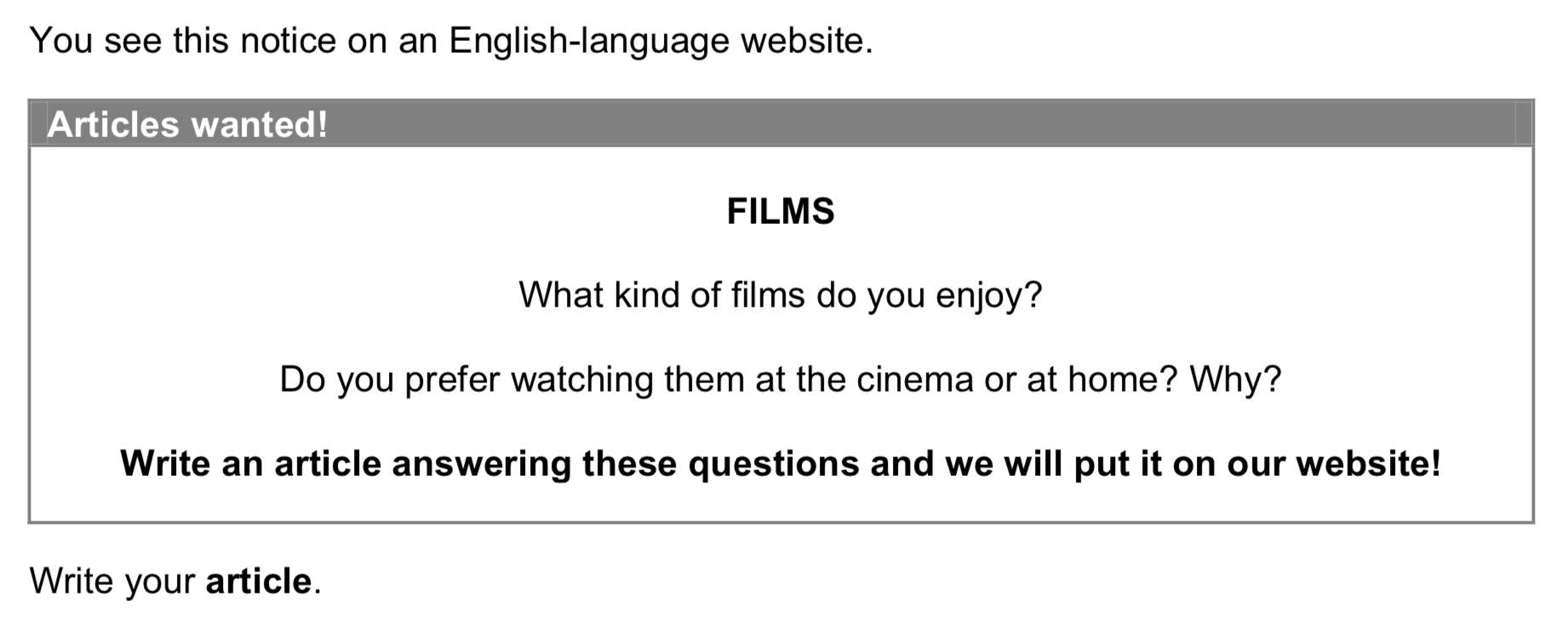
As you can see, the instructions are very clear. In this case, you must respond to an advertisement you saw on a website, and the theme is films. In general, articles will be on themes that allow you to express your opinion, and they won’t be very obscure topics, as at B1, they can’t complicate our lives too much, to be honest.
We will later see an example of a response for this task. For now, let’s look at the last type of Writing for the PET, the story.
Writing B1 Preliminary: Story (Story)
In this case, the Writing must also be around 100 words, but instead of an email or an article, you have to write a story. In my humble opinion, writing a story is more difficult than an article, as preparing the email is easier and, in general, we are more accustomed to writing articles thanks to schools. The story typically requires a greater use of verb tenses and creativity. But obviously, it all depends on you, your skills, and your creativity.
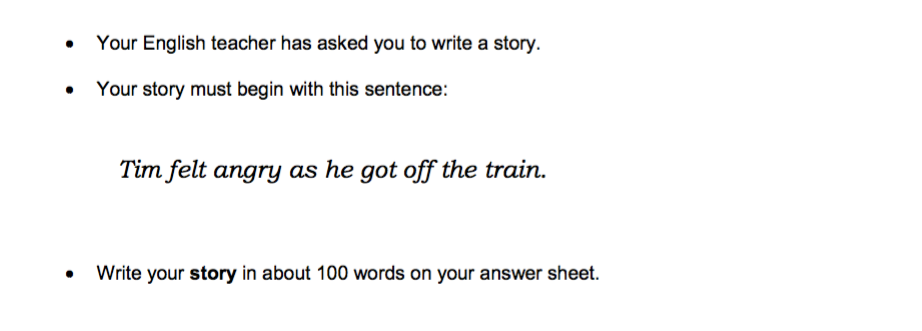
As you can see in this B1 Writing task, they provide you with the first sentence that your text must contain. At other times, they give you the title. And remember, you must include a title (whether they give it to you or not) and the first sentence (if they give it to you, obviously). Many people ask this during exams, so now you know: if you’re going to write the story, include what they give you. 🙂
Examples of Writing B1 Preliminary (PET)
In this section, we’re going to look at a Writing B1 example for each type of Writing. The goal of this section is to familiarise yourself with the different types of Writing and to get a clearer idea of what the examiners expect from you in your B1 exam. Additionally, in the following examples, I try to simulate a rather strong B1 level, so you know what your Writings should aspire to.
Let’s go for it!
Example of Writing B1 Part 1: Email
Below is an example email for the B1 Writing. Specifically, this is a possible response to the task set previously.
Hi Sandy,
Thanks a lot for writing back. I’m also really excited about visiting you!
On my first evening, I’d like to relax at home. I will probably be very tired from the trip, so I need to rest and get ready for the other days. Is that okay?
As for climbing, I’m afraid I can’t. I forgot to tell you, but I hurt my knee last week, so I can’t do sport now.
How about visiting some art galleries in your town? If you want, we could go. You know I love art! What do you think?
Well, I have to go now, but please let me know what you think.
Take care,
Luis
Great. Now we have the email example for the B1 Writing. As you can see, since it’s an email, it has a very well-defined structure:
- Greeting: Hi Sandy,
- Introductory paragraph (Me too): Thanks a lot for writing back.
- Idea 1 (Say which I prefer…): On my first evening,…
- Idea 2 (No because…): As for climbing,…
- Idea 3 (Ask Sandy…): How about visiting…?
- Closing paragraph: Well, I have to go now…
- Farewell: Take care,
- Signature: Luis
The good thing about writing an email for B1 is that all emails can/should follow the same structure. This way, there are certain parts and certain formulas that you can already have prepared from home.
I recommend the following post to learn how to write an email for B1.
Example of Writing B1 Part 2: Article (Article)
Below you have a possible response to the article posed in the previous section. Pay close attention to the organisation, the connectors, and how each paragraph focuses on a particular idea.
Thrillers are the best!
Watching films is one of my favourite hobbies. I try to watch a film or two every week. However, although I watch many films, I don’t like all types of movies. My favourite ones are thrillers.I love thrillers because the plot is usually awesome and you can never predict the ending. Also, I think thriller actors and directors normally do a very good job!
The best place to watch a good movie is at the cinema. The screen is huge, the seats are comfortable and you can have popcorn! That’s why I try to go to the cinema every weekend!
What about you? Do you like thrillers? What type of movies do you enjoy?
If you look closely, each paragraph focuses on one of the ideas posed in the task:
- Introduction: Introduction for What kind of films do you enjoy?
- 2nd paragraph: Development of What kind of films do you enjoy?
- 3rd paragraph: Do you prefer to watch them at the cinema or at home? Why?
- Last paragraph: I ask a question to the reader, since it is a website where they can likely leave comments.
Example of Writing B1 Part 2: Story (Story)
The Broken Train
Tim felt angry as he got off the train. The train had broken down and they had stopped in the middle of the countryside.
Everyone was getting off the train, speaking to each other. But Tim was tired and he didn’t want to talk much. So he sat under a tree and decided to take a nap. Tim was sleeping when, without a warning, he heard the sound of a train moving. All of a sudden, Tim woke up and saw the train moving away. He shouted, “Stop the train, please!”, but nobody heard him. And although he ran and ran, Tim couldn’t reach the train.
In the end, he gave up running and called his parents, who picked him up a few hours later.
If you pay attention to this story for B1, you will see that it has three well-defined paragraphs, a variety of verb tenses (was tired, didn’t want, was getting off, was sleeping, had broken, had stopped, etc.), time expressions (In the end, when, a few hours later) and expressions to create suspense (all of a sudden, without a warning). These are the elements that will make a story good or not, which is why I think that, in general, they are more difficult to write than emails.
Click here to know how to write a story for B1.
Now that we perfectly understand each part of the PET Writing, let’s see how this part of the B1 exam is assessed.
Writing B1 Preliminary (PET): how is it assessed
All the Writings of the PET are evaluated based on four fundamental assessment criteria. These are: Content, Communicative Achievement, Organisation, and Language. Let’s see what each of these criteria consists of:
- Content: This refers to how well you have completed the task, that is, whether you have done what was asked. In this sense, it is important that you respond to each point proposed in each exercise and that the information you write thoroughly covers each point and the task as a whole.
- Communicative Achievement: This criterion focuses on how appropriate your Writing is concerning the proposed exercise. In this sense, both style and register with which you have written become particularly relevant. At B1 level it is important that you write with familiar language, as you will be communicating with a family member or friend.
- Organisation: Is your writing logical and well structured? Perfect. In that case, you will score well in this section. In general, any Writing has to have coherently interconnected paragraphs, with well-cohesive sentences that offer a logical progression and are easy to understand. To do this, you must use a series of B1 connectors.
- Language: This criterion clearly addresses whether your grammar and vocabulary are at B1 level and that you do not make too many linguistic errors.
Tips for the B1 Preliminary Writing
As with every part of the B1 Preliminary (PET), there are a number of strategies you can undertake to ensure that your Writing meets the level expected by examiners. In general, I always recommend the following, regardless of what type of Writing it is:
- Make an outline before writing. It’s a good idea to make notes before starting to write to know how you will organise your Writing. This way, you will avoid exceeding the word count (although this isn’t very important), and you won’t leave any of the main ideas out.
- Write a draft and improve it until you reach the final version. Writing everything perfectly from the start is very difficult. Therefore, you should write a first draft, which you then need to rewrite and modify until it is perfect. This way, you will improve various aspects of the text such as vocabulary and grammar.
- Clearly define the paragraphs of each Writing. Although it may seem trivial, defining paragraphs makes your Writing, besides organised, visually attractive, which will leave a good impression on the reader, who in this case is an examiner, hehe.
- Write knowledgeably. You are in an English exam where you should demonstrate everything you know. Therefore, when writing, try to show off by using certain structures intentionally. Try to include a conditional sentence, a comparative, or something similar. This way, you will stand out more, and the examiners will notice that.
- Review before finalising it. Never submit a Writing exercise without reviewing it first. Read it when you finish, trying to look for possible typos, spelling mistakes, agreement errors, etc. Just by reviewing, you will avoid silly and common mistakes that could negatively affect your score.
Great, I think you should now have a much clearer idea of what the Writing of the B1 Preliminary is like. Nevertheless, if you still have any doubts, leave me a comment and ask me anything you want, that’s what I’m here for, to help you.
And in the meantime, don’t forget to keep smiling! 😀