
Speaking B1 Preliminary (PET): Complete Guide with Examples [Updated 2026]
If you still don’t know what the Speaking B1 Preliminary (PET) is like, don’t miss this post. Here, I will explain absolutely EVERYTHING about the Speaking part of the PET from Cambridge.

Luis Porras Wadley
Published on 28/04/25
Updated on 18/02/26
Book recommendation
Speaking B1: The Ultimate PET Speaking Guide for B1 Cambridge
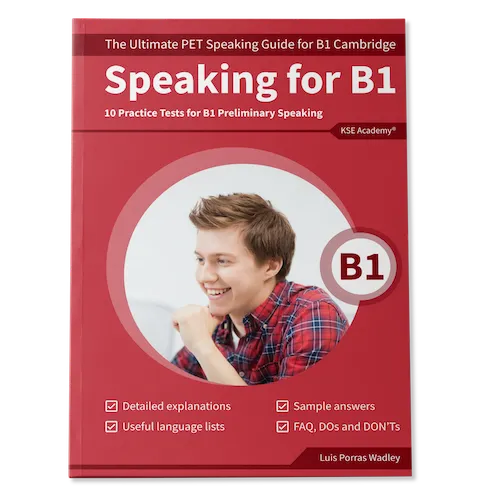
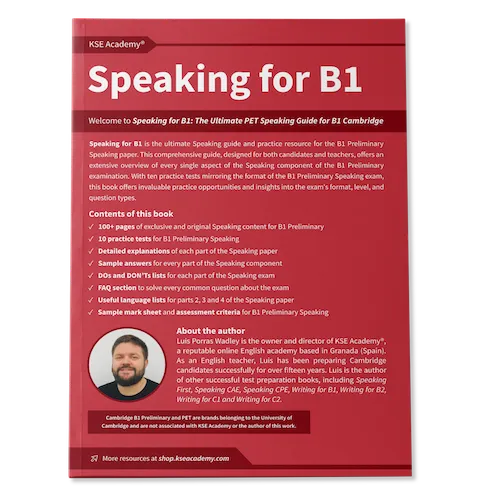
Table of contents
Book recommendation
Speaking B1: The Ultimate PET Speaking Guide for B1 Cambridge
The Speaking of the B1 Preliminary (PET) is the Speaking exam of the B1 level Cambridge English test. It is one of the 4 parts that make up the exam formerly known as the Preliminary English Test (PET). Since the Speaking exams, and in this case the Speaking of the PET, is one of the parts that scares candidates the most, I will explain in this post exactly what the Speaking of the B1 Cambridge entails, how each part works, and I will provide you with tips on how to tackle the exam itself. Oh, and I almost forgot, this post is for the oral exam of the B1 Preliminary (PET) updated to 2020.
Speaking B1: What is B1 Level
As is customary on this website, before I start looking at how each part works, I always try to define exactly what is expected of the candidate when taking the exam. In this case, I want you to understand what is expected of a candidate taking a B1 Speaking exam. And for that, we need to consult the Common European Framework of Reference for Languages (CEFR), which defines not only what the B1 level involves but also what is expected of a speaker with a B1 Speaking level.
Let’s see what the CEFR states generally and specifically about oral expression:
- In general:
– Can carry out, with reasonable fluency, a simple description of a variety of topics that are of interest to them, presenting them as a linear sequence of elements.
Common European Framework of Reference for Languages, p. 62
- In monologues:
– Provides simple descriptions about a variety of everyday matters within their specialty.
Common European Framework of Reference for Languages, p. 62-63
– Narrates or describes simple experiences following a linear sequence of elements with reasonable fluency. Gives detailed accounts of experiences, describing feelings and reactions.
– Relates details of unpredictable events, such as an accident.
– Relates plots of books or films and describes their reactions.
– Describes dreams, hopes, and ambitions.
– Describes real or imagined facts.
– Narrates stories.
– Develops arguments well enough that the majority can be understood without difficulty.
– Offers brief reasoning and explanations for opinions, plans, and actions.
- In public statements:
– Is capable of making short prepared statements on a relevant topic within their specialty that are clearly intelligible, even though accompanied by an unmistakably foreign accent and intonation.
Common European Framework of Reference for Languages, p. 63
- When speaking in public:
– Is able to make a brief prepared presentation on a topic within their specialty with sufficient clarity that the main ideas can generally be followed without difficulty, and whose main ideas are explained with reasonable accuracy.
Common European Framework of Reference for Languages, p. 64
– Is able to respond to follow-up questions, but may need to ask for them to be repeated if spoken quickly.
As you can see from reading the official descriptors of the CEFR, a B1 level in terms of speaking is an intermediate level for handling everyday situations. Therefore, the descriptors highlight words like «simple», «interest», «brief», «prepared», «practised», «reasonable», etc. These terms simply serve to emphasise that the B1 English level is an intermediate level and that, at an oral level, it is sufficient to get by in situations with native speakers.
I will now describe the Speaking of the B1 Preliminary from 2020, as the exam has recently changed slightly.
How the Speaking B1 Preliminary (2020 Model) Works
The Speaking of the B1 consists of 4 parts, which differ according to the type of tasks candidates have to complete and the type of speaking skills they must demonstrate. Generally and similarly to other Cambridge exams, the Speaking of the PET has the following characteristics:
- It lasts 10-12 minutes.
- It consists of 4 parts.
- It is conducted in pairs.
- It is evaluated by two oral examiners.
- During the exam, candidates must interact with another candidate and with one of the examiners, the Interlocutor.
- The other examiner (Assessor) does not speak; they simply evaluate.
Knowing these general characteristics, which are common to most exams from Cambridge English, let us now look at each part of the exam individually.
PET Speaking: Part 1
The first part of the B1 Speaking is individual and consists of a series of personal questions for candidates to introduce themselves and talk a little about themselves and their background. Among other things, you will need to specify your name, surname, origin, what you do for a living, etc.
This part of the Speaking, which lasts 2-3 minutes, is divided into two phases. The first phase is always the same, and they ask the following:
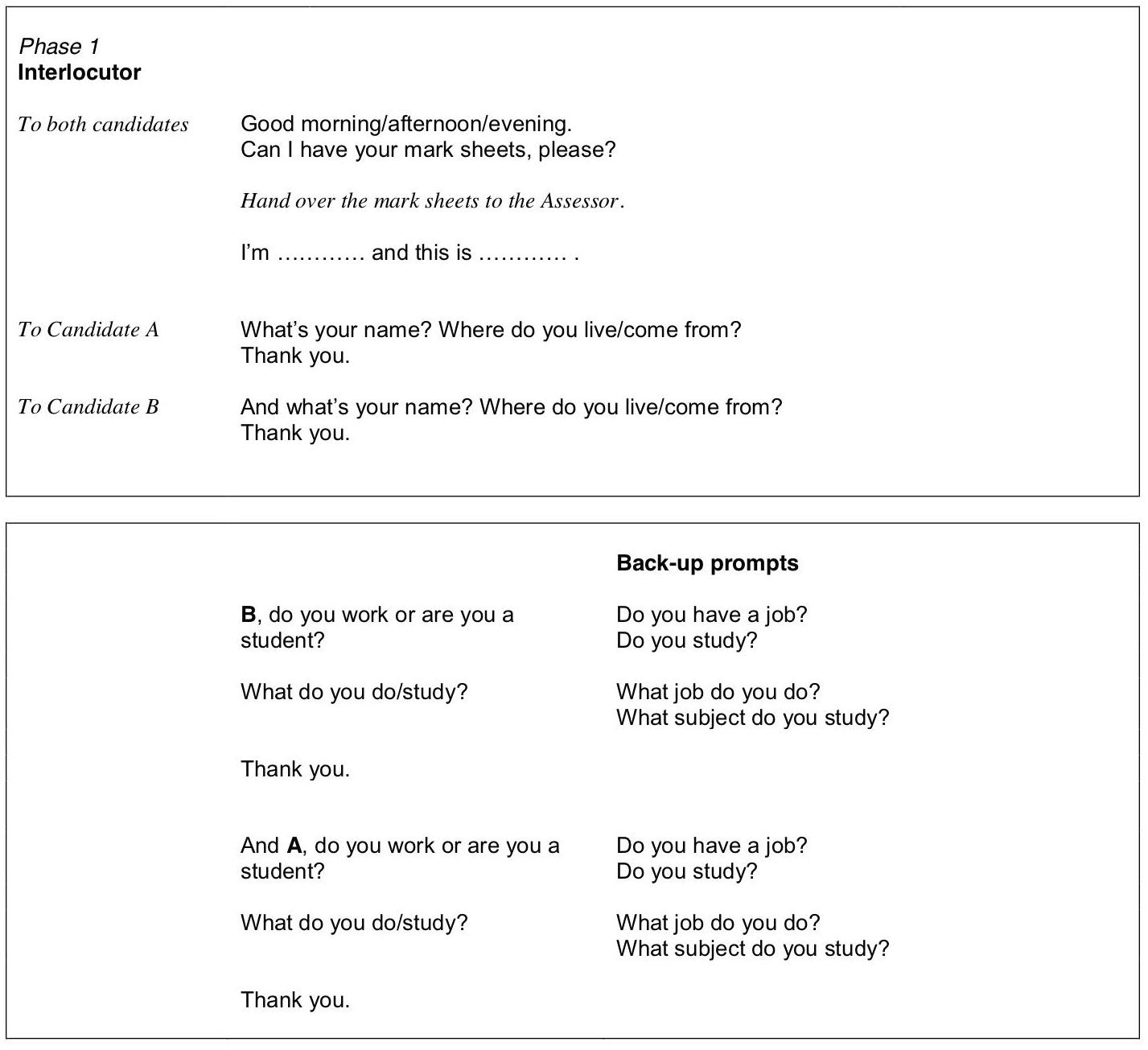
As you can see, the Interlocutor greets you, asks for the mark sheets, and then:
- introduces themselves,
- introduces their partner (the Assessor),
- and starts asking questions.
The good thing about this part of the Speaking exam is that it is always the same, so you will know exactly what to expect and can have your answers more or less prepared, although I recommend that it be «more or less», since if you have them 100% prepared and have memorised a paragraph, it will sound extremely artificial and could even be negative for your score.
After Phase 1, we move on to the second phase of part 1, which consists of a series of more varied questions about your hobbies, customs, experiences, preferences, etc. Let’s see an example:
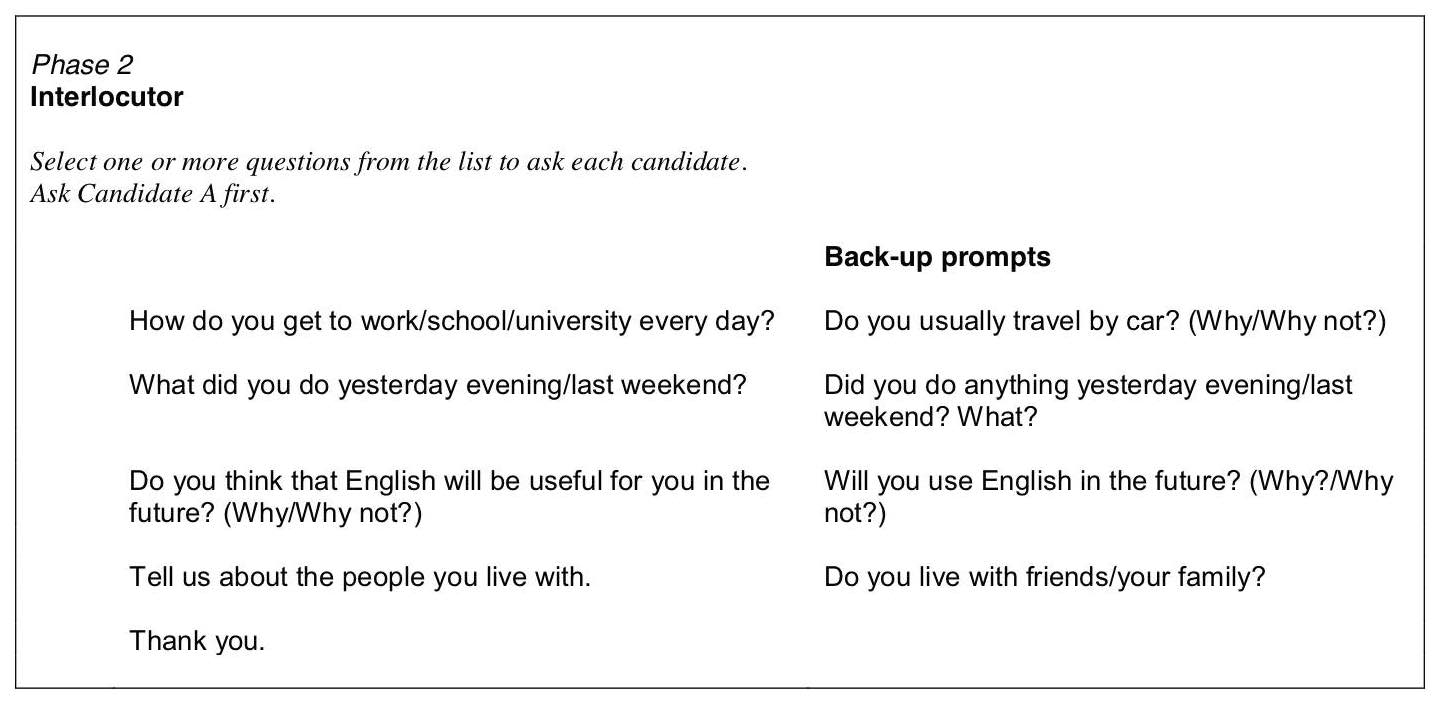
The questions here are a little more random, but the goal remains that you talk about yourself, your likes, your plans, your experiences, etc.
PET Speaking: Part 2
Part 2 of the B1 Speaking is also individual and lasts for 2-3 minutes. In this part, each candidate will have to describe an image in approximately 1 minute. The images for both candidates are of different themes, and at no time will the candidates have to interact.
Let’s look at an example of instructions and an image to describe for Candidate A:
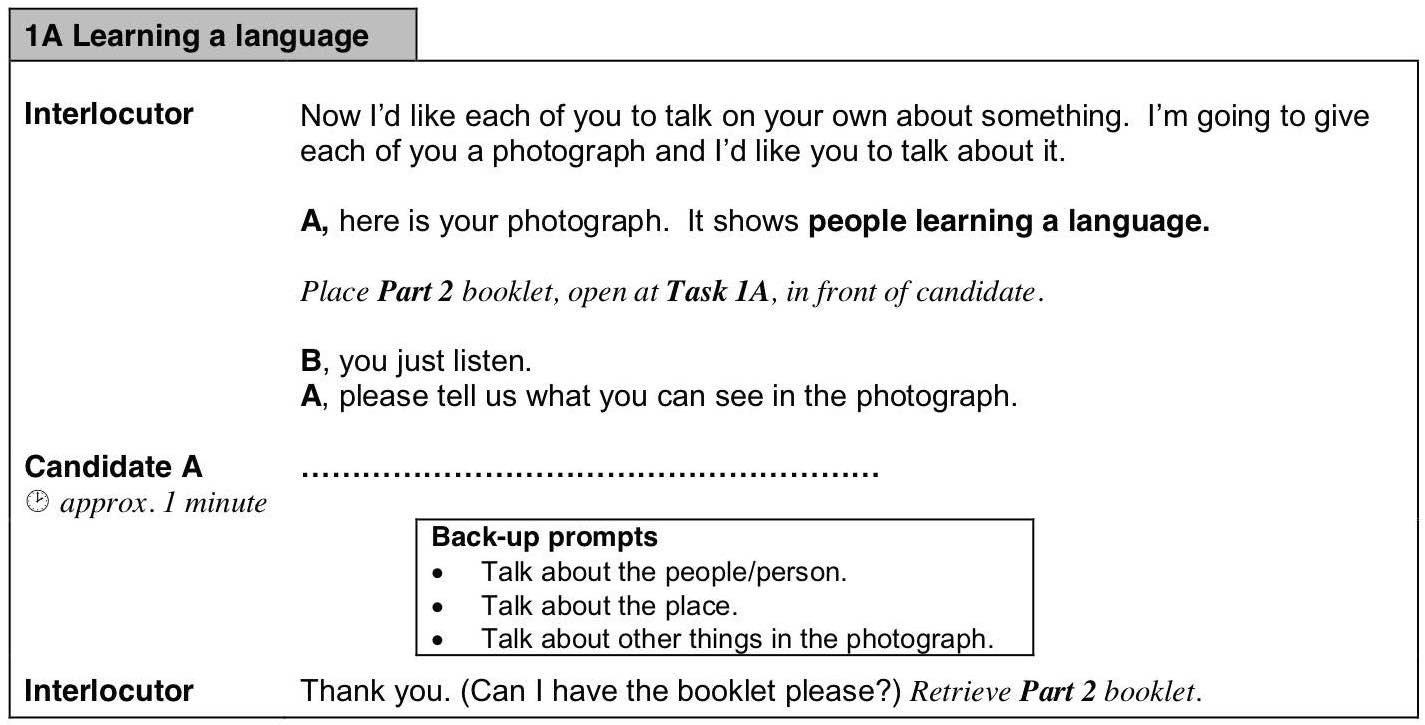

The goal of this part is to be able to describe what is happening in an image without having to speculate too much about the situation and without having to think too hard to produce the necessary language. For this reason, all the images show everyday situations in which a candidate with a B1 level should be able to cope.
PET Speaking: Part 3
The third part of the B1 Speaking consists of a conversation between the candidates to try to reach a conclusion. The conversation is preceded by instructions from the Interlocutor and will be based on a series of images that provide ideas for conversation about the given theme.
The dynamics for this task are as follows:
- The Interlocutor gives the instructions.
- The candidates talk for 2-3 minutes.
- The Interlocutor interrupts (if necessary) to end this part.
Now, let’s example how the interlocutor’s instructions are structured and what the images accompanying this activity look like.

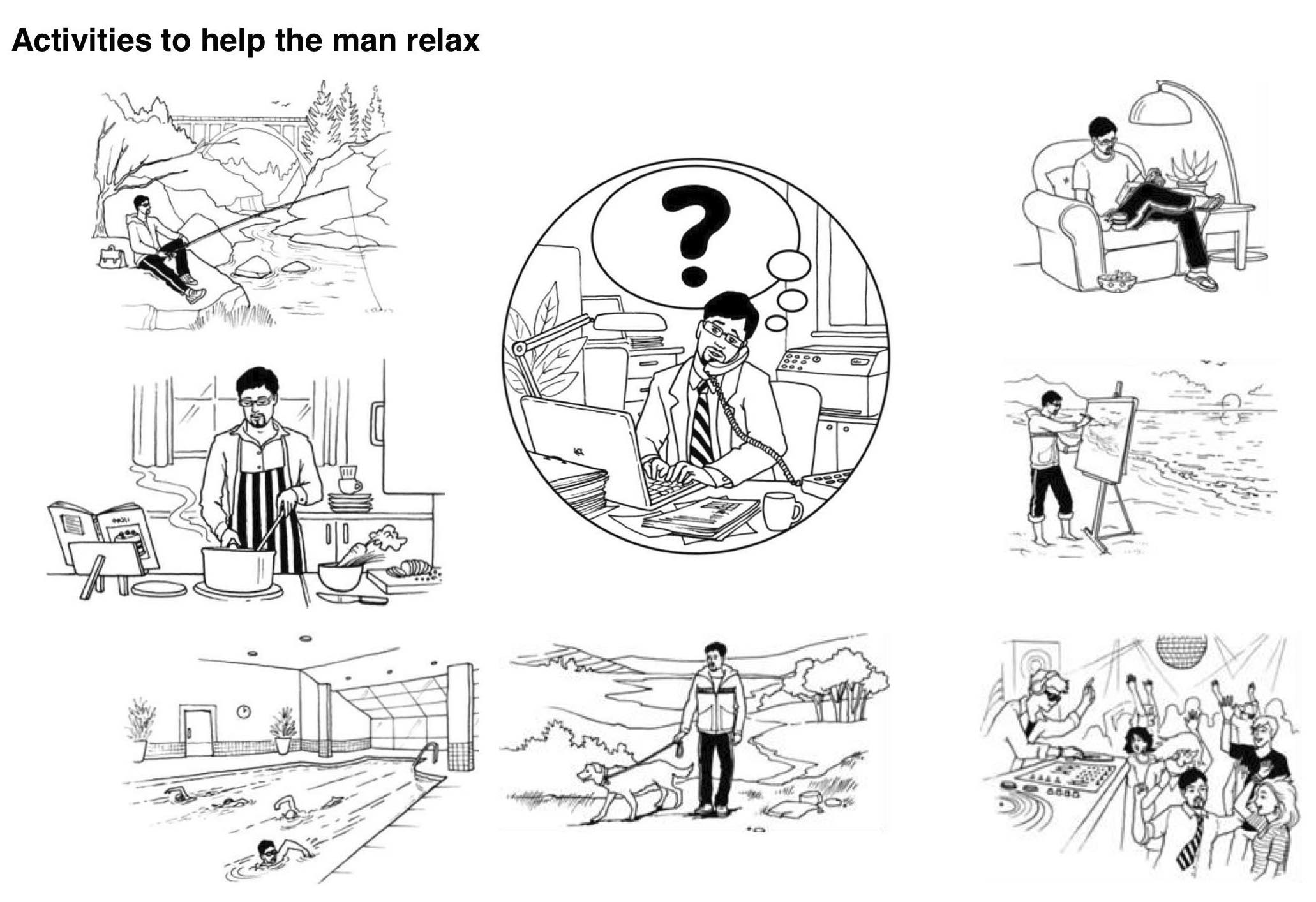
As you can read in the instructions, this part involves you talking together, meaning there should be interaction and communication between your partner and you. Therefore, it is very important that there aren’t very long turns and that the conversation does not turn into just two independent monologues.
Now let’s move on to the fourth part of the Speaking of the B1 Preliminary.
PET Speaking: Part 4
Finally, part 4 consists of a series of questions that the interlocutor asks the candidates, which are related to the theme of part 3. These questions may be directed to an individual candidate or to both, allowing for a natural conversation to establish between the two.
Let’s see the questions from part 4 that accompany part 3 of the B1 Preliminary Speaking exam.
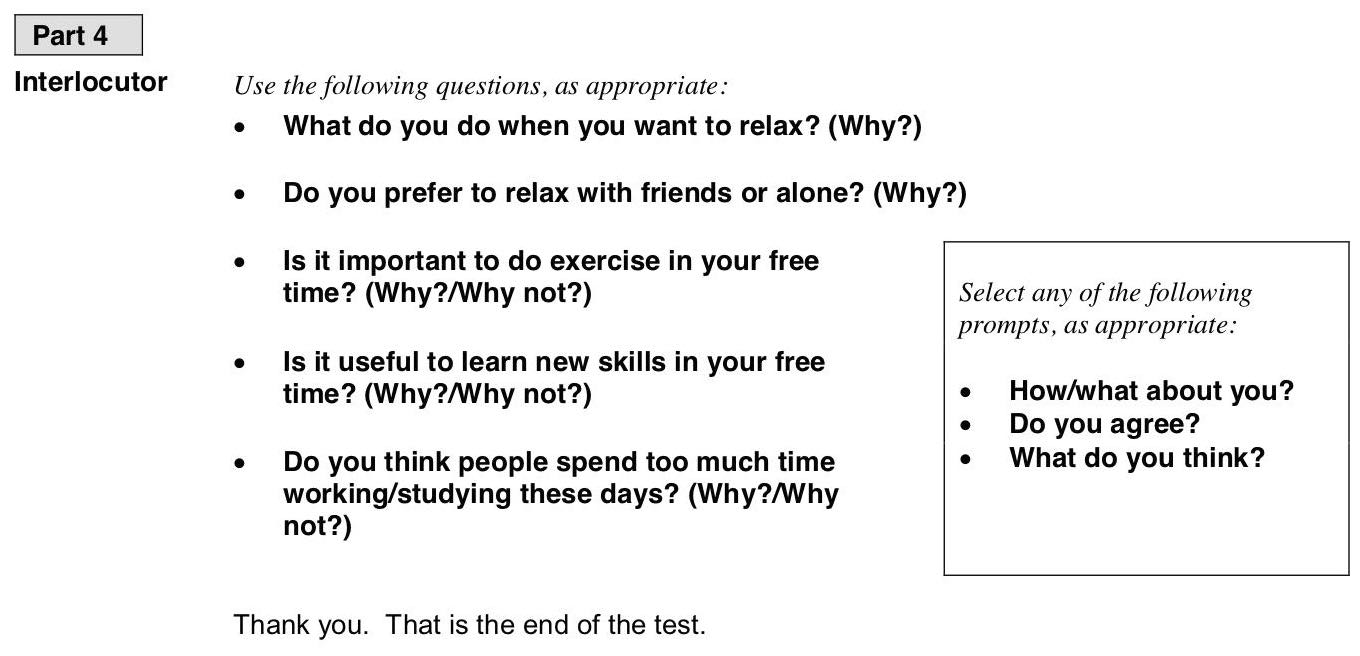
As you can deduce from seeing the questions in this part, it starts off with the same theme as part 3 (What do you do when you want to relax?) and then moves on to other questions that drift a little further away (Is it useful to learn new skills in your free time?).
Examples of Speaking B1 Preliminary (PET)
Now that you know the details of each part of the Cambridge B1 Speaking, it’s useful to see examples of exam responses to get a clearer idea of what is expected from a candidate when completing these types of tasks.
Given that parts 1 and 4 must be spontaneous, and there is no single correct way to answer a simple question, I will only focus on parts 2 and 3 to show you strategies and expressions to tackle these two parts.
Example of Speaking B1 Preliminary (PET): Part 2
In this section, we will see what the instructions for the new Speaking Part 2 of the PET look like, along with a model response example for you to learn a way to do it.
- Initial instructions from the examiner for Candidate A:
Now I’d like each of you to talk on your own about something. I’m going to give each of you a photograph, and I’d like you to talk about it.
Candidate A, here is your photograph. It shows people learning a language.
(holds the following image in front of candidate A)
Candidate B, you just listen.
Candidate A, please tell us what you can see in the photograph.
- Example response from Candidate A:
In this picture, I can see a group of people studying at the library. I think they’re in a college library because there are many bookshelves and a lot of books behind them. They are all good-looking, young people, probably university students, and they are sitting around a wooden table.
There are two women and a man, and I can see that they are all writing something in their notebooks. They might be doing some difficult language exercises. Moreover, they seem to be using some tablets, which are on the table, in front of them.
The man on the left has short brown hair and is wearing a shirt. The woman in the middle has long blonde hair and is wearing a hoodie; and the woman on the right has red hair and is wearing a nice blue jumper.
After about a minute, the examiner would say:
Thank you. (Can I have the booklet, please?)
After this, the process is repeated with Candidate B. As you can see, this part of the Speaking exam has a very simple dynamic. And, even though you might think otherwise, a minute goes by quickly, and if you have practised well, you shouldn’t have any problems filling it with things to say about an image.
Speaking B1: Useful Expressions for Describing Images
As you saw in the description of the previous section, I highlighted a series of expressions. These types of expressions are very useful when describing a photo. So now I will provide you with a summary of useful expressions that you can use in the Speaking of the PET.
Expressions for Starting a Description
- In this picture, I can see a group of people…
- In this picture, there are some people…
- This picture shows a couple/woman/man…
Expressions for Speculating
- I think…
- I believe…
- I suppose…
- They seem to be…
- He/she seems to be…
- Maybe they are…
- Probably, he/she/it is…
- They might be…
- Etc.
Expressions for Describing People’s Posture
- they are sitting
- they are standing
- they are lying down
Expressions for Describing the Position of Things and People
- On the left/right…
- In the middle/centre…
- At the top/bottom…
- In the background/foreground…
- In front of…/Behind…
- On…
- Under…
Basic Connectors
- because
- Also
- Moreover
- but
- However
Tips for the B1 Preliminary Speaking (PET) Part 2
Now let’s look at a series of tips for the Cambridge B1 Speaking, to avoid making basic mistakes that could penalise you or lead to a poor exam outcome.
- Always use the same structure for your description. By doing this, it will be much easier for you to automate certain processes and linguistic structures to describe new images.
- Speak until the examiner interrupts you. One of the fears of many candidates is that the interlocutor will cut them off. However, it’s not a problem, as it’s simply the examiner’s job to ensure that you both speak for about a minute, neither more nor less, to make it fair for everyone. What you should aim for is to have given a complete description by the time the examiner interrupts you.
- Don’t ramble. Don’t go off on tangents that are not shown in the image. You can speculate about why something is in the image (Example: I think they are in a library because I can see many books and bookshelves in the background.), but don’t start talking about yourself or your experiences while describing the image, as that is not what you’ve been asked to do.
- Don’t leave sentences unfinished; always try to complete your sentences.
- If you didn’t fully understand the task, ask the examiner to repeat the instructions. There’s no problem with this, and you won’t be penalised for it.
- Try to use relevant vocabulary pertaining to the theme of the image, and be quite descriptive, using appropriate vocabulary and adjectives.
- Smile if possible. A smile and a positive attitude are always more pleasant and give the impression that you are more communicative.
Now let’s see how to tackle part 3 of the PET Speaking.
Example of Speaking B1 Preliminary (PET): Part 3
In this section, we will see how the instructions for the new Speaking Part 3 of the B1 Preliminary are structured, along with an example of the conversation between two candidates.
- Instructions from the interlocutor for both candidates:
Now, in this part of the test, you’re going to talk about something together for about two minutes. I’m going to describe a situation to you.
(holds the following image in front of the candidates)
A young man works very hard and has only one free day a week. He wants to find an activity to help him relax.
Here are some activities that could help him relax.
Talk together about the different activities he could do, and say which would be most relaxing.
All right? Now, talk together.
- Example conversation between Candidate A and Candidate B:
– Candidate A: Shall I start?
– Candidate B: Of course, yes.
– Candidate A: Well, I think going fishing might be a good idea. Many people find it relaxing. What do you think?
– Candidate B: I agree, but maybe he needs to go far to go fishing. Something like swimming is healthier, and it’s closer to his house, probably. What’s your opinion?
– Candidate A: Well, you may be right. Swimming is a very healthy sport. And what about cooking?
– Candidate B: Cooking is great, but if this man works a lot, probably he wants to do something outside his house, so maybe cooking is not the best idea. I think hiking in the countryside with his dog is better, don’t you think?
– Candidate A: Ah, I think so too. Walking is healthy and he can spend time with his dog, which is nice. And, honestly, if he’s tired he won’t want to go to a club. What do you think?
– Candidate B: Of course not. And painting and reading, I believe they’re boring and not very active, so in my opinion the best option is to go hiking with his dog. Do you agree?
– Candidate A: I completely agree with you. It’s healthy and he can have a good time outdoors.
After about two minutes, the examiner would say:
Thank you. (Can I have the booklet, please?)
And thus, part 3 of the Speaking of this intermediate-level Cambridge exam will have concluded.
As seen in the previous conversation, we can highlight a series of characteristics regarding this part of the B1 Speaking test:
- Candidates must talk to each other, not simply deliver two disconnected monologues.
- It is crucial to express your opinion and ask your partner’s opinion.
- It is also essential to know how to express whether you agree or disagree with the other candidate.
- It’s not necessary to talk about all the options. This is often another important concern for candidates, and no, it is not mandatory to discuss every option. Moreover, you can even talk about options that aren’t there if they are relevant.
- It is not a strict requirement to reach an agreement. What the examiners need to see is that you at least attempt to do so through exchanging opinions and expressing agreement and disagreement.
Speaking B1: Useful Expressions for Debating
Now that we’ve seen an example of conversation, and I’ve highlighted several important expressions, let’s take a look at a short list of useful expressions for Part 3 of the PET Speaking.
Useful Expressions for Starting the Conversation
- Shall I start?
- Of course!
- Do you want to start?
- Okay, I’ll go first.
- Would you like to start?
- Yes, thank you.
Useful Expressions for Expressing Agreement or Disagreement
- Of course (not)
- I (completely) agree (with you)
- I think so too
- That’s true
- You may be right, but…
- I don’t think so…
- Etc.
Useful Expressions for Giving Your Opinion
- I think…
- I believe…
- I suppose…
- In my opinion, …
- The way I see it,
- … is a good choice.
- … is the best option.
- Etc.
Useful Expressions for Asking Your Partner’s Opinion
- What do you think?
- What do you think about…?
- What’s your opinion?
- …, don’t you think?
- …, isn’t it?
- Do you think … is a good idea?
- What/How about (doing) sth.?
- Etc.
Tips for the B1 Preliminary Speaking (PET): Part 3
Now let’s look at some quick tips for the conversation in part 3 of the PET Speaking:
- It must be a conversation, not two monologues. Keep this in mind, as if you do not interact properly, you will lose points in the interaction section, which we will look at shortly.
- Always try to justify your opinions. If you don’t, it may give the impression that you cannot do so or that you are really not paying attention and that there is insufficient communication.
- Make the conversation varied by talking about more than one option.
- Help your partner when needed, if they get stuck on an option or can’t think of a word.
- Make the most of your turns, but don’t ramble on excessively.
- Speak to your partner, not to the examiner.
- As before, try to smile and be nice. It creates a much better impression.
- Always try to finish each turn with a question to your partner, as this will help keep the conversation flowing.
How the Speaking of the B1 Preliminary (PET) is Evaluated
Sometimes, one of the things my students ask me the most is how the B1 Speaking is evaluated, as it’s not a matter of answering A, B, or C and seeing if the answer is correct, but rather something that candidates find hard to evaluate well. Therefore, in this section, I want to explain to you what the oral examiners take into consideration when grading you better or worse. These factors are divided into 5 categories:
- Grammar & Vocabulary: Obviously, this grading category focuses on the use of grammar and vocabulary. At B1 level, really, there is no need for perfect English or advanced grammar, as this is an intermediate level. However, you should attempt to not make mistakes with basic things at this level such as the present and past simple, asking questions, comparatives, basic prepositions, etc. Furthermore, regarding vocabulary, you need to ensure that it is relevant to the task you have been given.
- Discourse Management: This part refers to how you organise your speech. While at higher levels a greater variety of connectors and discursive elements is expected, in a B1 level exam, the candidate must demonstrate that they know how to use basic connectors like but, and, because, etc. Additionally, you should be able to speak continuously about everyday topics like those in the photos of part 2.
- Pronunciation: At B1 level, the only requirement for candidates regarding their pronunciation is that they are intelligible, meaning that what they are saying should be understood with little difficulty, especially when it comes to common words or expressions typical of an intermediate level.
- Interactive Communication: This section refers to the interaction between the candidates and with the examiner. In this sense, the way we respond to questions, ask questions, agree or disagree, express our opinion, etc., is important. It doesn’t have to be advanced, but should be sufficiently fluid.
- Global Achievement: This final score is given solely by the interlocutor, that is, the examiner who speaks with the candidates. It refers to the overall level of the candidate’s intervention, how comfortable they were, and how communicative they were. It represents a global impression in terms of communication of each candidate throughout the entire exam.
Well, I think that’s everything. I believe that with all this information you should have a very clear idea of how the B1 Speaking of Cambridge works. If you still have any questions, leave me a comment, and I’ll respond to you as soon as possible.
And until next time, don’t forget to keep smiling! 😀
Book recommendation
Speaking B1: The Ultimate PET Speaking Guide for B1 Cambridge