
Reading B1 Preliminary (PET): Complete Guide with Examples [Updated 2025]
El Reading del B1 Preliminary (PET) es la primera parte que se hace del examen. ¿Quieres saber cómo es? ¡No te pierdas este artículo!

Table of contents
As I have mentioned on other occasions, the B1 Preliminary is an extremely popular exam in Spain. In fact, along with the B2 First, they account for the majority of Cambridge exam registrations to this day. So in this article, I continue to provide the necessary information to understand the Cambridge B1 exam 100%, which is why today I am going to talk about the Reading of the B1 Preliminary (PET), one of the 4 parts that make up this intermediate level exam from Cambridge Assessment English.
Reading B1: what is the level
As I always do in these types of guides, let’s first look at exactly what is expected at the reading level (reading) according to the Common European Framework of Reference for Languages (CEFR), and then I will focus on the Reading exam itself.
According to the CEFR, a speaker of a language with a B1 reading level, in general:
Is capable of understanding the main points of clear texts in standard language if they deal with matters that are familiar to them, whether in work, study, or leisure situations.
Common European Framework, p. 26
And if we focus on the reading comprehension section, we can see that the CEFR elaborates on this skill at the B1 level with the following statements:
- In general
Reads simple texts about concrete facts that deal with topics related to their specialty with a satisfactory level of comprehension.
Common European Framework, p. 71
- Reading correspondence
Understands the description of facts, feelings, and wishes that appear in personal letters well enough to correspond regularly with a foreign friend.
Common European Framework, p. 72
- Reading for orientation
– Is capable of consulting lengthy texts in order to find the desired information and knows how to gather information from different parts of a text or from different texts in order to carry out a specific task.
– Finds and understands relevant information in everyday written material, such as letters, catalogues, and brief official documents.
Common European Framework, p. 72
- Reading in search of information and arguments
– Identifies the main conclusions in texts of a clearly argumentative nature.
– Recognises the line of argument in the treatment of the presented issue, although not necessarily in every detail.
– Recognises significant ideas from simple newspaper articles that deal with everyday topics.
Common European Framework, p. 72
- Reading instructions
– Understands simple instructions written clearly relating to a device.
Common European Framework, p. 73
As can be seen, at a Reading B1 level, nothing particularly complex is expected in terms of reading comprehension. Note that the words «simple», «everyday», «main», «brief», etc., are emphasised.
And now that we are familiar with the B1 reading comprehension level defined by the CEFR, let’s review the Reading of the PET exam, with the updated changes from 2020.
What the Reading B1 Preliminary is like
The Reading of the Cambridge B1 with the changes in 2020 has the following characteristics:
- Duration: 45 minutes
- Parts: 6
- Number of items: 32 questions
B1 Preliminary: Reading Part 1
The first part of the PET Reading consists of 5 multiple-choice questions with 3 possible answers (A, B, or C). Each question is an image with a short message. You must interpret each message and choose the correct answer, the only one that corresponds to the message in the image. This part has not changed from the exam model prior to 2020.
Below is an example of Reading Part 1 from the PET:
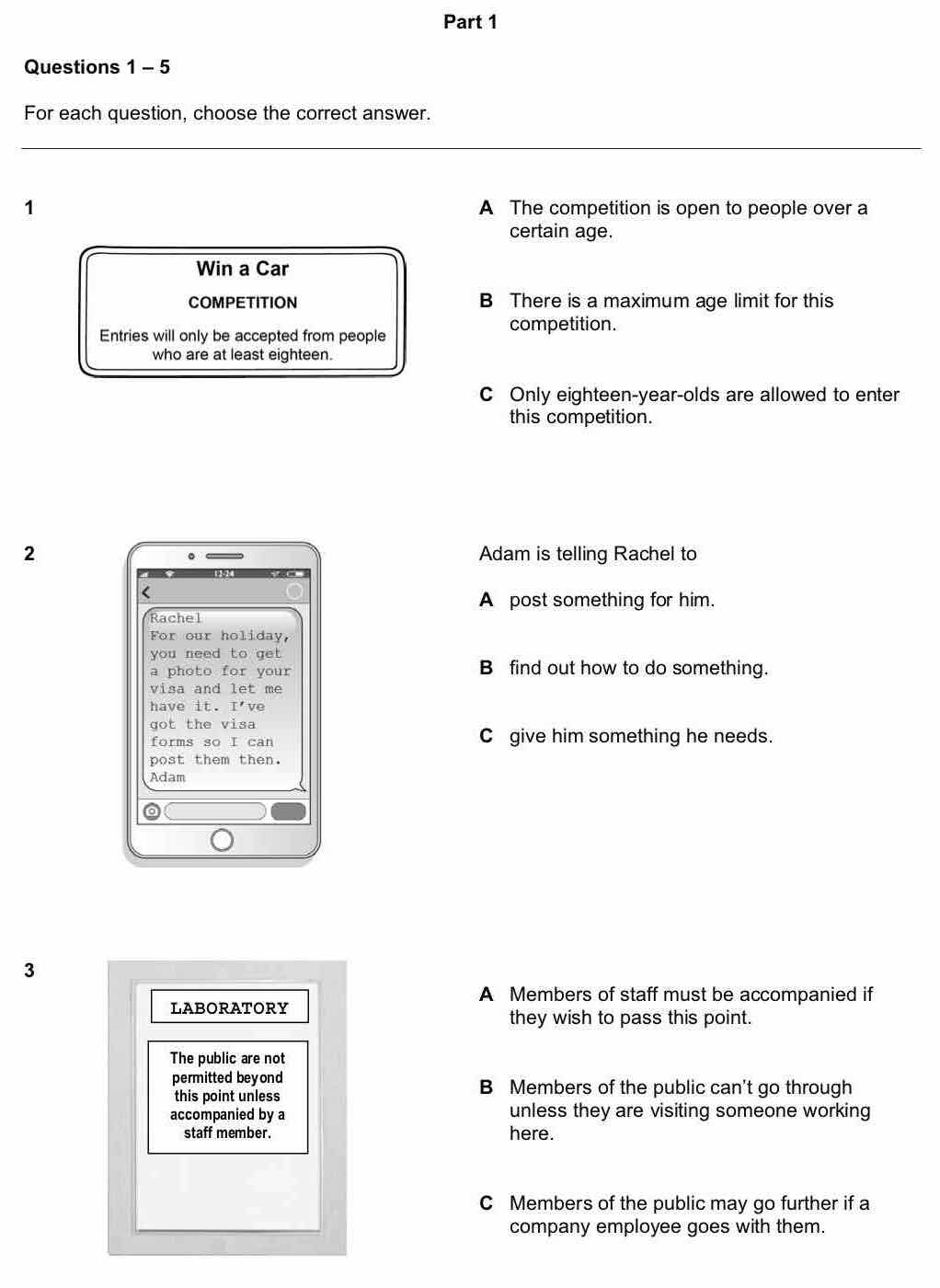
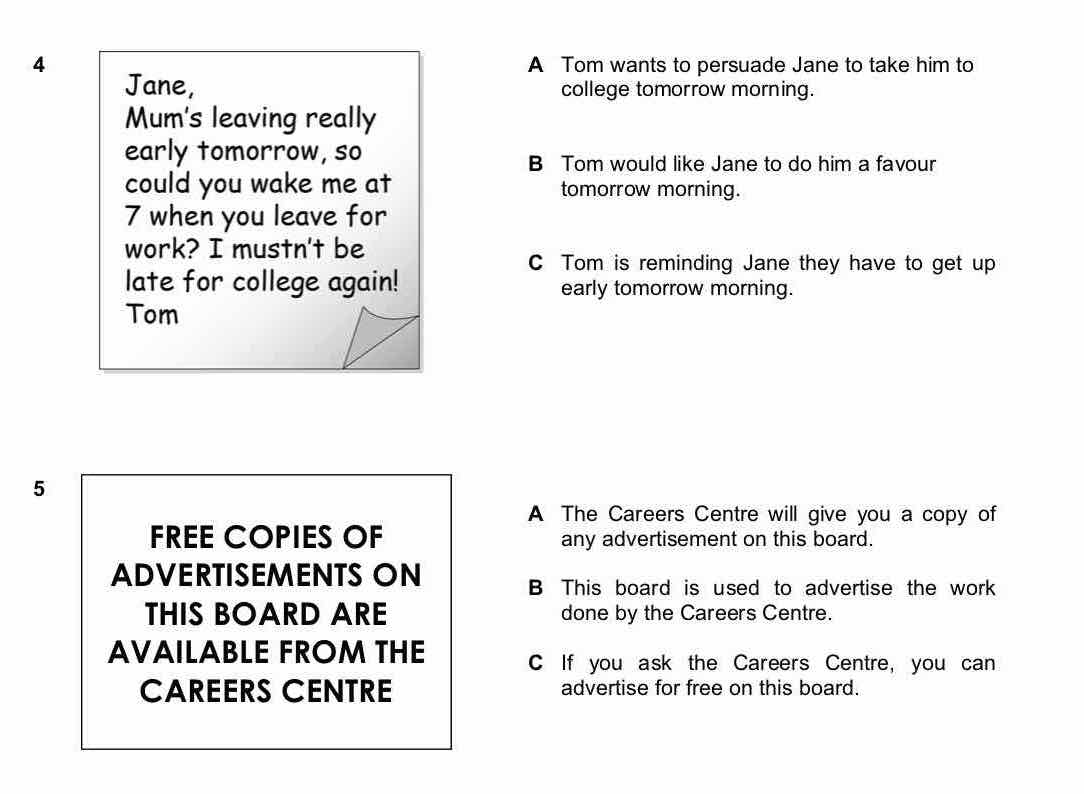
The focus of this part is on understanding specific expressions and short messages. Vocabulary and grammar are very important here, as there is little context from which meaning can be inferred. Therefore, if you are unfamiliar with any key word in one of the messages, you may not understand the correct meaning.
In my experience as a teacher, this part of reading comprehension is usually the easiest for students, although it is true that some questions can be quite difficult and lead to considerable confusion.
Below are the answers for the previous Reading task:
1. A
2. C
3. C
4. B
5. A
B1 Preliminary: Reading Part 2
The second part of the Reading of the B1 Preliminary has also not undergone any modifications regarding the previous exam model.
In this case, you must read 5 short texts that describe the preferences of certain individuals or groups of people. These preferences may relate to going to the cinema, reading books or magazines, taking a trip, dining out, etc.
Below, you will find 8 short texts that describe 8 different options that the aforementioned individuals can choose from. What you need to do is select the best option for each of the 5 individuals. Only one option per person, meaning there are 3 answers you should not select.
Here is an example of B1 Reading Part 2.
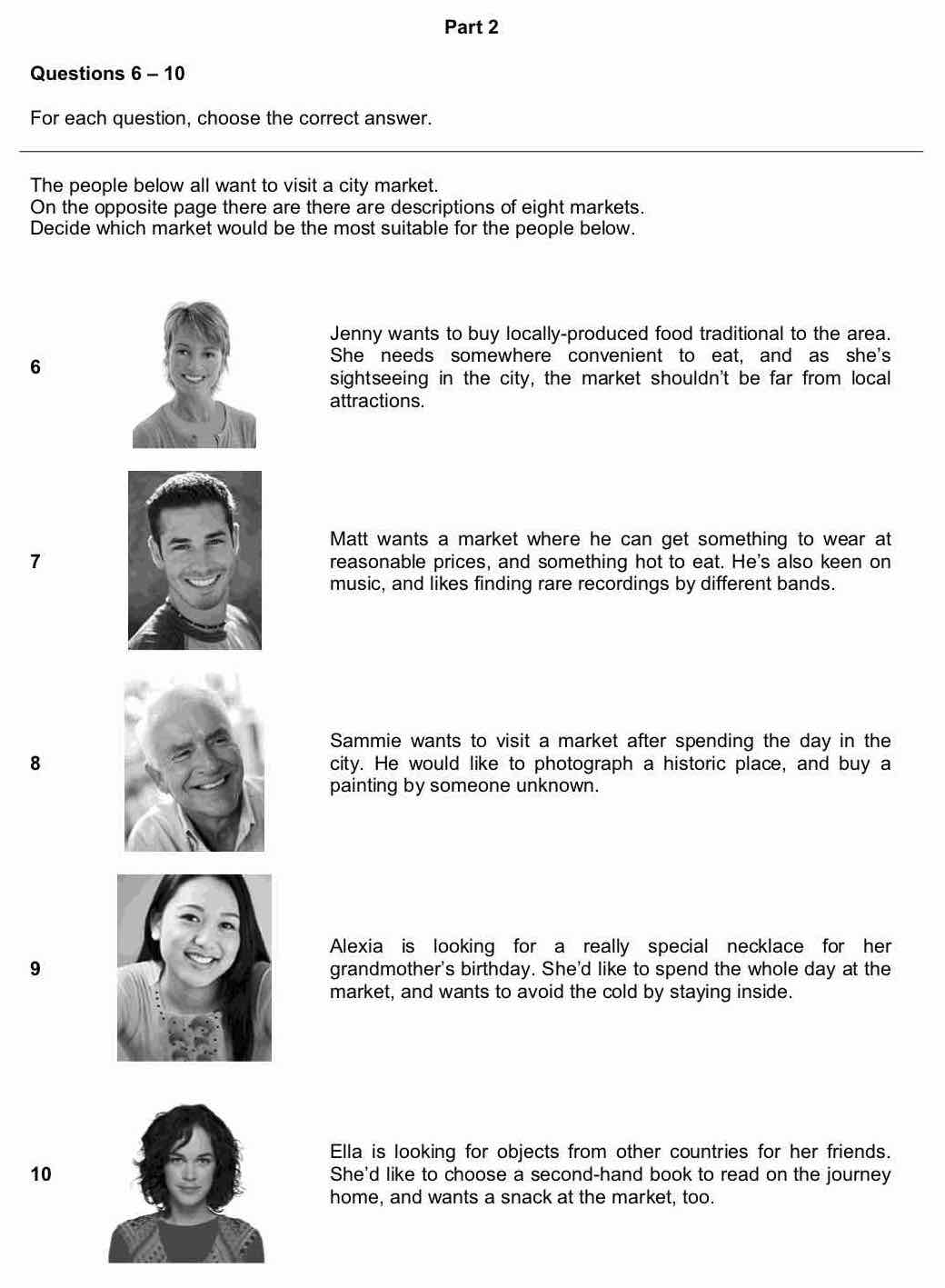
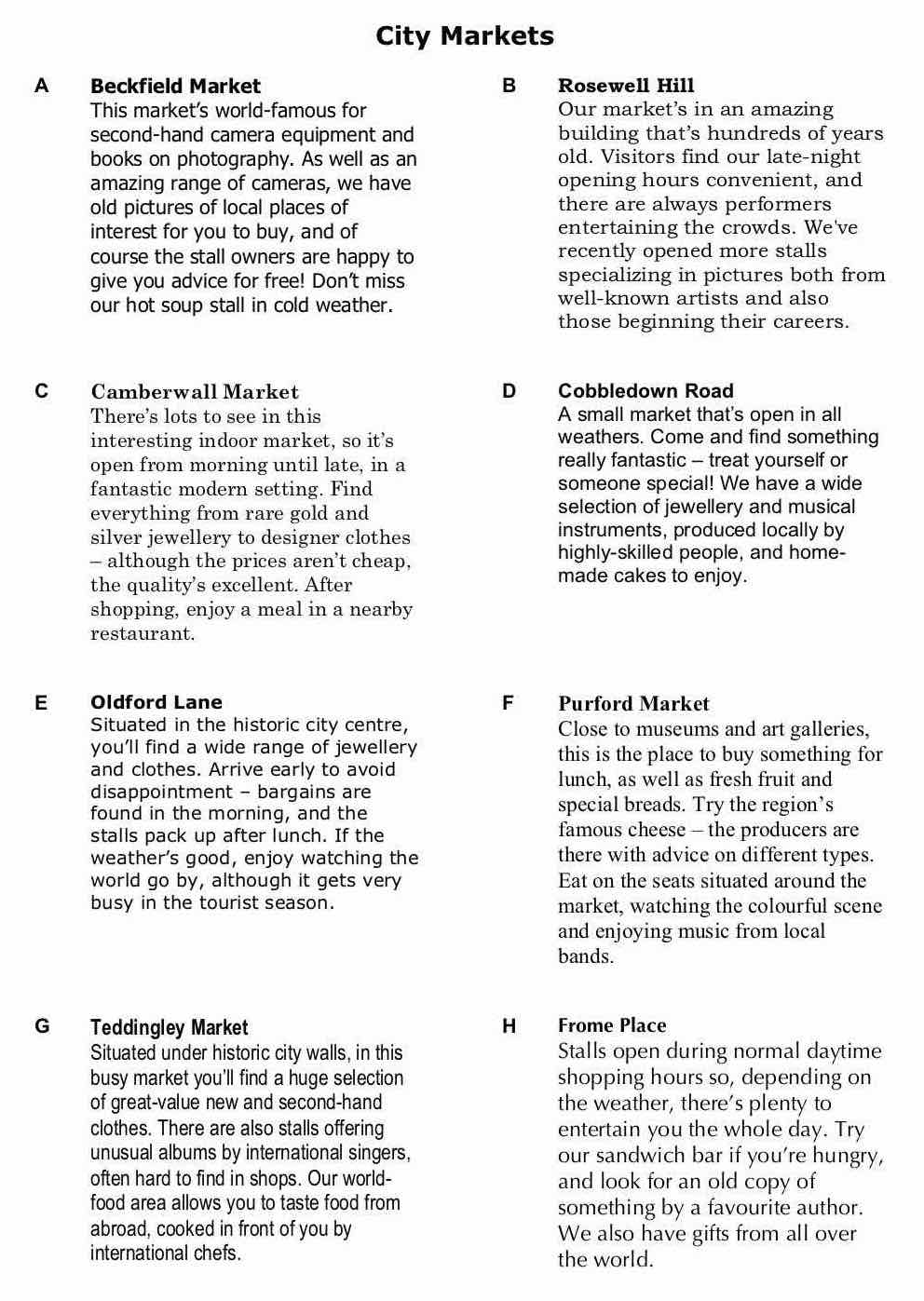
The easiest way to complete this type of activity is to first focus on the individuals and underline the key points that will give you the answer. For example, if we look at Jenny (6), we will see that the key information is:
- … locally-produced food traditional…
- … somewhere convenient to eat…
- … market shouldn’t be far from local attractions…
Then, you will need to look for information in one of the options that best matches Jenny’s preferences.
Here are the answers to this exercise:
6. F
7. G
8. B
9. C
10. H
B1 Preliminary: Reading Part 3
The Reading Part 3 of the B1 Preliminary is a classic task of a text with multiple-choice questions, and its format has not changed recently. In this case, it is a medium-length text with 5 multiple-choice questions with 4 possible answers (A, B, C, or D). What’s interesting about this text is that the first and last questions usually evaluate the overall reading comprehension of the text.
Let’s see an example of a text with multiple-choice questions.
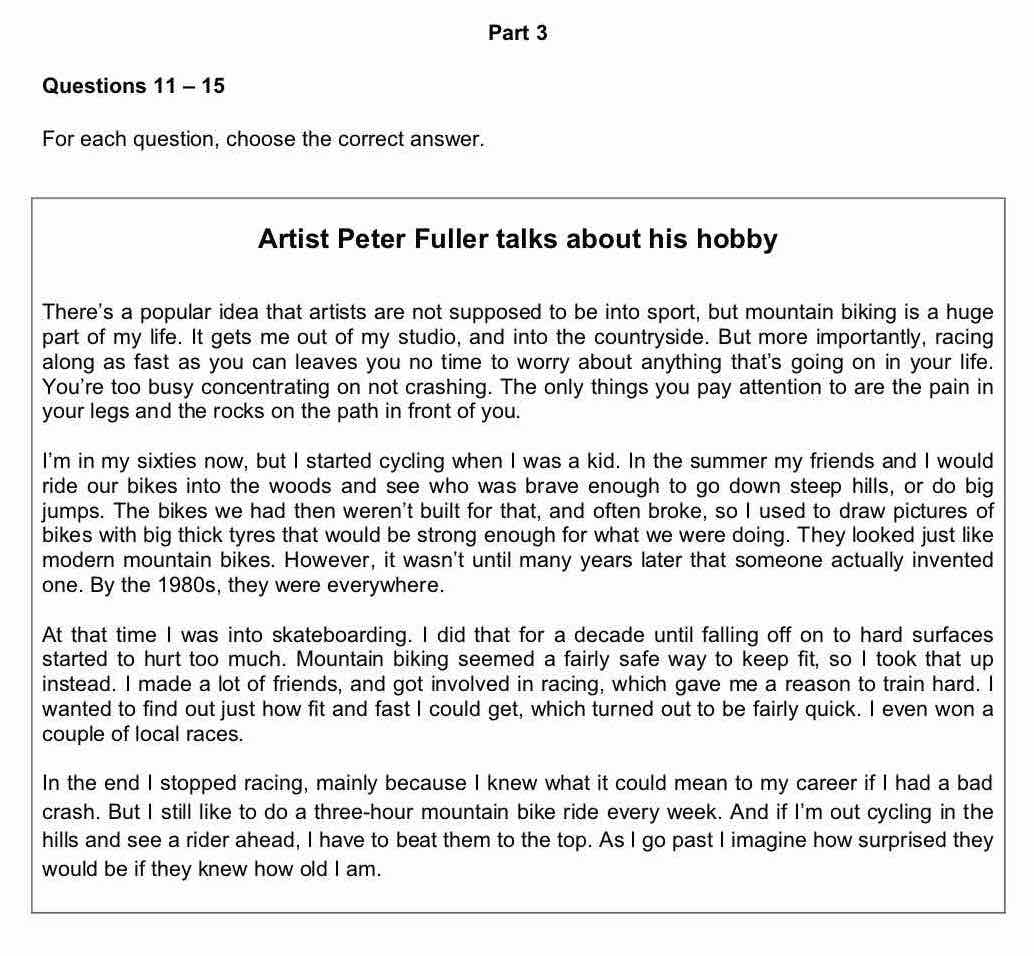
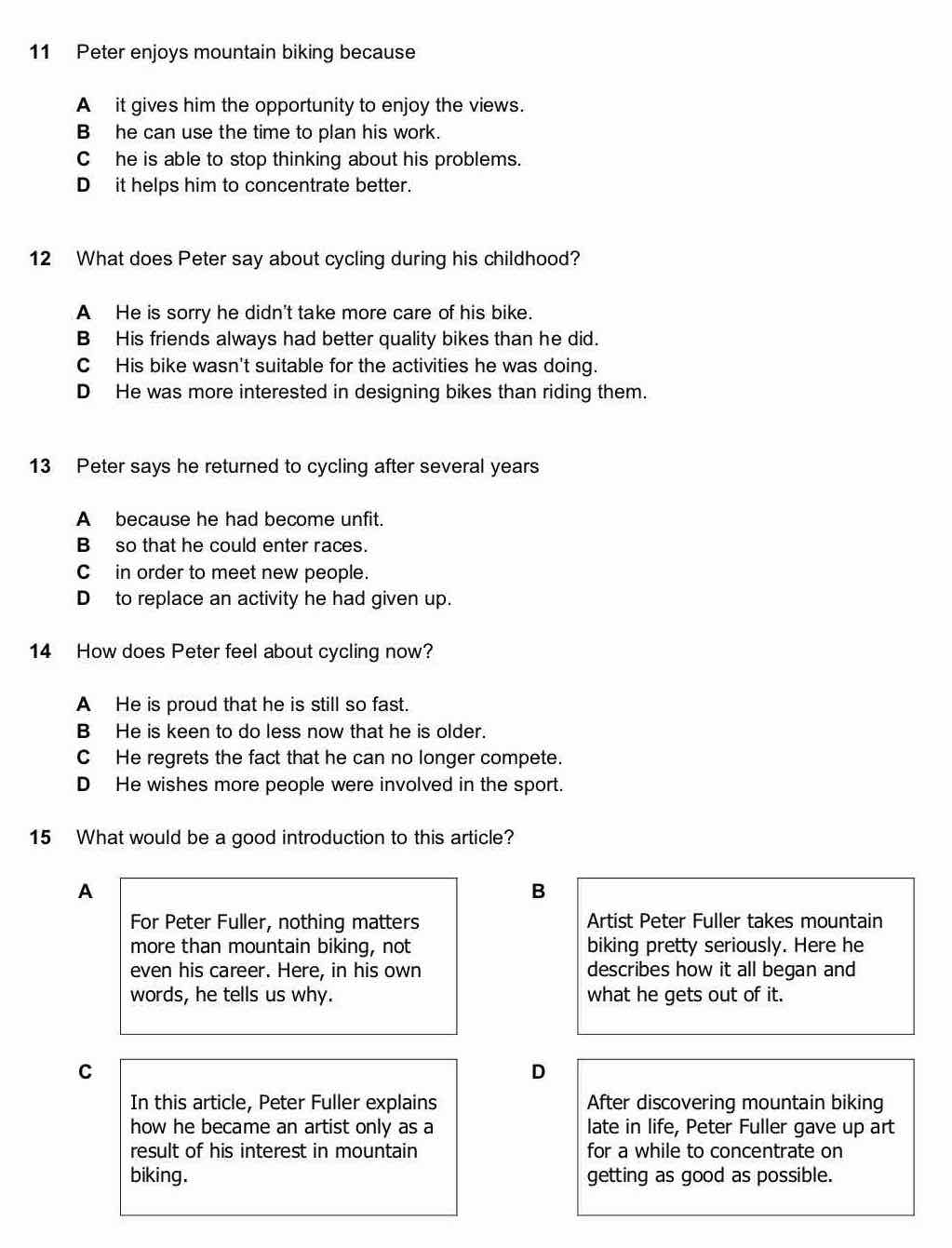
If you are interested in doing this task, here are the answers:
11. C
12. C
13. D
14. A
15. B
B1 Preliminary: Reading Part 4
Finally, we arrive at one of the new parts introduced in the 2020 exam format.
In this part of the Reading of the Cambridge B1, candidates must read a text missing 5 sentences. Below you have 8 possible sentences to fill in the text, but you should only choose one for each gap, leaving 3 possible answers that you should not select.
I find this part very interesting, and it also closely resembles one of the parts of the Reading of the B2 First (FCE), as Cambridge wanted to align the format of all its main suite exams a little more.
Let’s see an example.
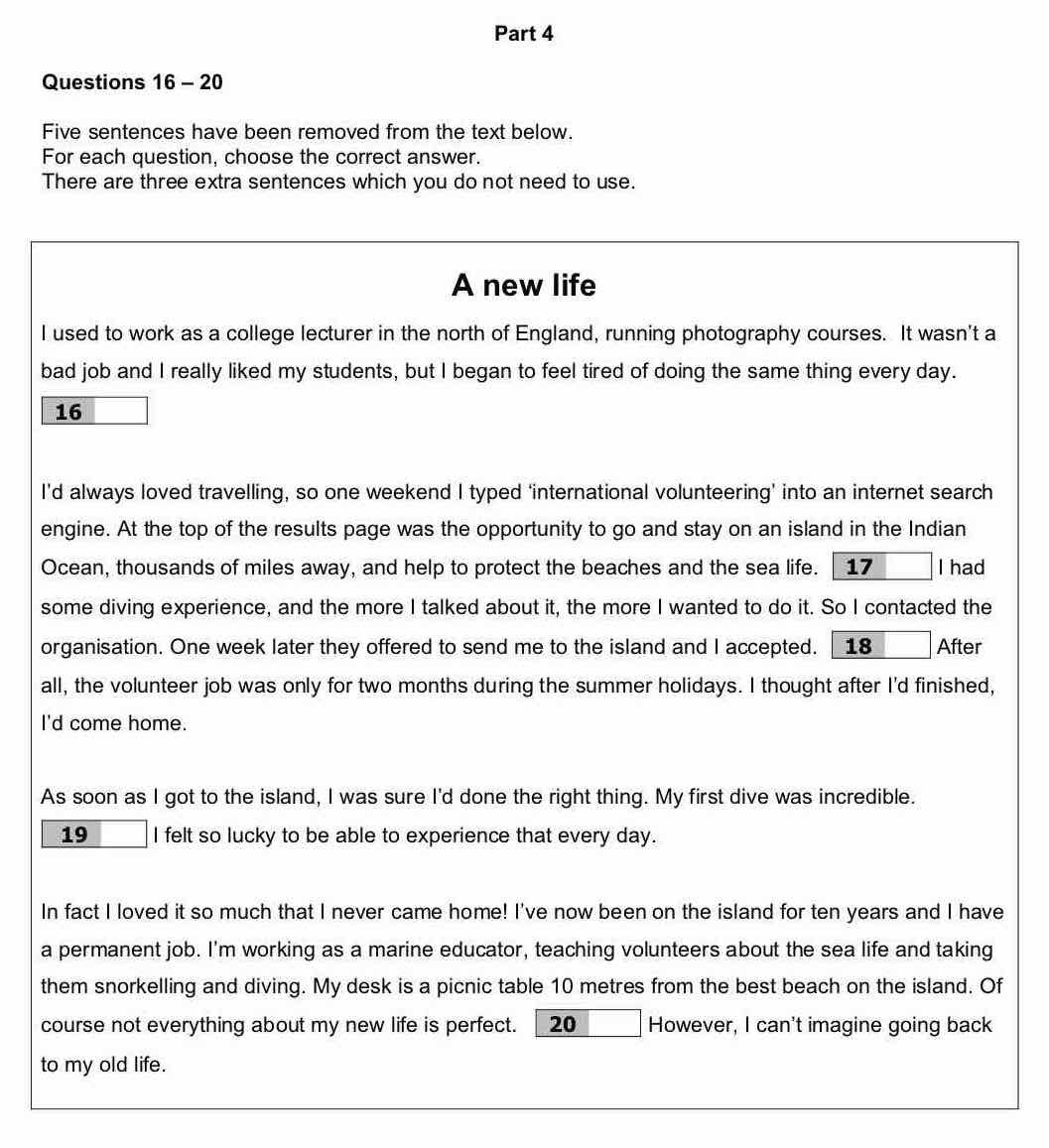
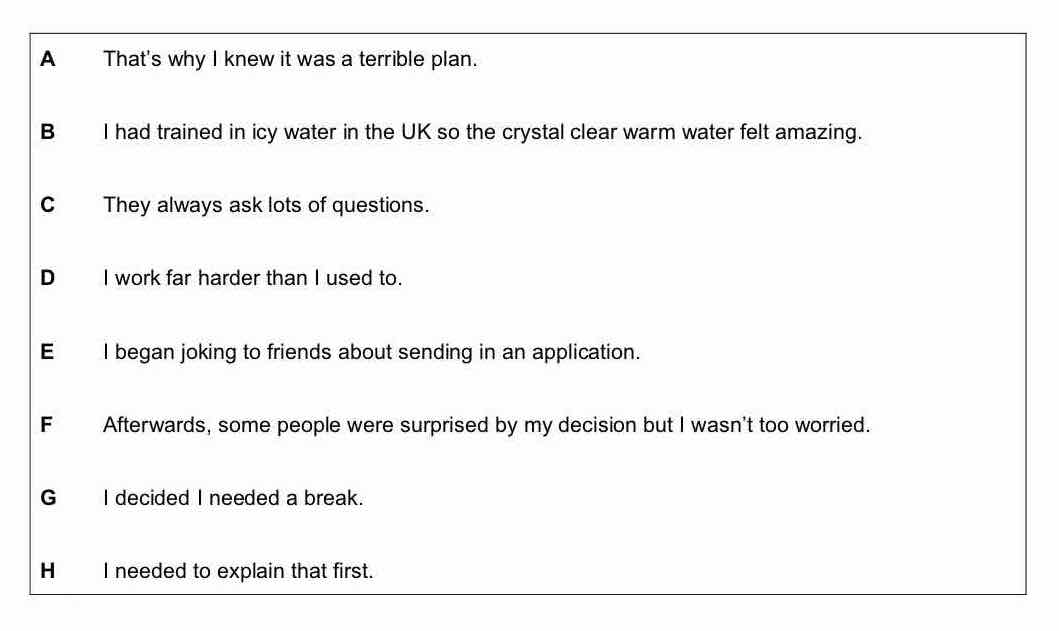
The key in these cases is, in addition to understanding the text quite well, to know how to identify elements in the text and in the possible sentences that give you clues about which sentence fits in each gap. For example, if we have the sentence «I needed to explain that first.» in option H, we see that the word «that» is referring to something that has been mentioned before. This will probably give us a fairly important clue.
The answers to the previous task are as follows:
16. G
17. E
18. F
19. B
20. D
B1 Preliminary: Reading Part 5
The format of Reading Part 5 of the PET has not changed as such, but the number of questions has been reduced. Previously there were 10 items, while now there are only 6.
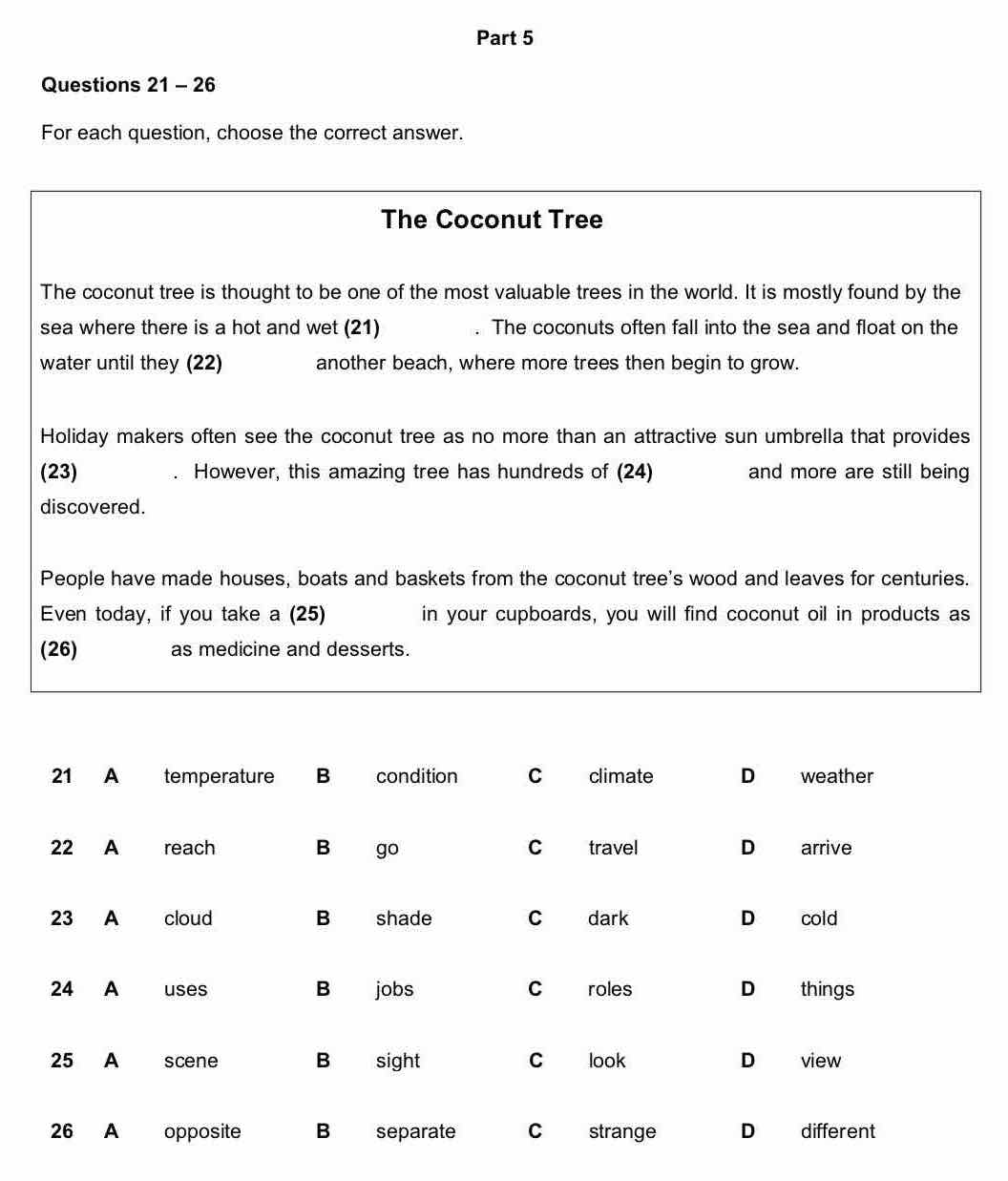
In this part, you need to read a text that has 6 gaps, and for each of them, you must choose an expression from 4 options (A, B, C, or D).
In this part of the Reading, which is very similar to the first part of Reading & Use of English of the B2 First (FCE), what is most evaluated is grammatical lexical knowledge.
Here is an example:
And below are the answers:
21. C
22. A
23. B
24. A
25. C
26. D
B1 Preliminary: Reading Part 6
And we come to the last part of the B1 Reading, which again is a new part introduced in 2020. In this case, it is very similar to Use of English Part 2 of the B2 First (FCE).
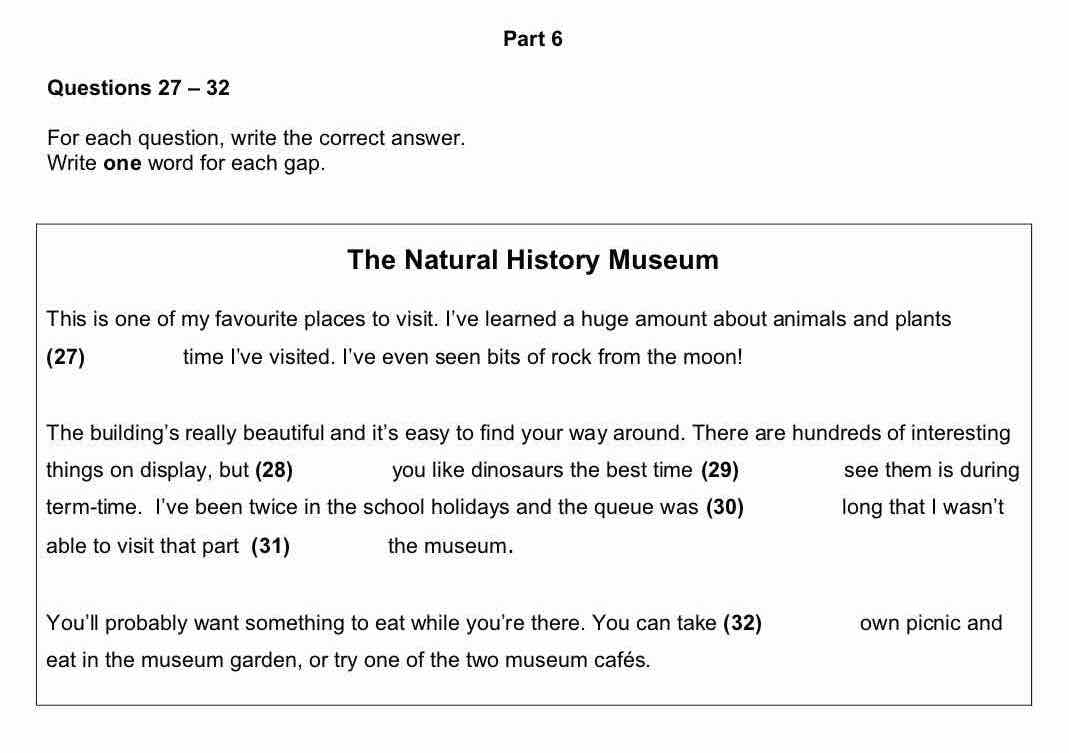
To complete this part, you must fill in 6 gaps in a relatively short text. For each gap, you can write only one word, this time no options are provided.
Basically, in this part, they are also evaluating our grammatical lexical knowledge of the English language, but in this case, the words you will need to use will be more grammatical words, such as prepositions, auxiliary verbs, etc., rather than nouns or adjectives.
I have provided an example below for you to take a look at and do if you’d like.
And here are the answers for this last part of the Reading:
27. every/each
28. if
29. to
30. so
31. of
32. your
How the Reading of the B1 Preliminary (PET) is evaluated
To know if you have passed this part of the B1 Preliminary is very simple, as each question counts for 1 point. You need a minimum of 23 points to pass. In other words, you need 23 correct answers to achieve a B1 reading level in this Cambridge exam.
Also, I recommend that you read this article on how the B1 Preliminary is evaluated, where I explain part by part how the exam is assessed and how much each item counts, as not all questions are worth one point in the rest of the exam.
Tips for the Reading of the B1 Preliminary
Unfortunately, reading is one of the most forgotten language skills, especially when it comes to exams, as candidates tend to be more concerned about other parts of the exam such as Speaking or Listening. However, there are people who really struggle, so if you are one of them, I recommend the following tricks and strategies to improve your Reading:
- Read a lot: It’s obvious, but few people do it. Of course, I do not recommend readings well above a B1 level, so it’s best to forget about reading The Lord of the Rings in English, as you will find it really hard and won’t learn much. The best is to read easy reading books, what we call graded readers, which are often adapted versions of classic books, or original versions specially written for language learners. You can see more in my article about the best books to prepare for the B1.
- Underline: This, more than a learning strategy, is an exam strategy, although it will also help you to learn in the long run. Underlining will be very useful for finding the answers to the questions in the different tasks, especially in part 2 or part 4, for example.
- Watch movies and series with subtitles: Reading subtitles will be very helpful for improving your reading speed. As it’s a B1 level, I recommend doing this with series or movies you have already seen in Spanish before, or with movies or series that are not too complex, so you can focus more on the language than on the series itself. Here is a list of movies according to your level to learn English.
- Extract vocabulary from everything you read: I don’t mean going crazy making lists, but rather noting down things that catch your attention or that are relevant or interesting. This way you can review vocabulary, little by little, and learn and increase your reading comprehension.
In short, the B1 Reading is not generally the most difficult part of this exam, but you shouldn’t underestimate it. Therefore, I recommend that you carry out the strategies I have mentioned and practice a lot before going for the exam.
Ah, and don’t forget to keep smiling!