
Phrasal Verbs in English: The Ultimate Guide for 2026
Los Phrasal Verbs en inglés pueden ser preciosos y extremadamente útiles si sabes utilizarlos bien. En esta sección te dejo los mejores consejos para aprender phrasal verbs en inglés.


Table of contents
Phrasal verbs in English are a real headache: there are millions of them, they are confusing, their meaning often bears no resemblance to the original verb, and there is a long list of other drawbacks that make them a total nightmare. However, phrasal verbs are absolutely essential in English, and for that reason, in this section I’m bringing you the most useful phrasal verbs and giving you tips to understand them and manage to memorise them more easily. 😄
What is a Phrasal Verb
As defined by the Oxford Dictionary, a phrasal verb is:
an idiomatic expression consisting of a verb combined with another element, typically either an adverb, a preposition, or a combination of both.
And an idiomatic expression is one that is used naturally by native speakers of a language. In this sense, it is important to understand that yes, phrasal verbs are used very frequently by native speakers, even if many of my students find it hard to believe.
The meaning of Phrasal Verbs
Another important characteristic of many phrasal verbs is that their meaning is not necessarily related to that of the original verb.
For example, the phrasal verb come up with means «to invent or think of something, such as an excuse or an idea, under pressure or in a moment of need». This definition, obviously, has nothing to do with the translation of come, which is simply «venir».
The truth is that most phrasal verbs must be learned individually as lexical units, not necessarily semantically related to the original verb—that is, the verb without the preposition or adverb.
Types of Phrasal Verbs
Although, unfortunately, the meaning of phrasal verbs isn’t always logical or explainable, there is a way to understand how they work. To do this, we need to know that they are divided into two categories: phrasal verbs with a direct object and phrasal verbs without a direct object.
Phrasal Verbs without a direct object
These phrasal verbs, obviously, do not take a direct object. This means they are simply accompanied by a preposition or adverb and do not directly affect «something» (sth.) or «somebody» (sb.).
Examples of phrasal verbs without a direct object:
- stand up
- hurry up
- go out
- turn up
- sit down
- wake up
- Etc.
Let’s look at a couple of example sentences with phrasal verbs without an object:
Pupils used to stand up every time a teacher entered the classroom.
If we hurry up, we can still make it to the concert.
These phrasal verbs are the easiest to use and understand in terms of how they work. However, sometimes there are phrasal verbs that have both versions: with and without a direct object. One example is wake (sb.) up, where «sb.» is «somebody», the direct object:
If we wake up early, we’ll make it on time! (without a direct object)
Please, wake your dad up. We need to leave now! (with a direct object)
Now let’s move on to phrasal verbs with a direct object.
Phrasal Verbs with a direct object
These phrasal verbs are those that take an object, which means they «affect» somebody (sb.) or something (sth.) in some way.
Some examples of this type of phrasal verb are:
- come up with something
- look something up
- turn something on
- look up to somebody
Let’s look at a couple of sentences to see better how they work with the object:
Bad students always come up with lame excuses.
Please, could you turn the music down a little?
The only problem with these phrasals is that the object isn’t always in the same position (in the middle or at the end). And depending on where we have to place the object, we have another subcategory of phrasal verbs: with a fixed object and with a movable object.
To know which type of phrasal verb it is, we have to look at where something or somebody is located. I’ll explain this below.
Phrasal verbs with a fixed object
This type of phrasal verb always places the object at the end—that is, after the preposition(s) and/or adverb(s). For example:
- come up with something
- look into something
- look forward to something
- get down to something
- look up to someone
Let’s look at a couple of example sentences:
We’ll have to look into a better way to travel to China. This one’s very expensive. (NOT: We’ll have to
look a better way intoto travel to China.)Everyone in the office looks up to the boss.
Phrasal verbs with a movable object
In this case, the object can go between the verb and the other particles or at the end; hence why it is «movable». Some examples are:
- look something up
- switch something off
- put somebody up
- turn something down
Let’s see how the object can go in the middle or at the end of the phrasal verb in the following sentences:
Did you have to look that word up in the dictionary?
Did you have to look up that word in the dictionary?You can take your jacket off if you want.
You can take off your jacket if you want.
The peculiarity of these verbs is that if we use a pronoun (instead of a noun) for the object, it must go in the middle. Take a close look:
Please, switch off the TV.
Please, switch the TV off.
Please, switch it off.
Please,switch off it.
In the third and fourth cases, we are using it as the object, which is a personal pronoun, so the fourth case would be incorrect. That is, a personal pronoun cannot go at the end of phrasal verbs with a movable object.
How to identify the type of phrasal verb
It really is very simple. You just have to keep the following in mind:
- Without an object: it does not take something (sth.) or somebody (sb.)
- With an object: it takes something (sth.) or somebody (sb.)
- Fixed object: it places something (sth.) or somebody (sb.) at the end
- Movable object: it places something (sth.) or somebody (sb.) in the middle
Knowing this, when you go to a dictionary and look up a phrasal verb, you have to check whether it takes an object or not, and if it does, where it is placed. Some dictionaries don’t show this, as they are more for native speakers than learners, but others do. Let’s look at an example from the Cambridge Dictionary:
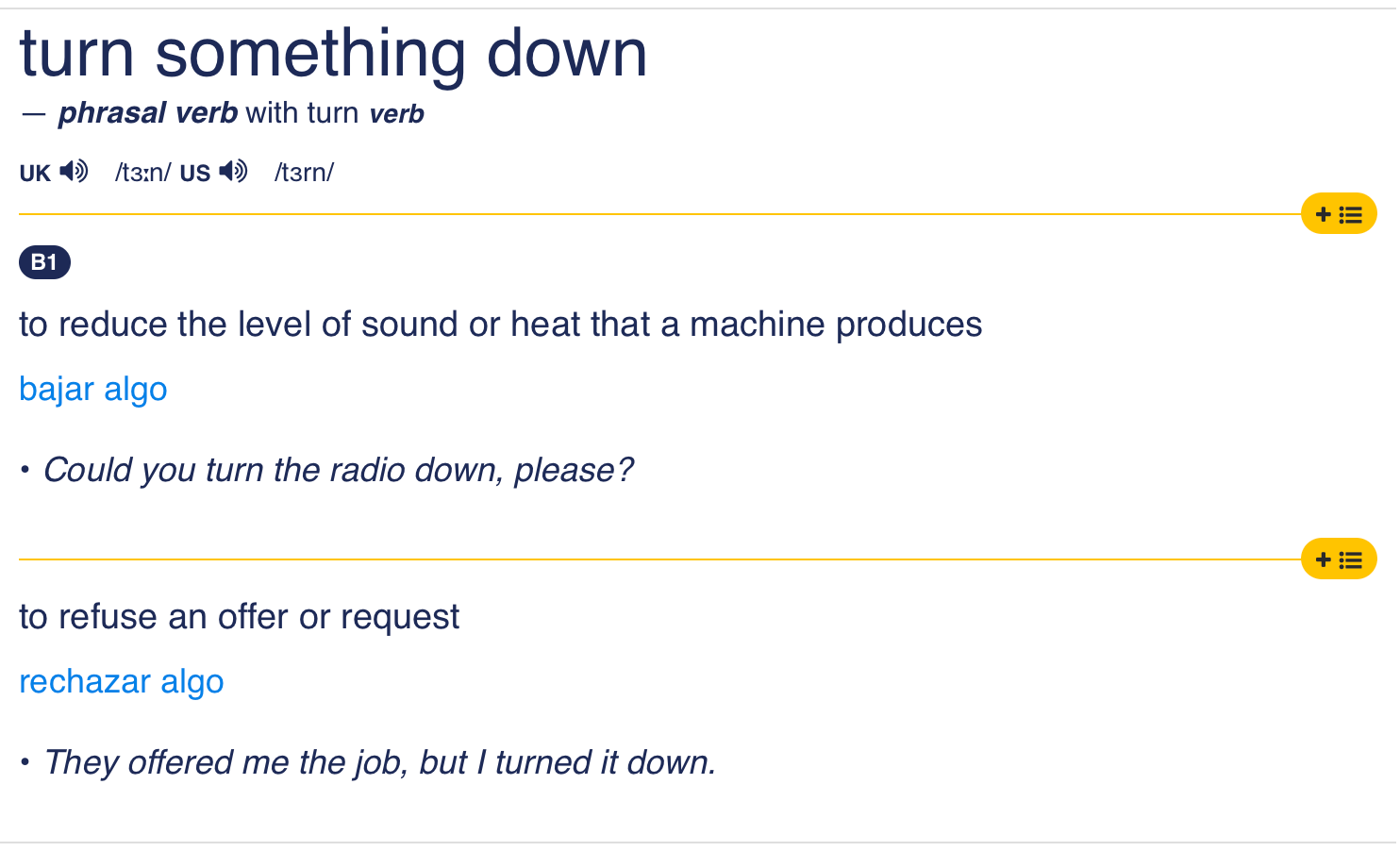
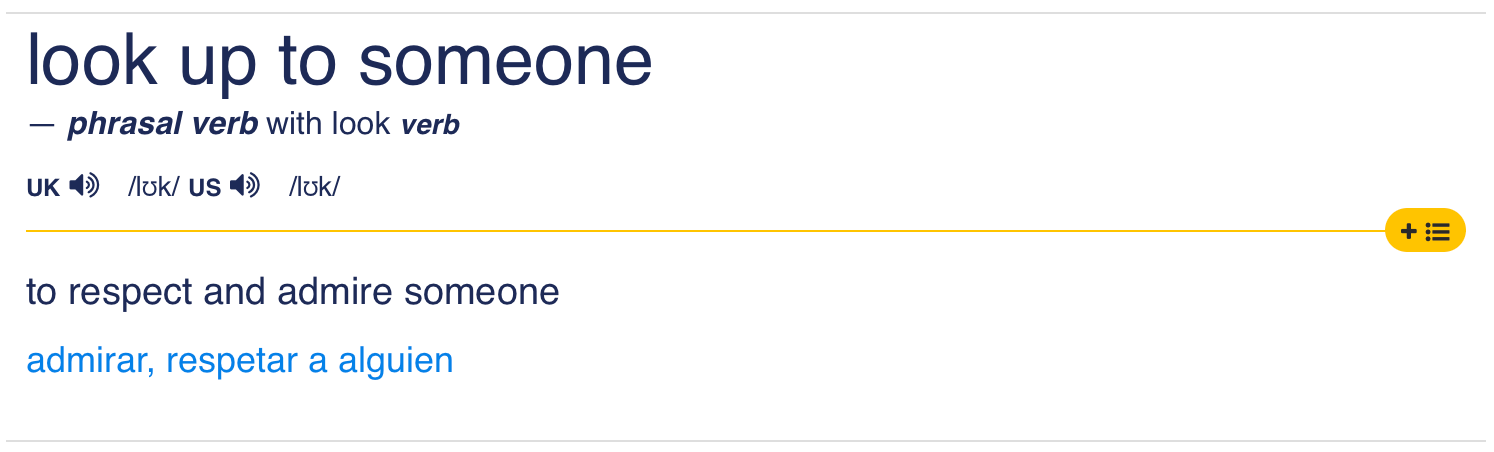
By noticing whether it takes an object or not, and if so, where it goes, you will be able to categorise phrasal verbs more easily, and memorise and put them into practice more quickly.
KSE Academy Phrasal Verbs Dictionary
If you are looking for a comprehensive and reliable resource to master phrasal verbs in English, look no further: KSE Academy presents its exclusive phrasal verb dictionary. In my dictionary, I give you clear, simple, and concise definitions, along with contextualised examples of use, so that you can understand and correctly use each phrasal verb.
Other articles about Phrasal Verbs
Explore KSE Academy’s other articles on phrasal verbs and dive into a fascinating world of knowledge and learning to master these dreaded (but lovable) verbs in English.