
How to write a Review for the C1 Advanced (CAE) [Guide 2026]
In this article, I teach you how to write a review for the Cambridge CAE Writing exam. I also provide a guide for the C1 Advanced (CAE) Writing to help improve your writing skills.

Table of contents
In today’s article, we’re going to learn how to write a review for the Cambridge CAE. The review, as you probably already know, is one of the tasks that can appear in the C1 Writing Part 2. And if you’re still not sure, don’t worry, because I’m going to explain everything from scratch. Are you ready? Let’s-a-go!
What are the parts of the C1 Writing?
The C1 Advanced (CAE) Writing, as we’ve mentioned on other occasions, is made up of 2 parts:
- Writing Part 1: Here you always have to write an essay. There is only one option, so you can’t choose. And, by the way, if you don’t know much about essays in English yet, click here to learn how to write an essay for the CAE.
- Writing Part 2: In this part you will have to choose from 3 options. For these options, the types of Writing that may appear are the following:
- Formal letter/email
- Informal letter/email
- Review
- Report
- Proposal
Each piece of writing you do should be between 220 and 260 words, approximately, and, as they are different types of writing, you should take into account the peculiarities of each one in terms of structure, register, grammar, vocabulary, etc.
So let’s start with the one that concerns us in this article: Reviews!
What is a C1 review?
A review in C1 Advanced is nothing more than a critique or appraisal, that is, a text whose main objective is to evaluate and describe a work (a book, a film, a product, etc.) or an experience or event (a concert, a performance, a play, etc.).
In the specific case of the C1 Advanced exam, it is important to note that the text is expected to be descriptive and subjective, while also being informative and critical, giving our reader a clear idea of the object, work, or experience evaluated and its artistic or commercial value.
How to write a Review for the CAE Writing
Below we will see the main characteristics of a C1 level Review so that you can take them into account when writing:
- Purpose: The purpose of any review is to talk about a topic in detail, evaluating its advantages and disadvantages, and making some recommendations. In addition, reviews are expected to engage the reader while providing information.
- Tone and register: Reviews are usually addressed to the general public (e.g.: website readers, magazine subscribers, etc.), so the language can be standard or even slightly informal. You should address the reader directly, in the second person, and you can use humour if you consider it appropriate.
- Structure: Every review needs a title. This should be as eye-catching as possible to grab the reader’s attention from the start. In the introduction, you should present what you are evaluating in a relaxed way, trying to entertain and engage the reader. Each paragraph between the introduction and the conclusion should deal with a different aspect. And you should wait until the conclusion to make a recommendation.
- Opinion: In a review for the CAE, you are expected to give your opinion throughout the text, although the recommendation is expected at the end. A review is very personal, so you can freely use first-person sentences.
- Common topics for reviews: C1 reviews generally ask you to write about restaurants, books, films, series, gadgets, music events, plays, performances, etc.
Example of CAE Writing Review
Now that we have seen the main characteristics of a review for the Cambridge Advanced (CAE) Writing, let’s look at a good example of a C1 level review, looking at both the example instructions and a possible answer.
C1 Review Instructions
In the text box below you can see an example obtained from the Cambridge website.
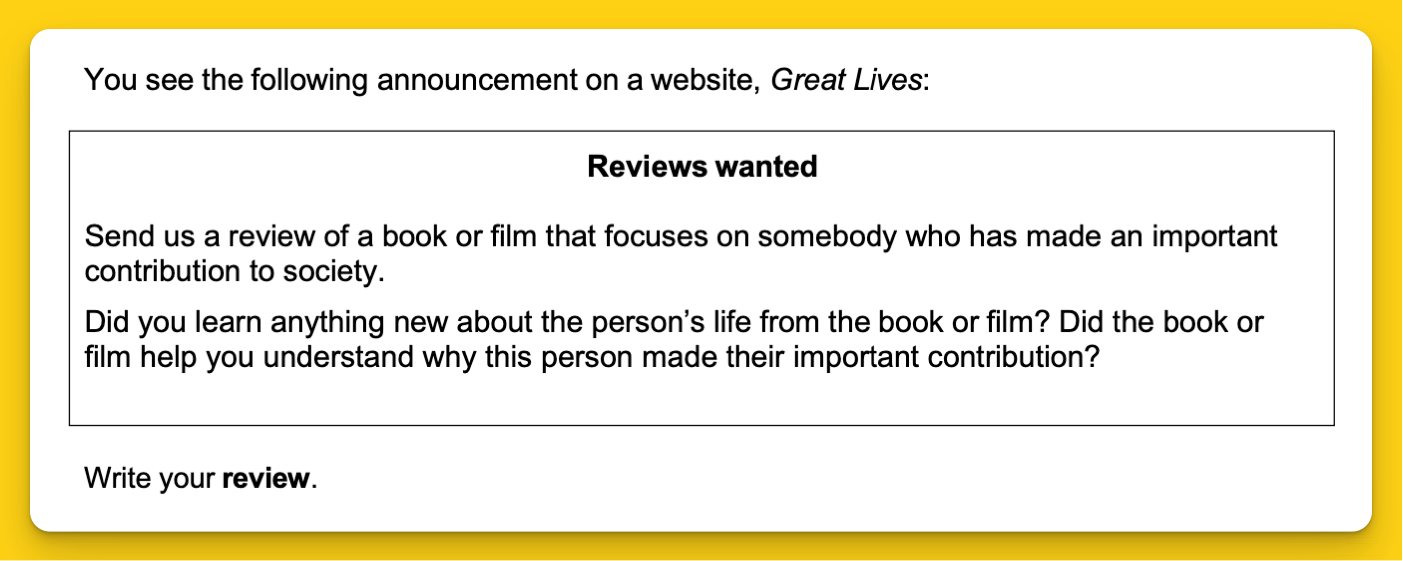
From these instructions, we must always extract the essential points:
- Topic: a review of a book or film that focuses on somebody who has made an important contribution to society
- Target reader: Great Lives website readers
- Points to cover:
- Did you learn anything new…?
- Did the book/film help you understand why…?
- Essential instructions for Part 2:
- Choose only one of the Writing tasks. That is, if you decide to do the review, you should not do any other task in Writing Part 2.
- Write the review using approximately 220-260 words.
C1 Review Example Answer
According to the task model presented above, we can structure the paragraphs of the C1 review in the following way:
- Introduction
- Film synopsis
- Learnings
- Reason why…
- Conclusion/Recommendation
As I always say, it’s not set in stone, but it’s most common to have 4 or 5 paragraphs in this type of Cambridge C1 Writing. So now let’s look at an example Review for the CAE Writing:
| Diving into The Radiant Life of Marie Curie What makes a person stand out and leave a lasting impact on society? «The Radiant Life of Marie Curie,» a captivating biographical film, perfectly answers this question through the extraordinary life of Marie Curie, the groundbreaking scientist. The movie takes us on a riveting journey, beginning with young Marie (played by Lila Thurstan) and her perseverance to study in France, despite numerous obstacles. As the narrative unfolds, viewers are captivated by the scientist’s tenacity, daring spirit, and compassion. A key turning point in the film is Marie’s collaboration and budding romance with Pierre Curie (portrayed by Oliver McMahon). Together, they delved into the uncharted territory of radioactive elements, unveiling a plethora of applications while braving potential dangers. Apart from gaining insights into her scientific contributions, the film divulges lesser-known aspects of Marie’s life. From her deep-rooted resilience to her passion for equal opportunities for women, the movie portrayed a side of her that far surpassed the conventional archetype of a scientist. What struck me the most about the film, however, was its ability to transport me to Marie Curie’s world and showcase her dogged determination. The portrayal of her struggles felt heartfelt, and her triumphs were nothing short of awe-inspiring. I realised that this relentless pursuit of knowledge and understanding is what makes her an exemplary figure. «The Radiant Life of Marie Curie» masterfully uncovers the driving forces behind Curie’s outstanding achievements. It demonstrates how her tireless work intertwined with her personality traits to make meaningful and essential contributions to society. For anyone seeking to be inspired, look no further than this unforgettable masterpiece. |
Firstly, without even starting to read this C1 review, we see that it consists of a title and 5 clearly marked paragraphs. This is very important, even if it doesn’t seem like it. And now, when we start to read and delve into this review, we can appreciate the following:
- Title: The title perfectly represents the content of this review for the CAE. With «Diving into» we refer to the fact that we are analysing or getting fully involved in «The Radiant Life of Marie Curie,» which in this case is the title of the work (film) we are analysing.
- Paragraphs: Each paragraph has a clear and crucial function for the review. Let’s take a closer look at what I mean:
- Paragraph 1 (introduction): In a creative way, we introduce the topic (using a question) of the book and make it clear what the tone and content of the rest of the paragraphs will be.
- Paragraph 2 (synopsis): Whenever we review a book or film, we will have to talk about the story of the film and its main characters. In this case, we don’t delve further into the film’s characteristics because we have been asked 2 clear questions (which we answer later), so in this paragraph we give a global overview of the plot and the main characters.
- Paragraph 3 (what I learnt): In the third paragraph we refer to things we have learned from the film. For example, her scientific contributions (Apart from gaining insights into her scientific contributions), lesser-known aspects of Marie Curie’s life (the film divulged lesser-known aspects of Marie’s life), and her personality and principles (From her deep-rooted resilience to her passion for equal opportunities for women).
- Paragraph 4 (why this person made…): In the penultimate paragraph, we address the second question described in the task. And we end up answering this question with the last sentence of this paragraph: I realised that this relentless pursuit of knowledge and understanding is what makes her an exemplary figure.
- Paragraph 5 (conclusion and recommendation): The last paragraph of any review is usually where we make a kind of summary and a recommendation. And this paragraph achieves exactly that with sentences like «For anyone seeking to be inspired, look no further than this unforgettable masterpiece.«
- Structure and connectors: This C1 review presents a good use of connectors with a fluid and cohesive narrative. Some connectors in the text, such as «as the narrative unfolds,» contribute to establishing a logical sequence of the text, while other connectors mark contrast, such as «despite» and «while,» or enrich and facilitate the understanding of relationships between different ideas. Finally, the use of connectors like «apart from» effectively adds additional information. Mastering connectors is crucial for maintaining the reader’s interest and providing clarity in the message to be conveyed, especially when we are talking about advanced levels like C1.
- Language:
- Although we don’t use informal language as such, it does have a less formal tone than other types of texts (such as the report), as we address the reader in the second person throughout and include ourselves in the first person in almost all paragraphs, giving our opinion about the film.
- We use a very good lexicon that helps to enrich the text and convey the content with clarity and style, while also demonstrating an advanced level of English (C1 or higher).
- captivating
- groundbreaking
- perseverance
- tenacity
- daring spirit
- compassion
- turning point
- budding romance
- delved into
- uncharted territory
- unveiling
- heartfelt
- awe-inspiring
- relentless pursuit
- dogged determination
- archetype
- The grammar of the text also helps to demonstrate a C1 level, although we don’t use excessively complex structures. What the grammar of this text achieves very well is a good progression of ideas, through the use of connectors and discourse markers, and highlighting the advanced vocabulary we have already mentioned in the previous point.
In short, this is a very good example of a Review for the CAE, with all the characteristics that a good review should have.
Another example of a C1 Review for the Cambridge CAE
Let’s look at another example of a C1 level review, this time with instructions taken from my C1 Writing PDF book.
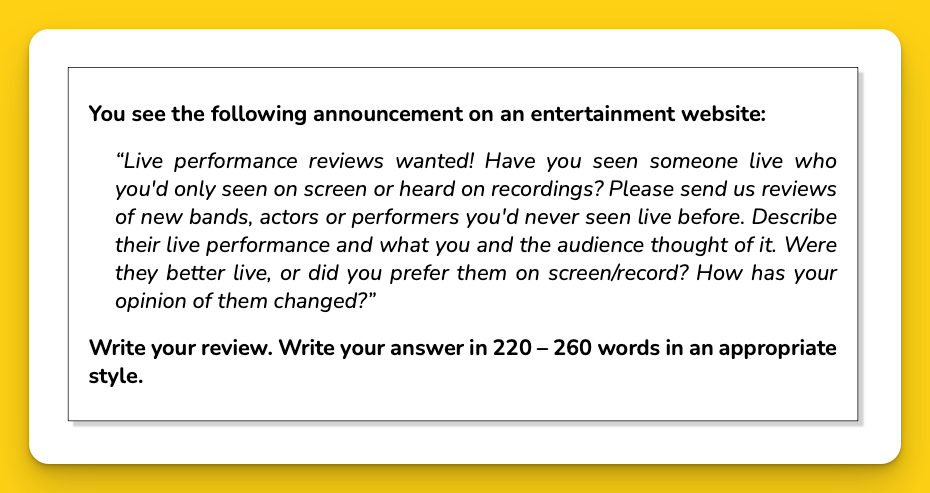
And here is an example answer.
| Echoes to Remember Last weekend, I attended the much-awaited live concert of the Radiant Echoes, an emerging indie rock band whose songs had already captured the hearts of many, including mine, through streaming platforms. Known for their distinctive melodies and soulful lyrics, I was almost literally dying to see them perform live. As the venue filled up, you could feel the excitement in the air, with fans sharing stories of their discoveries and favourite tracks. The moment finally arrived—the stage lights dimmed, and Radiant Echoes burst into the spotlight. The band’s raw and powerful live performance offered a new depth which you can’t quite grasp on their recordings. They had so much passion and energy on stage, and it was clear they’d been perfecting their act for ages. The audience’s enthusiasm was apparent—I too participated in singing along and dancing to their upbeat tunes. However, the night wasn’t all about jumping around and having a blast. There were some really emotional moments when the band played their slower, more heartfelt songs. The whole crowd swayed together, completely enveloped in the music. I feel that many of us entered the concert with high expectations based on their records, but as each minute passed, it completely changed our perspective. I’m sure I’m not alone when I say that their live show was so much more intense than their recorded material. In a world where digital media often dictates our perception, attending Radiant Echoes’ mesmerising live performance was an unexpectedly refreshing change. Needless to say, I can confidently recommend that you catch them live if you ever have the chance. |
Any doubts or questions?
Now let’s move on to one of the most common questions of all time!
Will I be penalised if I write less than 220 or more than 260 words?
This is the most typical question in this part of the exam and the answer is as follows: yes and no. Let me explain. The examiners don’t count the words and penalise you based solely and exclusively on the number of words. There’s a rumour among candidates and teachers that you lose points for every 10 words, but that’s not true. However, consider that if you have exceeded the word count by 50 or 100 words, or more, you are probably including information that is not relevant to the task, and that can be penalised. Similarly, if you write less than 220 words, you are likely missing important information or not covering it with the required detail.
Therefore, I always recommend exceeding the word count by a maximum of about 20 words. That way, you probably won’t lose silly points if the task covers the aspects you are asked for. 🙂
Guide for C1 Advanced Writing with examples and useful expressions
Although I have more articles on the website explaining how to do each type of task for the C1 Advanced, the best thing you can do to have plenty of information and practice is to purchase the official KSE Academy guide for the CAE Writing. In this guide you will find the following:
Digital format – Amazon – See sample
I hope this article on the C1 Writing Review has been very useful for you. If so, don’t forget to share it with your friends and family.
See you in the next post. Until then, don’t forget to keep smiling! 🙂