Use of English C1 Advanced (CAE): Complete Guide with Exercises
Having trouble with the C1 Advanced Use of English? Say no more! Here’s the ultimate guide to the Use of English for the CAE, complete with practice exercises.

Table of contents
The C1 Advanced (CAE), as we have seen, is a Cambridge C1 level exam composed of 5 distinct parts. These parts, which are called papers, are: Reading, Use of English, Writing, Listening and Speaking. And in this article, I am going to focus specifically on the Use of English C1 Advanced (CAE), which is often one of the most problematic parts for candidates. So I’m going to tell you exactly what each part is like, give you some examples, with videos and everything, and it will all be crystal clear. All that will be left is for you to study and practise tirelessly. 😅
Use of English C1 Advanced (CAE): What it is
Use of English refers to a person’s ability to apply their knowledge of English grammar and vocabulary in practice. In this case, as in the B2 First, the CAE Use of English is an ingenious combination of lexical and grammatical elements that assess how well the candidate (that’s you) knows how to use written English.
Unlike the exercises we’ve grown accustomed to doing in school, the typical fill in the gap exercises, the C1 Advanced Use of English exercises test you in a very intuitive way, in order to determine how well you control certain aspects of the English language. To give a few examples, you will need a high level of collocations, idioms, phrasal verbs, synonyms, advanced grammatical points, transformation of sentences and words, and much more.
For this reason, it is true that sometimes, for many candidates, the Cambridge C1 Use of English can become a real nightmare. However, it is one of my favourite parts 😅 and I can assure you that with a lot of practice and a bit of sense, you can do very well in this part of the C1 Advanced.
Use of English C1 Advanced (CAE): What parts it has
Before 2015, the C1 Use of English consisted of 4 parts. However, from 2015 onwards, it only comprises 3 parts, as the first part was counted as Reading, not Use of English. And this is something that many people find hard to understand.
But don’t worry, that’s what I’m here for, to explain it to you so you understand it perfectly. The first thing you should know is that, although the scores for Reading and Use of English are calculated separately, they are done in the same session. In this case, the C1 Reading & Use of English, which has 8 parts, is done in a 90-minute session.
However, the parts are counted as follows:
- Reading: Part 1, Part 5, Part 6, Part 7 and Part 8
- Use of English: Part 2, Part 3 and Part 4
But, given that Part 1, as you will see below, has more similarities with Use of English than with Reading (and in the past, in fact, it was considered Use of English), in this article I will also talk about it.
C1 Advanced (CAE): Use of English Part 1 – Multiple Choice
Part 1 of the Advanced Reading & Use of English, which as I have already told you counts as Reading, has 8 gaps that you must complete. To do this, you have 4 options (words or short expressions) for each of the gaps.
In principle, you might think that having the options makes the task easier. However, when you start doing the exercises, you realise that sometimes it is more confusing to have so many options, as they may all seem correct, or at least two of them. And this is because, at C1 level, you should already be familiar with many collocations, idioms, phrasal verbs, dependent prepositions, and a multitude of linguistic elements that make choosing between 4 options quite difficult at times.
To give you a better idea of what this part is like, below is an example of Use of English C1 Part 1 taken from an official exam.
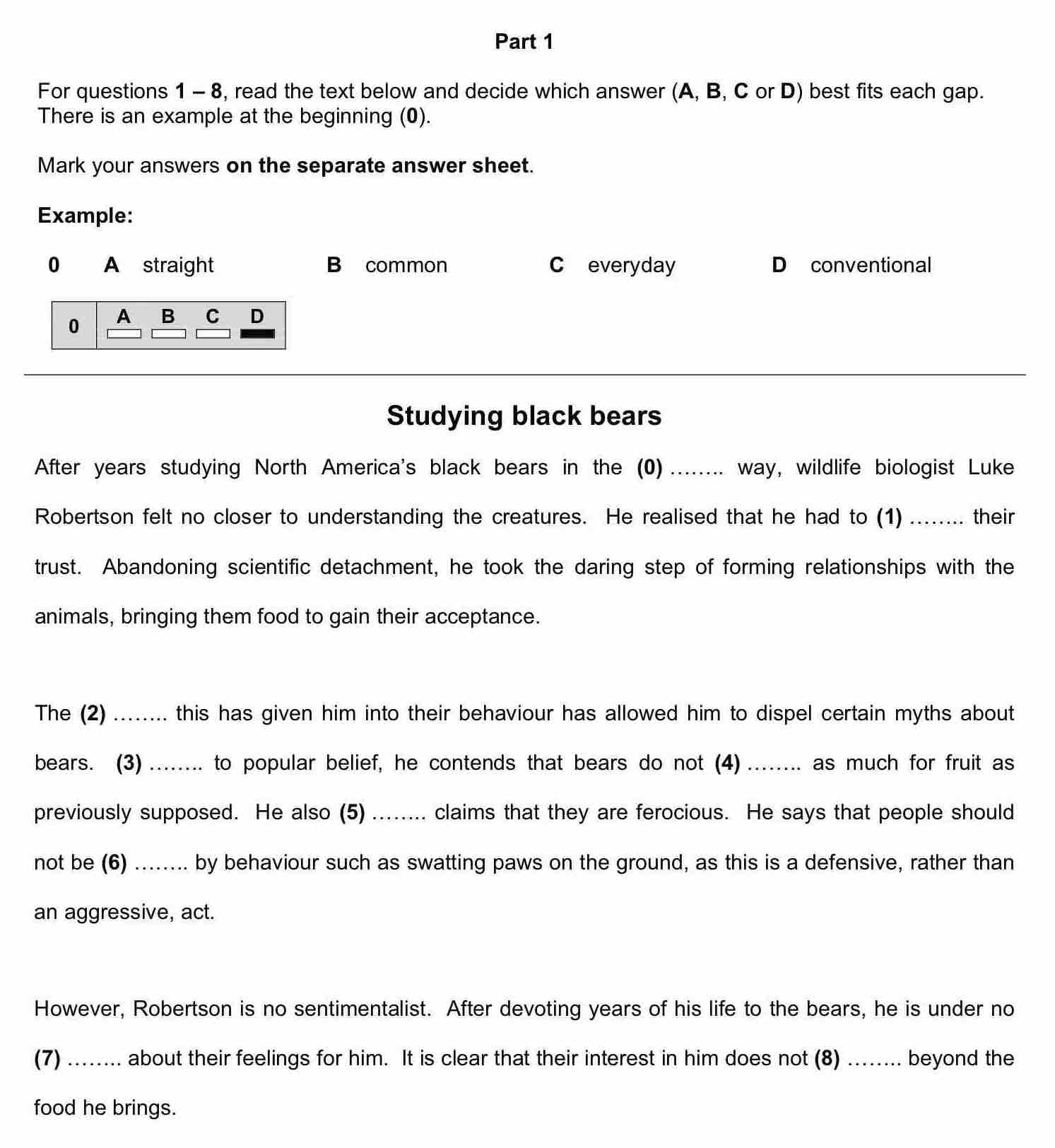
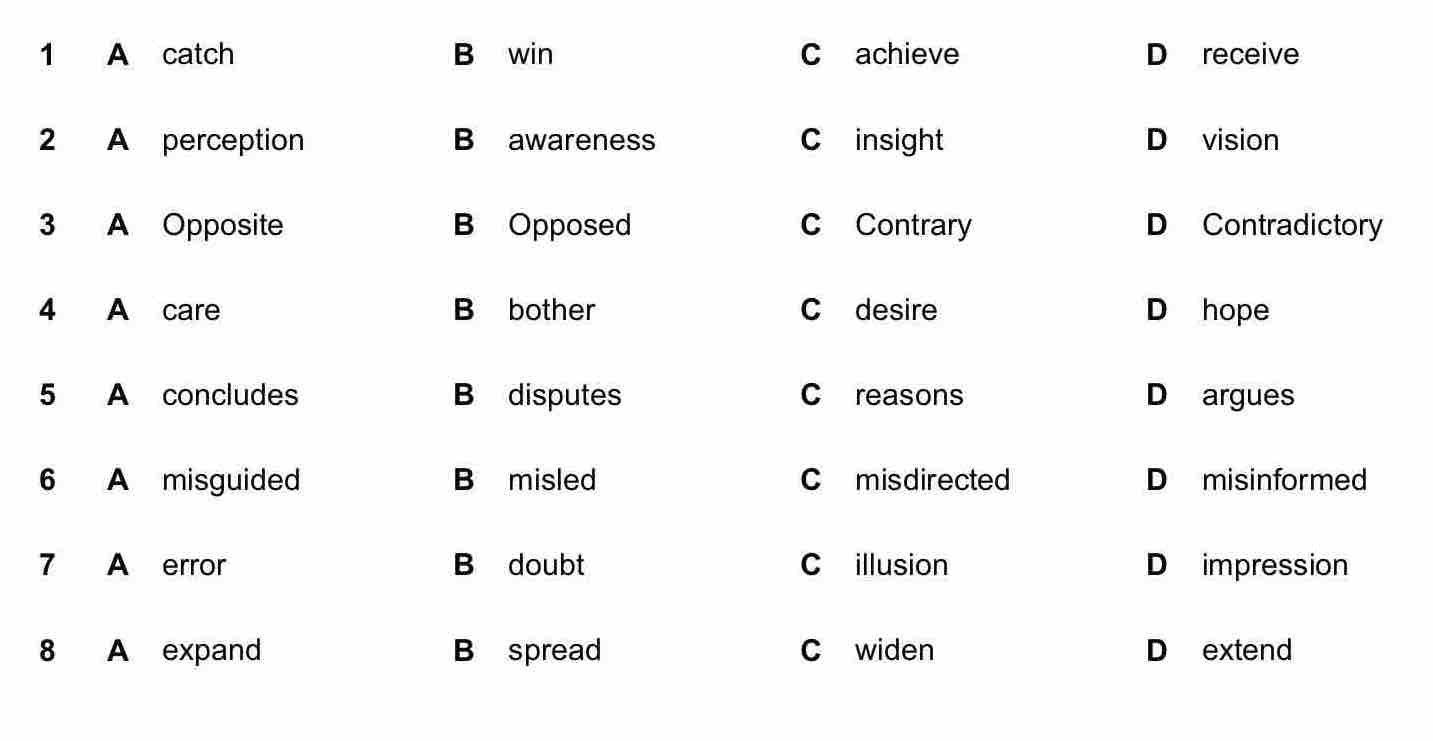
And in case you want to do this Part 1 exercise as practice, here are the answers below:
- B
- C
- C
- A
- B
- B
- C
- D
C1 Advanced (CAE): Use of English Part 2 – Open Cloze
As is the case in Part 1 of the Use of English, in Part 2 you are also presented with a short text with 8 gaps that you have to fill in. In this case, however, you don’t have options to choose from, but rather you have to think and figure out the word without «help».
Therefore, sometimes Part 2 can be one of the most difficult parts of the CAE Use of English, especially for candidates who have not previously done the B2 and are not familiar with this type of exercise.
To pass this part, it is essential to have a high level of English knowledge and know how to correctly use dependent prepositions, phrasal verbs, relative pronouns, idioms and idiomatic expressions, two-word verbs, etc.
And in case you still want to practise, below is another example, but this time of Use of English Part 2 taken from a real and official Certificate in Advanced English (CAE) exam, and just below I have put the answers. By the way, that is the old name for the C1 Advanced, but many people still refer to this exam by its old name.
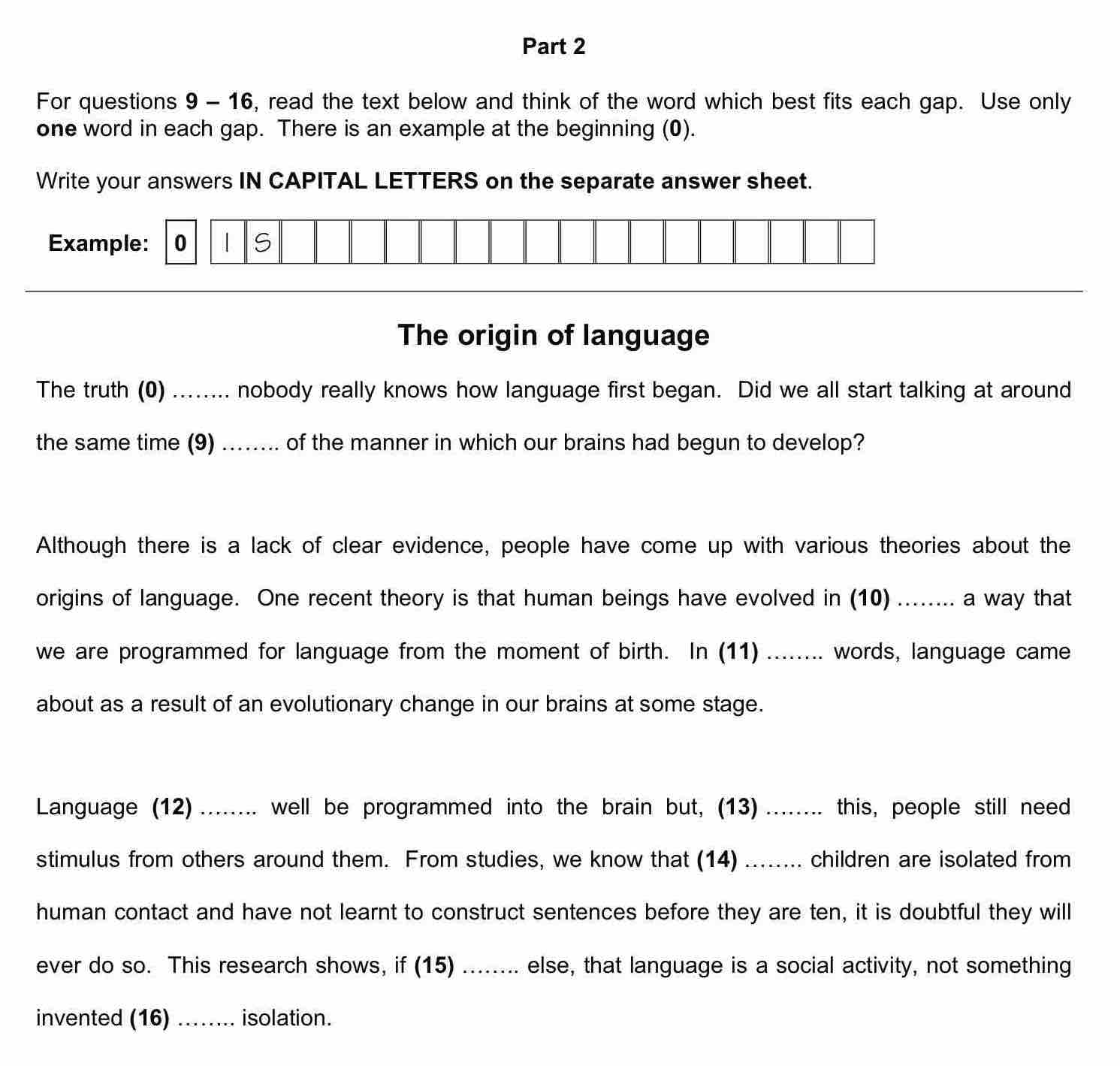
Answers:
- because
- such
- other
- could/may/might
- despite
- if/when/whenever
- nothing/little
- in
C1 Advanced (CAE): Use of English Part 3 – Word Transformation
In Part 3 of the Advanced Use of English, you will also have to work with a short text that has 8 gaps. But in this part, the task is very different from the previous ones. You’ll see now.
For each of the gaps, you are given a word whose root is common to the one you need in the gap. For example, imagine you are given the word EMPLOY. You will have to read the text carefully and understand it perfectly to know which word with the root common to «employ» you need to put in the gap. For example, that word could be UNEMPLOYMENT.
Basically, you have to transform the words (which come at the end of each line with a gap) so that, grammatically and semantically, they fit perfectly in the gap.
The most interesting thing about this type of exercise is that on the one hand you must know how to transform the word, and on the other hand it is essential to know how to identify what type of word you need in each gap: verb, noun, adjective or adverb.
In my opinion, due to the number of roots that many words in English and Spanish share, stemming from Latin, this is the least difficult part of the C1 Use of English for most candidates. But obviously, this is not the case for everyone.
Below is another example task. Remember that the words are on the same line as the gap where they should be transformed, i.e., they come in order. Don’t get confused.
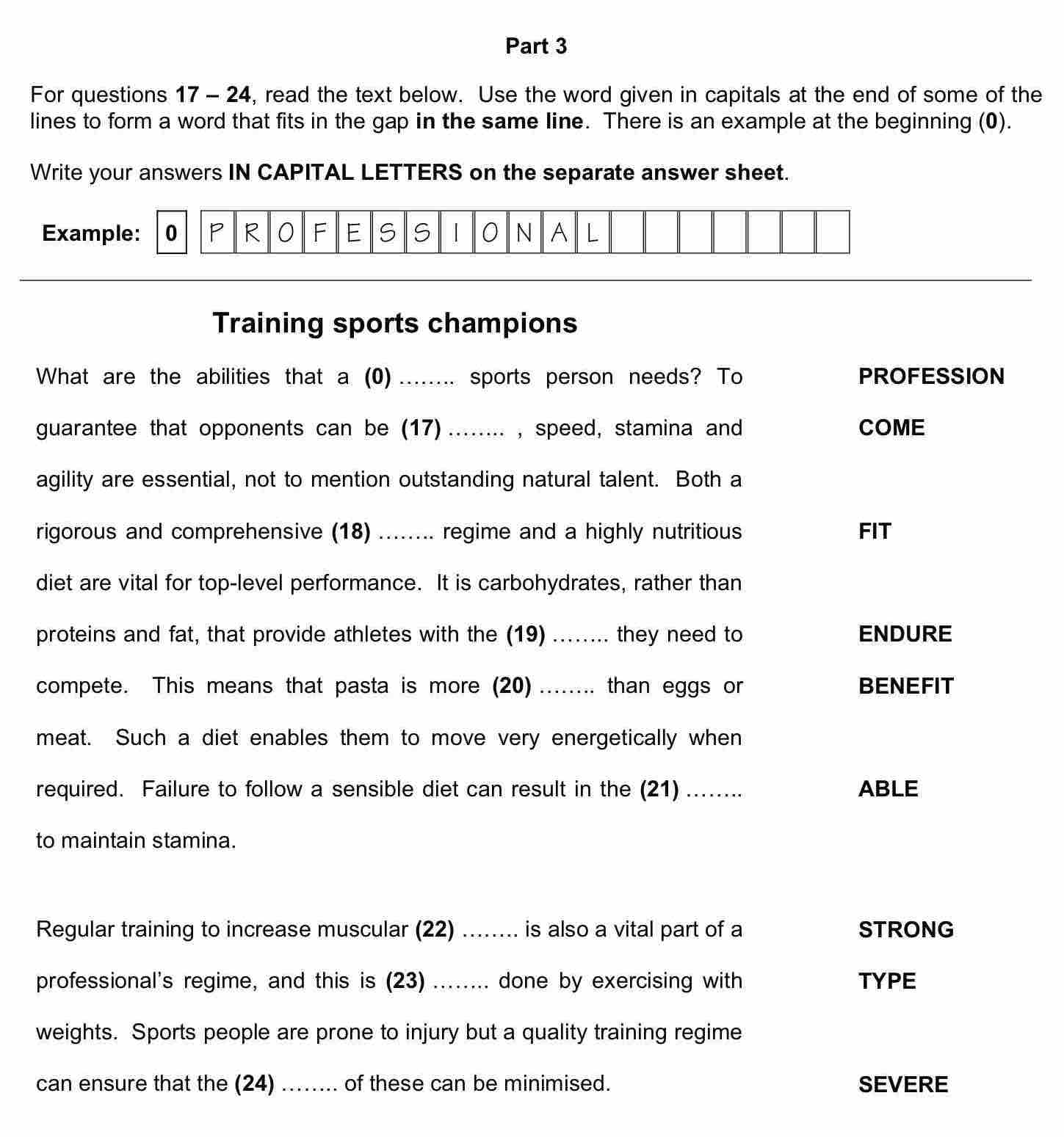
And here are the answers:
- overcome
- fitness
- endurance
- beneficial
- inability
- strength
- typically
- severity
What did you think of this part? Interesting, right?
C1 Advanced (CAE): Use of English Part 4 – Key Word Transformation
And finally, we arrive at my favourite part of the C1 Advanced: Use of English Part 4 Key Word Transformation.
In this part of the CAE, you have to transform 6 sentences using one word (the key word) in such a way that you achieve another sentence that has the same meaning. To transform each sentence, you must use the key word intact, meaning you cannot modify it in any way. And for C1 level, you must use between 3 and 6 words, including the key word.
I love it! 😀 I really like this task because it makes you think and reason, but I admit it’s quite difficult. In fact, I’d say it’s the most difficult of all. Let’s look at an example sentence so you can see exactly what needs to be done in Part 4 of the C1 Use of English.
James would only speak to the head of department alone.
ON
James ___________________ to the head of department alone.
If you pay attention to the sentence, you will see that part of the information is already reflected in the second sentence (e.g., to the head of department) and another part is not (e.g., would only speak). Perfect, now you must find a way to reflect that information using the word ON.
Beautiful, isn’t it? It blows my mind, haha.. Come on, think of the answer.
Ready? Okay, check your solution below.
Solution: James insisted on speaking to the head of department alone.
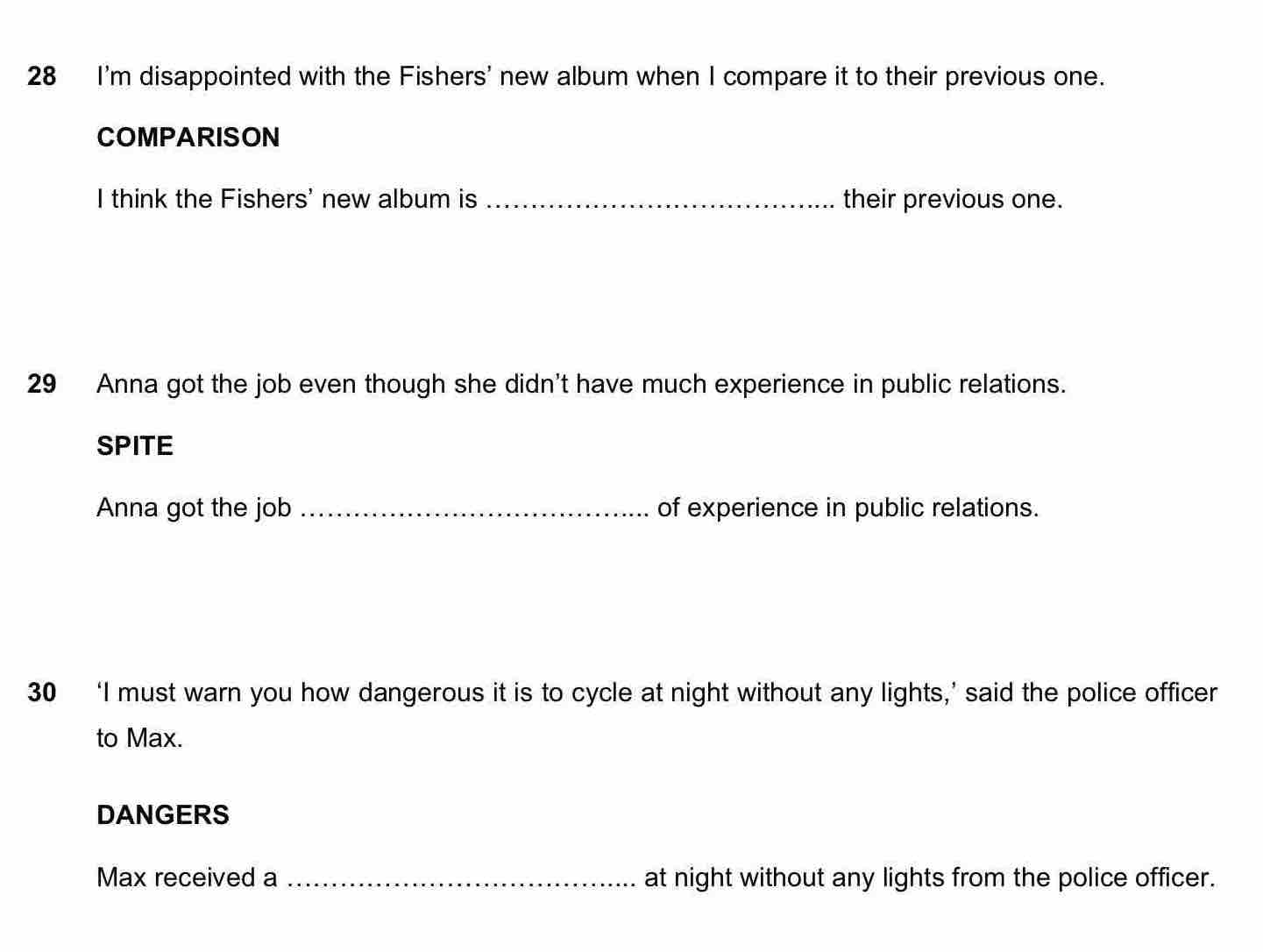
And for more examples, here is a video of mine and another 6 sentences for you to practise, with their respective solutions below.
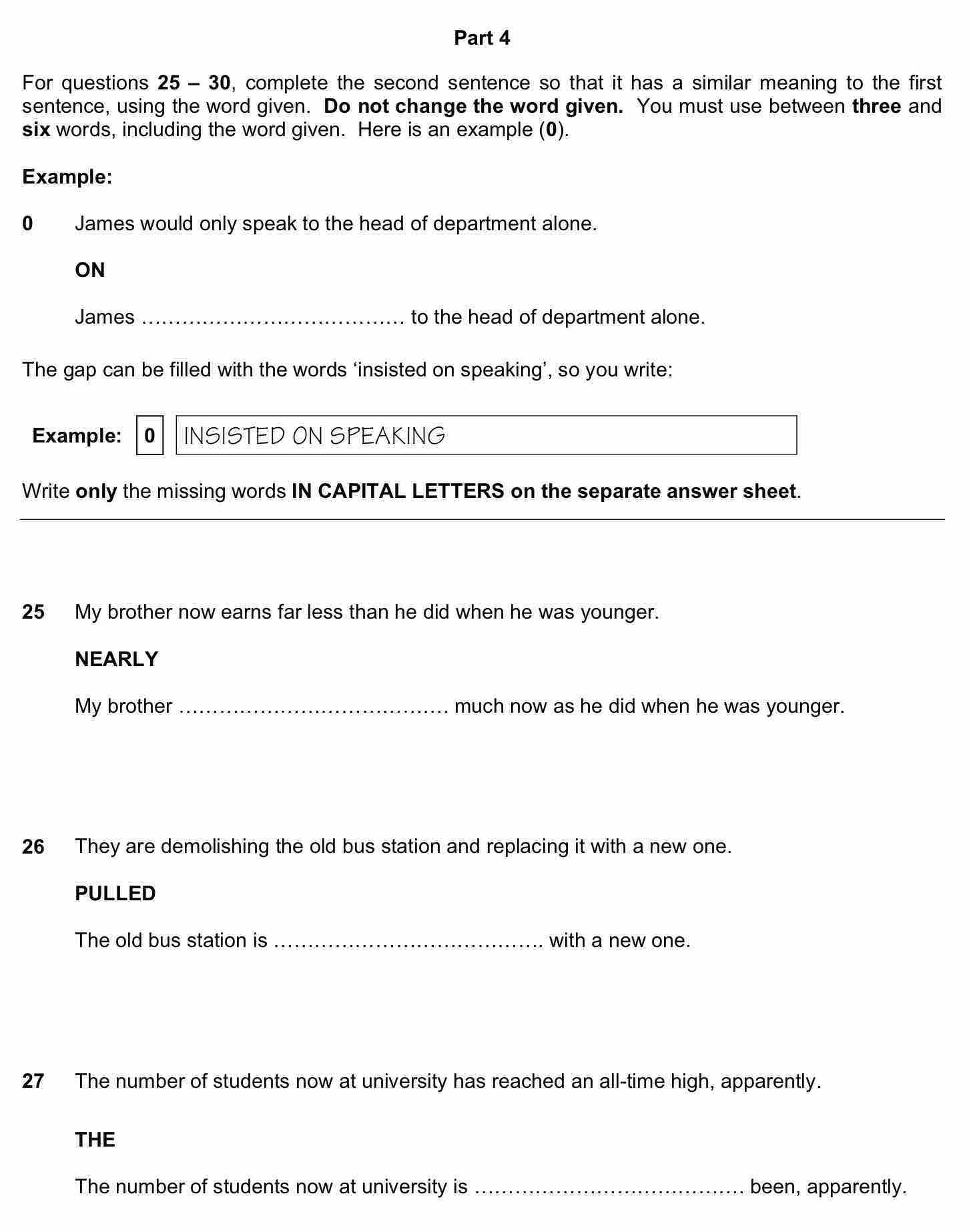
Answers:
- does not earn | nearly so/as OR does not make | nearly so/as
- being pulled down | and (being) replaced/to be replaced OR to be pulled down | and replaced
- the highest | (that/which) it has ever
- disappointing/a disappointment | in comparison with/to
- in spite of | a/her lack
- warning about / regarding / concerting | the dangers of / when cycling
If you want to practise the Use of English Part 4 of the C1 Advanced (CAE), I recommend my ebooks 50 Key Word Transformations for C1 Advanced (CAE). These are 2 exercise ebooks with 50 sentences containing the most common transformations that have appeared in past C1 Advanced (CAE) exams. If you want to take a look, just click on the image below.
Common content in the Use of English Part 4 of the C1 Advanced (CAE)
Although we have already seen some of the most typical lexical and grammatical content of this part of the exam, it is essential that you know as much as possible about what might come up. For this reason, I am giving you a list below of things that usually appear in the Use of English Part 4 of Cambridge C1:
- Conditional sentences
- Comparative sentences
- Passive sentences
- Reported speech verbs and structures
- All verb tenses
- Modal and semi-modal verbs (simple and perfect)
- So and Such / Too and Enough
- Quantifiers
- Countable and uncountable nouns
- Word transformation (nouns, verbs, adjectives, etc.)
- Common Collocations
- Dependent prepositions
- Idiomatic expressions
- Idioms
- Phrasal verbs
- And much more.
The good thing is that most of this content is covered in the best books to prepare for the C1 Advanced (CAE). So it is «simply» a matter of practising a lot, a lot. 😃
App for the Use of English C1 Advanced (CAE)
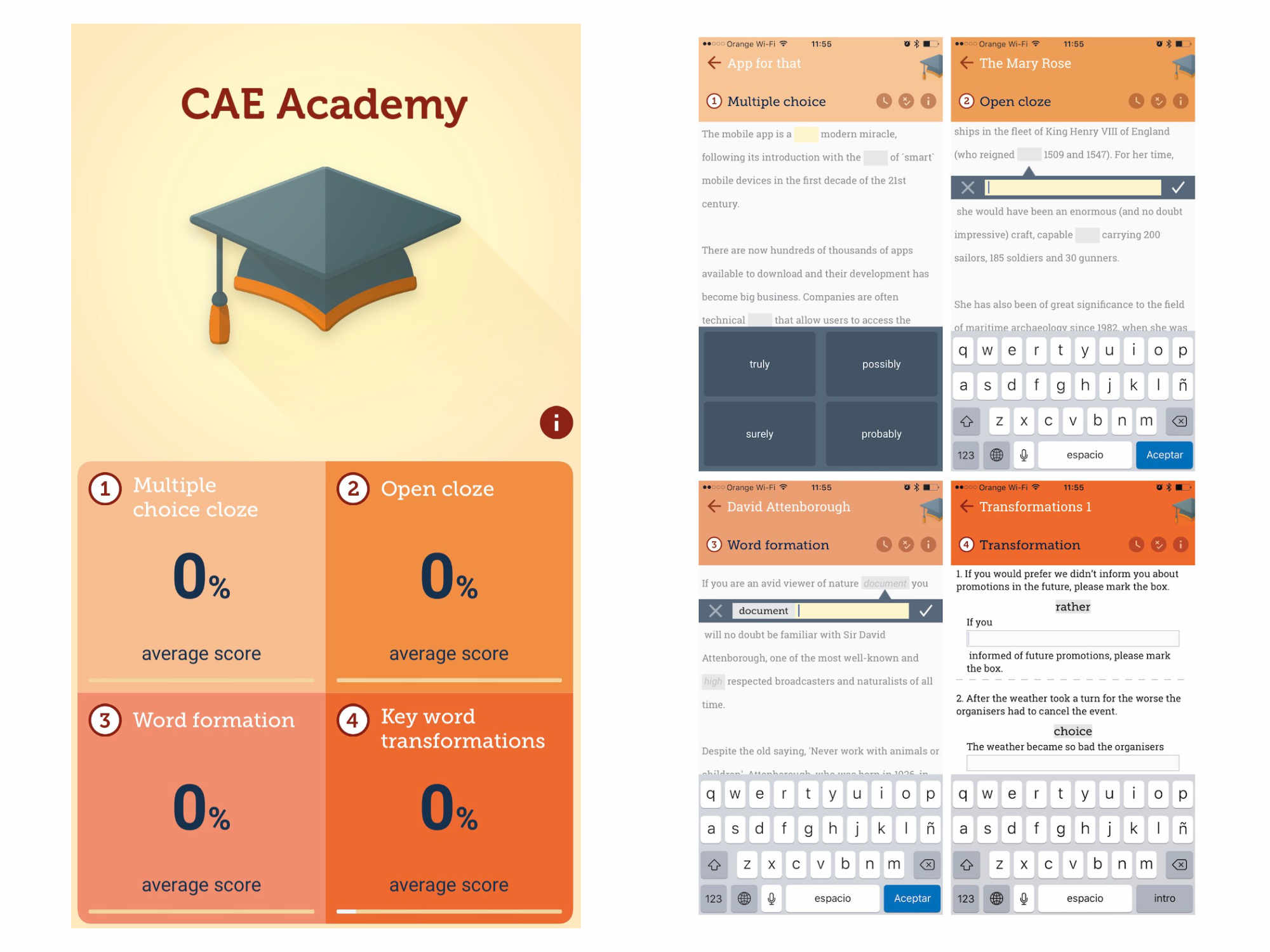
Apart from the Use of English C1 activities I have included in this article, there is a mobile application that I recommend to all my students so they can practise the Use of English interactively and without leaving their armchair. This app is called CAE Academy, and here you can see a video review I did some time ago so you can see how it works.
CAE Academy, developed by the publisher Prosperity Education, is an application that is available for both iOS and Android and offers 36 Use of English C1 Advanced exercises from Parts 1, 2, and 3, and 12 exercises from Part 4. These activities can be done on your mobile without needing to be connected to the internet. It’s an absolutely brilliant application, as the texts have been written and reviewed by experts in Cambridge Assessment English exams.
I hope this app is very useful for improving your Use of English! I recommend it 100%!
Tips for improving C1 level Use of English
As I have told you several times throughout this article, the C1 Use of English is one of the most problematic parts for CAE candidates. In my opinion, the problem we find here is that, in general, this type of exercise is not what we are used to in traditional English classes. This is because it is not about, for example, doing activities with a particular verb tense, but about knowing how to apply the knowledge of those verb tenses without being told which specific verb tense we have to use.
This applies to all the content we usually study in English. For this reason, the study method you need to use to practise the Use of English and ensure a great pass must be different.
Below are the tips you should follow to improve your Use of English:
- Read and listen actively a lot: Reading and listening to texts in English is fundamental for learning and perfecting English. However, if you want to improve your Use of English, you must do it actively, so simply putting Netflix on with English subtitles is not enough. No, if your intention is truly to improve your Use of English, you have to put on English subtitles and grab a notebook and pen to jot down idiomatic expressions, phrasal verbs, prepositions, etc., that appear in conversations. If you don’t, you will only improve your Listening and not so much your vocabulary and grammar. You have to do the same when you read. Take a short text, an article or something like that, and after reading it, reread it and underline all the interesting expressions, unusual word combinations you don’t know, etc. What you have to ask yourself is: would I know how to write this expression without having read it before? If the answer is no, write it down and study it well. Remember that we are talking about a C1 level now, so anything you don’t know, you should try to learn or at least understand.
- Keep your notes organised: Organisation in studying is essential, I always say it. Being organised helps us to categorise knowledge correctly in our brains when we study content, especially if you are a bit structured like me. 😂 For this reason, you need to have one or more notebooks, divided into categories. For example, you can divide them by Use of English parts (Part 1, 2, 3, or 4), by lexical or grammatical points (conditionals, modals, phrasal verbs, idioms, etc.), by semantic fields if it’s vocabulary, etc. You can do it however you want, but do it in an organised and systematic way. And if you are as modern as I am, I recommend using Google or Word documents, so you always have it more readily available.
- Review and repeat regularly: This is veeeery obvious, but you have no idea how many times I have to repeat the meaning of certain phrasal verbs in class, just to give you an example. Why does this happen? Well, because most people hardly ever review. However, nowadays it is very easy to review and practise, and it doesn’t have to be boring. With my students, I use the Quizlet platform and mobile app, with which you can create your own units to review and study whatever you want, on your mobile, tablet, or computer. Quizlet is really cool.
- Write, speak, and practise: Any language, including English, if you don’t practise it, you forget it. So if you want to improve your Use of English without taking steps backward, it is very important that you put your learning into practice when speaking and writing. It’s obvious that it will always be easier to do it when writing, as we have more time to think about what we write than what we speak. That’s why I recommend doing many Writings and making a maximum effort to include new expressions and collocations that you have recently learned by reading or listening.
- Consult an academy or an English teacher: English academies and teachers are, obviously, professionals and many like me specialise in Cambridge Assessment English exams, so we know what kind of content will appear in the exam and we can prepare you better than you can prepare yourself on your own.
How the C1 Advanced (CAE) Use of English is scored
The Use of English is one of the easiest parts to score, but you must remember what I explained earlier: the Reading and Use of English are done together, but they are scored separately, and Part 1 of the Reading & Use of English is actually part of the Reading, understood? Knowing this, the C1 Use of English is scored as follows:
- Part 2: 8 points (1 point / 1 item)
- Part 3: 8 points (1 point / 1 item)
- Part 4: 12 points (2 points / 1 item)
Parts 2 and 3 are very easy to correct, but in Part 4, each sentence can score 1, 2, or 0 points. When you do Use of English exercises from official exams, you will see that the answers are divided by this symbol «|». That is so as to assign one point to each part. That is, if you get one half wrong and the other right, you will get 1 point; if you get both right, 2 points; and if you get both wrong, 0 points.
To know if you have passed, you must add up all the points and get 16 or more points. The maximum you can get is 28 points, and 16 is the minimum to consider this part as passed. If you want to know more about the Cambridge scoring system, read my post on how to calculate your Cambridge Assessment English exam score. A classic on this website!
Anyway, I think there is nothing left for me to say or explain about the CAE Use of English. I hope I have helped you with this guide to the C1 Advanced Use of English, and that both the exercises and the CAE Academy app are useful to you. If you still have any questions, don’t hesitate to leave me a comment below. I always reply to all comments personally.
And until next time, don’t forget to keep smiling! 😃