
C1 Advanced (CAE) Speaking Part 3: Description, Sample Test & Useful Phrases
Learn all about C1 Advanced Speaking Part 3. Check out the description, some sample answers and download the whole post as PDF file to read offline.

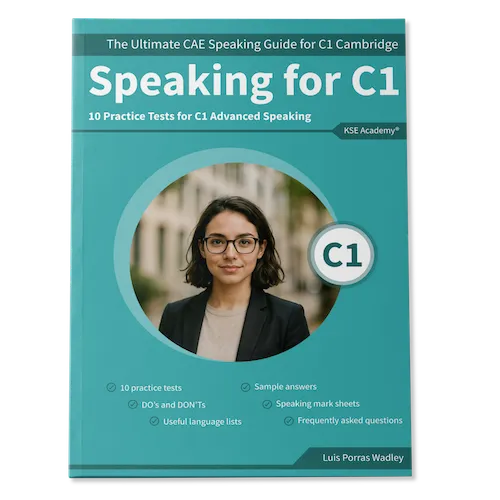
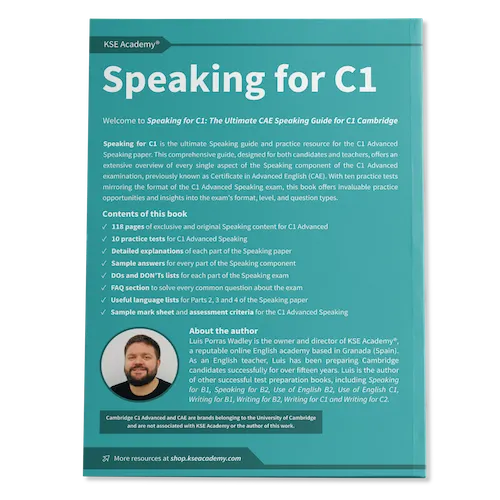
Table of contents
I have already told you all about the CAE Speaking Parts 1 and 2, so in this article I will focus more specifically on CAE Speaking Part 3. I doing so, I’ll give a full description of this part, which, together with C1 Speaking Part 2, is the most popular part of the exam. As we will see in the coming paragraphs, both candidates must work together in order to succeed in this part of the test.
Description of CAE Speaking Part 3
CAE Speaking Part 3 is the main collaborative task of the C1 Advanced test. In this part, you and your partner are presented with a topic in the form of a question and a few prompts linked to it . You are then expected to develop a two-minute discussion around the topic, making use of the prompts provided (optional). When the two minutes are over, you’re asked to make a decision with regard to the topic. You will have one more minute to do this. [amazon box=»1913825442″ description=»Get your copy of Speaking CAE to gain access to 10 complete C1 Advanced (CAE) Speaking Tests and many more things: description of each part, sample answers, guidance for every part, mark sheet, author comments and tips, etc.»]
Timing of the C1 Advanced Speaking Part 3
Although I’ve already mentioned the timing in the previous section, let’s see a more specific overview of how this part is carried out and how long it is supposed to be:
- Examiner’s instructions (total): 1 minute
- Pair discussion of the options: 2 minutes (3 minutes for groups of 3 candidates)
- Reaching a conclusion: 1 minute
- Total time: 4 minutes
And now that we know exactly how long it is, let’s move on to the instructions of this exam, so you know exactly what you can expect on the day of the exam. And there’s no better way to do this than with an example of C1 Advanced Speaking Part 3.
CAE Speaking Part 3 Example
C1 Advanced Speaking Part 3 Sample Test: Examiner’s initial instructions
– Interlocutor: Now, I’d like you to talk about something together for about two minutes.
Here are some things people think about when moving to a different country for work and a question for you to discuss. First you have some time to look at the task.
(The examiner places the following picture in front of you and allows you 15 seconds to read the question and study the options.)
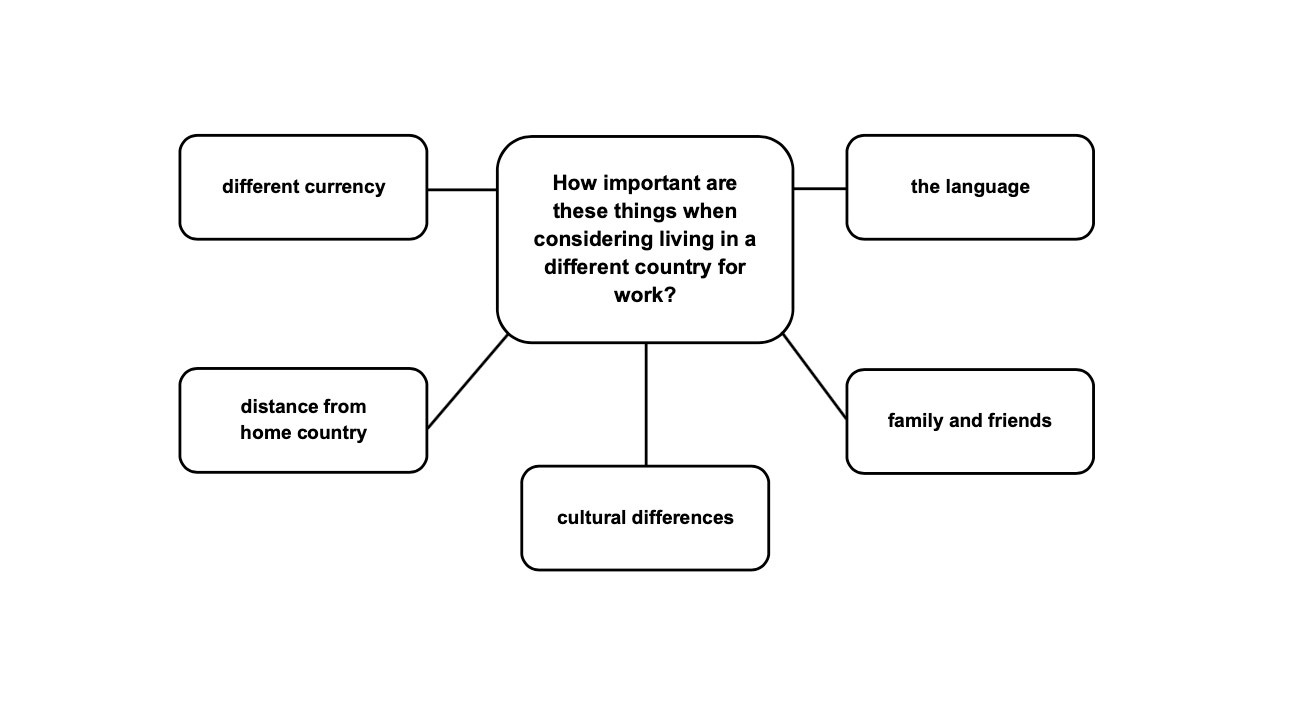
– Interlocutor: Now, talk to each other about how important these things are when considering living in a different country for work.
– Candidate A: Would you like to begin, or shall I?
– Candidate B: You can go first. Go ahead.
– Candidate A: Cheers. While moving abroad, it’s important to keep in mind the distance between your own country and the one you’re moving to. That’s gonna affect your cost to come home on vacation, as well as the time difference when you’re calling your friends and family back home. Would you agree?
– Candidate B: That’s an excellent point. You’re right, I guess I hadn’t given that much thought at first. Since you mentioned it, I think your family and friends also need to be considered. I don’t know about you, but I’m pretty sure it’s easier to move somewhere where you already know some people. What do you think?
– Candidate A: Sure, that’d make it so much easier. I know it’s hard to leave your loved ones behind. Let’s talk about the language now, as this is probably one of the most important things to bear in mind about before moving abroad. Don’t you think it would be nuts to move abroad for work if you can’t speak the language?
– Candidate B: Oh yeah, sure. Yeah. If you are moving for work, you should learn the language of the country you are moving to. What about the differences in currency and culture? Do you consider them to be important?
– Candidate A: Having to operate in another currency is not a big deal, because you can pick it up in a few days, but cultural differences… that’s another story, wouldn’t you say?
– Candidate B: Yes, definitely. Culture is such a broad concept that it takes years to get accustomed to a new one. Therefore, I think it’s worth getting to know a country’s culture before moving there. Well, that’s my philosophy anyway.
C1 Advanced Speaking Part 3 Sample Test: Examiner’s second set of instructions
When the first two minutes are up, the examiner will interrupt the conversation above to say:
Thank you. Now you have about a minute to decide which aspect is the least important when moving to a different country for work.
– Candidate A: Okay… what are your thoughts? Which one do you think is the least important?
– Candidate B: Well, I believe we have already discussed it. To my mind, the currency is not something you should be concerned about before moving to another country. Once you start using it, you will quickly become familiar with it; you will just need to keep it in mind before your trip so that you can exchange some money beforehand. How do you feel about that? Do you agree?
– Candidate A: Yeah, I do. It’s just one of those aspects of living abroad that you get used to very quickly. And it’s not as important as other aspects like language or cultural differences, right?
– Candidate B: Yes, exactly. So, shall we agree on this one?
– Candidate A: Yes, sure. We have an agreement.
C1 Advanced Speaking Part 3 Sample Test: Examiner’s final instructions
Thank you. Can I have the booklet, please?
Basic observations for C1 Advanced (CAE) Speaking Part 3
In the the sample task above, you will notice the following features of CAE Speaking Part 3:
- Instead of speaking alone, the candidates are required to interact with one another.
- Expressing and asking for opinions is important, as is agreeing and disagreeing with the other candidate and being able to change subjects.
- The examiner’s question is printed in the booklet he/she places in front of the candidates.
- There is no requirement for candidates to discuss all options on the booklet, but they are encouraged to do so.
- Candidates should share their opinions and ask questions during the discussion.
- Reaching an agreement with your partner is advisable, but not essential and not a test requirement.
- Candidates must demonstrate to the examiner that they are discussing and working towards a final decision, even if reaching an agreement doesn’t happen.
[amazon box=»1913825442″ description=»Get your copy of Speaking CAE to gain access to 10 complete C1 Advanced (CAE) Speaking Tests and many more things: description of each part, sample answers, guidance for every part, mark sheet, author comments and tips, etc.»]
CAE Speaking Part 3: Useful Phrases to Engage in a Discussion
In this section, we’ll take a look at some useful phrases and expressions that you can use in any discussion like the one in this part of the C1 Speaking. As I usually do, I have divided them into the different uses: starting a discussion, expression and asking for opinions, agreeing, disagreeing, changing the subject and concluding.
Starting a discussion
- Shall I start? / Yeah, go on.
- Shall I go first? / Of course, go ahead.
- Is it okay if I start? / Sure, no problem.
- Would you like to go first? / Yes, why not?
Expressing opinions
- I believe/think that…
- In my opinion,…
- The way I see it,…
- If you ask me,…
- I would say that…
- It seems to me that…
- In my view…
- As far as I’m concerned,…
Asking for your someone’s opinion
- statement, don’t you think/agree?
- statement, wouldn’t you say so?
- statement , wouldn’t you agree?
- statement, right?
- Do you think…?
- Do you believe that…?
- What do you think about…?
- How about…?
- What about…?
- What’s your take on…?
Agreeing
- I (totally) agree with you.
- You’re dead right.
- That’s (absolutely) true.
- You’re (absolutely) right.
- That’s a great idea.
- I couldn’t agree more.
- Yes, I see what you mean.
- I see it that way, too.
- Yes, of course.
- I think so, too.
Disagreeing
- I’m afraid I don’t see it the same way.
- I’m sorry but I have to disagree.
- You may be right, but I have a different view.
- That might be true, but I’m not sure I agree with you.
- I’m sorry, but I don’t agree.
Moving on to a different the subject
- As for + one of the options
- As to + one of the options
- In relation to + one of the options
- As regards + one of the options
- Regarding the question of the task,
- With regard to + paraphrased question
Concluding the discussion
- I believe we have an agreement, don’t we?
- So, do we have an agreement?
- Shall we stick to…?
- Shall we agree on..?
[amazon box=»1913825442″ description=»Get your copy of Speaking CAE to gain access to 10 complete C1 Advanced (CAE) Speaking Tests and many more things: description of each part, sample answers, guidance for every part, mark sheet, author comments and tips, etc.»]
Top 10 Tips for CAE Speaking Part 3
- Have a clear discussion, not 2 monologues: Many candidates believe that the more they speak, the better. However, this is not true here. As a general rule, it is what you say that counts, and in this section, you should be discussing rather than speaking alone.
- Justify your opinions: Justifying your opinions is as important as expressing them. In addition to showing the examiner that you are capable of justifying your opinions in English, you are also providing your partner with useful material for the remainder of the discussion. Let’s just say that your justifications help to guide the discussion.
- Try to speak about all the options: Even though it is not a requirement, if you rely exclusively on one option, you will have less of a chance to demonstrate your ability to interact with others. It is for this reason that I always recommend jumping from one option to another, so that you have multiple opportunities to agree, disagree, and express your opinions.
- Work with your partner: You should not view your partner as an enemy. It is important that you see him/her as an ally, as you will be assessed separately.
- Help your partner: If your partner is having difficulty finding the right words or ideas to express, you can lend a hand by offering some ideas or words that you think he/she is trying to express. In addition to being helpful to the conversation itself, this will also demonstrate to the examiner that you have good communication skills.
- Step up your interaction skills: A large part of the score in this section of the speaking test is determined by your ability to interact, which means that you need to ask for opinions from your partner and be able to agree or disagree with them. Therefore, if you wish to impress the examiner, you should familiarise yourself with a set of expressions. So do your best to avoid the typical «What do you think about…?» or «I agree/disagree», and go for something a little more advanced, such as «wouldn’t you agree?», or «I’m afraid I don’t hold the same opinion.»
- Keep your turn short: It is important to bear in mind that we are debating different options with the other candidate, not reciting a monologue. If you speak for 60 seconds continuously, you are not interacting, which indicates a lack of communication skills.
- Stick to the topic: Please ensure that you stay on topic and answer exactly what the examiner has asked.
- Finish your statements with a question or a question tag: A natural way of keeping the conversation flowing is to conclude your statements with a question, which is the entire purpose of Speaking Part 3.
- Address your partner: Keep in mind that you are having a conversation with someone, that is, your partner. In other words, when you speak, pay attention to your partner rather than to the examiner.
Bonus Tip
- Be polite & smile: You would be surprised at what humans can accomplish with politeness and a smile. By maintaining a positive, cheerful attitude, you will make a more favorable impression on the examiners and your partner, in addition to making you a more effective communicator.
[amazon box=»1913825442″ description=»Get your copy of Speaking CAE to gain access to 10 complete C1 Advanced (CAE) Speaking Tests and many more things: description of each part, sample answers, guidance for every part, mark sheet, author comments and tips, etc.»]
Video of a Real FCE Speaking Part 3
It’s good to see an actual test, so here’s the third part of the CAE speaking test. But remember, these candidates aren’t perfect, so learn from their mistakes instead of making them yours!
If you enjoyed this post, please comment and share! And don’t forget to keep up with KSE Academy’s latest news by following me on Facebook, Twitter and YouTube!And don’t forget to keep smiling!