
C1 Advanced (CAE) Speaking Part 2: Description, Examples & Useful Phrases
Learn all about C1 Advanced Speaking Part 2. Check out the description, some sample answers and download the whole post as PDF file to read offline.

Table of contents
In this post, we’re going to take a close look at Part 2 of the C1 Advanced (CAE) Speaking. This is one of the most characteristic parts of this exam and, for some candidates, one of the most difficult. However, as I always say, there’s always some great preparation you can do for it which will reduce stress and help you deal with this part in a very efficient way. And that is exactly what I’m here to teach you. So carry on reading and make sure to take notes!
Description of CAE Speaking Part 2
Part 2 is the main individual part of this Speaking test and it comprises two main tasks. Firstly, in turns, each candidate is given three photographs and two questions about them. The interlocutor asks each candidate to compare two of the photographs while responding to the questions. Secondly, when one candidate has done the first task, the other candidate has to respond to a question about the first candidate’s pictures.
[amazon box=»1913825442″ description=»Get your copy of Speaking CAE to gain access to 10 complete C1 Advanced (CAE) Speaking Tests and many more things: description of each part, sample answers, guidance for every part, mark sheet, author comments and tips, etc.»]
Timing of the C1 Advanced Speaking Part 2
CAE Speaking Part 2 has the following timing and order:
- Candidate A’s comparison + questions: 1 minute
- Candidate B’s follow-up question: 30 seconds
- Candidate B’s comparison + questions: 1 minute
- Candidate A’s follow-up question: 30 seconds
If this isn’t clear or you’re still unsure about the duration and dynamics of this part, please refer to the video at the end of this article, where you can see a video of a C1 Speaking test, including Part 2. Now that we’re familiar with the timing, let’s move on to the instructions. As I always say, it is important to know beforehand what kind of exam you’re taking, whether it be in regards to timing, tasks, instructions or content. For this reason, it is important to know the instructions you will be given for CAE Speaking Part 2 before taking it. So let’s move on to that!
CAE Speaking Part 2 Examples
What follows is a written reconstruction of what a C1 Advanced Speaking Part 2 would be like. Therefore, you’ll see that I’ve included both what the examiner (interlocutor) and candidates would say as well as the pictures on which the activity is based.
[amazon box=»1913825442″ description=»Get your copy of Speaking CAE to gain access to 10 complete C1 Advanced (CAE) Speaking Tests and many more things: description of each part, sample answers, guidance for every part, mark sheet, author comments and tips, etc.»]
Examiner’s initial instructions
In this part of the test, I’m going to give each of you three pictures. I’d like you to talk about two of them on your own for about a minute, and also to answer a question about your partner’s pictures.
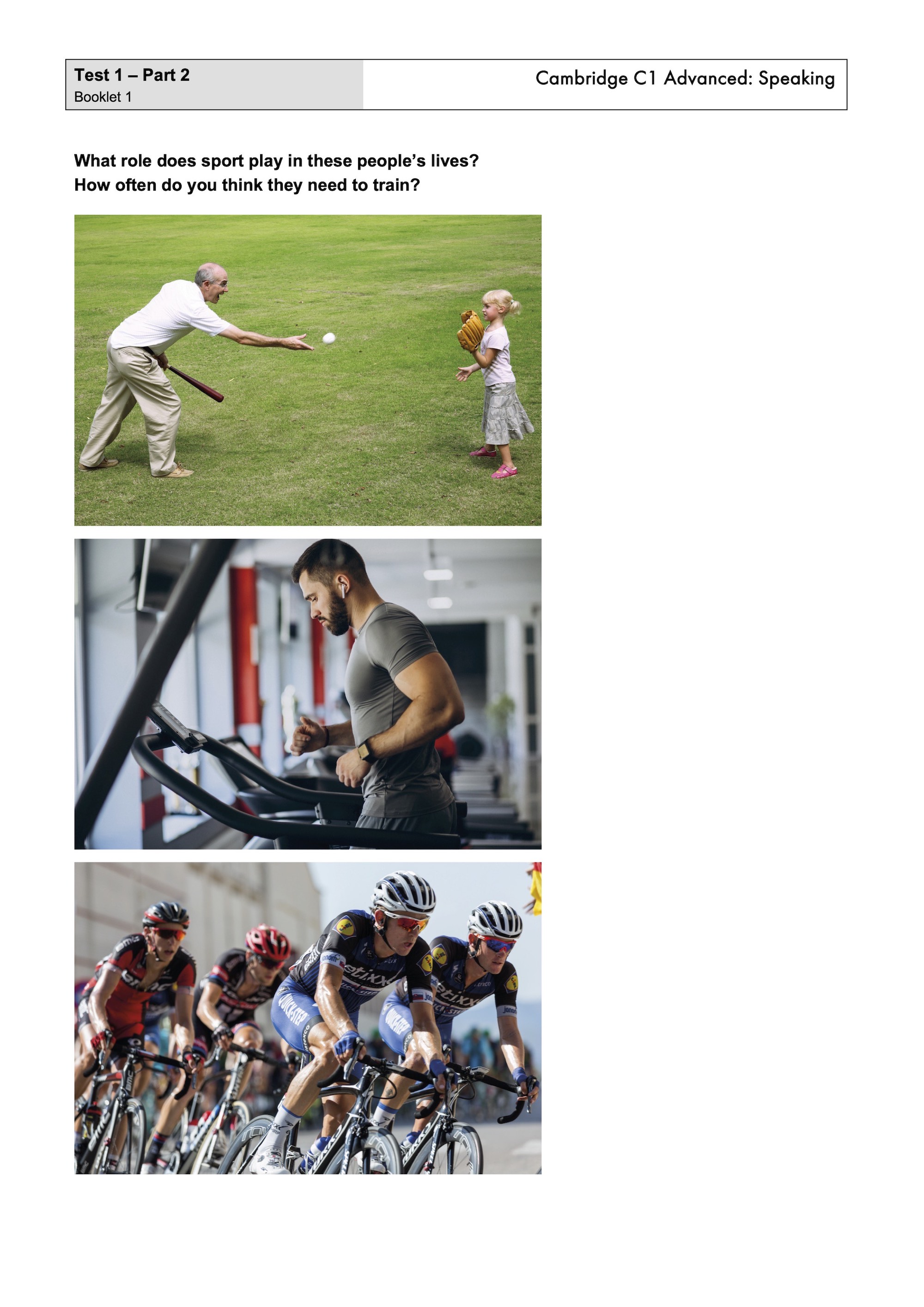
(Candidate A), it’s your turn first. Here are your pictures. They show people doing some sport. I’d like you to compare two of the pictures and say what role sport plays in these people’s lives and how often you think they need to train.
(place the following pictures in front of Candidate A)
Candidate A’s response
Both of these pictures show people doing some sport in entirely different circumstances. While in the first picture baseball is simply a carefree game that a grandfather and granddaughter are enjoying together, the third picture portrays a situation in which sport plays a far more serious role, as these men appear to be taking part in a professional cycling competition. In their case, cycling is probably a means to making a living, whereas in the first picture they’re just playing for pure fun.
As for the second question, I believe that training almost daily is vital for the cyclists, as they need to keep up their performance in order to compete at a high level. On the other hand, training isn’t required whatsoever for playing baseball occasionally with your grandchild, as in the first picture.
Examiner’s follow-up question for Candidate B
Candidate B, who do you think needs to train the hardest?
Candidate B’s response
Well, I completely agree with Candidate A. The way I see it, the cyclists in this picture actually make a living out of sport, whereas for the other people it’s more of a fun hobby or a personal choice. For this reason, I believe it’s the cyclists who have to train the hardest, as they need to keep up their fitness levels in order to enter and actually win professional competitions.
[amazon box=»1913825442″ description=»Get your copy of Speaking CAE to gain access to 10 complete C1 Advanced (CAE) Speaking Tests and many more things: description of each part, sample answers, guidance for every part, mark sheet, author comments and tips, etc.»]
Basic Observations for C1 Speaking Part 2
Let’s now make a few observations about the task above, where we can notice the following features:
- Candidate A is asked to compare two pictures (not three!) and to answer two questions about them.
- The questions the examiner includes in his explanation are also written above the pictures, so don’t worry about having to memorise them. That would be crazy!
- The person comparing speaks longer (1 min.) than the person answering the follow-up question (30 sec.), that is, in this case, Candidate A will have to speak longer than Candidate B.
- Given that Candidate A only has one minute to complete the task, he/she has compared both pictures while answering the questions. What’s important to notice here is that the comparison will have to be based on the questions about the pictures, as there’s not nearly enough time to do a full comparison and then focus on answering the questions.
- The expressions in bold are useful words or phrases to use in any comparison.
- Candidate A’s comparison follows a clear order: general introductory sentence + comparison with first question + comparison with second question. Although this particular order is not compulsory, it is recommendable.
Useful Language for CAE Speaking Part 2
What follows is a short list of expressions you can use in C1 Speaking Part 2 while comparing both pictures. I have divided these expressions into categories, according to when you would use each of them:
Useful Language to Compare the Photographs in CAE Speaking Part 2
Starting your comparison
- Both of these pictures show…
- These two pictures show…
- The two situations in these pictures are…
Talking about similarities
- These two pictures are similar because…
- These two situations are similar in that…
- In both pictures we can see…
- One similarity between these two pictures/situations is that…
- Another similarity might be that…
- One thing that these two situations have in common is that…
- One thing that these two pictures share is that…
- The most obvious similarity is that…
- These two pictures share the fact that…
- Both pictures (…) in the same way.
Talking about differences
- One of the most obvious differences (between these two pictures) is that…
- Another difference is that…
- Something that makes these two pictures different is…
- What makes these two situations (so/completely) different is…
- While the first picture …, the second one…
- The first picture…. However, the second one…
- The first picture… whereas the second one…
- Although the first picture…., the second one…
- On the one hand, the first picture shows… .
- On the other hand, the second one…
Introducing the answer to the question
- As for + paraphrased question
- As to + paraphrased question
- In relation to the question,…
- In response to the question, I’d say that…
- As regards the question,…
- Regarding the question of the task,
- With regard to + paraphrased question
Useful Phrases to Compare the Photographs in C1 Speaking Part 2
This task does not follow a particular structure, as it depends on the topic of the pictures. But you are typically asked to draw on your own experience in connection with the topic or to choose one of the pictures and justify your answer. For example, in the task above, the question for Candidate B starts «who do you think…?“ So you need to use expressions to provide your opinion.
So let’s see some expressions to answer this question correctly:
- In my (honest/humble) opinion,
- As far as I’m concerned,…
- The way I see it,…
- If I had to choose one of these two (…), I would (definitely) go for…
- In my experience,…
- In my case,…
- Well, it’s not an easy choice, but I think I’d prefer to…
- I would (…) no doubt.
- I would definitely prefer/choose…
- I believe that it’s more important to…
There is no specific formula to answer this follow-up question, given the broad spectrum we’re dealing with, but the expressions above will definitely help you answer more appropriately. My advice is that you focus on 2-3 of each category and try to organise your speech by using these expressions.
[amazon box=»1913825442″ description=»Get your copy of Speaking CAE to gain access to 10 complete C1 Advanced (CAE) Speaking Tests and many more things: description of each part, sample answers, guidance for every part, mark sheet, author comments and tips, etc.»]
Top 10 Tips for CAE Speaking Part 2
- Compare, don’t describe: Candidates often spend the entire minute describing both pictures separately, instead of comparing them. Keep in mind that the examiner explicitly asks you to «compare two pictures», so make sure you do so!
- Don’t overuse “and”: In the past, I have noticed that candidates tend to use the word «and» all the time, instead of something that expresses contrast. Since you’re asked to compare (not describe!), you ought to make use of other connective devices. Check out the model answer in this article above and notice the phrases in bold.
- Don’t focus too much on one picture: A minute is not much time, so you should make sure your speech includes the most prominent ideas about both pictures.
- Allow enough time to answer the question: It’s not unusual for candidates to spend so much time talking about the pictures that they forget to respond to the question, and they get interrupted by the interlocutor. Even though getting cut off is neither good nor bad in itself, not answering the question will negatively impact your score.
- Address the interlocutor: In this task, you don’t have to address your partner. This is an individual task, so simply focus on what you’re saying and address your remarks directly to your interlocutor.
- Finish your sentences: Candidates often begin a sentence and then realize they have made a mistake, and stop in mid-sentence. Your speech should not fade out in the middle; finish expressing your thoughts properly!
- Focus the pictures and the question: Compare the two pictures without mentioning things that happened to you in the past. The purpose of this part is to focus on the situations of the pictures, not on your own experiences.
- Stick to the topic: When the examiner asks you the follow-up question, simply stick to the topic and answer what he or she asked specifically.
- Ask for repetition: It’s perfectly fine to ask the examiner to repeat the instructions or the follow-up question if you didn’t catch it the first time.
- Use related vocabulary: In this article, we have primarily focused on comparing and expressing our opinions, but you still need to demonstrate that your vocabulary is of C1 level. So make sure you use the terms you’ve learnt in class and drop some advanced terms here and there that might impress your examiners.
Bonus tip!
- Smile: You’d be surprised by what human beings can achieve with a smile. A positive, upbeat attitude will help you make a better impression on the examiners, as well as making you a better communicator.
Video of a Real CAE Speaking Part 2
[amazon box=»1913825442″ description=»Get your copy of Speaking CAE to gain access to 10 complete C1 Advanced (CAE) Speaking Tests and many more things: description of each part, sample answers, guidance for every part, mark sheet, author comments and tips, etc.»]
If you liked this post, please comment and share it! Follow KSE Academy on Facebook, Twitter & YouTube and keep up with the latest news.
Oh, and don’t forget to keep smiling!