
How to Succeed in B2 First (FCE): Speaking Part 2
In FCE Speaking Part 2, you are asked to compare two pictures and answer one question. Here’s the best way to do that! 😎

Table of contents
In this post, I am going to focus on FCE Speaking Part 2, the second part of the B2 First (FCE) Speaking Test, which is one of the most interesting parts of this B2-level exam. It’s one of the easiest to prepare but also one of the parts that makes candidates most nervous. So that’s why I’m here, to teach exactly what you have to do and how to do Part 2 of the B2 First Speaking. So keep on reading!
Description of FCE Speaking Part 2
This part of the test comprises 2 tasks. First, you or your partner will have to compare two pictures and answer one question in the process. Second, you or your partner will be asked a follow-up question after the comparison. When you make the comparison, your partner will answer the other question and vice versa.
Timing of the B2 First Speaking Part 2
This part of the test is supposed to last 3 or 4 minutes, and the main elements that are timed are the following:
- Candidate A’s comparison + question: 1 minute
- Candidate B’s follow-up question: 30 seconds
- Candidate B’s comparison + question: 1 minute
- Candidate A’s follow-up question: 30 seconds
Instructions and Possible Candidate’s Response
When sitting any speaking exam, it is important to know what to expect, whether it be in terms of timing, tasks, instructions, content, etc. For this reason, I believe it is essential to be familiar with the instructions you will receive during FCE Speaking Part 2. Let’s go:
Examiner’s initial instructions
In this part of the test, I’m going to give each of you two photographs. I’d like you to talk about your photographs on your own for about a minute, and also to answer a question about your partner’s photographs.
(Candidate A), it’s your turn first. Here are your photographs. They show people who are helping other people in different situations.
(place the following pictures in front of Candidate A)
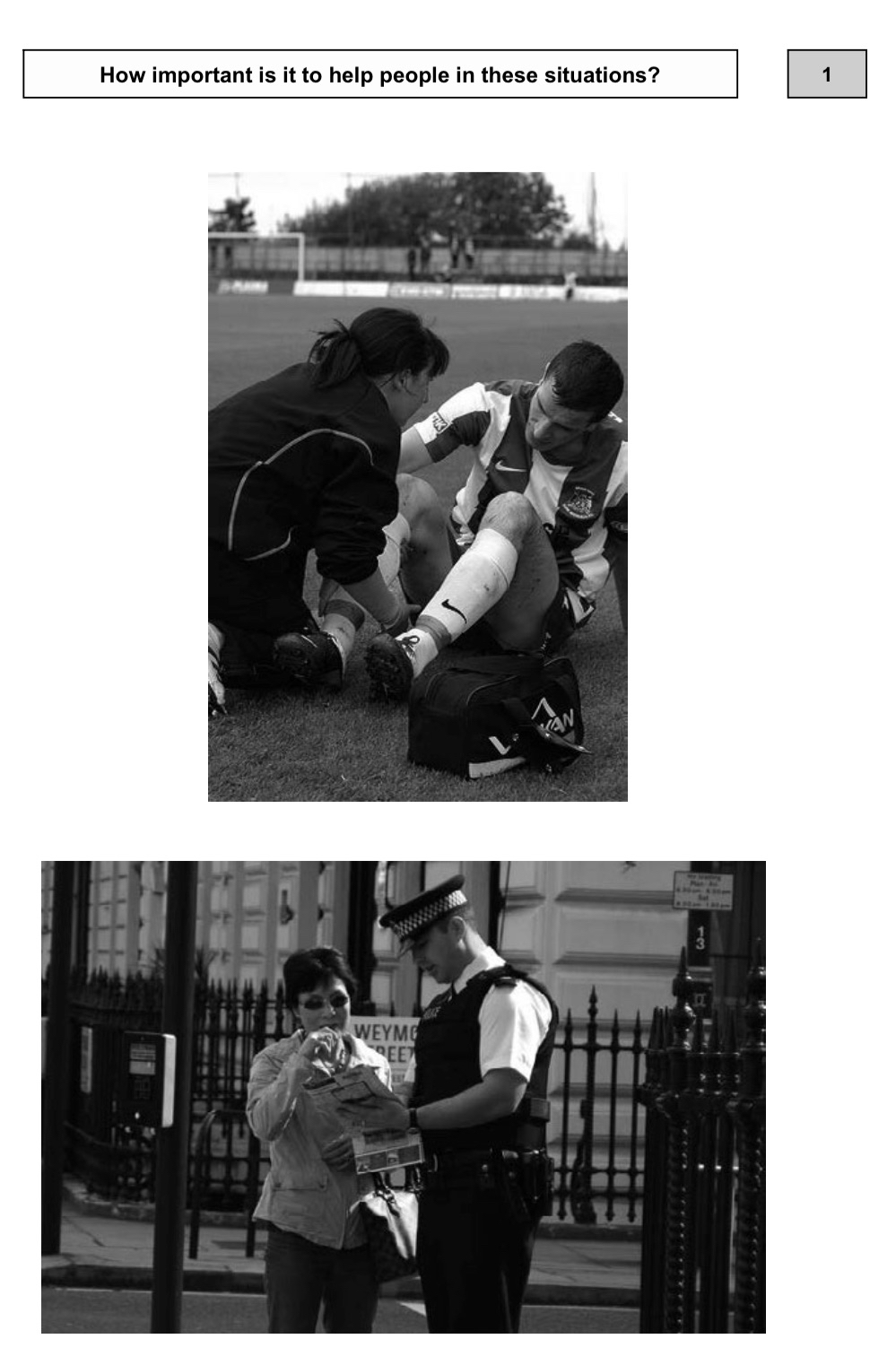
I’d like you to compare the photographs, and say how important it is to help people in these situations.
Candidate A’s response
(introduction) Both of these pictures show people getting some help; the first one shows a football player who seems to be injured and the second one is an Asian tourist getting help from a policeman.
(similarities + differences) Although both situations involve someone helping a person, they are very different. In the first one, the football player needs help because he’s had an injury and, probably, he can’t walk properly. On the other hand, in the second picture, the tourist is probably asking for directions because he might be lost. Also, the footballer is likely to be in pain, while the tourist may only be a little nervous.
(question) As for how important it is to help these people, I’d say it’s important in both situations. However, I strongly believe that the footballer needs more help than the tourist, as his situation is obviously more serious.
Examiner’s follow-up question for Candidate B
(Candidate B), do you find it easy to ask for help when you have a problem?
Candidate B’s response
Well, it depends on the problem, but normally I do. Whenever I have a serious problem I ask my mum or my dad for advice. It’s not easy, but I do it. With other problems, I always ask my friends first, because they normally know what to do.
Basic Observations for B2 Speaking Part 2
If you read the task above carefully, you will notice the following features:
- Candidate A is asked to compare two pictures and to answer a question about them.
- The question the examiner includes in his explanation is also written above the pictures, so don’t worry about having to memorise it.
- Candidate A will have to speak longer than Candidate B, that is, the person comparing speaks longer than the person answering the follow-up question.
- Candidate A has clearly compared both pictures and answered the question.
- The expressions in bold are useful words or phrases to use in any comparison.
- Candidate A’s comparison follows a clear order: introduction + similarities, differences, question. Although this particular order is not compulsory, it is recommendable.
FCE Speaking Part 2: Useful Phrases to Compare Pictures
In this section, we’ll see useful expressions that you can use in any comparison. However, as a basic tip, I’ll tell you that in order to compare, most of the connectors you’ll have to use are contrasting connectors. Let’s see.
- Starting your comparison
- Both of these pictures show…
- These two pictures show…
- The two situations in these pictures are…
- Talking about similarities
- These two pictures/situations are similar because/in that…
- In both pictures we can see…
- One similarity between these two pictures/situations is that…
- Another similarity might be that…
- One thing that these two pictures/situations have in common is that…
- One thing that these two pictures share is that…
- The most obvious similarity is that…
- These two pictures share the fact that…
- Both pictures (…) in the same way.
- Talking about differences
- One of the most obvious differences (between these two pictures) is that…
- Another difference is that…
- Something that makes these two pictures different is…
- What makes these two situations (so/completely) different is…
- While the first picture …, the second one…
- The first picture…. However, the second one…
- The first picture… whereas the second one…
- Although the first picture…., the second one…
- On the one hand, the first picture shows… . On the other hand, the second one…
- Introducing the answer to the question
- As for + paraphrased question
- As to + paraphrased question
- In relation to the question,…
- In response to the question, I’d say that…
- As regards the question,…
- Regarding the question of the task,
- With regard to + paraphrased question
Special Case: Advantages vs Disadvantages
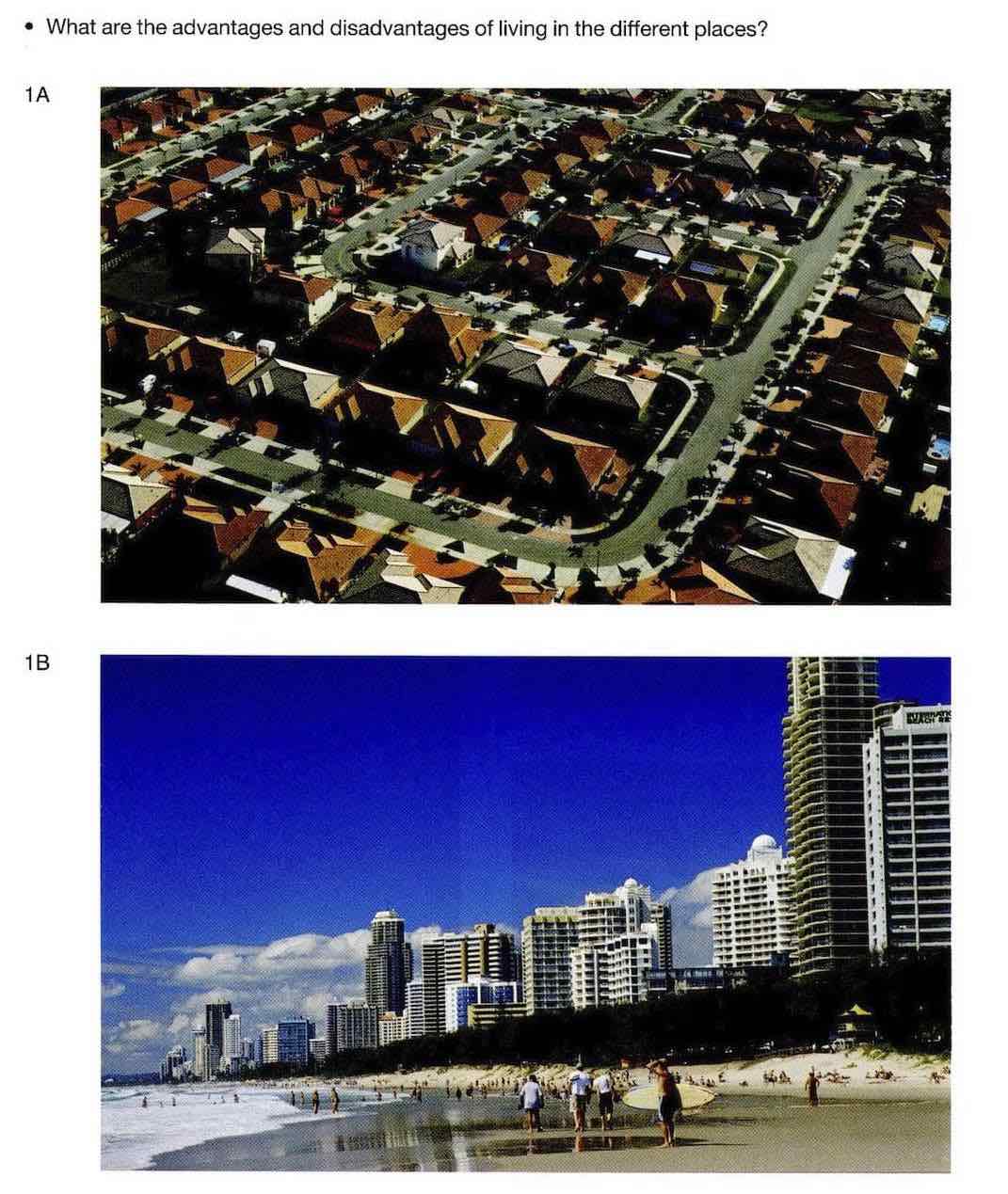
I have decided to write this as a separate section because I find that FCE speaking tasks involving advantages and disadvantages are somewhat special. The issue with these tasks is that they usually involve too many ideas to follow the structure above (intro + similarities + differences + question). In this case, I always recommend my students to blend the question into the rest of the task, that is, answer the question at the same time as the comparison is being made. This can be done with any task, really, but in this case, I’d say is especially important. Let’s see a comparison of this particular case for the task below:
Candidate’s response
Both of these pictures show different places where people live; the first one is a neighbourhood of detached houses, while the second one is a coastal city with many skyscrapers.
(similarities + differences + question) One advantage of living in the first place is that you can have your own garden where you can relax with your family. Also, it’s a very quiet place. On the other hand, the obvious upside of living on the seaside is that the weather is usually mild and you can go swimming and sunbathing quite often.
As for the disadvantages, I believe that the neighbourhood in the first picture can be a little boring for young people as there isn’t much to do
As you can see in the task above, the comparison is made around the question of the task, i.e. advantages and disadvantages. In this way, you’re saving time to do the task properly without leaving anything out.
FCE Speaking Part 2: Useful Phrases for the Follow-up Question
Although this part of the task does not follow a particular structure, given that it depends on the topic of the pictures, you are typically asked to draw on your own experience in connection with the topic or to choose one of the pictures and justify your answer. For instance, in the task above, the question for Candidate B would be something like: «where would you prefer to live?«
So let’s see some expressions to answer this question correctly:
- As far as I’m concerned,…
- The way I see it,…
- If I had to choose one of these two (…), I would (definitely) go for…
- In my experience,…
- In my case,…
- Well, it’s not an easy choice, but I think I’d prefer to…
- I would (…) no doubt.
- I would definitely prefer/choose…
- I believe that it’s more important to…
There is no specific formula to answer this follow-up question, given the broad spectrum we’re dealing with, but the expressions above will definitely help you answer more appropriately.
Top 10 Tips for FCE Speaking Part 2
- Compare, don’t describe: it is common for candidates to spend the whole minute describing both pictures separately instead of comparing them. Remember, the examiner explicitly asks you to «compare these two pictures», so don’t forget to do it!
- Don’t overuse «and»: I have noticed that my students tend to use the word «and» all the time in order to switch from picture 1 to picture 2. «And» is a connector to add ideas, not to express contrast. And, since you’re comparing, you should use other types of connectors. See both of the tasks in this article and notice the connecting phrases in bold.
- Don’t focus too much on one picture: one minute is not a long time, so you should make sure you fit into your speech the most important ideas about both pictures.
- Allow enough time to answer the question: some people spend so much time talking about the pictures that they forget to answer the question, and they get cut off by the interlocutor. While getting cut off is neither bad nor good, not answering the question will have a negative impact on your score.
- Address the interlocutor: in this task, you shouldn’t address your partner. This is an individual task, so simply concentrate on what you’re saying and address your comments to the interlocutor.
- Finish your sentences: it is common for candidates to start a sentence and then regret and stop in midstream. Do not let your speech fade out in the middle of a sentence; finish expressing your ideas!
- Focus the pictures and the question: while comparing both pictures, you should not talk about related things that happened to you. In this part, you are supposed to focus on the situations of the pictures, not on your own experiences.
- Stick to the topic: when answering the follow-up question, make sure that you stick to the topic and answer exactly what the examiner asked.
- Ask for repetition: it’s perfectly alright to ask the interlocutor to repeat the instructions or the follow-up question if you didn’t get it the first time.
- Use related vocabulary: while this article has focused mainly on expressions to compare and give your opinion, you obviously need to prove that your vocabulary is at a B2 level. So make sure you draw on what you have studied and drop some advanced terms that might impress the examiners.
Bonus Tip
- Smile: you’d be surprised by what human beings can achieve with a smile. A positive, cheerful attitude will make you cause a better impression on the examiners, plus it makes you, to some extent, a better communicator.
Video of a Real FCE Speaking Part 2
It is always useful to see a real exam, so here’s a video of the second part of this speaking test. But remember, these candidates are not perfect, so try to learn from their mistakes rather than make them yours!
If you liked this post, please comment and share it! Follow KSE Academy on Facebook, Twitter & YouTube and keep up with the latest news.
Oh, and don’t forget to keep smiling!
Jonny says:
Hey Luis, great post, loads of brilliant tips. Totally agree with ‘Smile’, it really does make a difference. I would like to add a tip: if you make a mistake, don’t worry, just correct yourself. You can stop and say something like «Sorry, I mean…»
Luis @ KSE Academy says:
Hey Jonny, thanks for your comment. That’s a very good tip. 🙂
Naomi says:
Thank you for this amazing information. Very useful tips for this exam part. As you said this part is not very complicated but you need to improvise and I really get nervous about that.
ANA CAROLINA CLAVERIE says:
Your post helps me a lot.
I’m preparing the exam and the tips are exactly what I need.
Thanks a lot from Argentina!
Yulia says:
Thanks Luis,
Really helpful for us teachers when we try to explain how to pass this part of the speaking exam.
Patricia says:
Thank you for such useful tips! They’ve been really helpful for our students.