
Speaking B2 First (FCE): Complete Guide with Examples
Are you still unsure about what the B2 First (FCE) Speaking test is like? In this post, I’ll explain everything you need to know about the Speaking paper of the FCE.

Table of contents
The B2 First Speaking is the B2 level Speaking exam from Cambridge Assessment English, and it is one of the 5 parts that make up the B2 First exam, formerly called the First Certificate in English (FCE). In this post, given that the B2 Speaking is one of the most complicated parts of the B2 First, I am going to explain exactly what the B2 First Speaking is like, describing each part and giving you an example for each one. 💪🏼
Speaking B2: What the B2 level is
As we saw in the B2 First Writing guide, it is important to define what the B2 level is when we talk about Speaking. That is, what is expected of a candidate in a B2 oral exam?
Level B2, in general, is an upper-intermediate level, so slightly more fluency is expected than at previous levels, expecting a Speaking candidate to be able to express ideas beyond what surrounds them. But to get a better idea, let’s see what the Common European Framework of Reference for Languages (CEFR), commonly called the Framework of Reference (MER), says:
- Overall:
– Gives clear, systemically developed descriptions and presentations, highlighting significant points and relevant supporting detail appropriately.
– Gives clear, detailed descriptions and presentations on a wide range of subjects related to his field of interest, extending and backing up his ideas with subsidiary points and relevant examples.
- In monologues:
– Gives clear, detailed descriptions on a wide range of subjects related to his field of interest.
– Develops arguments systematically, giving appropriate emphasis to important points and relevant supporting details.
– Develops arguments with clarity, extending and defending his points of view with subsidiary points and appropriate examples.
– Constructs a chain of reasoned argument.
– Explains a viewpoint on a topical issue giving the advantages and disadvantages of various options.
- In public announcements:
– Can give a clear, prepared presentation on most general topics, with a degree of fluency and spontaneity which allows him to use it as a stand and interact with the audience.
– Gives clear, systemically developed presentations, highlighting significant points and offering relevant supporting detail.
– Is able to depart spontaneously from a prepared text and follow up points raised by members of the audience, often showing remarkable fluency and ease of expression.
– Gives clear, prepared presentations, reasoning for or against a particular point of view, and showing the advantages and disadvantages of various options.
– Responds to a range of follow-up questions with a degree of fluency and spontaneity which causes no tension to either himself or the audience.
As you can see, a B2 Speaking is no easy task, as the speaker is already expected to be able to handle unfamiliar situations, with a spontaneity that is far from that of a B1 level speaker.
Now that we know what B2 level Speaking is according to the CEFR, let’s focus on the FCE Speaking and all its parts.
What the B2 First Speaking is like
The B2 First (FCE) Speaking consists of 4 distinct parts. Each of these four parts is designed for the candidate to demonstrate different skills typical of a B2 oral exam. In general, the FCE Speaking has the following peculiarities:
- It has 4 parts.
- It is done in pairs.
- It is evaluated by two oral examiners.
- During the exam, you must interact with your partner and with one of the examiners, the Interlocutor.
- The other examiner does not speak, they simply evaluate.
Let’s now move on to describing each of the different parts of the B2 First Speaking.
FCE Speaking: Part 1
In the FCE Speaking Part 1 of the FCE oral exam, the interlocutor will ask you a series of basic personal questions (where you are from, why you are learning English, past experiences, jobs, studies, etc.). In addition, you will have to express your opinion on various topics.
This part of the B2 Speaking is completely individual, so you only interact with the examiner. However, you have to pay attention to what your partner is asked, as they may repeat the question to you. To give you an idea of what they ask in Part 1 of the First (FCE) Speaking, here are a series of questions downloaded from the Cambridge Assessment English website.
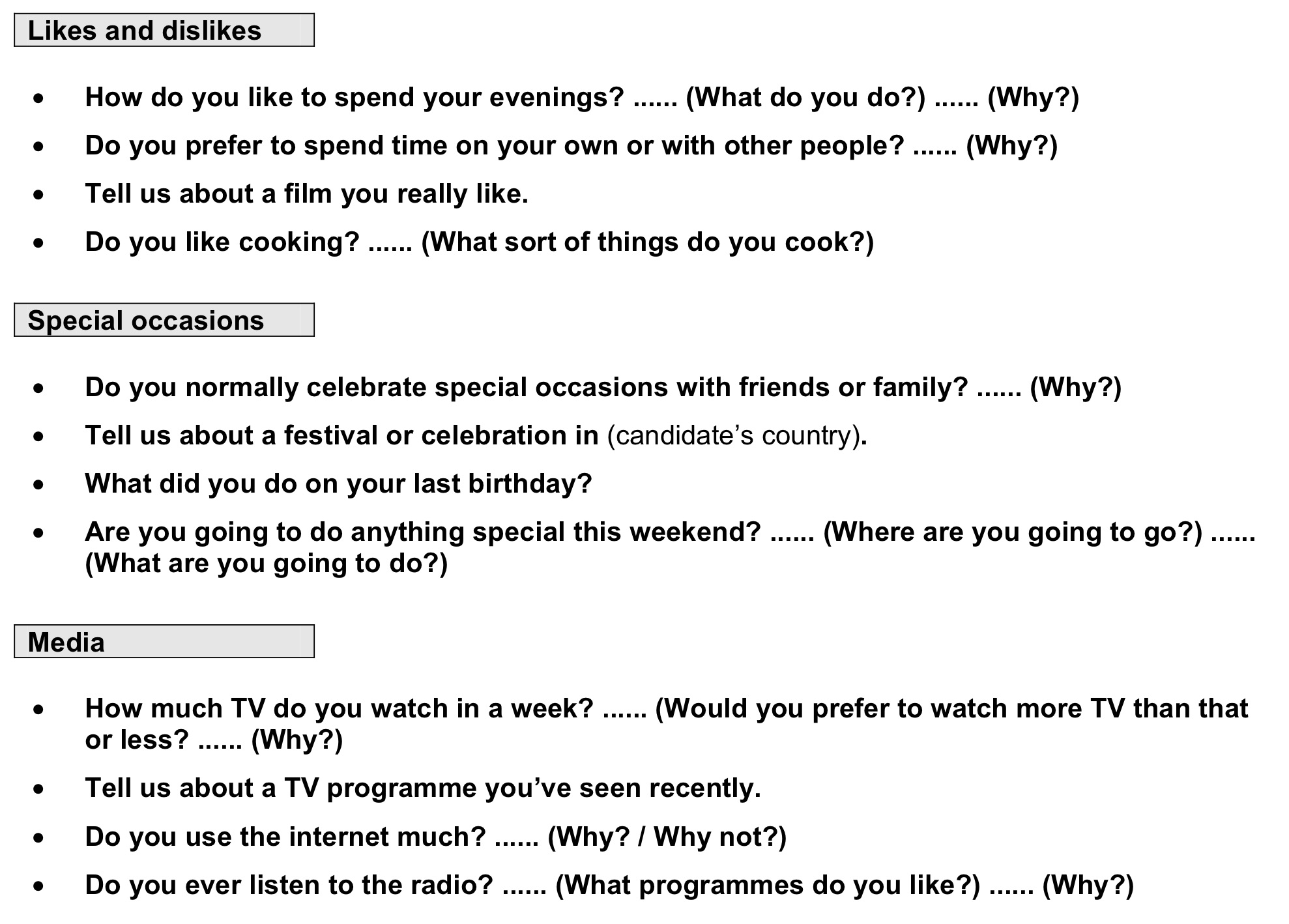
As you can see, these are questions about your likes, interests, past experiences, etc.
Let’s now move on to FCE Speaking Part 2.
FCE Speaking: Part 2
Speaking B2 Part 2 of the First exam is what we call the «long turn» for each candidate. This means that in this part each candidate will have a longer speaking turn than during the rest of the exam. Specifically, each candidate will have to compare two images with a question in 1 minute, individually. After this, they will have to answer a question about the images that their partner has compared, in 20 or 30 seconds. In other words, the exercise dynamic would be something like this:
- Examiner’s instructions
- Candidate A’s comparison (1 minute)
- Candidate B’s question (20-30 seconds)
- Candidate B’s comparison (1 minute)
- Candidate A’s question (20-30 seconds)
To better understand what B2 Speaking Part 2 is like, here are some examiner’s instructions and, below, the photos that the two candidates taking the B2 First (FCE) would supposedly compare.
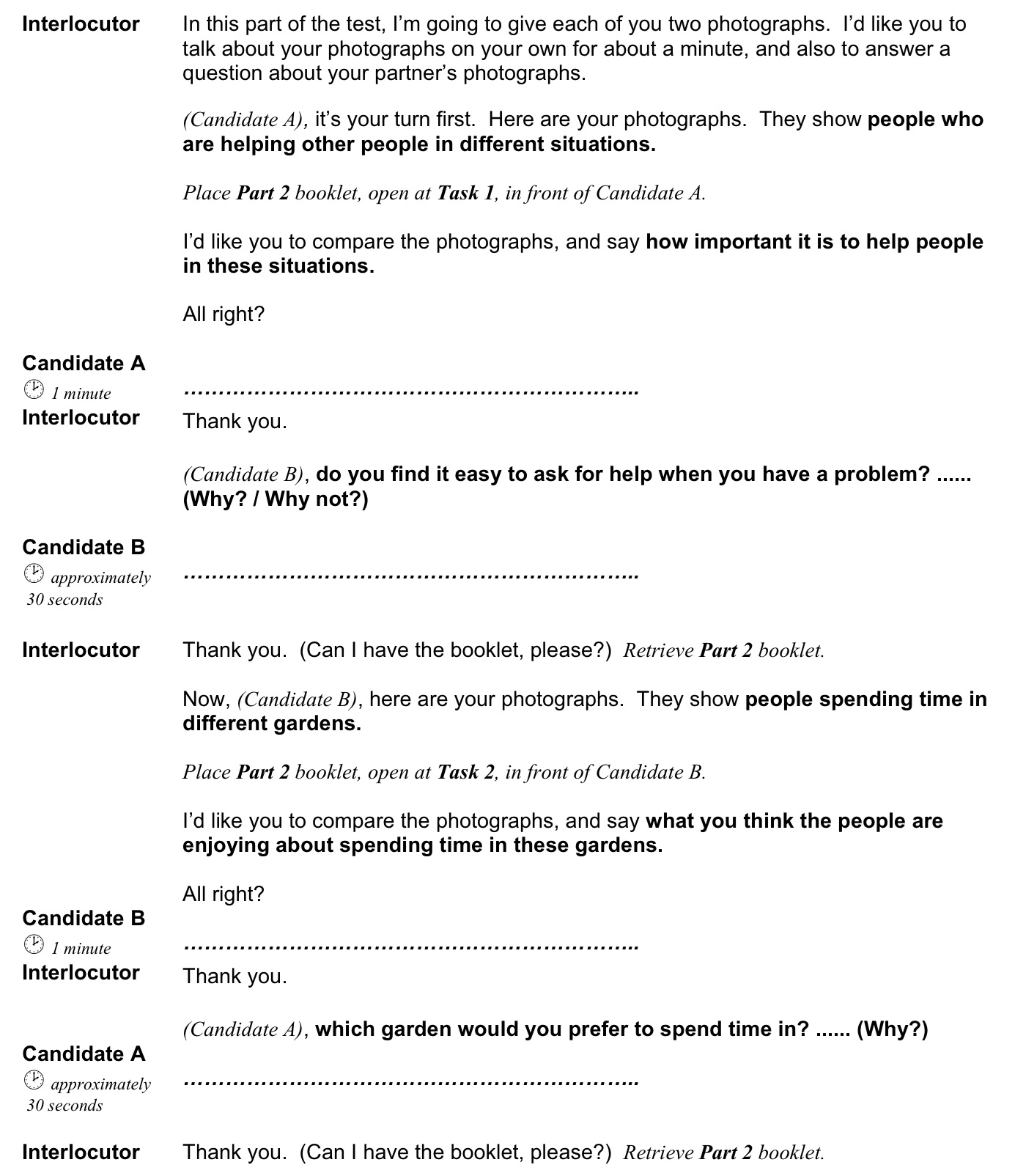
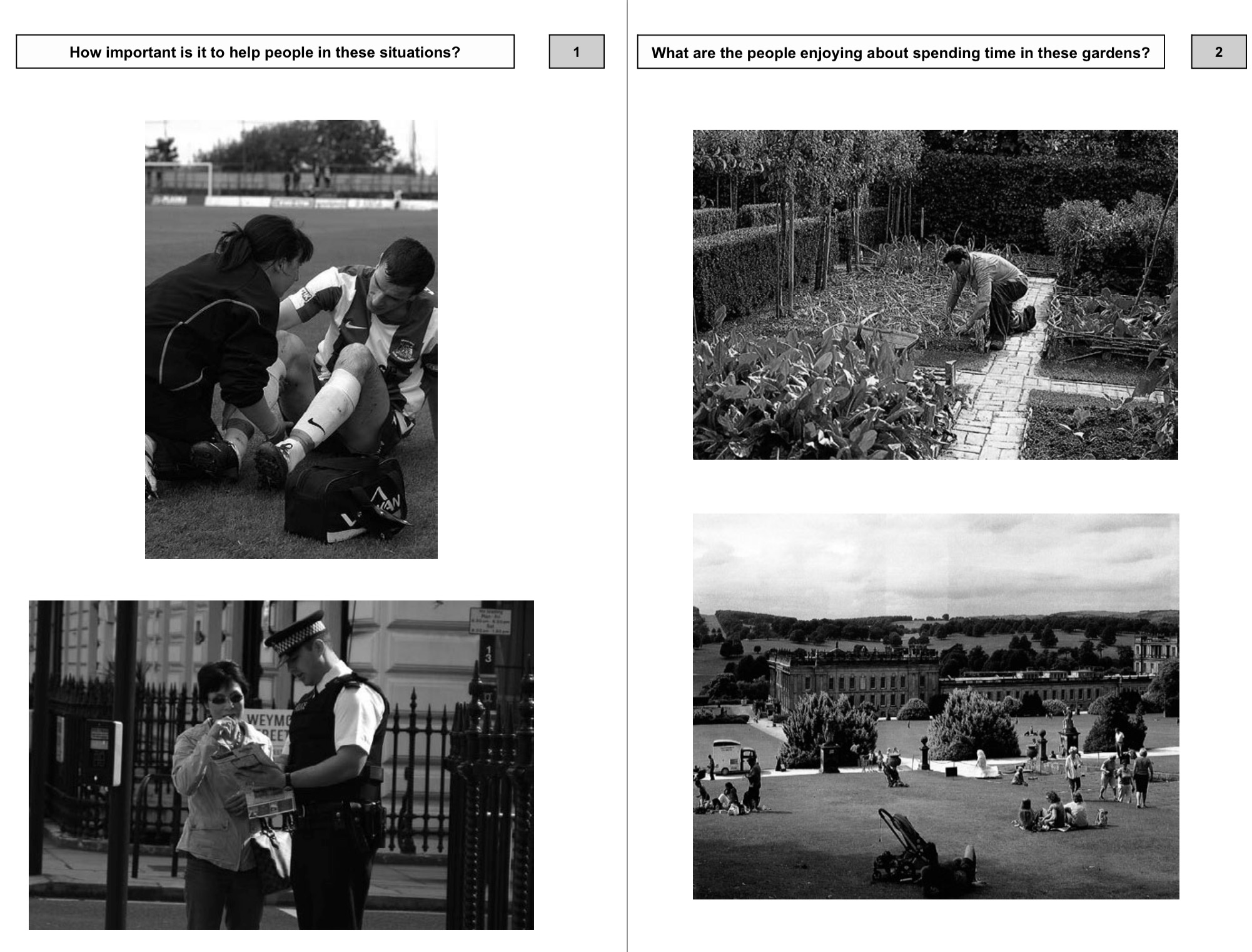
When you make the comparison, what the examiners will focus on most is how well you compare, describe, express opinions, speculate, etc. So I recommend you practise this part of the Speaking well to make it as fluent as possible.
By the way, although these images appear in black and white, they will be in colour in the exam, so don’t worry about that.
FCE Speaking: Part 3
In B2 First (FCE) Speaking Part 3 you will have to interact with your exam partner. In this case, you are not expected to give a monologue, as in Part 2, but rather to show that you are capable of maintaining a conversation with your partner.
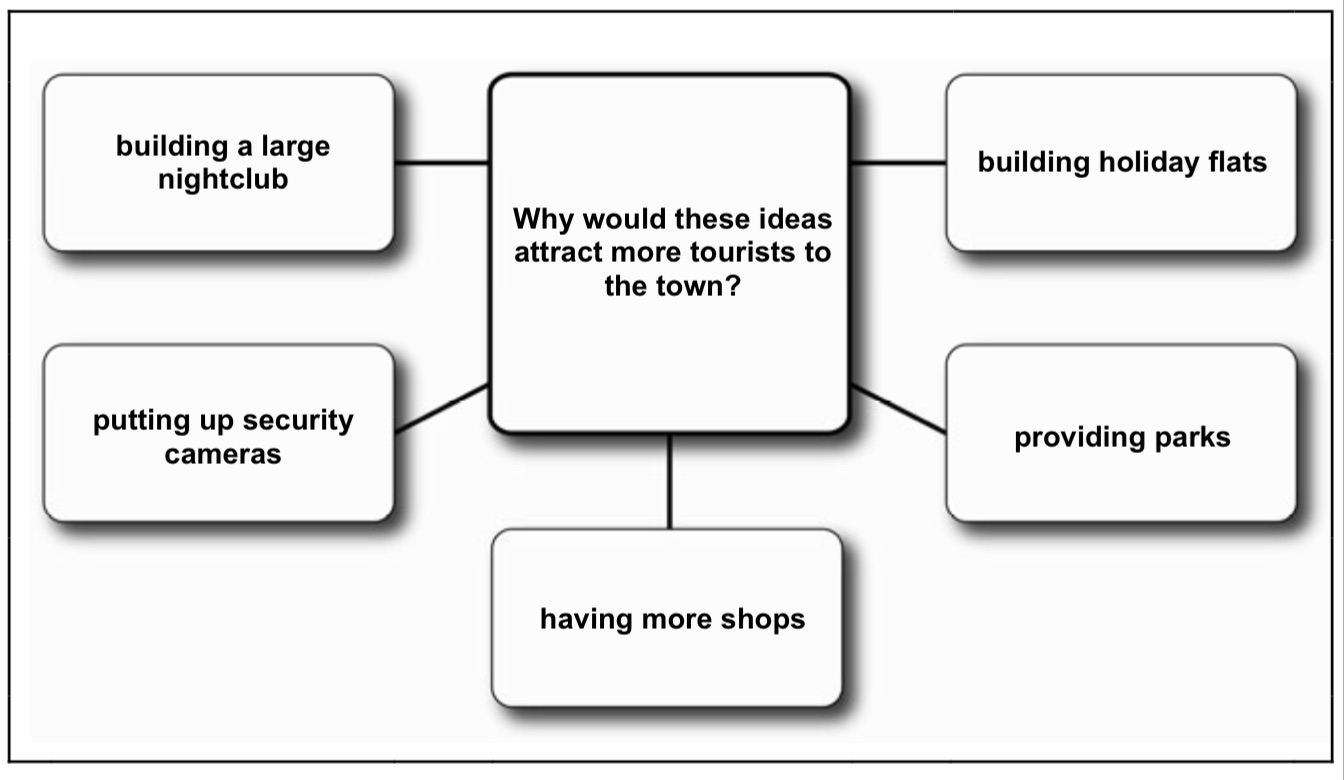
Specifically, in this part of the FCE Speaking exam, the examiner describes a situation to you and presents you with a task in the form of a question and possible topics to discuss in relation to the question. Basically, what you have to do is talk about the different options that have been presented to you and work towards reaching an agreement.
Since it is a conversation, this part of the Speaking exam assesses how you exchange ideas, express and justify opinions, agree and disagree, suggest, speculate, evaluate different options, etc. The goal is to reach an agreement.
The dynamic of this part is as follows:
- Examiner’s instructions
- Discussion (2 minutes)
- Examiner’s instructions
- Discussion to reach a conclusion (1 minute)
Basically, you have 2 minutes to discuss the different ideas before the examiner interrupts you and asks you to reach an agreement. From that moment on, you have 1 minute to conclude the conversation trying to reach an agreement.
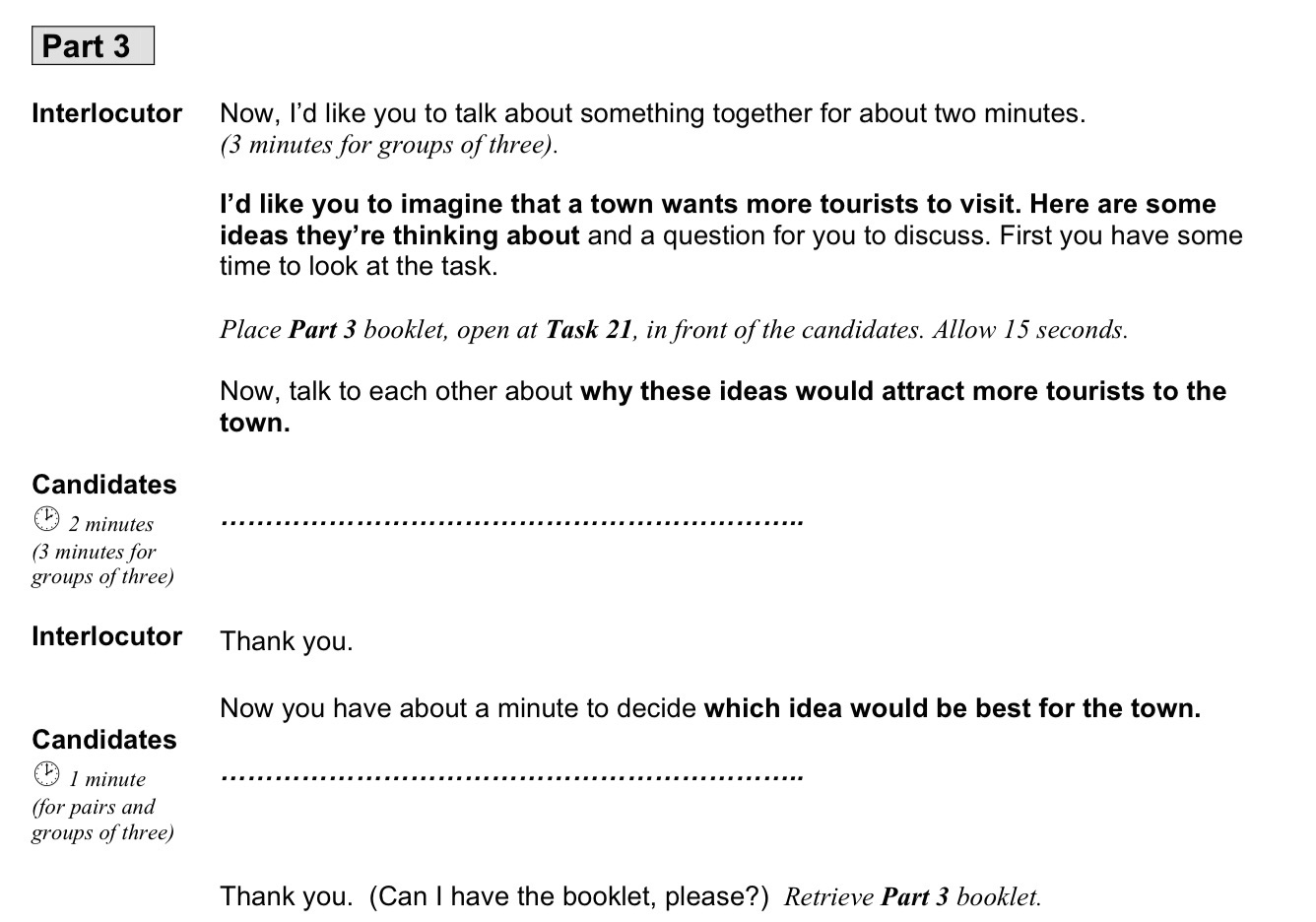
Below you have an example of the examiner’s instructions, including interruption and closing of Part 3, and what you and your partner would have in front of you to discuss: the diagram with the question and some ideas to help you.
FCE Speaking: Part 4
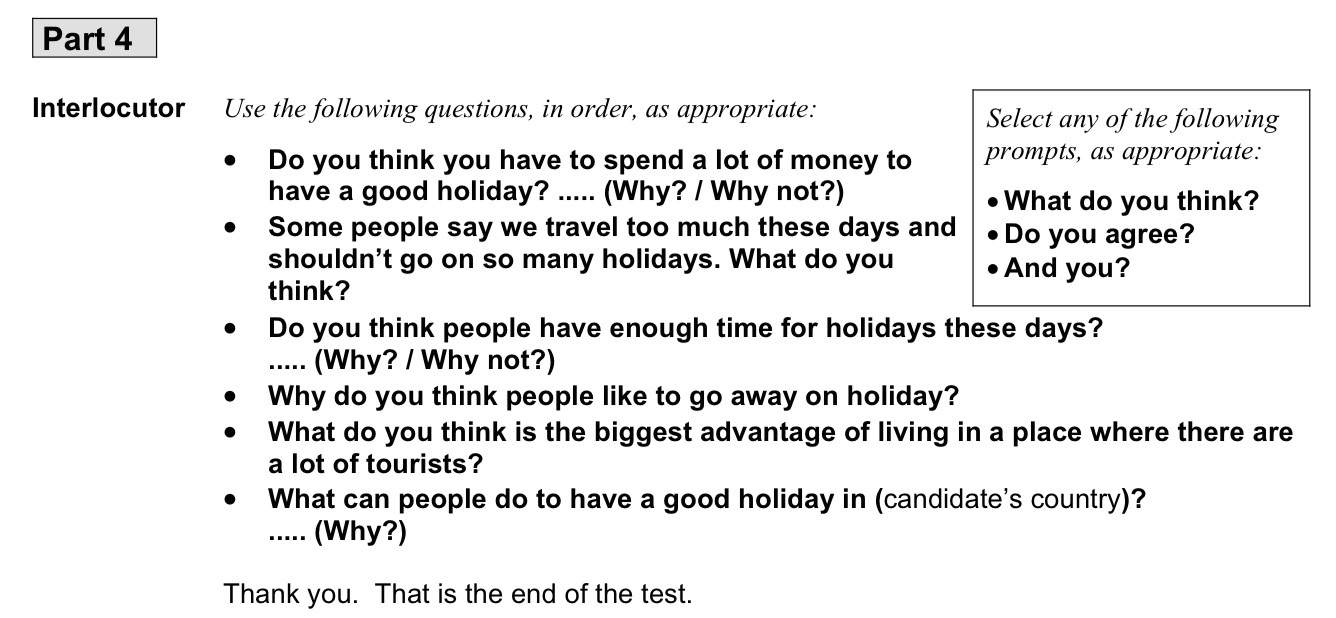
In the FCE Speaking Part 4 of the First exam, it is a mixture between a long turn and an interaction. In this last part of the exam, the examiner will ask you questions and you must answer in an extended manner. It is also typical for them to present you with a statement and ask you to express your opinion on it, saying whether you agree or disagree.
This part of the First Speaking exam starts with the theme presented in Part 3 of the Speaking. That is, if Part 3 was about tourism and holidays, Part 4 begins with questions related to the same topic. And what is most evaluated is how you express and justify your opinions.
To give you a better idea, here is a series of questions that make up Part 4 of the exam. It is normal for the examiner to choose a few, not all, otherwise the exam would become too long.
B2 First (FCE) Speaking Examples
In this section, I want to present a couple of written examples of what your answers should be like. Given the spontaneity and naturalness of Parts 1 and 4 of the B2 Speaking exam, I will only present examples of what Parts 2 and 3 should be like, i.e., the individual comparison, and the interaction with your partner.
B2 First Speaking Example: Part 2 (FCE)
- Examiner’s initial instructions to Candidate A
In this part of the test, I’m going to give each of you two photographs. I’d like you to talk about your photographs on your own for about a minute, and also to answer a question about your partner’s photographs.
(Candidate A), it’s your turn first. Here are your photographs. They show people who are helping other people in different situations.
(places the following images in front of Candidate A)
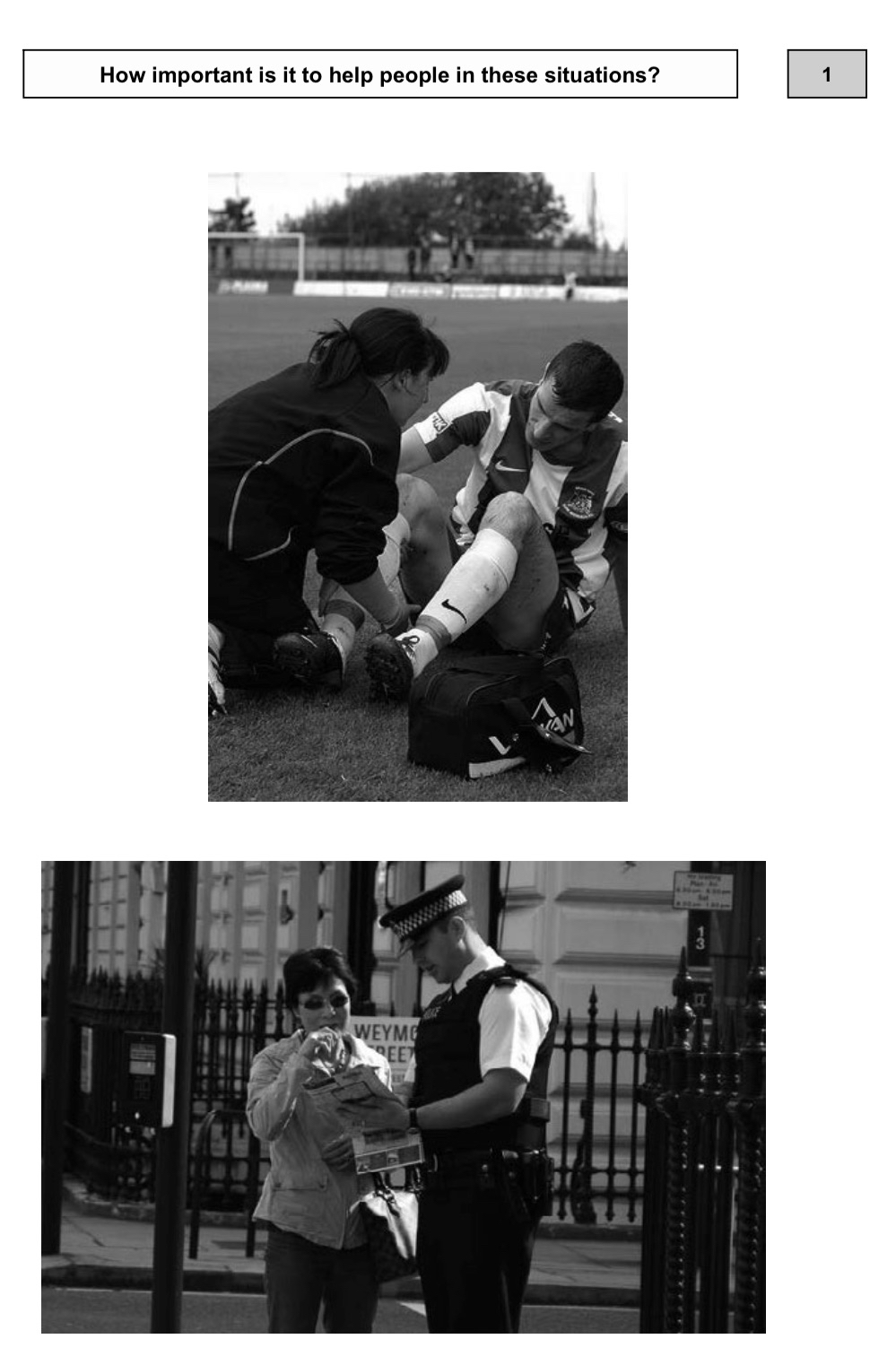
I’d like you to compare the photographs, and say how important it is to help people in these situations.
- Candidate A’s answer
(introduction) Both of these pictures show people getting some help; the first one shows a football player who seems to be injured whereas the second one is an Asian tourist getting help from a policeman.
(similarities + differences) Although both situations involve someone helping a person, they are very different. In the first one, the football player needs help because he’s had an injury and, probably, he can’t walk properly. On the other hand, in the second picture, the tourist is probably asking for directions because he might be lost. Also, the footballer is likely to be in pain, while the tourist may only be a little nervous.
(question) As for how important it is to help these people, I’d say it’s important in both situations. However, I strongly believe that the footballer needs more help than the tourist, as his situation is obviously more serious.
- Examiner’s question to Candidate B
(Candidate B), do you find it easy to ask for help when you have a problem?
- Candidate B’s answer
Well, it depends on the problem, but normally I do. Whenever I have a serious problem I ask my mum or my dad for advice. It’s not easy, but I do it. With other problems, I always ask my friends first, because they normally know what to do.
After this, the process is repeated in the same way, but starting with Candidate B and ending with Candidate A.
As you can see, in this part of the B2 Speaking, the following characteristics can be observed:
- Candidate A is asked to compare 2 images and answer a question about them, the one at the top of the image.
- Candidate A must speak more than Candidate B, as it is their turn to compare the images.
- Candidate A has compared the images well and has answered the question.
- The expressions in bold are useful expressions for any comparison.
- Candidate A’s comparison follows a quite clear marked order, which is highly recommended in this part of the B2 Speaking.
- The question to Candidate B relates to their personal experience and preferences, and should not be too extended.
Speaking B2: Useful expressions for comparing images
Below is a series of useful expressions that I use with my students to make comparisons. My advice is to choose the ones you like the most or that sound most natural to you and try to use them in all the comparisons you make to practise for the B2 Speaking exam.
- To start the comparison:
- Both of these pictures show…
- These two pictures show…
- The two situations in these pictures are…
- To talk about similarities:
- These two pictures/situations are similar because/in that…
- In both pictures we can see…
- One similarity between these two pictures/situations is that…
- Another similarity might be that…
- One thing that these two pictures/situations have in common is that…
- One thing that these two pictures share is that…
- The most obvious similarity is that…
- These two pictures share the fact that…
- Both pictures (…) in the same way.
- To talk about differences:
- One of the most obvious differences (between these two pictures) is that…
- Another difference is that…
- Something that makes these two pictures different is…
- What makes these two situations (so/completely) different is…
- While the first picture …, the second one…
- The first picture…. However, the second one…
- The first picture… whereas the second one…
- Although the first picture…., the second one…
- On the one hand, the first picture shows… . On the other hand, the second one…
- To introduce the answer to the question:
- As for + paraphrased question
- As to + paraphrased question
- In relation to the question,…
- In response to the question, I’d say that…
- As regards the question,…
- Regarding the question of the task,
- With regard to + paraphrased question
Tips for B2 First (FCE) Speaking: Part 2
Let’s look at some essential tips for succeeding in Part 2 of the FCE Speaking:
- Compare, don’t just describe.
- Don’t use «and» too much and try to use contrast connectors like «whereas», «while», «however», etc.
- Try to talk about both images more or less equally.
- Don’t forget to answer the question that comes with the images.
- Address the interlocutor, not your partner.
- Don’t leave sentences unfinished, always finish expressing your ideas.
- Don’t ramble or start talking about your own experiences.
- If you haven’t understood the task well, ask the interlocutor to repeat the instructions.
- Try to use vocabulary relevant to the topic of the images.
- Smile! A good smile and a positive attitude are always more communicative.
Let’s now move on to Part 3 of the FCE Speaking.
B2 First Speaking Example: Part 3 (FCE)
- Examiner’s initial instructions
Now, I’d like you to talk about something together for about two minutes.
I’d like you to imagine that a town wants more tourists to visit. Here are some ideas they’re thinking about and a question for you to discuss. First you have some time to look at the task.
(The examiner places the following image in front of the candidates and waits 15 seconds)
Now talk to each other about why these ideas would attract more tourists to the town.
- Conversation between candidates (2 minutes)
– Candidate A: Shall I go first?
– Candidate B: Sure, go ahead.
– Candidate A: I believe that this option (pointing), “building a large nightclub”, will attract tourists, especially young ones who enjoy partying and going out with friends, don’t you think?
– Candidate B: Yes, I think so, too. However, it might not be the best type of tourism, because it can disturb neighbours and residents. How about having more shops?
– Candidate A: Oh, that’s a great idea. If the city offers a good shopping experience, many people will be attracted to it, which I guess is quite positive for everyone. Wouldn’t you agree?
– Candidate B: Yes, of course. Maybe that option could go hand in hand with building holiday flats because. The way I see it, you want tourists to spend more time in your city. So if you have plenty of shops and accommodation, it’s the perfect combination, right?
– Candidate A: Yeah, you’re absolutely right. But what do you think about the other two options? (pointing)? Do you think they’re a good idea?
– Candidate B: Well, if you ask me, putting up security cameras isn’t very appealing to anyone. But I suppose parks can be attractive, but I’m not sure how much exactly. What’s your take on those two options?
– Candidate A: As you said, security cameras are not appealing at all. As for parks, maybe they are a good thing for residents, but not for tourists, particularly.
- Second instructions from the examiner
After two minutes, the examiner interrupts the candidates and says the following:
Thank you. Now you have about a minute to decide which idea would be best for the town.
- Candidates trying to reach an agreement (1 minute)
– Candidate B: Well, given our previous comments, I would say that the two best options would probably be the shops and the holiday flats, don’t you think?
– Candidate A: Yeah, well, I do agree with you on having more shops, but I think that building a nightclub is more important than holiday flats.
– Candidate B: Okay, I see what you mean, but I don’t think the same way. Shall we stick to having more shops then?
– Candidate A: Yes, sure, I also think it’s the best one. So do we have an agreement?
– Candidate B: Yes, we do.
- Examiner’s final turn
Thank you. Can I have the booklet, please?
Now that you have read what a conversation for B2 First Speaking Part 3 should be like, let’s analyse a little what we have just read:
- Candidates must interact with each other, not give 2 separate monologues.
- It is essential to express and ask for opinions, agree and disagree, if appropriate, and be able to change the topic.
- The main question is at the centre of the task.
- Candidates should discuss the options around the main question.
- The bold phrases are useful expressions for any conversation of this type.
- It is not an absolute requirement to reach an agreement, but it is important to try.
Speaking B2: Useful expressions for discussing
In this section, I am going to give you a list of useful expressions that you can use in B2 First (FCE) Speaking Part 3, so that you can choose a few to try and put into practice each time you do this part of the oral exam. Here we go.
- To start the discussion:
- Shall I start? / Yeah, go on.
- Shall I go first? / Of course, go ahead.
- Is it okay if I start? / Sure, no problem.
- Would you like to go first? / Yes, why not?
- To express your opinion:
- I believe/think that…
- In my opinion,…
- The way I see it,…
- If you ask me,…
- I would say that…
- It seems to me that…
- In my view…
- As far as I’m concerned,…
- To ask your partner:
- statement, don’t you think/agree?
- statement, wouldn’t you say so?
- statement , wouldn’t you agree?
- statement, right?
- Do you think…?
- Do you believe that…?
- What do you think about…?
- How about…?
- What about…?
- What’s your take on…?
- To express agreement:
- I (totally) agree with you.
- You’re dead right.
- That’s (absolutely) true.
- You’re (absolutely) right.
- That’s a great idea.
- I couldn’t agree more.
- Yes, I see what you mean.
- I see it that way, too.
- Yes, of course.
- I think so, too.
- To express disagreement:
- I’m afraid I don’t see it the same way.
- I’m sorry but I have to disagree.
- You may be right, but I have a different view.
- That might be true, but I’m not sure I agree with you.
- I’m sorry, but I don’t agree.
- To change the topic:
- As for + one of the options
- As to + one of the options
- In relation to + one of the options
- As regards + one of the options
- Regarding the question of the task,
- With regard to + paraphrased question
- To conclude the discussion:
- I believe we have an agreement, don’t we?
- So, do we have an agreement?
- Shall we stick to…?
- Shall we agree on..?
Tips for B2 First (FCE) Speaking: Part 3
Let’s look at some good practices that will help you succeed in Part 3 of the FCE Speaking:
- Discuss and ask, don’t give a monologue.
- Always justify your opinions.
- Try to ensure the discussion does not focus solely on one option.
- Work with your partner to keep the discussion flowing.
- Help your partner when they need it.
- Make an effort to use useful expressions for interaction.
- Make your contributions concise but effective.
- Focus on the topic you are discussing and don’t ramble too much.
- Try to end your turns with a question to your partner.
- Address your partner, not the examiner.
- Smile! A smile always makes a better impression than a sour face.
B2 First (FCE) Speaking: How it is assessed
One of the most frequent questions from my students, exam candidates, is how the B2 Speaking is assessed, that is, what the oral examiners take into account to grade this oral test. Well, it’s quite simple. The oral examiners assess the following categories of your performance:
- Grammar & Vocabulary: This category obviously focuses on the grammatical and lexical accuracy of your speech. However, in a B2 Speaking exam, it’s no longer enough to simply avoid making mistakes; the assessor (the examiner who evaluates) will also look at whether, in addition to not making many errors, you are capable of using grammatical structures and vocabulary at an intermediate-advanced level, i.e., at B2 level.
- Discourse Management: This criterion refers to how you are able to organise your discourse. That is, the assessor will pay attention to how you organise and link your ideas using connectors, pronouns, and other linguistic elements of coherence and cohesion. Furthermore, it is important that you can deliver a monologue in a continuous manner, without too many pauses, errors, and hesitation.
- Pronunciation: This criterion is relatively easy to understand. In the FCE Speaking exam, your pronunciation is expected to be adequate, that there is no difficulty in understanding you, and that there is some intonation when speaking.
- Interactive Communication: In this regard, the examiner will pay attention to how you respond and ask questions, how you exchange ideas, and how you are capable of maintaining a conversation naturally using interaction mechanisms: questions, statements and negatives, agreeing and disagreeing, etc.
- Global achievement: This mark is the only one awarded by the interlocutor (the examiner who speaks with the candidates) and refers to the overall level of each candidate’s performance. It is the overall communicative impression that the candidate gives the examiners throughout their oral exam.
Great. I think with this MEGAGUIDE you should now have a pretty good idea of what the First Speaking is like. Even so, if you have any suggestions or questions, please do not hesitate to leave me a comment, which I will answer with all my enthusiasm. 😃