
Writing the Perfect Email for B1 Preliminary (PET)
Find out how to write a proper email for B1 Preliminary (PET) Writing Part 1, where you are asked to write your answer in 100 words.

Table of contents
As we’ve already seen in the B1 Writing Guide (in Spanish), updated for the 2020 changes, the Writing component consists of 2 parts. The first one is an email whereas the second one is a story or an article, as you can choose which to do. For this reason, in this post I’m going to teach you how to write an email at B1 level for your Preliminary (PET) exam.
How to Write an Email for B1 Preliminary (PET)
In order to know the steps to write an email for this B1 exam, the first thing we need to do is to find out what the instructions are like and know what you’re expected to do. And even though we saw this in the B1 Writing guide (in Spanish), we will now go over it again and dive in even deeper.
Instructions for Writing B1 Preliminary Part 1: Email
In this part of the test, you are given an email from an English friend or relative, and you are asked to respond to it in about 100 words. This email contains annotations which help you identify exactly what you need to respond to.
As regards the topics, they’re usually not very difficult, as you’re expected to write at an intermediate level, about topics you are familiar with: sports, hobbies, TV programmes, the weather, your town/city, etc. Here’s an example taken from Cambridge English sample papers:
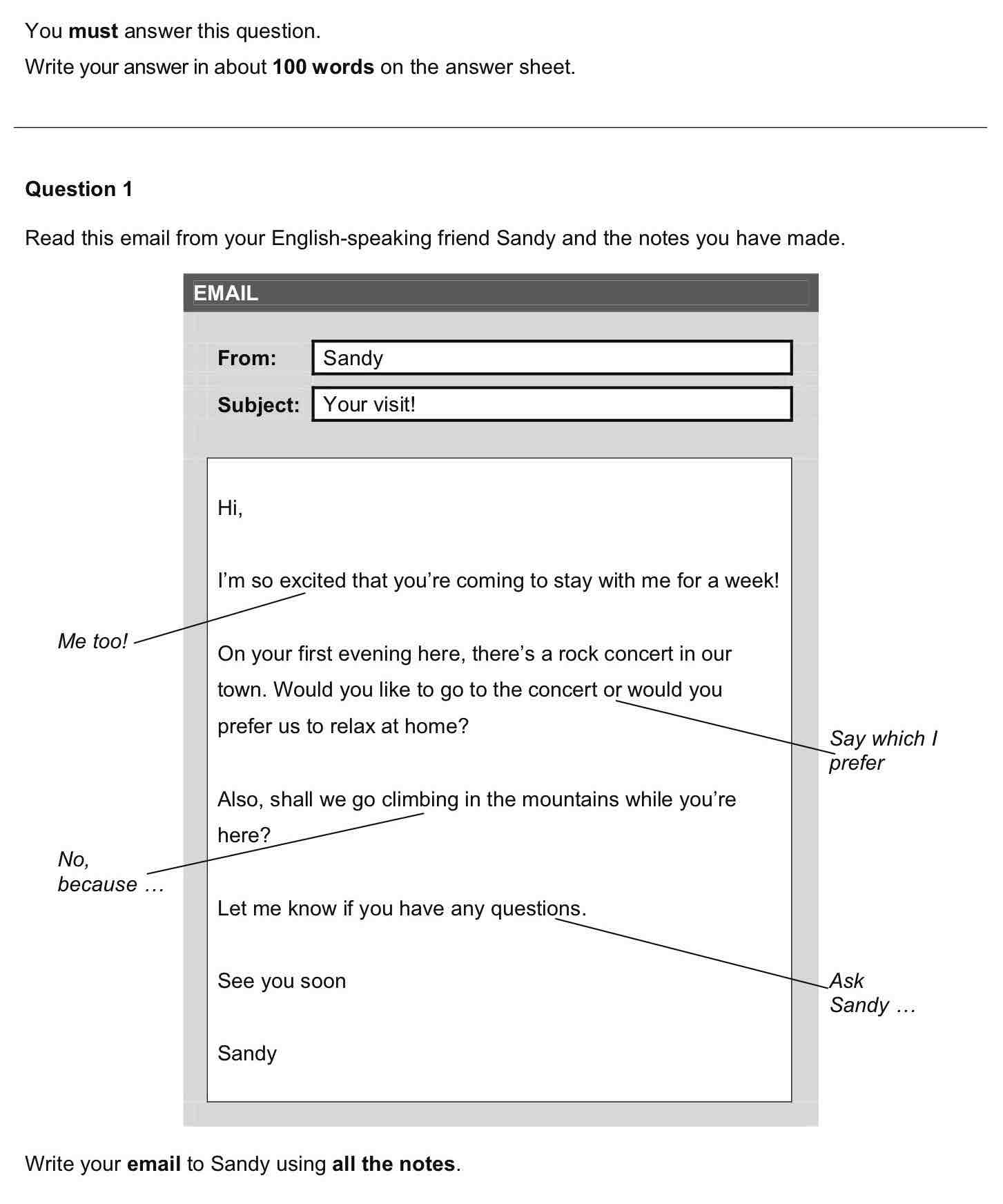
As you can see in the example above, taken from Cambridge’s official website, we have received an email from a person so-called Sandy, who is a friend of ours. In addition, we have made some annotations, which are the points we need to address in your email:
- Me too!
- Say which I prefer
- No, because…
- Ask Sandy…
In this sense, Cambridge is making this task easier, as we definitely won’t go blank and they are pointing out the structure that our email should have, which we will see in the following section.
Email structure
The first thing you need to know is the different parts of an email, and these are:
- Greetings: we greet the other person (i.e. say «hi» or «hello»).
- Opening paragraph: we react to the other person’s news and ask them how they are feeling and whatever else you feel is appropriate.
- Main paragraph 1: in this paragraph we deal with the first important point, which we can identify in the instructions.
- Main paragraph 2: if there is a different point to deal with, this paragraph will do so.
- (We might have more main paragraphs, depending on the task.)
- Closing paragraph: in this paragraph we «start» to say goodbye by wishing the other person well and asking them to reply to your email.
- Goodbye: we use a short expression to say goodbye.
- Signature: we sign the email with our name.
In general, all emails must follow the same structure, and also, I recommend you following these two pieces of advice::
- Don’t write From: y To:, as it is completely unnecessary and Cambridge won’t penalise you. Also, you’re saving words which you can use in the body of your email.
- Don’t write a subject, for the same reason as before.
Now that we know the different parts of an email, we should see an example.
Example Email for PET Writing Part 1
Let’s take a look at the following example of a Preliminary (PET) task answer for Writing Part 1, where we can see an answer to the sample task we saw above:
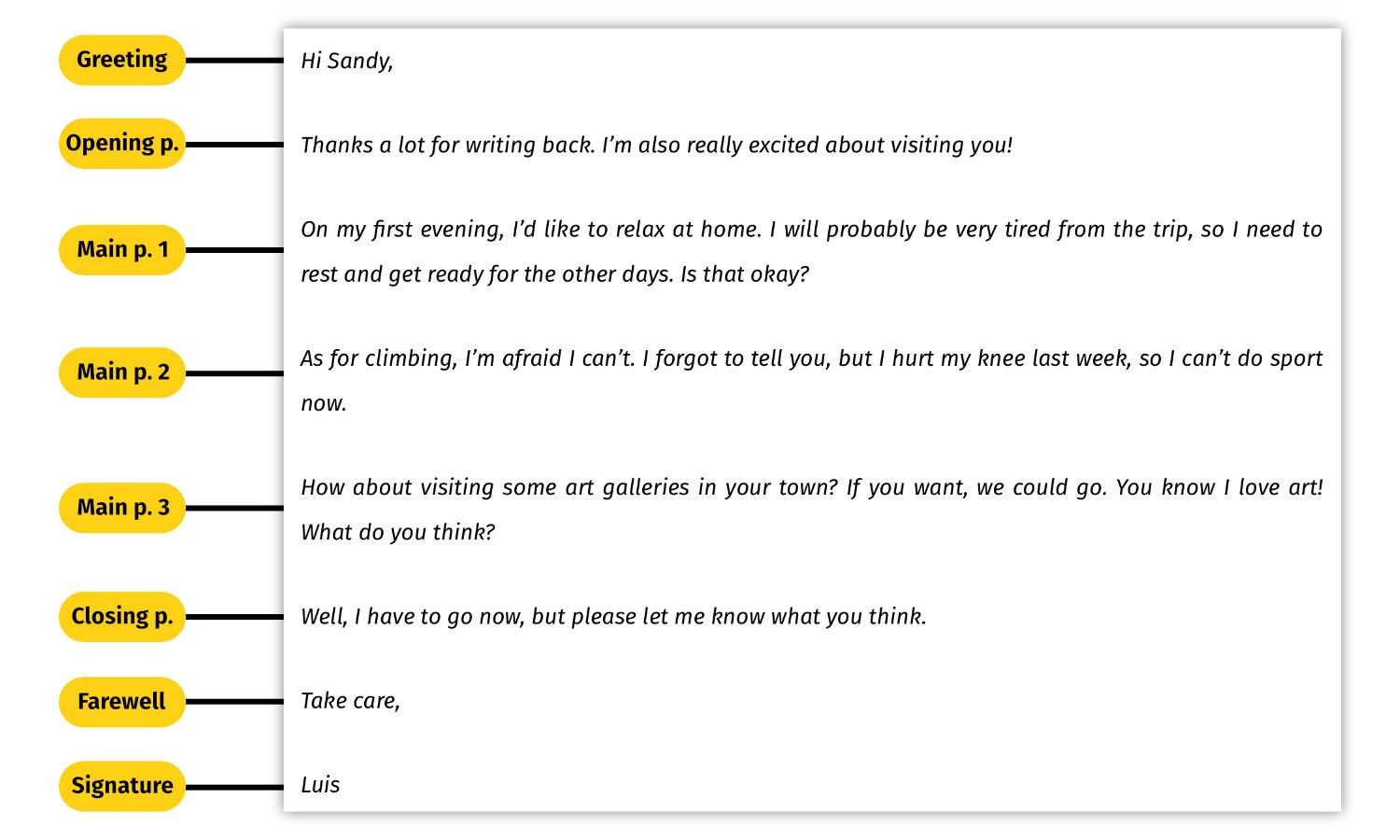
In the example above, you can see the different parts of an email well defined. It’s important that your writing is visually appealing, apart from having good grammar and vocabulary. This means that the paragraphs should be well defined, with a space in between, and that you should know when to break lines. This is specially important after greetings, after opening and closing paragraphs, and after saying goodbye. This will make your text visually appealing, as it will look like a real email.
Expressions to use in your email
In this section, we are going to focus on different expressions you can use in the different parts of the email. While the main paragraphs will vary completely depending on the topic of your writing, most of the other parts in the email can be practised and memorised almost completely. Let’s take a look:
Greetings
In order to start your email in Writing Part 1 for Cambridge English: Preliminary (PET), you can use different expressions, which are really typical and easy to remember. We have 3 basic ways to greet in this kind of writing, which is usually for a friend or family member:
- Hi John,
- Hello John,
- Dear John,
Notice how «hi» is less formal than «hello» or «dear». Also, don’t forget to write a comma (,) right after greeting your friend or relative. After greeting the addressee (i.e. the person who will read the email), you must start the opening paragraph in a new line.
Opening paragraph
The opening paragraph is the place to react to your friend’s or relative’s email. In order to do so, you can use a number of different expressions. Here we have some examples:
- It’s nice / great / good to hear from you.
- It’s nice / great / good to read your email.
- I’m glad to hear your news.
- I’m excited about… (your news.)
- It’s great to hear that…
- I’m sorry to hear that…
- I’m really sorry to read your news.
- Thanks a lot for writing!
- It was good to receive your email.
- Thank you very much for your email.
And many more. Also, it’s a good idea to ask your friend or relative how they are feeling, which you can do like this:
- Hope you are doing well.
- How’s it going?
- How are you (doing)?
- How are things (going)?
You can also add some information that you think is relevant or necessary, but don’t expand this paragraph very much, because the important information must go in the main paragraphs.
Main paragraphs
For the main paragraphs, there aren’t any fixed expressions which you must use, as it depends mostly on what you have to write about. However, you should try to make use of connectors and appropriate punctuation. So let’s take a look at common useful connectors and the punctuation we use them with:
- … and… : to connect two similar things or ideas.
I love reading and listening to music.
My favourite meal is fish and chips.
- …, but… : to connect two contrasting ideas.
I love watching Tv, but I don’t have a favourite show.
I am reading a book, but I don’t remember the title.
- . However, … : to connect contrasting ideas.
Last month, I went to the cinema. However, I didn’t enjoy the movie.
I am a very big fan of this author. However, I haven’t read his last novel.
- Moreover, … : to add more information about something.
- … because… : to justify an opinion or idea.
My mum is the perfect cook because she knows a lot of recipes and has plenty of experience. Moreover, she experiments with different ingredients all the time.
- . Because of that, … : to justify an opinion, fact or idea.
My mum likes to cook using new ingredients all the time. Because of that, she creates original dishes every month.
- . As for…/ Regarding… : to switch to a new topic. For instance, you can use this connector to start the second main paragraph.
As for/Regarding why I like this cookery show, I think it’s because it’s a great way to see new recipes.
- Time linkers: then, after that, yesterday, this morning, last summer, etc.
Last night, I watched a very good action film.
With many connectors, we typically use a comma (,) after it when we start a sentence (e.g.: However, Last night, Moreover, etc.).
Closing paragraph
As we mentioned earlier, a closing paragraph in this Writing part 3 is used to start saying goodbye to the addressee and to ask for a response to your email. So we can use the following expressions:
- Well, it’s time to say goodbye.
- Anyway, I have to go now.
- Well, it’s time to go.
- Anyway, gotta go.
- I really hope to hear from you soon.
- I’m looking forward to hearing from you.
- I hope you write back soon.
- Make sure you write back soon.
Also, if you still have to write more words, you can add a question for a subsequent email. This question should be related to the topic of your piece of writing.
Saying goodbye
There are many ways in English to close an informal email. The most frequently used ones are the following:
- Best wishes,
- Best,
- Sincerely,
- Take care,
- All my love,
- Love,
- Lots of love,
- See you soon,
- Regards,
Notice how there is a comma (,) after each of the phrases. Also, after writing any of these sentences, make sure you write your name on a different line. And write your name without a full stop!
Another example of an email at B1 level
Now that we know what expressions we should be using in our writing, we are going to take a look at another task and a sample answer. In this case, this is an example of an old task, but the email follows the same rules. Pay close attention to how it’s structured and how its paragraphs are well defined and separated:

Notice how the expressions in bold are used. Whenever you write an email, you should think about this type of expressions and make sure you use them appropriately.
Top 5 Tips for writing an Email for B1 Preliminary (PET)
- Learn and memorise a set of expressions. Make sure you already know a set of expressions to use in your greetings, opening and closing paragraphs, and to say goodbye. This will save you a lot of time while doing a task, and you will avoid making silly mistakes as you will already know the expressions by heart.
- Write a well-structured and visually-appealing email. One of the things Cambridge English examiners pay attention to is the organisation of your piece writing, so make sure not to write a messy email. Also, remember that punctuation matters, so be sure to separate your sentences with stops and commas and don’t write excessively long sentences.
- Brainstorm, write, read and edit. Before starting to write your email, brainstorm a couple of things and write down some ideas. This can include vocabulary related to the topic. For example, if you have to write about TV shows, you can write down thinks like «contestants», «cookery show», «prize», etc. Then, write out your email. After that, read it and look for possible mistakes or opportunities for improvement (e.g.: adding descriptive adjectives, rephrasing sentences, etc.).
- Read carefully and identify the task. Don’t start writing right away. Make sure you read the task carefully and that you identify exactly what you are being asked. Sometimes, we don’t pay attention to the instructions and we end up writing about something different. This will mean losing points, in a very silly way, I must say.
- Experiment at home, be conservative in the exam. Homework is the best chance to be creative and experiment different ways to express yourself. So make sure you try your hardest to keep improving when you write at home. On the other hand, when you’re doing an exam, don’t risk trying out new words or expressions, as you may be making a terrible mistake. So be safe in your exam and stick to what you already know works.
Did you find this post useful? Did you? Well, don’t forget to comment and share. And if you love the English language, follow KSE Academy on Facebook, Twitter & YouTube! And don’t forget to subscribe to the blog!
Oh, and don’t forget to keep smiling!
LILIANA BORBOLLA says:
EXCELLENT HELP FOR THE NEW 2020 PET FORMAT. THANKS A LOT
Luis @ KSE Academy says:
Hi Liliana! Thanks a lot for your comment! Take care!
Cortix says:
Grazie mille di tutto, saluti dall’ Italia
María Vazquez says:
Hello Liliana.Thanks.Excellent help.
María from Uruguay
Paqui Muñoz Mendoza says:
you are great Luis. Thanks a lot for your good work. Paqui Muñoz Mendoza
Luis @ KSE Academy says:
Thank you very much, Paqui. It’s great to receive comments like this from time to time.
Andres says:
Thanks Luis
ROCIO says:
Your help was so useful. Thanks.
Luis @ KSE Academy says:
Thanks for your comment, Rocío. Take care!
Priscila says:
Thank you so much!
Khey Sett says:
Thank you so much for sharing. It’s very useful and helpful.
Luis @ KSE Academy says:
Thank you! 🙂
Arthur says:
Nice work, Luis! I’m continuing my classes online during the coronavirus, and this post provides a great, visually-appealing review of this part of the new test. I will be sending my students here next week to help with their homework!
Luis @ KSE Academy says:
Thank you very much for your comment. Hope your students find it useful. Take care!
Angelines says:
The best email. that I found.
Thanks.
Luis @ KSE Academy says:
Thank you, Angelines! 🙂
Claudia says:
Super clear!!!!
Thank you very much.
Claudia
Luis @ KSE Academy says:
Thank you, Claudia! 🙂
PAOLA says:
EXCELLENT GUIDE!! THANK YOU SO MUCH FOR SHARING IT
Luis @ KSE Academy says:
Thank you for your comment, Paola. 🙂
CESAR CRUZ says:
THANKS 🙂
Luis @ KSE Academy says:
You’re welcome! 🙂
Cameron says:
Thank you soo much, im 12 and doing the test, this is the day before the test and your info was soo usfull, have a good evening
Luis @ KSE Academy says:
Hi, Cameron. Thanks a lot for your comment. Sorry for taking so long to reply. I hope you passed your test! 😀
Carina Gianoli says:
Absolutely clear guidelines for Writing Part 1 Email
Thanks a lot for sharing it!!!
Luis @ KSE Academy says:
Thank you so much for your comment! 🙂
Susana says:
Great work! Thank you for sharing
Luis @ KSE Academy says:
Thank you for reading, Susana! 🙂
Bernat says:
Happy New Year!
Useful tips, good job.
Thanks!
Luis @ KSE Academy says:
Thank you so much for your feedback. Take care and Happy New Year to you too!
camila says:
THANK YOU VERY MUCH MY DEARRRRRR. I’m having the Cambridge PET exam tomorrow and I’m really nervous… Wish me luck!
Luis @ KSE Academy says:
Hey, Camila! Hope your exam was fine! Don’t forget to come back here and let us know your score! 🙂
carlos says:
I love you Luis
Luis @ KSE Academy says:
Haha, thank you, Carlos! Love u too!
Val says:
Precious guide and helpful insight, thank you.
Luis @ KSE Academy says:
Thank you very much! 🙂
Juliana says:
Great post, thanks!
Luis @ KSE Academy says:
Thank you, Juliana! 🙂
Lenin says:
As an exam coach myself, I really want to congratulate you for this wonderful and useful site. It’s great to see an updated B1 Preliminary writing guide; I’m using it right now with the candidates I teach. Keep up the great work!
Luis @ KSE Academy says:
Hey, Lenin. Thanks a lot for such a nice comment. I hope your students find it useful. If you ever have any feedback, let me know. Thanks again!
Win says:
Extremely detailed and useful guidance for those who is taking the PET exams!
Thanks a lot.
Luis @ KSE Academy says:
Thank you! 🙂
Olivia says:
OLIVIA
15/1/2023 A LAS 11:49
Hello, happy new year.
Tulia Vogensen says:
As an exam preparation teacher myself, I would like to thank you for all your hard work. Yours is the best site I have found online with important tips and useful samples for our students. Keep up the great work! I really appreciate it!
Luis @ KSE Academy says:
Thank you very much for your comment, Tulia. 🙂
Marisa Rosa Frattaroli says:
Excellent! thanks for your work
Marisa from Argentina
Marta Domènech Cañas says:
Very useful and clear!. Thanks very much for your help!