
All the colours in English and Spanish: pronunciation and list in PDF
Aprende los colores en inglés con este MEGA LISTADO. Desde los colores primarios básicos hasta los más complejos y poco comunes. Descarga el PDF ahora.

Table of contents
If you speak Spanish, I’m sure you’ve heard the saying «para gustos, los colores» (or literally «for tastes, the colours»). The truth is that, although I am only capable of thinking of 5 or 6 colours off the top of my head, the world of fashion reminds me that many more actually exist. For this reason, I’ve decided to write this post about colours in English and Spanish, to teach you not only the basic or primary colours, but also some more complex ones. I’ll also show you how they are pronounced (with a few audio tracks), their phonetic representation, and I’ll give you the list of colours in PDF so you can download them and consult the list online. Are you ready? Let’s go!
List of colours in English and Spanish
Now we are going to look at the list of colours in English, but to make it simpler, we are going to divide them into primary and secondary colours.
Primary colours in English
Primary colours (also known as basic or primitive colours) are those that are not formed by combining other colours, hence their name. Depending on the colour theory we follow, the primary colours may vary, but that doesn’t concern us here, so we will follow one of the most common classifications.
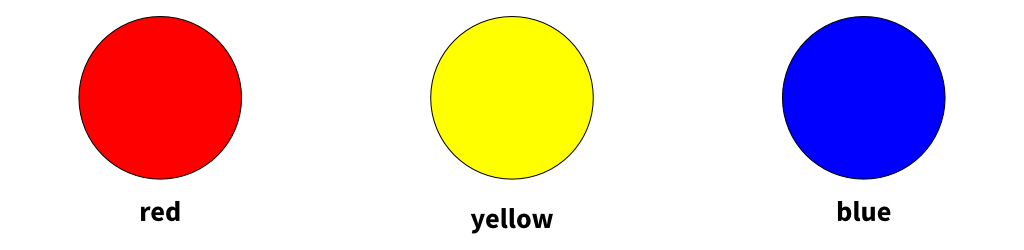
Below is the list of primary colours in English and their pronunciation:
| SPANISH 🇪🇸 | ENGLISH 🇬🇧 |
| rojo | red |
| amarillo | yellow |
| azul | blue |
Secondary colours in English
Secondary colours are those formed by combining primary colours.
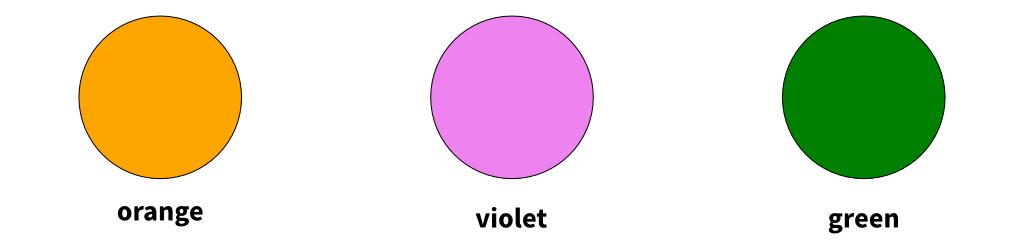
The secondary colours are:
| SPANISH 🇪🇸 | ENGLISH 🇬🇧 |
| naranja | orange |
| verde | green |
| violeta | violet |
More colours in Spanish and English
Here is a list of other colours in English. Some are very basic, like black or white, and others are a nightmare, like chartreuse or seasprite. Sorry! 😂
| SPANISH 🇪🇸 | ENGLISH 🇬🇧 | SPANISH 🇪🇸 | ENGLISH 🇬🇧 |
| blanco | white | lila | mauve |
| negro | black | melocotón | peach |
| gris | grey (BrE) / gray (AmE) | amarillo mostaza | mustard |
| azul marino | navy blue | amarillo limonada | lemonade |
| celeste | sky blue | salvia | sage |
| marrón | brown | verdiazul | teal |
| magenta | magenta | verde amarillento | chartreuse |
| rosa | pink | verde musgo | moss |
| morado | purple | verde brillante | kelly green |
| color ciruela | plum | verde bosque | forest |
| rosáceo | blush | verde marino | seasprite (green) |
| color mandarina | tangerine | verde claro | mint |
| rojo escarlata | scarlet | lila | lilac |
| beige | beige | crema | cream |
| púrpura | crimson | marrón / bronceado | tan |
| fucsia | fuchsia | azabache | jet black |
| dorado | golden | ámbar | amber |
| plateado | silver | terracota | terracotta |
| índigo | indigo | verde lima | lime |
| aguamarina | aquamarine | verde esmeralda | emerald |
| lavanda | lavender | turquesa | turquoise |
| ocre | ochre | coral | coral |
| oliva | olive | granate | maroon |
| castaño | chestnut |
Colour patterns
Below is a list of patterns that are often related to colours and clothing.
| SPANISH 🇪🇸 | ENGLISH 🇬🇧 |
| liso | plain |
| a cuadros | checked |
| con flores | flowered |
| con rayas | striped |
| con lunares | spotted / dotted |
| estampado | printed |
Shades of colours in English
Below is a list of the shades of colours in English:
| SPANISH 🇪🇸 | ENGLISH 🇬🇧 |
| oscuro | dark |
| claro | light |
| radiante | bright |
| brillante | shiny |
| chillòn | loud |
| intenso | deep |
| pálido | pale |
| apagado | dull |
| opaco | opaque |
| transparente | transparent |
How to pronounce colours in English?
In this section I provide you with the complete list of colours in alphabetical order (all those we have seen above) with their phonetic representation. Also, right below here, above the table, I’ve included a recording in which I pronounce each and every one of the colours (in Spanish and English) so that you can also practise if you don’t know how to read phonetic symbols.
| ENGLISH 🇬🇧 | PRONUNCIATION |
| amber | / ˈæm bər / |
| aquamarine | / ˌæk wə məˈrin / |
| beige | / beɪʒ / |
| black | / blæk / |
| blue | / blu / |
| blush | / blʌʃ / |
| brown | / braʊn / |
| chartreuse | / ʃɑrˈtruz / |
| chestnut | / ˈtʃɛsˌnʌt, -nət / |
| coral | / ˈkɔr əl / |
| cream | / krim / |
| crimson | / ˈkrɪm zən / |
| emerald | / ˈɛm ər əld / |
| forest | / ˈfɒr ɪst / |
| fuchsia | / ˈfyu ʃə / |
| golden | / ˈgoʊl dən / |
| green | /ɡrin/ |
| grey (BrE) / gray (AmE) | / greɪ / |
| indigo | / ˈɪn dɪˌgoʊ / |
| jet-black | / ˈdʒɛtˈblæk / |
| kelly green | / ˈkɛl i ɡrin/ |
| lavender | / ˈlæv ən dər / |
| lemonade | / ˌlɛm əˈneɪd / |
| lilac | / ˈlaɪ lək / |
| lime | / laɪm / |
| magenta | / məˈdʒɛn tə / |
| maroon | / məˈrun / |
| mauve | / moʊv / |
| mint | / mɪnt / |
| moss | / mɒs / |
| mustard | / ˈmʌs tərd / |
| navy blue | / ˈneɪ vi ˈblu / |
| ochre | / ˈoʊ kər / |
| olive | / ˈɒl ɪv / |
| orange | / ˈɒr ɪndʒ / |
| peach | / pitʃ / |
| pink | / pɪŋk / |
| plum | / plʌm / |
| purple | / ˈpɜr pəl / |
| red | / rɛd / |
| sage | / seɪdʒ / |
| scarlet | / ˈskɑr lɪt / |
| seasprite (green) | / ˈsiz prɑɪt / |
| silver | / ˈsɪl vər / |
| sky blue | / skɑɪ blu/ |
| tan | / tæn / |
| tangerine | / ˌtæn dʒəˈrin / |
| teal | / til / |
| terracotta | / ˈtɛr əˈkɒt ə / |
| turquoise | / ˈtɜr kɔɪz / |
| violet | / ˈvaɪələt / |
| white | / waɪt / |
| yellow | / ˈyɛloʊ / |
Tips for learning colours in English and Spanish
Remembering colours can be difficult, especially if we get into the list of less common ones. But don’t worry, I’m here to help you with these tips for memorising colours in English.
1. Start with the most basic colours
The first step is to focus on basic colours. These are the colours most used in everyday life (they are the only ones I use! 😅), so it is important to learn them first. As basics, you can start with black, white, red, blue, yellow, green, grey, brown, etc.
2. Practise with images
Learning the typical vocabulary list of colours is fine, but the idea is that you know how to use them when necessary. For this reason, I recommend that you use images to practise colours. Simply go to Google, look for some images of scenes with people, animals, things, etc. and start describing the images as we do in the B1 Preliminary.
3. Practise regularly
As they say in English, practice makes perfect. If you really want to memorise colours in English, you have to practise regularly. Every day, try to name all the colours you can in English. Perhaps you can even do it by looking at the objects around you. This will help you keep them fresh in your memory.
4. Use flashcards
A good way to memorise words and associate them with their concept is by using flashcards. You can create them in many ways. For example, you can use an online tool like Quizlet to create your own flashcards or you can download the PDF I’ve provided at the end of this article and use it on your computer or mobile to review.
5. Don’t despair
There are a huge number of colours. In fact, while writing this article today, I myself have learned a couple of colours I didn’t know. So don’t worry if you find it a bit difficult. Focus on the main colours, the ones you will need most in your daily life, and then move on to the rest to gradually expand and improve your vocabulary level.
By following these tips, you will be on the right track to memorising colours in English. Keep practising and reviewing, and soon you will be able to confidently name all the colours in English, both in written and spoken form.
Exercises
Fun facts about colours in English
In this mini-section (consider it a bonus, haha), I will briefly tell you about 4 curiosities regarding colours in English:
- Black and white: In Spanish, we say «blanco y negro» and it would sound strange to say «negro y blanco». However, in English we always say «black and white». This is a collocation and it would sound very odd to change the order.
- The suffix -ish: This suffix will be very useful when the colour is not very well defined but does resemble one. For example, if something is yellowish or has a poorly defined yellow tone, you can say «yellowish».
- American English vs British English: In American English, many words ending in «-our» lose the «u». Therefore, in British English we write «colour», but in American it is written «color». This affects other words like «colourful/colorful» or «multicolour/multicolor».
- Idioms with colours: There are many idioms in English involving colours (called colour idioms). For example, we say «green with envy» when someone is very envious; «out of the blue» to say that something happens unexpectedly; or «caught red-handed» when someone is caught just as they are doing something wrong.
Download as PDF
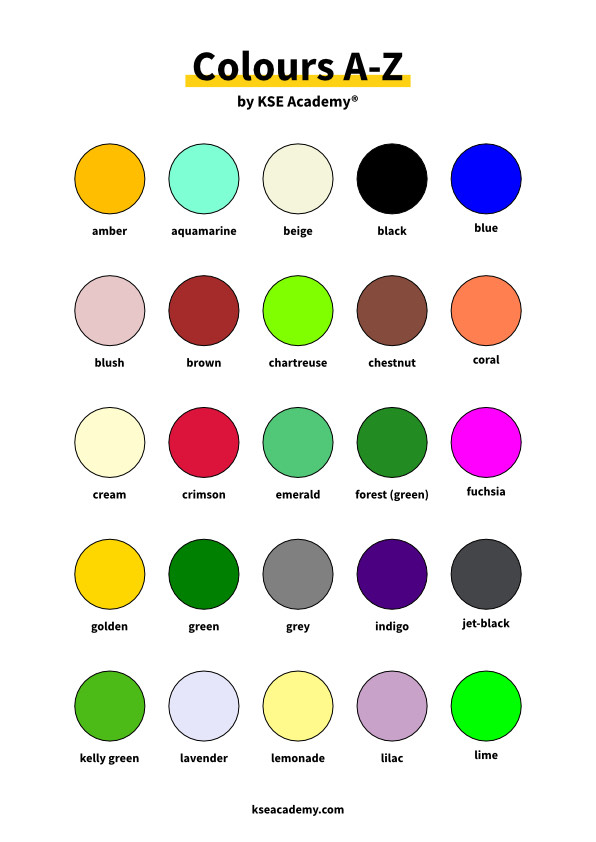
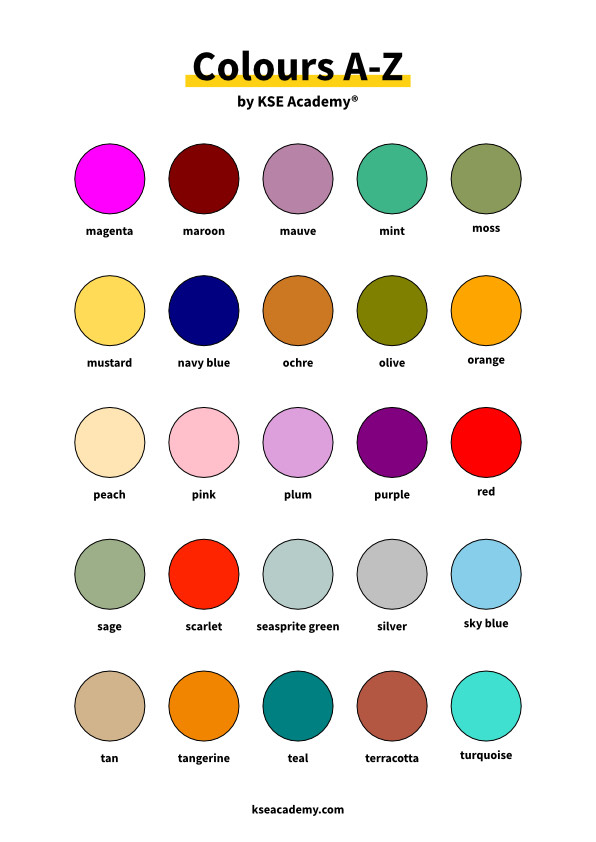
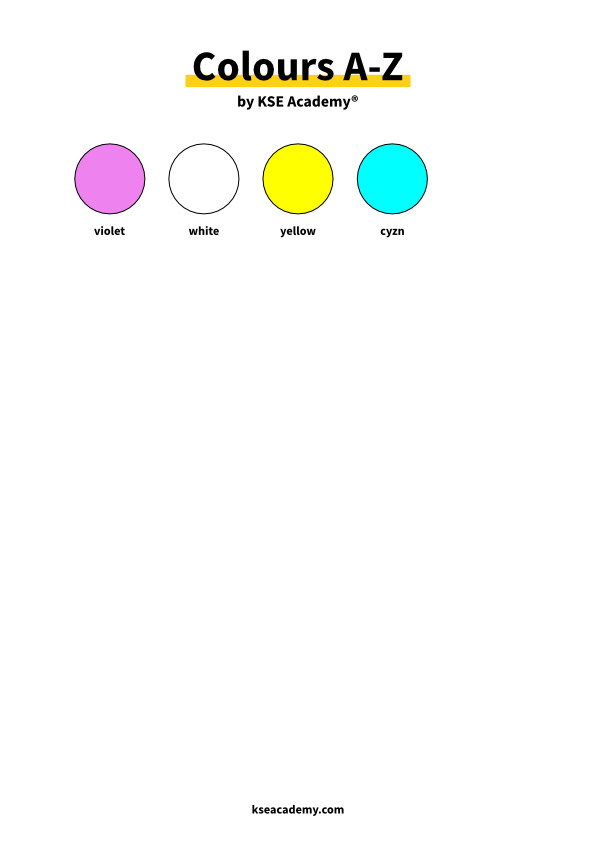
Click the following button to download the PDF of the list of colours in English. There are loads of them!
And in case you think it would be useful, I’ve also provided this post for download in PDF.