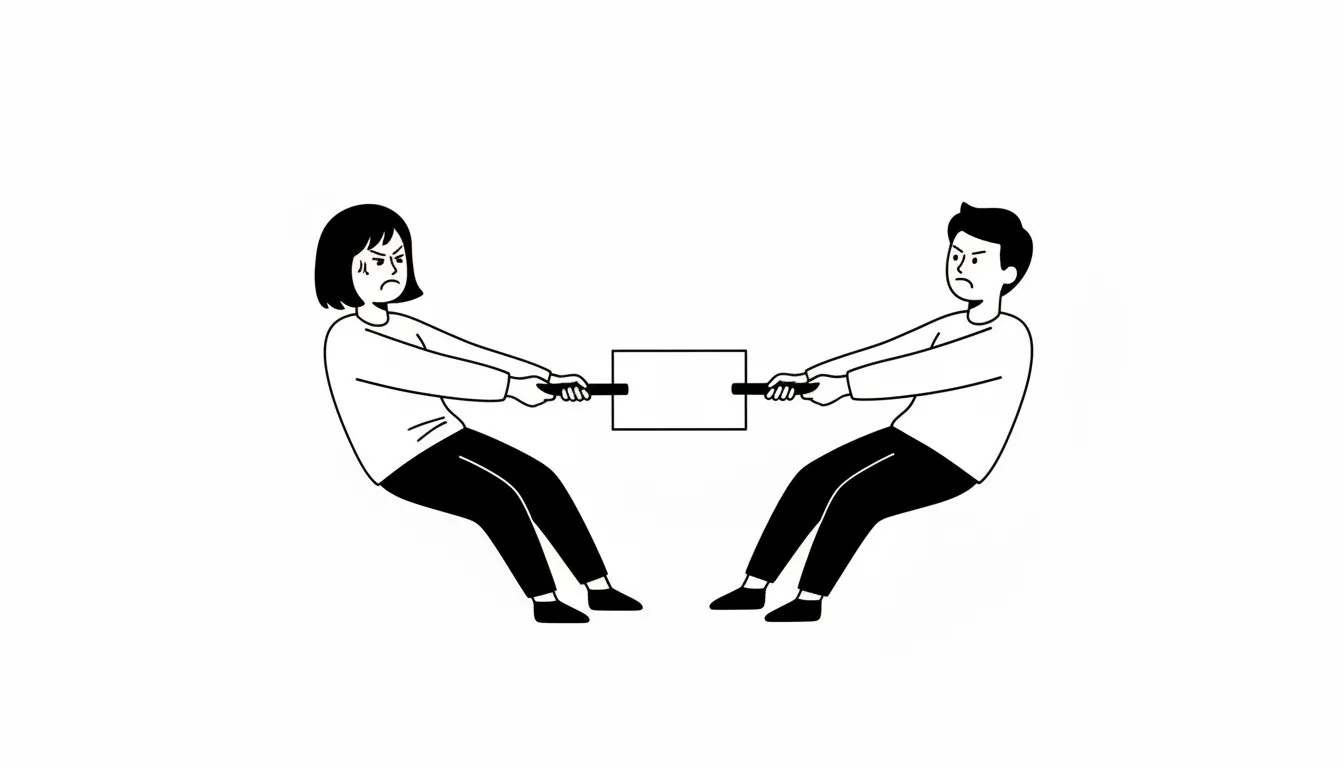
Difference between BORROW and LEND
Can you borrow me? ❌ Discover the difference between LEND and BORROW in English with examples, tips, and exercises. You’ll never confuse them again!

Table of contents
If you’ve ever said «Can you borrow me your pen?», don’t worry—you’re not alone. This mistake is so common amongst Spanish speakers (including my students…) that it’s practically become a rite of passage for any English learner. But today we’re going to clear up this confusion once and for all. Because yes, in Spanish we simply say «prestar», but in English we need two different verbs: borrow and lend. And whilst it might seem confusing at first, I promise that by the end of this article, you’ll have it crystal clear. Ready? Let’s dive in!
Why do LEND and BORROW confuse Spanish speakers so much?
The answer is simple: in Spanish we only have one verb for this action. When we say «¿Me prestas tu boli?» or «Le presté dinero a mi hermano», we’re using the same word for two completely opposite actions. In English, however, things change. Here we need to clearly specify the direction of the action: are you giving something temporarily or are you receiving it?
This linguistic difference means that our Spanish brains tend to directly translate «prestar» with one of these two verbs without thinking about the direction of movement. And that’s where the problem lies. But don’t worry, because once you understand the logic behind each verb, it’ll be a piece of cake.
BORROW: When YOU take something temporarily
Meaning and use of BORROW
Borrow means to take something temporarily or to ask for something temporarily. We use this verb when we are the ones receiving something temporarily from another person. Think of borrow as «to take». The object comes towards you, you receive it.
The key is to remember that the subject of the sentence with borrow is always the person who receives, not the one who gives. If I borrow your mobile, I am the subject of the action.
Grammatical structure with BORROW
The typical structure of borrow is:
- Borrow + something (+ from someone)
That is, you can use borrow without mentioning who you’re borrowing something from, although it’s very common to include the preposition FROM followed by the person.
Additionally, borrow is a regular verb, so its past tense and past participle are formed by adding -ed:
- Present: borrow
- Past: borrowed
- Past participle: borrowed
Practical examples with BORROW
- Can I borrow your umbrella? = Can I take your umbrella temporarily? / Can you lend me your umbrella?
- I borrowed £50 from my sister yesterday. = Yesterday I took £50 temporarily from my sister.
- She always borrows clothes from her friends. = She always asks to borrow clothes from her friends.
- Do you mind if I borrow your laptop for a few hours? = Do you mind if I take your laptop temporarily for a few hours?
- I need to borrow some money to pay the rent. = I need to ask for some money temporarily to pay the rent.
Notice that in all these examples, the subject (I, she, you) is the one who receives the object temporarily.
LEND: When YOU give something temporarily to someone
Meaning and use of LEND
Lend means to give something temporarily or to let someone use something temporarily. We use this verb when we are the ones giving something temporarily to another person. Think of lend as «to give». The object moves away from you, you hand it over.
The key is to remember that the subject of the sentence with lend is always the person who gives or lends, not the one who receives. If I lend you my book, I am the subject of the action.
Grammatical structure with LEND (and its two forms)
Lend has two possible structures, both equally correct:
- Lend + someone + something
- Lend + something + to someone
Unlike borrow, with lend you always need to mention both the object and the person who receives it. That’s why two complements appear in the structure.
Examples of both structures:
- I lent Tom my bike. (structure 1)
- I lent my bike to Tom. (structure 2)
Both mean exactly the same thing: «I lent my bike to Tom».
Practical examples with LEND
- Can you lend me your pen? = Can you give me your pen temporarily?
- She lent her brother £100 last month. = She gave her brother £100 temporarily last month.
- I can’t lend you my car today, I need it. = I can’t give you my car temporarily today, I need it.
- The bank refused to lend me any more money. = The bank refused to give me any more money temporarily.
- Could you lend me a hand with this? = Could you give me some help with this?
Notice that in all these examples, the subject (you, she, I, the bank) is the one who gives or lends the object to another person.
Conjugation of LEND (irregular verb)
Watch out! Unlike borrow, lend is an irregular verb. Its conjugation is:
- Present: lend
- Past: lent
- Past participle: lent
Always remember to pronounce and write that final «T» in the past tense and past participle. It’s very important. Don’t say «lended», because that form doesn’t exist.
The definitive trick to distinguish BORROW and LEND
The direction of the object rule
Imagine that the object being lent is a ball. Visualise its movement mentally:
- BORROW → The ball comes TOWARDS you ⬅️ (you receive it)
- LEND → The ball moves AWAY FROM you ➡️ (you give it)
If the object comes towards you: BORROW
If the object moves away from you: LEND
As simple as that. The direction of movement decides everything.
The subject trick: «Can I…» vs «Can you…»
Another super useful trick is to look at the subject of the question:
If the subject is I:
- ✅ Can I borrow your phone? (Correct – I receive)
- ❌ Can I lend your phone? (Incorrect – I’d be asking if I can lend YOUR phone to someone else)
If the subject is YOU:
- ✅ Can you lend me your phone? (Correct – you give me)
- ❌ Can you borrow me your phone? (Incorrect – it doesn’t make sense)
Both correct questions mean the same thing in Spanish («¿Me prestas tu móvil?»), but in English the structure changes depending on who the subject is.
BORROW vs LEND: Comparison table
| Aspect | BORROW | LEND |
|---|---|---|
| Meaning | To take/ask temporarily | To give/lend temporarily |
| Direction | ⬅️ Towards you (receive) | ➡️ Away from you (give) |
| Subject | Who receives the object | Who gives the object |
| Verb type | Regular | Irregular |
| Past | Borrowed | Lent |
| Past participle | Borrowed | Lent |
| Typical preposition | FROM (borrow from someone) | TO (lend something to someone) |
| Equivalent verb | To take | To give |
| Example | I borrowed £20 from John | John lent me £20 |
The 5 most common mistakes with BORROW and LEND (and how to avoid them)
Mistake 1: Saying «Can you borrow me…?»
This is THE MISTAKE par excellence, the one that makes any native speaker’s ears bleed. Many students say:
❌ Can you borrow me your dictionary?
Why is it wrong? Because you’re literally asking «Can YOU take my dictionary temporarily?», which doesn’t make any sense. Borrow means that the subject is the one who receives, not the one who gives.
✅ The correct forms would be: Can you lend me your dictionary? or Can I borrow your dictionary?
Mistake 2: Confusing the past tense of LEND
Since lend is irregular, many students make the mistake of regularising it:
❌ She lended me her notes.
The form «lended» simply doesn’t exist in English. The past tense of lend is lent:
✅ She lent me her notes.
Repeat: lend-lent-lent. Commit it to memory.
Mistake 3: Forgetting the prepositions FROM and TO
When you mention the person in your sentences, you need to use the correct prepositions:
- Borrow FROM someone (take temporarily from someone)
- Lend something TO someone (give something temporarily to someone)
Examples of common mistakes:
❌ I borrowed a book to the library.
✅ I borrowed a book from the library.
❌ He lent his car from me.
✅ He lent his car to me. or He lent me his car.
Mistake 4: Using LEND when it’s a first-person question
When you want to ask to borrow something in the first person, some students try to use lend:
❌ Can I lend your pencil?
This would mean «Can I lend your pencil?», that is, can I lend your pencil to someone else? It doesn’t make sense.
✅ The correct form is: Can I borrow your pencil? (I receive it)
Remember: if the subject is «I» and you want to receive something, use borrow.
Mistake 5: Not distinguishing between LOAN, LEND and BORROW
Here’s a third guest at the party that can cause confusion: loan. But don’t worry, we’re going to clarify it in the next section. For now, remember that loan is mainly a noun (a loan), whilst lend and borrow are verbs.
Practical exercises to master BORROW and LEND
Nothing like practice to consolidate what you’ve learnt.
How many did you get right? If you got any wrong, go back and reread the corresponding sections. The key is to identify who the subject is and where the object is going.
Useful expressions and phrases with BORROW and LEND for everyday use
Now that you’ve mastered the theory, let’s look at some everyday expressions that will be very useful. These phrases are especially important if you’re preparing for the B1 Speaking Cambridge exam, as this type of functional vocabulary is exactly what examiners expect to hear.
To ask to borrow something (BORROW):
- Could I possibly borrow…? (formal)
- Do you mind if I borrow…? (polite)
- Can I borrow… for a sec? (informal)
- Would it be okay to borrow…? (polite)
- I was wondering if I could borrow… (very polite)
To lend something (LEND):
- I can lend you… if you need it.
- Would you like me to lend you…?
- I’d be happy to lend you…
- I don’t mind lending you…
- Feel free to borrow my… (offering)
To decline politely:
- Sorry, I can’t lend you… right now.
- I’d love to lend it to you, but I need it myself.
- I’m afraid I can’t lend you… at the moment.
Money-related contexts:
When we talk about money, these verbs are especially common. If you want to expand your money vocabulary in English, I recommend you explore more related expressions, as in the financial world lend and borrow are fundamental words.
- Can you lend me some money until Friday?
- I need to borrow some cash for the bus.
- Banks lend money to businesses.
- He borrowed £5,000 from the bank to buy a car.
LOAN: The third guest at the party (noun vs verb)
Let’s now talk about loan, which often enters the conversation and causes even more confusion.
LOAN as a noun (most common):
In British English, loan is primarily a noun meaning «a loan», especially in formal or financial contexts:
- I took out a loan to buy a house. = I requested a loan to buy a house.
- She has a student loan. = She has a student loan.
- The bank approved my loan application. = The bank approved my loan application.
- He’s paying back his car loan. = He’s paying back his car loan.
LOAN as a verb (mainly in American English):
In American English, loan is also used as a verb, functioning as a synonym of lend:
- Can you loan me $20? (American English) = Can you lend me $20? (British English)
However, in standard British English, it’s preferable to use lend as a verb and reserve loan for the noun. So, if you’re learning British English or preparing for a Cambridge exam, stick with this rule:
- LOAN = noun (a loan)
- LEND = verb (to lend)
- BORROW = verb (to borrow)
As simple as that.
Conclusion: BORROW vs LEND – You’ll never confuse them again
And there you have it: everything you need to know about the difference between borrow and lend. Let’s recap the key points:
- BORROW = to take/ask temporarily (⬅️ the object comes towards you)
- LEND = to give/lend temporarily (➡️ the object moves away from you)
- Borrow is regular (borrowed), lend is irregular (lent)
- With borrow, the subject receives; with lend, the subject gives
- Borrow uses the preposition FROM; lend uses TO
- Never say «Can you borrow me…» – it’s the most common mistake
- Loan is mainly a noun (a loan)
The next time you need to use one of these verbs, simply ask yourself: «Am I giving or receiving?». If you’re receiving, use borrow. If you’re giving, use lend. As simple as that.
Practise these verbs whenever you have the chance, and soon they’ll come out naturally, without having to think. And remember: mistakes are part of learning, so don’t get frustrated if it’s difficult at first. With time and practice, you’ll master this difference like a true pro.
And until the next article, don’t forget to keep smiling!