What score do I need to pass my Cambridge English exam?
What’s the minimum score to pass my Cambridge English exam? Find out in this article, whatever your level is.

Table of contents
What score do I need to pass my Cambridge English exam? As an English teacher and director of KSE Academy (Granada), this is one of the most common questions my candidates ask me, and it’s no wonder, as it seems very few people outside the profession know how Cambridge exam scores are calculated nor what the score needed to pass Cambridge Assessment English exams is. However, in this article I’m going to resolve all your doubts. And if you still have any, ask by leaving a comment at the end of the article.
How does Cambridge English score the exams?
Each Cambridge English exam has a different scoring system, although it is quite similar among the most common ones, such as Preliminary (PET), First (FCE), Advanced (CAE) or Proficiency (CPE). In these cases, each exam is divided into 4 or 5 parts (Reading, Writing, Listening, Speaking and Use of English), and each part accounts for an equal percentage of the exam. If there are 4 parts, each has a weighting of 25%, and if there are 5 parts, each has a weighting of 20%. Within each part, some questions are worth 1 point while others are worth 2, depending on the exam and the task. The assessment criteria for each Cambridge English exam can be read on their official website. Here you can view any of their exams and see how much each item is worth in each part.
So far, so good. To calculate the score, we simply add up the points from the correct answers, and then apply the 20% or 25% percentages to each part, and add them up. But, what score do we need to pass each exam? Keep reading.
What score is needed to pass Cambridge English exams?
Okay. Until the end of 2014, it was quite simple to remember, as to pass an exam you simply had to achieve a specific percentage. In fact, it was like this:
- KET and PET: 70%
- FCE, CAE and CPE: 60%
When you took an exam and the result came out, you simply obtained a percentage which we used to determine if you had passed or not. And depending on whether it was higher or lower, we knew if you had passed with an A, B, or C.
But that changed in January 2015. Since then, although you still need to obtain 60% or 70% of the exam score, your results are no longer published as a percentage, but in a non-percentage numerical form. This was because, in January 2015, Cambridge Assessment English (formerly Cambridge English Language Assessment) published its almighty results scale, called the «Cambridge English Scale«.
What is the Cambridge English Scale?
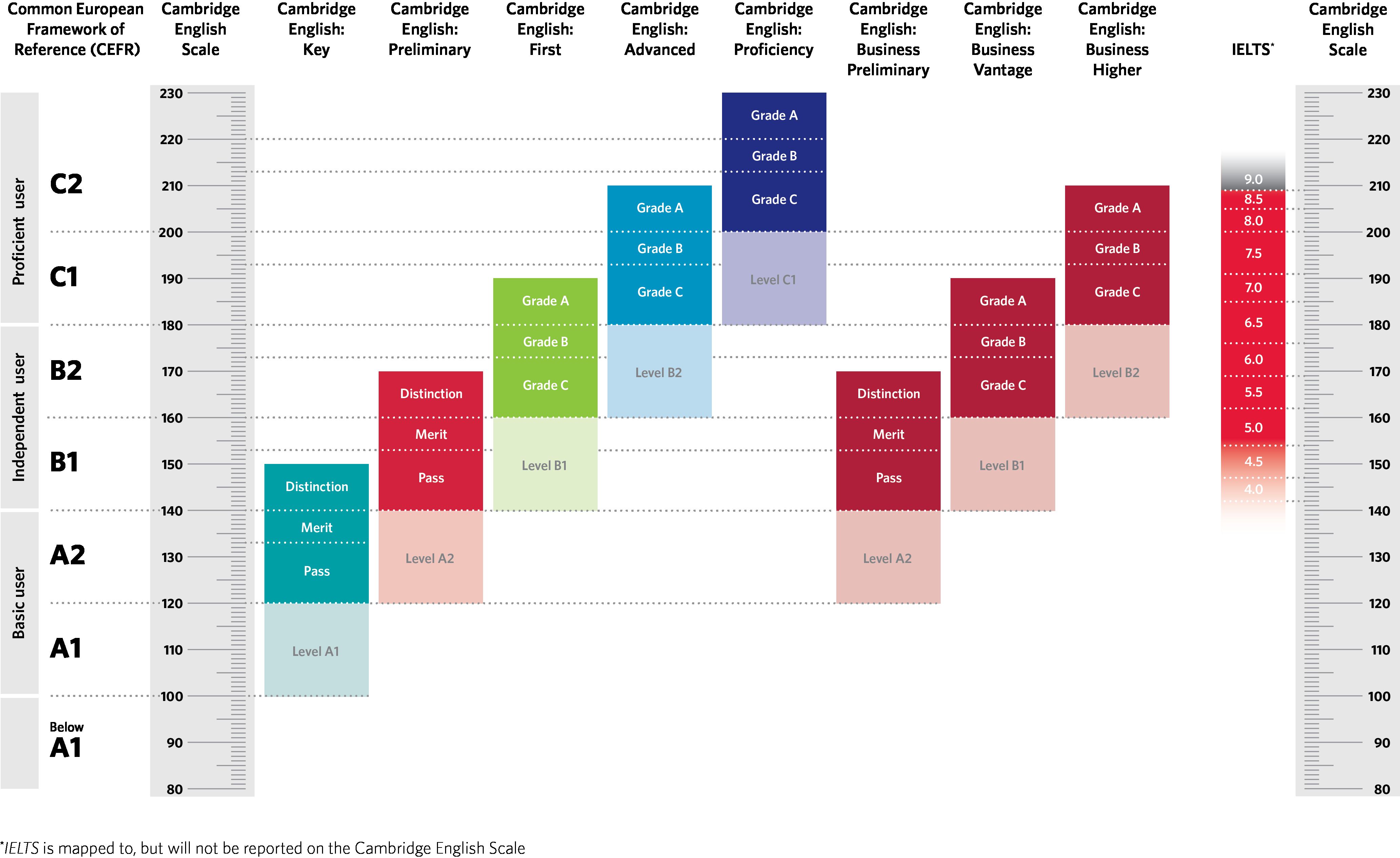
Believe it or not, the Cambridge English Scale simplifies things quite a bit, although not at first glance. However, if we take a quick look, we’ll see the following:
On the left:
- The descriptors for Basic user, Independent user and Proficient user, according to the Common European Framework of Reference for Languages.
- The descriptors for specific linguistic levels according to the Common European Framework: A1, A2, B1, B2, C1, C2.
- The Cambridge English scale, which ranges from 80 points up to 230.
And here, as you can see, is where the magic happens: Cambridge has designed its scale and exam scoring so that they can be used linearly with the levels established by the Common European Framework. For this reason, if a candidate obtains a score of, for example, 175, we will know that this candidate has approximately a high B2 level. But the best part is that we don’t even need to know which exam that candidate took. 😀 Although it’s true that only 2 exams fall within the range of 175 points: First (FCE) and Advanced (CAE). The others don’t include that score, either because it’s too high (for KET or PET) or too low (for CPE).
Enough beating around the bush, what score do I need to pass my Cambridge English exam?
Okay, I’ll tell you now. Well, basically, to pass you need the following score, depending on the exam:
Score needed to pass A2 Key (KET)
| PUNTUACIÓN | GRADE | NIVEL MCERL |
|---|---|---|
| 100 - 119 | Level A1 (Fail) | A1 |
| 120 - 132 | Grade C | A2 |
| 133 - 139 | Grade B | A2 |
| 140 - 150 | Grade A | B1 |
Score needed to pass B1 Preliminary (PET)
| PUNTUACIÓN | GRADE | NIVEL MCERL |
|---|---|---|
| 120 - 139 | Level A2 (Fail) | A2 |
| 140 - 152 | Grade C | B1 |
| 153 - 159 | Grade B | B1 |
| 160 - 170 | Grade A | B2 |
Score needed to pass B2 First (FCE)
| PUNTUACIÓN | GRADE | NIVEL MCERL |
|---|---|---|
| 140 - 159 | Level B1 (Fail) | B1 |
| 160 - 172 | Grade C | B2 |
| 173 - 179 | Grade B | B2 |
| 180 - 190 | Grade A | C1 |
Score needed to pass C1 Advanced (CAE)
| PUNTUACIÓN | GRADE | NIVEL MCERL |
|---|---|---|
| 160 - 179 | Level B2 (Fail) | B2 |
| 180 - 192 | Grade C | C1 |
| 193 - 199 | Grade B | C1 |
| 200 - 210 | Grade A | C2 |
Score needed to pass C2 Proficiency (CPE)
| PUNTUACIÓN | GRADE | NIVEL MCERL |
|---|---|---|
| 180 - 199 | Level C1 (Fail) | C1 |
| 200 - 212 | Grade C | C2 |
| 213 - 219 | Grade B | C2 |
| 220 - 230 | Grade A | C2 |
So there you have it. What score do you need to pass? It depends on your exam, but the minimum to pass is the minimum score for Pass (KET and PET) or Pass with Grade C (FCE, CAE and CPE). Furthermore, if you take any other Cambridge exam, you will also be able to know if you have passed or not with this scale. The only one that, although it appears, will not have this type of scoring, will be the IELTS exam, which is very specific for studying full degree courses at universities in the United Kingdom, among other countries.
Score needed to pass all Cambridge English exams
- Score needed to pass A2 Key (KET): 120
- Score needed to pass B1 Preliminary (PET): 140
- Score needed to pass B2 First (FCE): 160
- Score needed to pass C1 Advanced (CAE): 180
- Score needed to pass C2 Proficiency (CPE): 200
Do you have any questions about Cambridge exam scores? Ask in the comments. And if you’re in Granada, feel free to pop in and ask in person at our English academy at c/ Arabial 4 18004 Granada. We’ll be happy to answer your questions without any obligation.
And if you found this post useful, don’t forget to share it and subscribe and follow us on our social media channels.