Duolingo English Test (DET): Reading
Complete guide to the Reading section of the DET 2026: strategies, tips and examples to master Read and Select, Fill in the Blanks, Read and Complete and Interactive Reading.

Table of contents
If you are preparing for the Duolingo English Test (DET), you probably already know that the Reading section is not like that of other traditional exams. Here, you won’t find long passages followed by standard reading comprehension questions. The DET assesses your reading comprehension in a much more dynamic and innovative way, combining vocabulary recognition, word completion, and interactive reading tasks.
In this comprehensive guide, I am going to explain in detail each of the four Reading tasks you will find in the exam: Read and Select, Fill in the Blanks, Read and Complete, and Interactive Reading. I will give you specific strategies for each type, preparation tips, and all the information you need to maximise your score in this fundamental section of the DET.
If you want to know about all aspects of the exam, I recommend reading my Duolingo English Test (DET) guide, where you will find complete information on all sections.
What Does the DET Reading Section Assess?
The Reading section of the Duolingo English Test assesses your ability to understand written texts in English at different levels and in various contexts. Unlike more traditional exams like IELTS or TOEFL, the DET is not limited to measuring whether you understand a long academic text and can answer questions about it.
The DET goes further and assesses:
- Vocabulary recognition: Your ability to distinguish real words from pseudowords that sound plausible but do not exist
- Contextual understanding: Your ability to deduce missing words based on the context of a sentence or passage
- Orthography and spelling: Your precise knowledge of how English words are written
- Global and detailed comprehension: Your ability to understand both the main idea of a text and specific details
- Textual cohesion and coherence: Your ability to identify how ideas are connected in a text
All these skills are essential for functioning in an English-speaking academic or professional environment, where you will need to read articles, reports, emails, and various documents quickly and accurately.
General Features of Reading in the DET
Before going into detail with each type of task, it is important that you know some general features that define the Reading section of the DET:
- Adaptive system: All Reading tasks are adaptive, which means that the difficulty of the questions you receive is adjusted according to your previous answers. If you answer correctly, the following words or texts will be more difficult. If you make mistakes, the difficulty will decrease. This system allows the exam to assess your real level with greater precision in less time.
- First half of the exam: All Reading tasks appear during the first half of the test, which lasts approximately 25 minutes. In this first part, Reading, Writing, Listening, and Speaking tasks are mixed randomly and adaptively.
- Reading subscore: Your answers in all Reading tasks contribute to your specific Reading subscore (as well as your overall DET score). This subscore will appear on your certificate alongside those for Listening, Writing, and Speaking, giving institutions a more detailed view of your strengths.
- Automatic AI marking: All Reading tasks are marked automatically by an artificial intelligence engine. Answers are considered correct or incorrect; there are no partial scores.
- You cannot go back: Once you have completed a task or answered a question, you cannot go back to change your answer. Therefore, it is essential to read carefully before responding.
Read and Select: Identify Real Words in 5 Seconds
Read and Select is probably the fastest and most dynamic task in the entire Reading section. It is a vocabulary recognition exercise that tests your familiarity with real English words and your ability to distinguish them from made-up words that may look convincing.
How Does Read and Select Work?
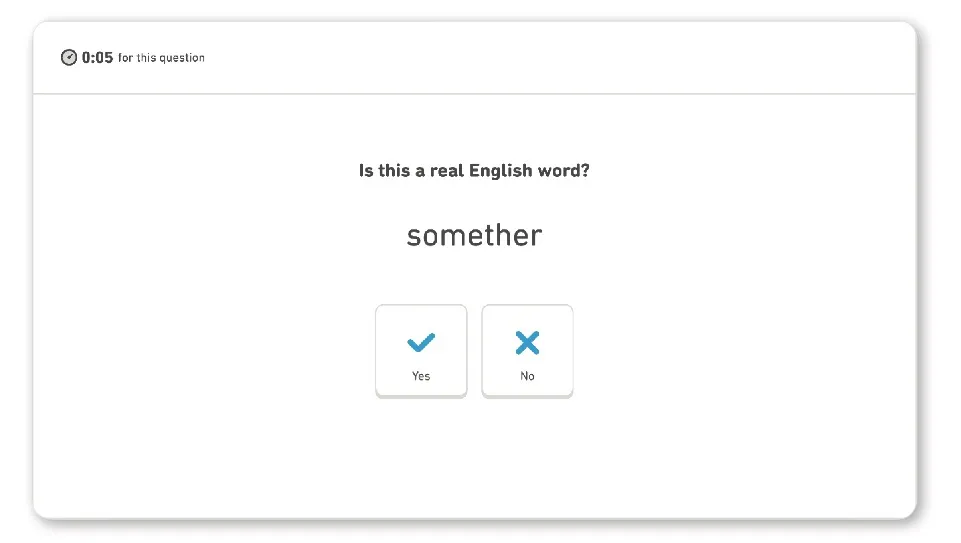
In this task, you are presented with a series of words, one by one, in the centre of the screen. Each word remains visible for exactly 5 seconds, and during that time, you must decide whether it is a real English word or not.
Task format:
- You will receive between 15 and 18 words in total per set
- There is only one Read and Select set in the entire exam
- It appears in the first half of the test
- You have exactly 5 seconds for each word
- You must click «Yes» if the word is real, or «No» if it is not
- The timer starts automatically when the word appears
- After clicking, the next word appears immediately
What are pseudowords? The fake words that appear in this task are not random combinations of letters. They are carefully designed «pseudowords» that follow English phonetic and orthographic rules, so they sound and look like real words. For example, brelt does not exist, but it could exist because it follows typical English patterns and resembles real words like belt or melt.
Some examples of real words you might see: files, mountain, birthday, consultation, heinous, alabaster, prevaricate.
Some examples of pseudowords: brelt, frimble, wanture, hobar, thirther, docuse, leadine, quarnish, sprogle.
Strategies to Master Read and Select
With only 5 seconds per word, you need to trust your instinct and your vocabulary knowledge. Here are the best strategies for this task:
1. Trust your first impression
If you immediately recognise a word because you have seen or used it before, click «Yes» without hesitation. Your brain is very good at recognising familiar patterns. If a word sounds completely strange to you and you have never encountered it, it is most likely fake.
2. Pronounce the word mentally
Sometimes, seeing a written word is not enough. Try to «hear it» in your head. Real words usually sound natural when you pronounce them mentally, while pseudowords can sound strange or forced. This technique is especially useful with less common words.
3. Look for suspicious orthographic patterns
Although pseudowords are designed to look real, they sometimes have letter combinations that are uncommon in English. For example, certain consonant combinations at the beginning or end of a word, or unusual vowel patterns. However, be careful: English has many spelling exceptions, so do not rule out a word just because it looks «weird».
4. Watch out for words that look like real ones
Many pseudowords are created by slightly modifying real words. For example, wanture looks like adventure or wander, but it is neither of those. Thirther might remind you of thither or further. If a word reminds you of another but is not exactly the same, it is probably fake.
5. Do not waste time in doubt
With only 5 seconds, you cannot afford to get stuck. If you reach second 3 or 4 and are still not sure, make a decision based on your best intuition. It is better to take a risk than to let the time run out without answering.
6. Pay attention to British and American variants
The DET accepts both British and American spelling in Read and Select. So words like colour and color, centre and center, or travelling and traveling are all valid. Do not reject a word just because it uses a different spelling variant than the one you are used to.
7. Remember there can be any proportion of real words
Do not assume there will be exactly 50% real words and 50% fake ones. There could be 10 real and 8 fake, or 6 real and 12 fake. Each word should be assessed independently, without trying to «balance» your answers.
How to Prepare for Read and Select
The best preparation for Read and Select is to expand your receptive vocabulary, that is, your ability to recognise words even if you do not actively use them when speaking or writing.
Long-term improvement strategies:
- Read extensively in English: Novels, articles, blogs, news. The more you read, the more words you will find in context, and your brain will store them automatically
- Use vocabulary flashcards: Applications like Anki or Quizlet allow you to create vocabulary decks and review them regularly
- Learn affixes and roots: Knowing prefixes (un-, re-, pre-, dis-), suffixes (-tion, -ness, -able, -ment), and common roots will help you identify if a word «could» be real. For example, if you know that -tion turns verbs into nouns, you will recognise that consultation comes from consult
- Play word games: Scrabble, crosswords, word searches, or apps like Words with Friends expose you to varied vocabulary in a fun way
- Study academic vocabulary lists: Lists like the Academic Word List (AWL) contain intermediate-advanced level words that frequently appear in academic texts
- Familiarise yourself with British and American spelling: Learn the main differences (colour/color, realise/realize, centre/center, etc.) so you do not hesitate when you see either form
Specific exam practice:
- Look for DET practice tests that include Read and Select (several are available online)
- Practise making quick decisions: Set a 5-second timer and get used to deciding under time pressure
- Review lists of commonly confused words in English
Fill in the Blanks: Complete Words with Missing Letters
Fill in the Blanks is another word completion task, but unlike Read and Select, here you need to not only recognise the correct word but also write it with perfect spelling. It is a task that combines reading comprehension, vocabulary knowledge, and precise spelling.
How Does Fill in the Blanks Work?
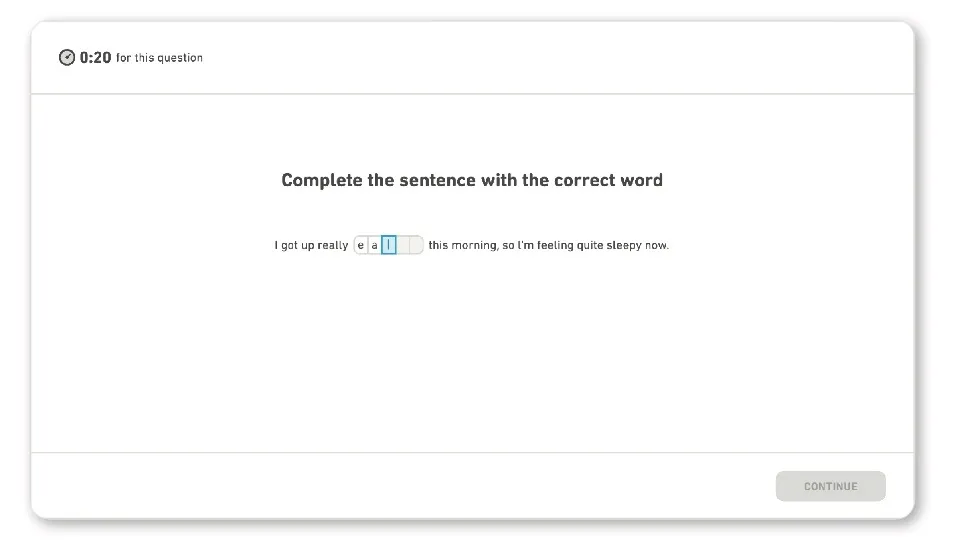
In this task, you are presented with a sentence containing an incomplete word. Some letters of the word are visible (usually the first ones), while others are represented by blank spaces or small squares. Your job is to type the missing letters to complete the word correctly.
Task format:
- You will receive between 6 and 9 sentences in total per set
- There is only one set of Fill in the Blanks in the entire exam
- It appears in the first half of the test
- You have 20 seconds to complete each word
- There is only ONE incomplete word per sentence
- The incomplete word can appear in any position in the sentence
- Sentences can be up to 20 words in length
- The first letters of the incomplete word are always shown
Example: «To prevent them from spoiling, perishable goods must be qui _ _ _ _ _ transported from the production site to retail outlets.»
The correct answer is quickly (the missing letters are: c, k, l, y).
As you can see, the context of the sentence gives you important clues: you need an adverb that modifies the verb «transported», and the idea that perishable products spoil suggests they must be transported with speed.
Strategies to Solve Fill in the Blanks Effectively
1. Always read the full sentence first
Do not jump straight to the incomplete word. Read the whole sentence from start to finish to understand the general context, the theme of the sentence, and its overall meaning. This contextual understanding is your best clue for deducing the correct word.
2. Identify the grammatical function of the missing word
Ask yourself: is it a noun, a verb, an adjective, or an adverb? Look at the words surrounding the gap:
- If there is an article (a, an, the) just before, you probably need a noun or an adjective followed by a noun
- If it is after a verb and modifies the action, it is probably an adverb
- If it is between a subject and an object, it could be a verb
- If it is before a noun, it could be an adjective
3. Look for meaning clues in the rest of the sentence
The incomplete word usually relates directly to other words in the sentence. Look for:
- Synonyms or antonyms: Other words that reinforce or contrast the meaning
- Colocations: Common combinations of words (for example, «make a decision», «heavy rain», «deeply concerned»)
- Logical connectors: Words like «but», «however», «therefore» that indicate the relationship between ideas
- Thematic context: The general theme of the sentence helps you limit the possibilities
4. Take advantage of visible letters
The first letters you can see are a huge clue. Think of words you know that start with those letters and make sense in the context. If you see «qui _ _ _ _ _» and you need an adverb, «quickly» is an obvious choice.
5. Consider verb tense and agreement
If the incomplete word is a verb, look at:
- The verb tense of the rest of the sentence
- The subject (singular or plural, first/second/third person)
- Whether it is active or passive voice
For example: «The scientist _ _ _ _ _ _ _ _ a discovery» → you need a past tense verb, probably «made» («made a discovery» is a common colocation).
6. Check your spelling before continuing
This point is crucial: the system marks answers as correct or incorrect. A single spelling mistake makes your answer incorrect, even if you have identified the right word. Take a second to verify:
- Double letters (committee, success, embarrass)
- Correct vowels (separate, not seperate)
- Tricky endings (-ance/-ence, -able/-ible, -tion/-sion)
7. Use colocations to your advantage
Colocations are combinations of words that appear together frequently in English. If you recognise a colocation, you will have solved the task quickly. Common examples:
- make a decision/mistake/difference
- take advantage/responsibility/action
- pay attention
- deeply concerned/committed
- highly recommended/skilled
Specific Preparation for Fill in the Blanks
To master Fill in the Blanks, you need to work on three areas: productive vocabulary (words you can use actively), precise spelling, and contextual understanding.
Recommended practice exercises:
- Crosswords: They are perfect for this task because they combine meaning clues with partially revealed letters, exactly like Fill in the Blanks
- Cloze tests: Exercises where words are removed from a text and you must complete them according to the context
- Dictations: They help you improve your spelling and associate sounds with letters correctly
- Lists of commonly misspelt words: Study words with tricky spelling in English
- Colocation exercises: Learn which words usually go together in English
Knowledge of affixes and roots:
Understanding how words are formed in English gives you an advantage in this task. For example:
- If you know that -ly turns adjectives into adverbs, you will recognise «qui _ _ _ _ _» as «quickly»
- If you know the prefix inter- (between, mutual), words like «international» will be easier to complete
- If you know that -tion creates nouns from verbs, you will recognise «disco _ _ _ _ _» as «discovery»
British vs. American spelling:
Good news: In Fill in the Blanks, the DET accepts BOTH British and American spelling. So you can write «summarize» or «summarise», «color» or «colour», «center» or «centre» and all will be correct. Choose the variant you feel most comfortable with and be consistent.
Read and Complete: The Challenge of the Incomplete Passage
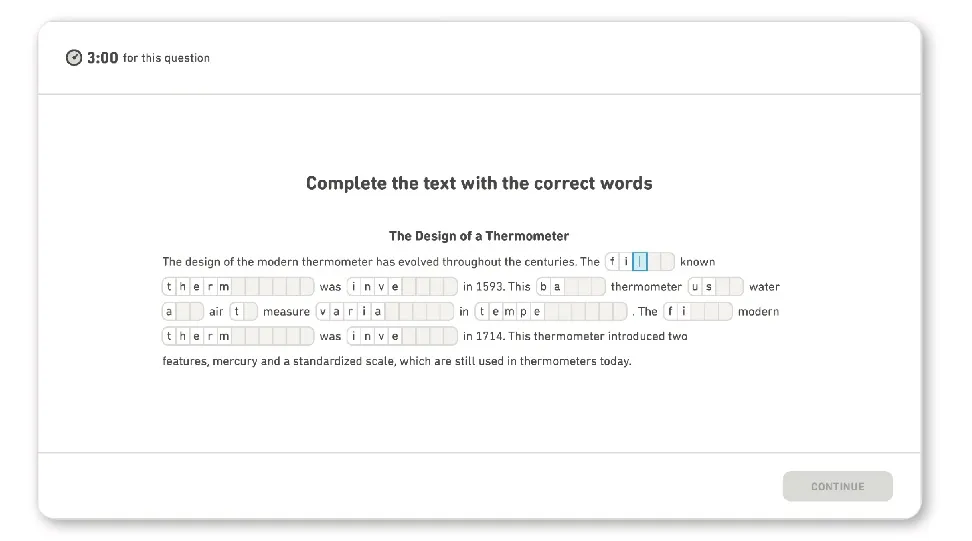
Read and Complete is essentially Fill in the Blanks on a larger scale. Instead of completing a single word in an isolated sentence, you must complete multiple incomplete words in a full passage. This task assesses your ability to use context more broadly and maintain text coherence while completing it.
How Does Read and Complete Work?
You are presented with a short passage (usually a paragraph) with a title. The first and last sentences of the passage are complete, but in the middle sentences, there are several incomplete words that you must complete by typing the missing letters.
Task format:
- You will receive between 3 and 6 passages in total during the exam
- All appear in the first half of the test
- You have 3 full minutes to complete the ENTIRE passage
- Each passage has between 5 and 8 incomplete words
- Incomplete words are NEVER next to each other (there is always at least one complete word between them)
- Incomplete words are NEVER proper nouns
- The first sentence and the last sentence are always complete
- The passage includes a title that gives you context on the topic
Types of texts: Passages can be of various genres, including narrative fiction, news articles, excerpts from academic textbooks, scientific descriptions, essays, etc.
Key Differences with Fill in the Blanks
Although Read and Complete is similar to Fill in the Blanks, there are important differences that change your strategy:
1. Multiple incomplete words: Instead of focusing on a single word, you must manage 5-8 words simultaneously. This requires a more global view of the text.
2. Broader context: You have a full passage with a title, not just an isolated sentence. This means more contextual clues, but also more information to process.
3. Time management: 3 minutes might seem like a lot, but if you have 8 incomplete words, that is less than 25 seconds per word (including the time to read the full passage). You need to be efficient.
4. American spelling only: This is a CRUCIAL difference. Unlike Fill in the Blanks (which accepts both variants), Read and Complete ONLY accepts American spelling. So you must write «color» not «colour», «center» not «centre», «traveling» not «travelling», etc.
5. Textual coherence: The words you complete must maintain the coherence of the text. If you complete a word incorrectly, it can affect your understanding of the rest of the passage.
Advanced Strategies for Read and Complete
1. Read the full passage FIRST
Before trying to complete any word, read the whole passage from start to finish, including the title. Try to understand:
- What is the text about?
- What is the main idea?
- What type of text is it? (narrative, descriptive, argumentative, expository)
- What is the tone? (formal, informal, academic, journalistic)
This global understanding will provide a mental framework for all the words you complete later.
2. Start with the easiest words
Do not try to complete the words in the order they appear. Do the ones that are most obvious to you first. This has two advantages:
- You gain confidence and momentum
- Each word you complete gives you more context for the remaining difficult words
3. Use the «virtuous cycle» of context
The more words you complete, the better you will understand the passage, and the better you understand it, the easier it will be to complete the remaining words. This is the «virtuous cycle» of Read and Complete. Therefore, it is important not to get stuck on a difficult word at the beginning: complete the easy ones first to create that positive cycle.
4. Take advantage of the passage title
The title is not just for aesthetics: it gives you valuable information about the topic and may contain key vocabulary that will be repeated in the text. For example, if the title is «The Design of a Thermometer», you know the incomplete words will likely be related to thermometers, temperature, measurement, etc.
5. Look for the same word elsewhere in the text
Sometimes, the word you need to complete (or a very similar form) appears complete in another part of the passage or even in the title. For example, if the title says «The Mysterious Island» and later on there is «the is _ _ _ _ _», you know it is «island».
6. The same word can appear incomplete more than once
Do not think it is a trick. If a word clearly fits in two different gaps, it is probably the correct answer for both. The text may repeat key words to maintain cohesion.
7. Pay attention to connectors and logical structure
The complete words between the gaps are important clues. Observe:
- Contrast connectors (but, however, although) → suggest a change in direction
- Cause-effect connectors (because, therefore, thus) → suggest logical relationships
- Addition connectors (moreover, furthermore, also) → suggest ideas that add up
- Words indicating time or sequence (first, then, finally) → help you follow the narrative
8. Do not spend more than 20-25 seconds on a difficult word
If you have been thinking about a word for half a minute and cannot think of it, type your best guess and move on. You can return at the end if you have time left. It is better to complete all words (even if some are guesses) than to leave gaps blank because you ran out of time.
9. Reread the full passage when finished
If you have 20-30 seconds left, read the whole passage with the completed words. Verify that:
- Everything makes logical sense
- The spelling is correct (especially American spelling)
- The words grammatically agree with the rest of the sentence
Preparation Tips for Read and Complete
CRITICAL note on American spelling:
Remember that Read and Complete ONLY accepts American spelling, unlike other DET tasks. This means you must specifically familiarise yourself with the differences between British and American English:
| British English | American English | Pattern |
|---|---|---|
| colour, honour, flavour | color, honor, flavor | -our → -or |
| centre, theatre, metre | center, theater, meter | -re → -er |
| realise, organise, recognise | realize, organize, recognize | -ise → -ize |
| travelling, cancelled, labelled | traveling, canceled, labeled | double L → single L |
| defence, offence, licence | defense, offense, license | -ce → -se (nouns) |
| grey, plough | gray, plow | special cases |
Predictive reading practice:
An excellent exercise to prepare for Read and Complete is to practise «predictive reading». Every time you read a book, article, or any text in English:
- Before moving to the next page, try to predict what word will come next
- Partially cover words with your finger and try to guess them based on the first letters and the context
- Read the headline of an article and the first paragraph, then try to predict what vocabulary will appear in the following paragraphs
Crosswords, again:
Crosswords remain your best ally. They train you exactly in the skills you need: deducing words from limited context, using partial letters as clues, and precise spelling.
Cloze passage exercises:
Look for «cloze test» or «cloze passage» exercises online. These are passages where words have been systematically removed (for example, every seventh word) and you must complete them. It is perfect practice for Read and Complete.
Interactive Reading: The Most Comprehensive DET Task
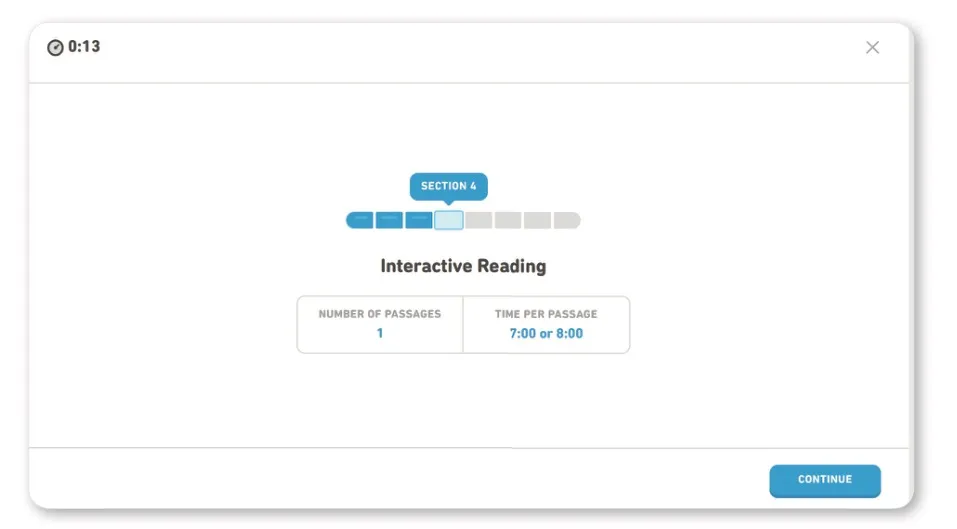
Interactive Reading is, without doubt, the most complex and complete task in the entire DET Reading section. It is not just a single question, but a linked sequence of 6 different sub-questions about the same academic or informative text. What makes this task unique is that the text is revealed progressively: each new question shows you a little more of the passage, as if you were «discovering» the text while reading it.
General format:
- You will receive 2 full sets of Interactive Reading during the exam
- Each set contains exactly 6 sub-questions in a fixed order
- You have between 7 and 8 minutes to complete the 6 sub-questions of each set
- The text is academic or informative (it can be about science, history, technology, society, art, etc.)
- It is an adaptive task that affects your Reading subscore
Let’s look at each of the 6 sub-questions in detail:
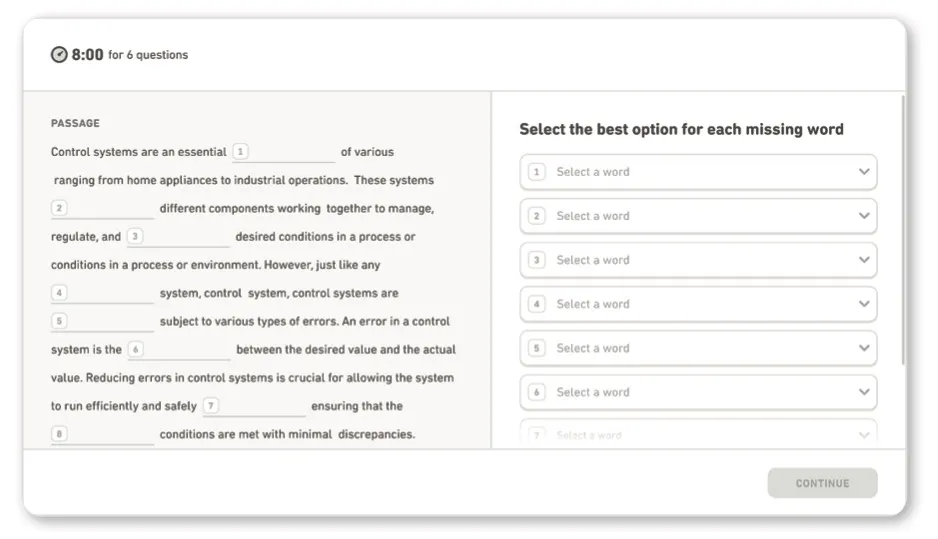
1. Complete the Sentences
This is the first sub-question and your first contact with the text. You are shown the first half of the passage, but with several gaps (between 4 and 6 missing words). For each gap, you must select the correct word from a dropdown menu with 3 or 4 options.
How it works:
- You click on each gap and a dropdown menu with options appears
- The options are usually words with similar meanings or grammatical functions
- Only one option is correct according to the context
- You can change your selections before clicking «Continue»
Specific strategies:
- Read the whole sentence before choosing: Do not select a word just because it «sounds good». Read the full sentence with each option mentally to see which fits best
- Look for grammatical clues: Sometimes options are grammatically different (a verb vs. a noun, singular vs. plural). The sentence grammar will tell you which one is correct
- Consider the global meaning: The word must make sense not just in that sentence, but in the context of the whole paragraph
- Discard clearly incorrect options first: If you have 4 options and can eliminate 2 immediately, you only need to choose between the remaining 2
- Pay attention to colocations: Some words simply «go together» in English more than others
Common mistakes:
- Choosing the first option without reading the others
- Selecting a word because you know it better, even if another is more appropriate
- Not rereading the full sentence after making your selection
2. Complete the Passage
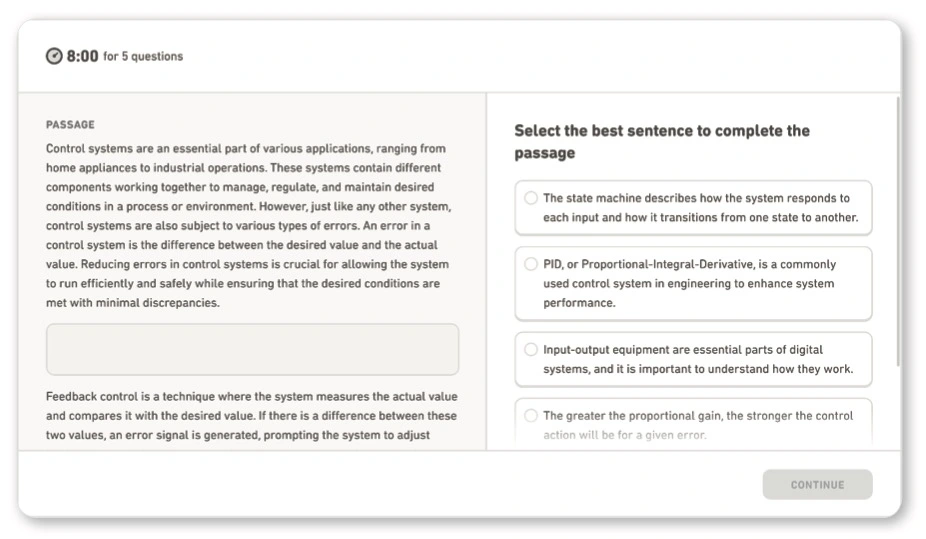
Now you are shown the first half of the text (which you already completed) and the beginning of the second half. A crucial transition sentence is missing between both parts. You must choose, from several options, the sentence that best connects both halves of the text.
How it works:
- You see the first half of the text (already completed)
- There is a gap where a sentence should go
- After the gap, the second half of the text begins
- You must select the best transition sentence from 3-4 options
Specific strategies:
- Read the last sentence of the first half: It tells you where the previous thought ends
- Read the first sentence of the second half: It tells you where the text is heading next
- Look for thematic coherence: The transition sentence must logically connect both ideas
- Pay attention to connectors: Words like «however», «moreover», «therefore», «in addition» in the options give you clues about the logical relationship between parts
- Consider pronouns and references: If the second half begins with «This» or «These» or «Such», the transition sentence must introduce what that pronoun refers to
- Check the flow: Read the full text mentally with each option; the correct one will make the text flow naturally
Common transition types:
- Contrast: The second part presents an opposite or different idea
- Addition: The second part adds more information or examples
- Cause-effect: The second part explains consequences or results
- Example or specification: The second part illustrates with concrete cases
- Temporal: The second part continues a chronological sequence
3 and 4. Highlight the Answer
These are sub-questions 3 and 4, and both work the same way (which is why I explain them together). You are asked a specific question about the content of the text, and you must click and drag to highlight (select) the exact part of the text that answers that question.
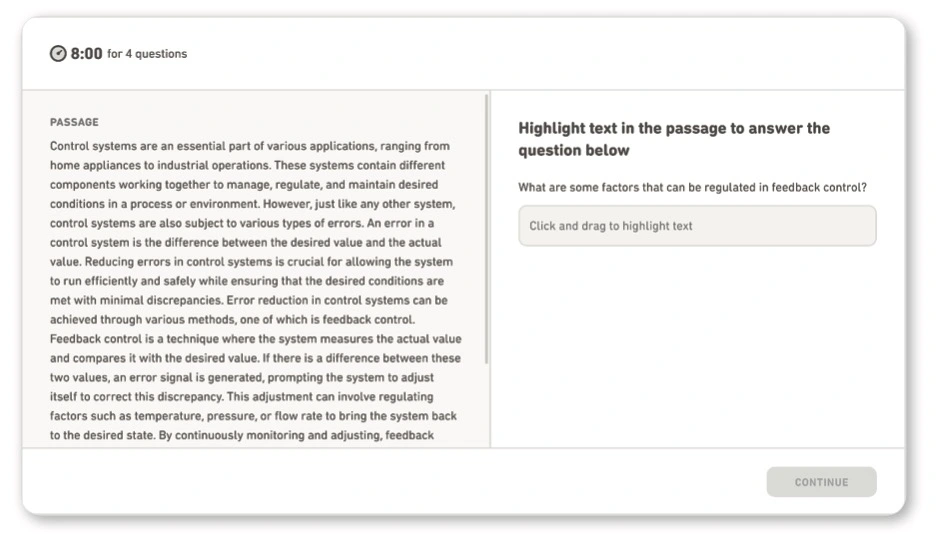
How it works:
- Now you can see almost the entire text
- A specific question appears at the top
- You must click at the start of the answer and drag to the end to highlight it
- The highlighted portion is marked in colour
- You can change your selection by clicking and dragging again
Typical question examples:
- «Highlight the sentence that explains why…»
- «Highlight the part of the text that describes…»
- «Highlight where the author mentions…»
- «Highlight the evidence that supports…»
Specific strategies:
- Read the question carefully: Make sure you understand exactly what is being asked. Are they looking for a cause, an effect, an example, a description, a definition?
- Search for keywords: Identify important words in the question and search for where they appear in the text (or synonyms of them)
- Be precise, not excessive: Do not highlight entire paragraphs. Select only the portion of the text that DIRECTLY answers the question. It could be a phrase, a full sentence, or even two sentences if both are necessary for the complete answer
- But do not fall short either: If you highlight only part of the answer, it will be incorrect. Make sure to include all relevant information
- Read what you have highlighted in isolation: Once you have made your selection, read only the highlighted part and ask yourself: «Does this completely answer the question?» If something is missing, expand the selection
- Pay attention to grammatical boundaries: Generally, correct answers start and end at natural boundaries of sentences or phrases, not in the middle of a grammatical construction
Directed scanning technique:
For these questions, you do not need to reread the whole text word for word. Use the scanning technique:
- Identify the keywords in the question
- Move your eyes quickly over the text looking for those words (or synonyms)
- When you find them, read that section more carefully
- Determine if that portion completely answers the question
5. Identify the Idea
Finally, you can see the full text! Now that you have seen and worked with the whole passage, you are asked to identify the main or central idea of the complete text. You are presented with several statements (usually 4), and you must select the one that best expresses the main idea.
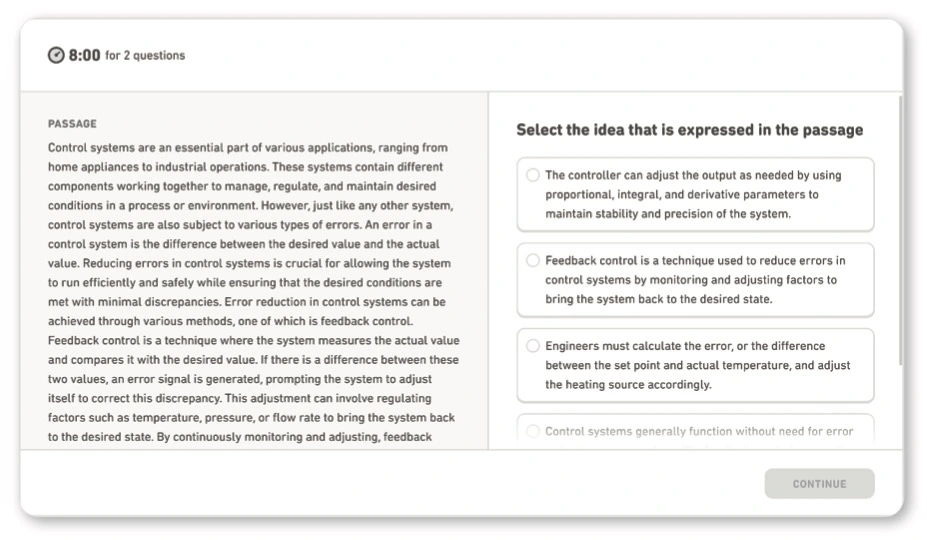
How it works:
- You can see the full passage
- Four statements about the text are presented
- You must select the one that best captures the main idea
- Other options may be true but represent secondary ideas or details, not the central idea
Difference between main idea and secondary details:
This distinction is crucial to answering correctly:
- Main idea: The central message the author wants to communicate in the ENTIRE text. It is the «umbrella» idea under which all other points fall
- Secondary ideas or details: Specific points, examples, data, or arguments that SUPPORT the main idea but are not the central focus
Specific strategies:
- Think of the text as a whole: Do not focus on a specific paragraph or section. The main idea must encompass the ENTIRE passage
- Ask yourself these questions: «What is this text mainly about?» «If I had to summarise it in one sentence, what would I say?» «What message does the author want to convey?»
- Discard too specific options: If a statement refers only to an example or a detail mentioned in one paragraph, it is probably not the main idea
- Discard too general options: The main idea must be specific to the text, not a universal truth that could apply to any text on the same topic
- Use the process of elimination: Often it is easier to eliminate the 3 incorrect options than to identify the correct one directly
- Look for concept repetition: Concepts or themes repeated throughout the text are usually related to the main idea
- Pay attention to the introduction and conclusion: The first and last sentences of the text often contain or suggest the main idea
Common distractor types:
- The specific detail: Mentions something true from the text but only as an example or secondary point
- Overgeneralisation: A statement so broad it could apply to many different texts
- Partial information: Captures only part of the text, ignoring other important sections
- Incorrect inference: Something you might conclude from the text but that the author is not actually arguing
6. Title the Passage
This is the final Interactive Reading sub-question. Now that you have worked extensively with the text, you must choose the most suitable title for the full passage from several options.
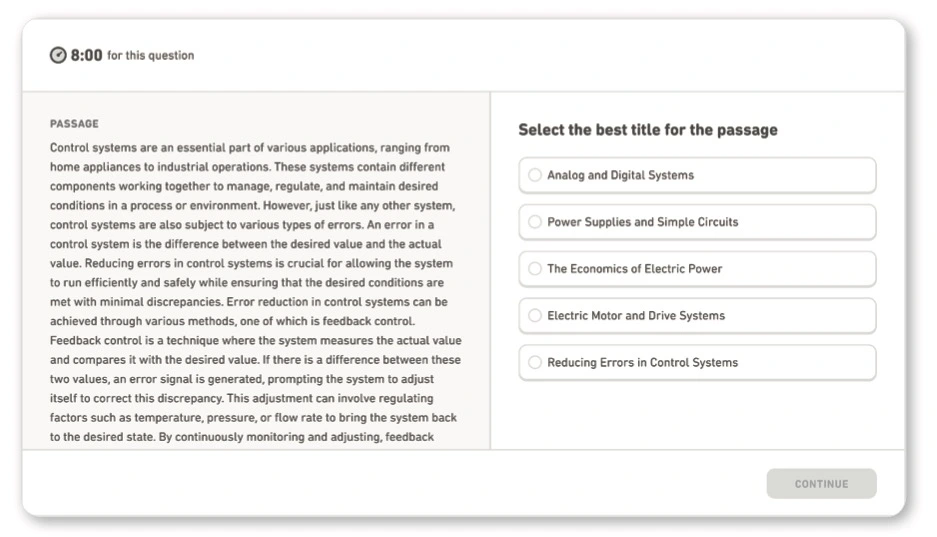
How it works:
- You can see the full text (if the original passage had a title, you won’t see it now)
- Four possible title options are presented
- You must select the title that best represents the text content
Characteristics of a good title:
- Specific but not overly detailed: Captures the main topic without entering into secondary details
- Reflects the full scope of the text: Not just one part or section
- Accurate: Does not exaggerate or downplay the content
- Appropriate for the tone and text type: An academic title for an academic text, a journalistic one for a news article, etc.
- Can be descriptive or conceptual: It can directly describe the topic («The History of Thermometers») or capture a central idea («How Temperature Measurement Changed Science»)
Specific strategies:
- Compare with the «Identify the Idea» answer: The title and main idea are closely related. If you correctly identified the main idea, the title should reflect that same idea more concisely
- Discard too broad titles: «Science» would be too broad for a text about thermometers
- Discard too specific titles: «Mercury in Fahrenheit’s 1714 Thermometer» would be too specific if the text discusses the general evolution of thermometers
- Look for text keywords in titles: The best title probably contains words or concepts that appear repeatedly in the passage
- Consider the text focus: Is it historical? Scientific? Comparative? Descriptive? The title should reflect that focus
- Ask yourself: «If I saw this title in an index, would I expect to find this content?» The title should create accurate expectations about the content
Option analysis:
Imagine a text about how thermometers have evolved since the 17th century. Let’s analyse possible titles:
- ❌ «Temperature» → Too general, does not mention thermometers or evolution
- ❌ «Fahrenheit’s 1714 Invention» → Too specific, ignores the rest of the history
- ❌ «Scientific Instruments Throughout History» → Too broad, would include much more than thermometers
- ✅ «The Evolution of the Thermometer» → Specific, accurate, captures the full scope
Master Strategies for Interactive Reading
Now that you know the 6 sub-questions individually, let’s look at global strategies to maximise your performance in the whole Interactive Reading task:
1. Manage your time wisely
With 7-8 minutes for 6 questions, you have approximately 1-1.5 minutes per question on average. However, some questions are faster than others:
- Complete the Sentences: Can take 2-2.5 minutes (it has the most elements)
- Complete the Passage: 1-1.5 minutes
- Highlight the Answer (×2): 1 minute each if you use scanning effectively
- Identify the Idea: 1-1.5 minutes
- Title the Passage: 30-45 seconds (it is the fastest if you understood the text well)
Do not get stuck for too long on a difficult question. It is better to make a reasoned choice and move on than to lose precious time.
2. Use accumulated information (crucial!)
This is the most important Interactive Reading strategy: each question gives you MORE information about the text. Use everything you have learned in previous questions for the following ones:
- After «Complete the Sentences», you already understand the topic and text vocabulary better
- After «Complete the Passage», you know the general structure and how ideas connect
- The «Highlight the Answer» questions force you to read specific sections very carefully, which improves your global comprehension
- By the time you reach «Identify the Idea» and «Title the Passage», you have worked so much with the text that its central message should be very clear
3. Read each new revealed section carefully
When a new question reveals more of the text you hadn’t seen before, take 10-15 seconds to read that full new section before trying to answer the question. This initial time investment will save you time later and improve your understanding.
4. Alternate between global and detailed comprehension
Interactive Reading requires BOTH types of comprehension:
- Detailed comprehension: Necessary for «Complete the Sentences», «Complete the Passage», and «Highlight the Answer»
- Global comprehension: Necessary for «Identify the Idea» and «Title the Passage»
While working on the first (detailed) questions, also start forming a global picture of the text in your mind. Constantly ask yourself: «What is this really about?»
5. Trust your progressively built comprehension
By the time you get to the final two questions (Identify the Idea and Title the Passage), you have spent 5-6 minutes working intensively with this text. You have completed words, connected ideas, searched for specific information. Trust the understanding you have developed. Your first impression of the main idea or the best title is likely correct.
6. Do not be intimidated by texts on unfamiliar topics
You may receive a text about quantum physics, medieval history, marine biology, or any other topic. You do not need prior knowledge of the topic to answer correctly. ALL the information you need is in the text itself. The questions assess your ability to read and understand, not your knowledge of the subject.
Comparison: The 4 DET Reading Tasks
To help you have a clear vision of all the Reading tasks and their differences, here is a full comparative table:
| Feature | Read and Select | Fill in the Blanks | Read and Complete | Interactive Reading |
|---|---|---|---|---|
| Time per item | 5 seconds per word | 20 seconds per sentence | 3 minutes per passage | 7-8 minutes per set |
| Frequency | 1 set of 15-18 words | 1 set of 6-9 sentences | 3-6 passages | 2 full sets |
| Main skill | Vocabulary recognition | Contextual vocabulary + spelling | Contextual comprehension + spelling | Integral comprehension |
| Type of answer | Selection: Yes/No | Writing: missing letters | Writing: missing letters | Mixed: multiple choice + highlight + type |
| Accepted spelling | British and American | British and American | Only American | N/A (Selection) |
| Relative difficulty | Low-Medium (depends on vocabulary) | Medium | Medium-High | High |
| Context | None (isolated words) | One sentence | One full paragraph | Extensive academic passage |
| Key preparation | Expand receptive vocabulary | Colocations + spelling | Predictive reading + American spelling | Academic comprehension practice |
| Best ally for practice | Extensive reading + flashcards | Crosswords | Cloze tests + crosswords | Academic texts + exam practice |
Study Plan to Improve Your DET Reading
Now that you know all the Reading tasks in detail, you need a structured plan to prepare effectively. The key lies in combining a general improvement of your English level with specific practice for the exam format.
General Preparation Tips
1. Develop BOTH types of vocabulary
For the DET, you need two types of vocabulary:
- Receptive vocabulary: Words you can recognise and understand when you see or hear them (important for Read and Select, Complete the Sentences, Identify the Idea)
- Productive vocabulary: Words you can use actively when writing or speaking, including their exact spelling (crucial for Fill in the Blanks and Read and Complete)
Your receptive vocabulary will always be larger than your productive vocabulary, but for the DET you need to work on both.
How to expand your receptive vocabulary:
- Read extensively in English (novels, articles, blogs, news)
- Do not look up EVERY unknown word; try to deduce meaning from context
- Use vocabulary apps like Memrise or Quizlet
- Study academic vocabulary lists (Academic Word List)
- Watch series and films in English with English subtitles
How to expand your productive vocabulary:
- Practise writing the new words you learn
- Do dictations to associate sounds with correct spelling
- Use flashcards where you type the word (don’t just recognise it)
- Create your own sentences with new vocabulary
- Pay special attention to the spelling of difficult words
2. Read regularly (this is the MOST important!)
There is no better preparation for Reading than… reading. The more you read, the better:
- Diversify your reading: News articles, academic texts, fiction, essays, blogs. The DET can include any type of text
- Read actively: Ask yourself questions about what you read. What is the main idea? How are the paragraphs connected? What does this word mean in context?
- Vary the difficulty: Read both texts that are comfortable for you and texts that challenge you
- Set a goal: For example, reading 20 minutes daily in English
Recommended reading resources:
- BBC Learning English (intermediate-advanced level articles)
- The Guardian, New York Times (quality journalism)
- Scientific American, National Geographic (popular science texts)
- Medium.com (essays and articles on varied topics)
- Project Gutenberg (free classic books)
3. Master American spelling
Given that Read and Complete only accepts American spelling, you need to know the main differences well. Create specific flashcards with British/American pairs and practise typing with the American variant if you are not used to it:
- Practise writing texts consciously using American spelling
- Set your spell checker to «English (US)»
- Read American texts (newspapers, books by US authors) to familiarise yourself
4. Learn about affixes and word formation
Understanding how English words are built gives you a huge advantage in Fill in the Blanks and Read and Complete. Study:
- Common prefixes: un-, re-, pre-, dis-, mis-, over-, under-, inter-, trans-, sub-, etc.
- Common suffixes: -tion, -ment, -ness, -able, -ible, -ful, -less, -ly, -ous, -ive, etc.
- Latin and Greek roots: bio (life), geo (earth), therm (heat), scrib (write), etc.
5. Practise speed reading (scanning and skimming)
For Interactive Reading especially, you need to master two speed reading techniques:
- Skimming: Quick reading to grasp the general idea of a text. You move your eyes quickly over the text to understand the general topic and structure
- Scanning: Quick search for specific information. You move your eyes over the text looking for a keyword, date, name, etc., without reading everything
Practise these techniques by reading articles and timing yourself. Try skimming for 30 seconds first to grasp what it’s about, then practise scanning by searching for specific information.
Common Mistakes in DET Reading
Knowing the typical errors helps you avoid them:
In Read and Select:
- Thinking too long about a word (remember: you only have 5 seconds)
- Rejecting a word just because it has an uncommon spelling (English has many exceptions)
- Accepting a pseudoword that looks like a real word
In Fill in the Blanks:
- Not reading the whole sentence before trying to complete the word
- Identifying the correct word but typing it with incorrect spelling
- Ignoring obvious grammatical clues (number agreement, verb tense, etc.)
In Read and Complete:
- Not reading the whole passage before starting to complete words
- Using British spelling when only American is accepted
- Getting stuck on a difficult word and losing valuable time
- Not taking advantage of the passage title as a thematic clue
In Interactive Reading:
- Not reading the new text sections when they are revealed
- In «Highlight the Answer»: Highlighting too much (entire paragraphs) or too little (just single words)
- Confusing specific details with the main idea
- Not managing time well between the 6 sub-questions
- Not using accumulated information from previous questions for the next ones
Preparation Calendar
Depending on how much time you have before the exam and your current level, here is a simple suggested study plan:
If you have 3 months:
Month 1 – Foundation building:
- Read 30 minutes daily in English (variety of texts)
- Learn 15-20 new words per week with flashcards
- Do 2-3 English crosswords per week
- Study common prefixes, suffixes, and roots
- Familiarise yourself with the DET format by looking at examples
Month 2 – Specific practice:
- Continue reading 30 minutes daily
- Practise cloze test exercises
- Do DET practice tests focusing on Reading
- Practise predictive reading (guessing words before reading them)
- Study British/American spelling differences
- Practise skimming and scanning with articles
Month 3 – Refinement and mock exams:
- Do full DET practice tests (at least 2 per week)
- Analyse your mistakes and work on your weaknesses
- Practise time management in each task type
- Review vocabulary you have had trouble with
- The week before the exam: Do a full mock exam under real conditions
If you have 1 month:
You need a more intensive approach:
- Week 1: Familiarise yourself with all task types + read 45 min daily + intensive vocabulary (20-25 words/day)
- Week 2: Practise each task type specifically + continue reading + study American spelling
- Week 3: Full practice tests (1 every 2 days) + mistake analysis + work on identified weaknesses
- Week 4: Mock exams under real conditions + strategy review + rest the day before the exam
If you have 1-2 weeks:
Focus on the essentials:
- Do at least 3-4 full practice tests
- Memorise the key strategies for each task type
- Review American spelling if you are not familiar
- Practise time management intensively
- Read academic texts in English daily to get used to the style
Frequently Asked Questions About DET Reading
How many Reading tasks are there in total?
In a full DET exam you will find:
- 1 set of Read and Select (15-18 words)
- 1 set of Fill in the Blanks (6-9 sentences)
- Between 3 and 6 Read and Complete passages
- 2 full Interactive Reading sets (12 sub-questions in total: 6 per set)
The exact number can vary slightly as the exam is adaptive, but these are the typical ranges.
Can I go back in Reading tasks?
No. Once you have completed a task or answered a question and clicked «Continue», you cannot go back to change your answer. Therefore, it is essential to:
- Read carefully before answering
- Check your spelling before continuing (in Fill in the Blanks and Read and Complete)
- Do not rush unnecessarily
However, within the same task before clicking «Continue», you CAN change your answers. For example, in Read and Complete you can modify the words you have completed until you decide to move on.
Does it matter if I use British or American spelling?
It depends on the task:
- Read and Select: Both variants are accepted (you might see «colour» or «color», both would be real words)
- Fill in the Blanks: Both variants are accepted (you can write «summarise» or «summarize»)
- Read and Complete: ONLY American spelling is accepted (you must write «color», not «colour»)
- Interactive Reading: Not applicable (these are multiple choice or highlight questions, you do not type words)
This difference in Read and Complete is very important and many candidates are unaware of it, so make sure to practise specifically with American spelling for that task.
How is the Reading score calculated?
The DET uses a complex scoring system based on artificial intelligence. For Reading specifically:
- All answers are marked as correct or incorrect (no partial points)
- The system is adaptive: if you answer well, the following questions are harder (and worth more)
- Your performance in all Reading tasks contributes to your Reading subscore
- The Reading subscore also influences your overall DET score (ranging from 10 to 160)
You do not need to answer every question perfectly to obtain a good score. What’s important is maintaining a consistent level of correct answers on questions at your difficulty level.
What is the most difficult Reading task?
Difficulty is subjective and depends on your strengths, but generally:
- Interactive Reading is considered the most complex because it combines multiple skills, requires deep comprehension, and has the most managed time pressure (7-8 minutes for 6 sub-questions)
- Read and Complete is challenging due to the amount of information you must process in 3 minutes and the requirement for exclusively American spelling
- Read and Select can be difficult if your receptive vocabulary is limited, especially when less common academic words appear
- Fill in the Blanks is usually considered the most «friendly» if you have good contextual vocabulary and know spelling well
The important thing is to identify which one is most difficult for YOU specifically and dedicate more practice time to it.
Conclusion
The Reading section of the Duolingo English Test is unique in its approach: instead of simply asking you to read passages and answer questions, it assesses your reading comprehension from multiple angles, combining vocabulary recognition, contextual deduction, precise spelling, and both detailed and global comprehension.
The keys to mastering DET Reading are:
- Constantly expand your vocabulary (both receptive and productive)
- Read extensively in English (it is the best preparation of all)
- Know the specific format of each of the 4 tasks
- Practise specific strategies for each question type
- Master American spelling for Read and Complete
- Manage your time efficiently, especially in Interactive Reading
- Take practice tests to familiarise yourself with the exam pace
Remember that the DET is an adaptive exam, so do not be discouraged if the questions become harder as you progress: that means you are doing well. Trust your preparation, read carefully, manage your time wisely, and apply the strategies we have covered in this guide.
With constant practice and a strategic approach, you can maximise your score in the Reading section and achieve the result you need on the Duolingo English Test. If you want to delve deeper into other aspects of the exam, don’t forget to check my comprehensive Duolingo English Test (DET) guide, where you will find complete information on all sections.
And until the next article, don’t forget to keep smiling!