Duolingo English Test (DET): Complete Guide for Candidates (2026)
The best online guide to the Duolingo English Test (DET) 2026. Question types, rules, scoring, and expert tips. Certify your English level with Duolingo!

Table of contents
If you are looking for an internationally recognised English exam that is fast, accessible, and can be taken from the comfort of your own home, the Duolingo English Test (DET) might be exactly what you need. In this complete guide, I am going to explain everything you need to know about this exam: from how it works to every type of question you will encounter, as well as the technical requirements, the rules you must follow, and the strategies to get the most out of your preparation.
The DET has gained massive popularity in recent years and is already accepted by more than 6,000 institutions worldwide, including Ivy League universities, elite business schools, and academic programmes in Europe, Asia, and Latin America. So, if you are thinking about studying abroad or need to certify your English level, this guide will be very useful for you.
1. Introduction to the Duolingo English Test
The Duolingo English Test is a 100% online English proficiency exam that you can take from anywhere with an internet connection. Unlike other traditional exams such as IELTS or TOEFL, you don’t need to travel to an official centre or book a date weeks in advance. You simply buy the exam, take it whenever you want (within 21 days of purchase), and receive your certified results in approximately 48 hours.
The DET assesses the four main language skills: reading, listening, writing, and speaking. What makes it special is its adaptive format: the exam algorithm adjusts the difficulty of the questions as you answer, which allows it to accurately assess your level in less time than other exams.
Advantages of the DET compared to other exams
Why are more and more students choosing the Duolingo English Test? Here are some of its main advantages:
- Total flexibility: take the exam whenever you want, wherever you want, without prior appointments or official centres.
- Speed: it lasts only one hour and you receive the results within 48 hours.
- Competitive price: it is considerably more affordable than IELTS or TOEFL.
- Unlimited results sharing: you can send your certificate to as many universities as you wish at no additional cost.
- Modern format: the adaptive system makes the exam more dynamic and better reflects your real level.
- Wide recognition: accepted by thousands of institutions across the globe.
Who is this exam for?
The DET is primarily designed for international students who need to certify their English level to access university or postgraduate programmes. It is also useful if you need to demonstrate your linguistic proficiency for study visa applications in some countries, although it is advisable to check the specific requirements according to your destination.
It is especially popular among those looking for a more flexible and modern alternative to traditional exams, and among those who have tight deadlines and need quick results.
2. Practical information about the exam
2.1. General characteristics
Before going into detail about the exam content, it is important that you know its basic features:
- Total duration: approximately 1 hour (60 minutes)
- Format: 100% online, from your computer at home
- Results: certified in approximately 48 hours
- Scoring: scale from 10 to 160 points, in increments of 5
- Validity: 2 years from the date of the exam
- Frequency: you can take up to 3 exams in any 30-day period
- Deadline to take it: you have 21 days to complete the exam after purchasing it (if you buy a bundle of 2 exams, you have an additional 21 days after receiving the result of the first one to take the second)
Once you complete the exam, you can send your results for free and without limits to all the institutions you wish, directly from your account on the Duolingo platform.
2.2. Technical and environmental requirements
The DET has quite strict technical and environmental requirements, as they need to ensure the security and integrity of the exam when taken from home. Pay close attention to this section because failure to meet these requirements can result in your exam not being certified.
Equipment needed
- Computer or laptop with a functional front camera, microphone, and speakers (or external speakers)
- Secondary camera: a smartphone or tablet that you will use to record your screen, keyboard, and upper body throughout the exam. This is a mandatory security measure implemented in 2025-2026
- Stable internet connection: it is strongly recommended to use a wired connection instead of Wi-Fi
- A keyboard and a mouse: they can be external, but you can only use one of each (you cannot switch between multiple keyboards or mice during the exam)
- A single screen: you must disconnect any secondary monitor

Environment requirements
- Private room: you must be completely alone during the entire exam, without interruptions
- Quiet: no background noise or distractions
- Well-lit: your face must be clearly visible at all times
- No materials: you cannot have paper, pens, books, notes, or any other supporting material
About the secondary camera (mobile)
This is one of the most important requirements and the one that generates the most questions. Your mobile phone will act as a security camera during the exam:
- It must be fully charged or connected to a charger throughout the exam
- You must activate «Do Not Disturb» mode and ensure that no contacts can bypass this mode
- Place it leaning against a heavy object to the left or right of your computer
- Horizontal position is the most stable
- The phone must record your screen, keyboard, and your upper body
- Once the exam begins, you cannot touch or move the phone
Prohibited equipment
- Earphones or headphones of any kind: your ears must be visible at all times
- Smartwatches
- Tablets, additional mobiles, or other electronic devices (except for the mobile used as a secondary camera)
- Multiple monitors
- Paper, notebooks, writing materials
2.3. Identification requirements
During the initial phase of the exam, you will have to verify your identity by presenting a physical document to the camera. It is very important that you know which documents are acceptable in your country:
- India: only passport is accepted
- China: passport or government-issued ID with a photograph
- Other countries: check the documents accepted in your country at englishtest.duolingo.com/ids
Very important: only original physical documents are accepted. Photocopies, digital images, or photographs of the document are not valid. It must be the real document.
3. Exam rules: what to do and what to avoid
The Duolingo English Test rules are strict, and failure to comply can have serious consequences, from your results not being certified to a permanent ban from taking the exam again. So, pay close attention to this section.
What you MUST do during the exam
- Keep your face, ears, and mouth visible at all times for both cameras
- Keep your face well-lit and within the camera frame
- Look at the screen during the entire exam (except when writing, when you can look at the keyboard)
- Stay in full-screen mode with the mouse cursor inside the exam window
- Be completely alone in the room, without interruptions
What you MUST NOT do (strict prohibitions)
- DO NOT use earphones, headphones, or audio devices: your ears must be visible at all times
- DO NOT look away from the screen: the only exception is looking at the keyboard during writing tasks
- DO NOT use external help of any kind:
- Software, programmes, or browser extensions on your computer (restart the computer and close all applications before starting)
- Dictionaries, translators, or other devices
- Help from another person
- DO NOT cover your face, ears, or mouth at any time
- DO NOT speak until you are told to do so (in the speaking tasks)
- DO NOT memorise answers from other sources: your answers must relate to the questions and be in your own words
- DO NOT save or record the exam questions
- DO NOT take notes: keep unauthorised mobiles, other devices (tablets, smartwatches, etc.), notebooks, and any writing materials away from you
- DO NOT create multiple accounts to take the exam: results from secondary accounts will not be certified
Consequences of breaking the rules
If you breach any of the Duolingo English Test rules, Duolingo reserves the right to:
- Not certify your exam results
- Invalidate previously certified results
- Not offer a refund for the cost of the exam
- In serious cases, permanently ban you from taking the Duolingo English Test again
The system uses artificial intelligence and human review to detect irregularities, so I strongly recommend that you follow all the rules to the letter.
4. Exam structure
The Duolingo English Test is divided into three main phases that total approximately 60 minutes. Let’s look at each of them in detail.
4.1. Phase 1: Introduction and verification (≈5 minutes)
This initial phase is crucial to ensure that everything is in order before starting the assessed part of the exam. During these first minutes:
- Identity verification: you must present your physical identification document to the camera so that the system can verify it
- Room scan: using your secondary camera (mobile), you must perform a complete scan of the room where you are to demonstrate that you are alone and do not have prohibited materials
- Ear scan: also with the secondary camera, you must show your ears to confirm that you are not wearing earphones or hidden audio devices
- Rules explanation: the system will remind you of the main rules of the exam
- Technical verification: it will be checked that your camera, microphone, and connection are working correctly
Once this phase is completed, you can no longer pause or stop the exam until it finishes.
4.2. Phase 2: Adaptive graded test (≈45 minutes)
This is the main part of the exam, where your English level is assessed. It lasts approximately 45 minutes and is completely adaptive.
What does it mean to be adaptive?
The system uses an intelligent algorithm that adjusts the difficulty of the questions in real time based on your answers:
- The exam begins with intermediate difficulty questions
- If you answer correctly, the following questions will be more difficult
- If you make mistakes, the difficulty decreases
- This allows your level to be assessed accurately using fewer questions than in a traditional exam
The interesting thing about the adaptive format is that two people taking the exam at the same time may see completely different questions, because the system personalises the experience according to each candidate’s performance.
Integration of skills
Unlike other exams that have clearly separated sections (first reading, then listening, etc.), the DET integrates the four skills continuously. This means that:
- The questions are presented in a random order
- You can go from a reading task to a speaking task, then to a listening task, etc.
- Many tasks assess multiple skills simultaneously (for example, reading a text and then talking about it)
- This format reflects real language use in academic and everyday contexts
During these 45 minutes, you will see all the types of questions that I will explain in detail in section 6 of this guide.
4.3. Phase 3: Writing Sample and Speaking Sample (≈10 minutes)
The final phase of the exam consists of two more extensive production tasks: a writing sample and a speaking sample. These tasks have special characteristics that you should know:
- They do not score directly in your total: these samples do not affect your numerical score of 10-160
- They are sent to universities: when you send your results to an institution, it receives both your score and these two samples
- They are reviewed by admissions: university admissions officers read/listen to them to have a more qualitative view of your level
- Real importance: although they don’t score numerically, they can be decisive in competitive admissions processes
Writing Sample: you will be given a topic to write about for 5 minutes (with 30 seconds of prior preparation). They are usually questions about personal experiences or opinions.
Speaking Sample: you will answer a question orally for 3 minutes (also with 30 seconds of preparation). This response is recorded on video and universities can view it.
Since these samples go directly to universities, it is important that you take them very seriously and give your best. They are your opportunity to show not only your English level but also your communication ability, your personality, and your suitability as a candidate.
5. Scoring system
Understanding how the DET scoring system works will help you interpret your results and know what you need to achieve the level required by your target university.
5.1. General scale
The Duolingo English Test uses a scale from 10 to 160 points, with 5-point increments. This means the possible scores are: 10, 15, 20, 25… 150, 155, 160.
This scale is aligned with the Common European Framework of Reference for Languages (CEFR), which classifies language levels from A1 (beginner) to C2 (native or near-native mastery). Here is a general interpretation:
| DET Score | CEFR Level | Description |
|---|---|---|
| 10-55 | A1-A2 | Basic level: understanding of simple words and phrases |
| 60-95 | B1 | Intermediate level: everyday communication with some limitations |
| 100-125 | B2 | Upper intermediate level: capable of handling academic topics and complex situations |
| 130-160 | C1-C2 | Advanced level: fluent mastery in academic and professional contexts |
The scores are generated using artificial intelligence models specifically trained to evaluate language, combined with a security review process that includes both algorithms and human review before certifying the result.
5.2. Subscores
In addition to your overall score, the DET provides eight subscores that give you a more detailed view of your performance. These are divided into two categories:
Individual subscores (4)
These measure each skill separately:
- Listening: your ability to understand spoken English
- Reading: your ability to understand written texts
- Speaking: your ability to communicate orally in English
- Writing: your ability to write in English
Integrated subscores (4)
These combine pairs of skills to reflect integrated uses of the language:
- Literacy = Reading + Writing: measures your combined competence in understanding and producing written texts. It reflects skills crucial for academic success, such as reading scientific articles and writing assignments.
- Comprehension = Reading + Listening: assesses your global ability to understand the language, both written and oral. It is fundamental for following classes, lectures, and study materials.
- Conversation = Speaking + Listening: measures your ability to participate in oral exchanges, listening and responding. It is essential for class debates, presentations with questions, and everyday communication.
- Production = Speaking + Writing: reflects your ability to actively generate language, both orally and in writing. It demonstrates how you express yourself and communicate your ideas.
All subscores use the same 10-160 scale in 5-point increments. It is normal to have different subscores; for example, you could have a Listening score of 120 but a Speaking score of 105. This helps you identify areas of strength and areas you need to improve.
5.3. Table of approximate equivalencies
Many students ask me how the DET compares to other well-known exams like IELTS or TOEFL. Here is an orientative equivalency table, although it’s important to remember that these are approximations and each institution sets its own thresholds:
| DET | IELTS | TOEFL iBT |
|---|---|---|
| 160 | 8.5-9 | 120 |
| 145 | 7.5 | 113-116 |
| 130 | 7 | 98-103 |
| 120 | 6.5 | 87-92 |
| 105 | 6 | 70-75 |
| 90 | 5 | 53-58 |
| 75 | 4.5 | 42-46 |
Important note: these equivalencies are approximate and orientative. Each university or institution sets its own minimum requirements for the DET according to its criteria. Always check the specific requirements of your target programme.
6. Types of exam questions
Now we come to the most practical part of this guide: knowing each type of question you will find in the DET in detail. The current exam (2026) includes 13 main types of tasks distributed among the four skills. I am going to explain each one with specific examples and strategies so you know exactly what to expect and how to tackle them.
6.1. Reading
Reading tasks in the DET are not limited to reading long passages and answering questions, as in other exams. They include vocabulary recognition tasks, completing words, and interactive reading. Let’s look at each type:
6.1.1. Read and Select
This task assesses your vocabulary recognition and spelling in English. You are presented with a list of mixed words: some are real English words and others are pseudo-words (invented words that look real but do not exist).
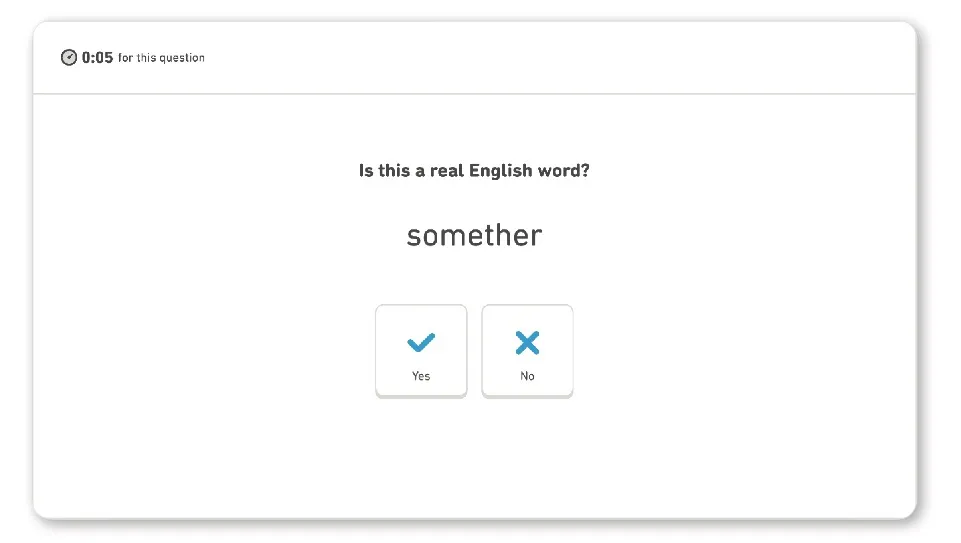
Time: 5 seconds per word | Frequency: 15-18 words per set | Adaptive: Yes
How it works: for each word that appears on the screen, you must click «Yes» if it is a real English word, or «No» if it is not.
Example of words:
- files → YES (real word)
- brelt → NO (pseudo-word)
- mountain → YES (real word)
- frimble → NO (pseudo-word)
Key strategies:
- Click «Yes» if you recognise the word or have seen it before in real contexts
- Click «No» if the word looks strange to you or you have never seen it
- You can pronounce the word mentally to help you decide if it sounds natural
- Watch out for pseudo-words that look like real words (for example, brelt looks like belt)
- Don’t overthink it: trust your initial instinct, as time is very limited
- If you are really not sure, it’s better to take a chance than to let time run out
6.1.2. Fill in the Blanks
In this task, you must complete a sentence by typing the missing letters in an incomplete word. You are presented with a phrase with a partially hidden word, and you must complete it correctly.
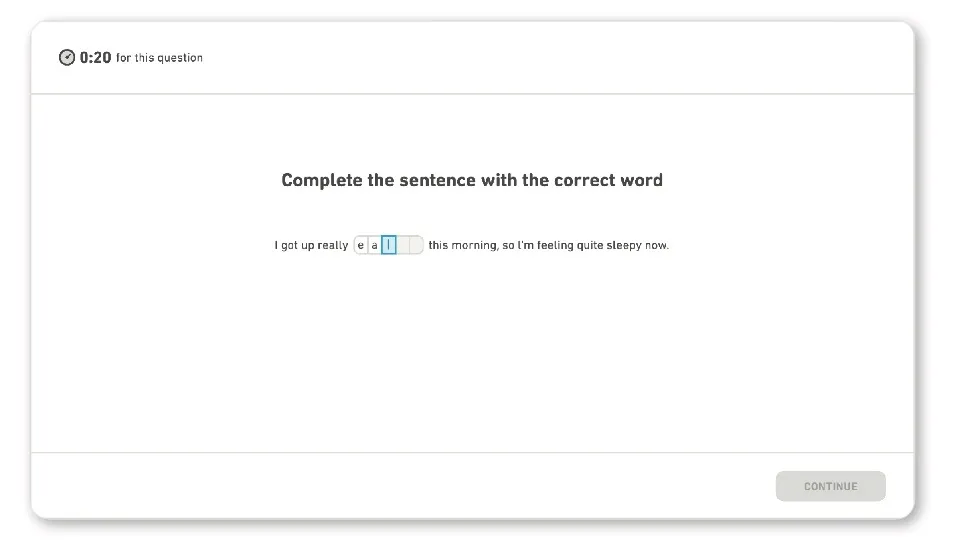
Time: 20 seconds per sentence | Frequency: 6-9 sentences | Adaptive: Yes
How it works: a sentence appears with a word that has some visible letters and others hidden (represented by small boxes or gaps). You must type the missing letters to complete the word correctly.
Example:
«To prevent them from spoiling, perishable goods must be q u i __ __ __ __ transported from the production site to retail outlets.»
Answer: quickly (the missing letters are: c, k, l, y)
Key strategies:
- Read the entire sentence first to understand the context before attempting to complete the word
- Look for clues in the rest of the sentence: synonyms, antonyms, common phrases, or collocations
- Consider the grammatical role of the word (is it a noun, verb, adjective, adverb?)
- The visible letters give you an important clue about the word; use them to think of possible words
- Spelling must be exact: check carefully before continuing
- If there are definite articles or prepositions nearby, they may give you clues about the type of word missing
6.1.3. Read and Complete
This task is similar to Fill in the Blanks, but on a larger scale. You are presented with a full passage (a paragraph with a title) that contains multiple incomplete words, and you must complete them all.
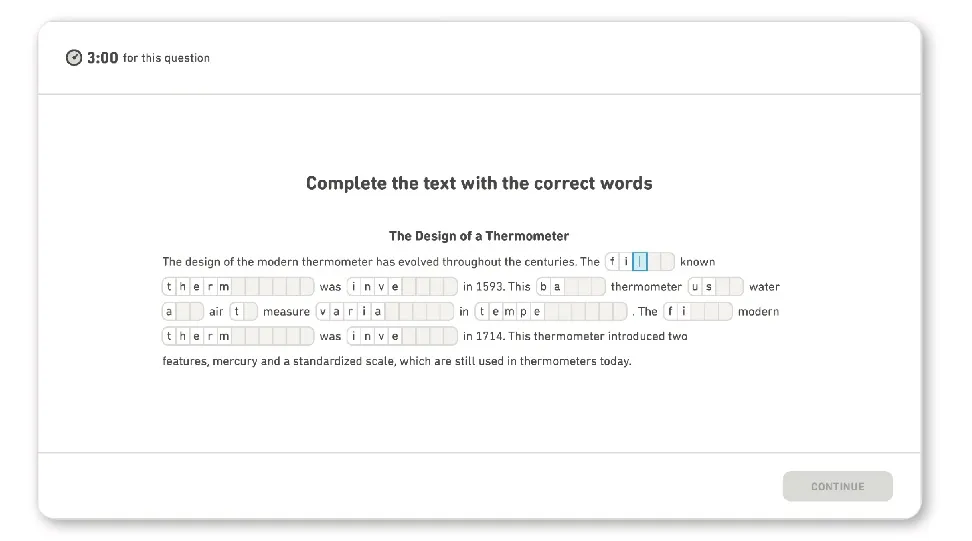
Time: 3 minutes per passage | Frequency: 3-6 passages | Adaptive: Yes
How it works: a text appears with a title and several sentences. Some words are incomplete (with visible letters and gaps). You must click on each incomplete word and type the missing letters.
Important characteristics:
- There are between 5 and 8 incomplete words per passage
- Incomplete words are never adjacent (one next to the other)
- They are never proper nouns
- You have 3 minutes to complete the entire passage
Key strategies:
- Read the entire passage first, including the title and all complete sentences, to understand the general theme
- Start with the easiest words you can identify quickly; this will give you confidence and save you time
- Use the general context of the paragraph and the surrounding sentences to deduce difficult words
- Take advantage of grammatical clues: the sentence structure tells you if you need a verb, noun, adjective, etc.
- Leave the most difficult words for last; when you return to them with the context of the other completed words, they may become easier
- Manage your time well: do not spend more than 20-25 seconds on a single word; it’s better to move on and come back later
- Check your spelling before submitting, especially on words that cost you the most effort
6.1.4. Interactive Reading
This is one of the most complete and demanding tasks of the exam. You are presented with an academic or informative text and must respond to a series of 6 linked questions about it. The interesting thing is that the text is revealed progressively: each question shows you a little more of the passage.
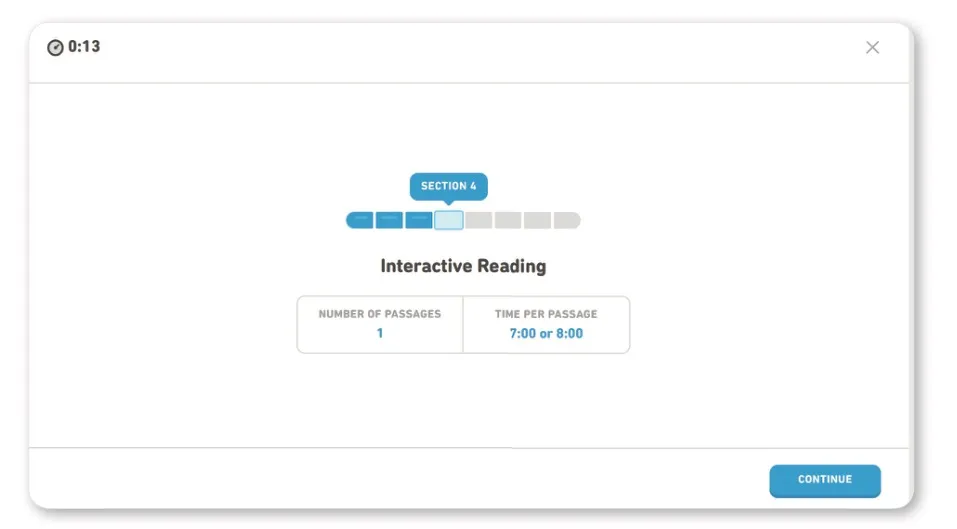
Time: 7-8 minutes for the 6 questions | Frequency: 2 complete sets | Adaptive: Yes
How it works: you will see a text on an academic topic (it can be about science, history, technology, society, etc.) and you will answer 6 sub-questions in this specific order:
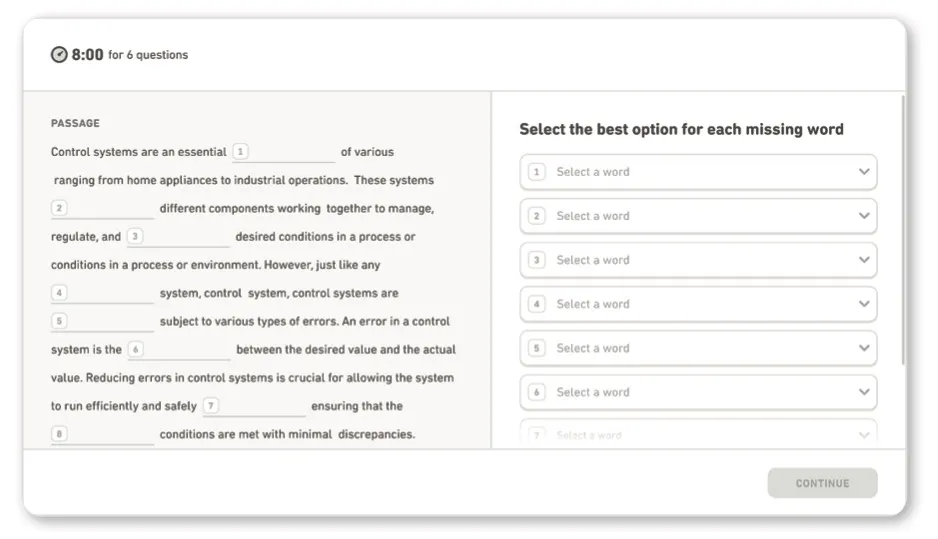
1. Complete the Sentences
The first half of the text appears with some gaps. You must select the correct word from a dropdown menu for each gap. There are between 4 and 6 gaps.
2. Complete the Passage
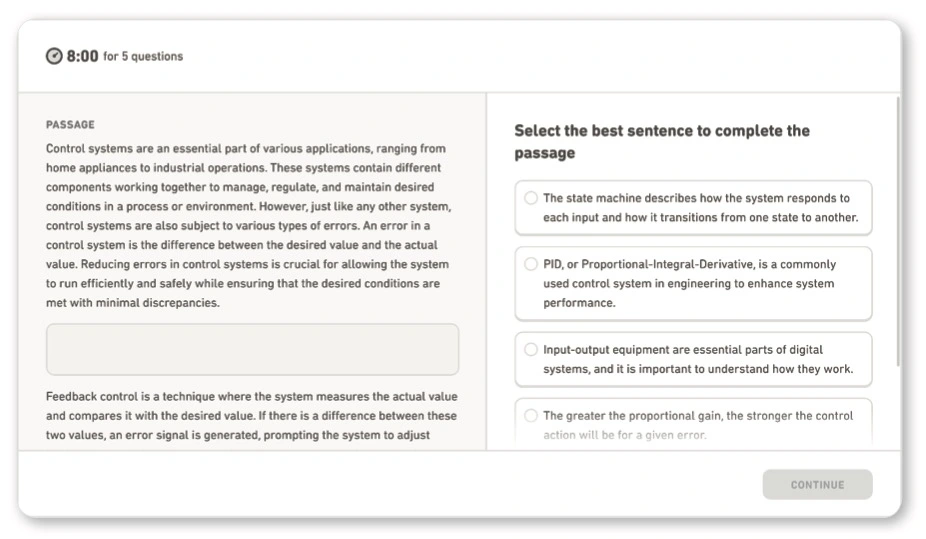
You are shown the first half of the text (already completed) and the beginning of the second half, but a transition sentence is missing between both parts. You must choose the best sentence from several options to connect both halves coherently.
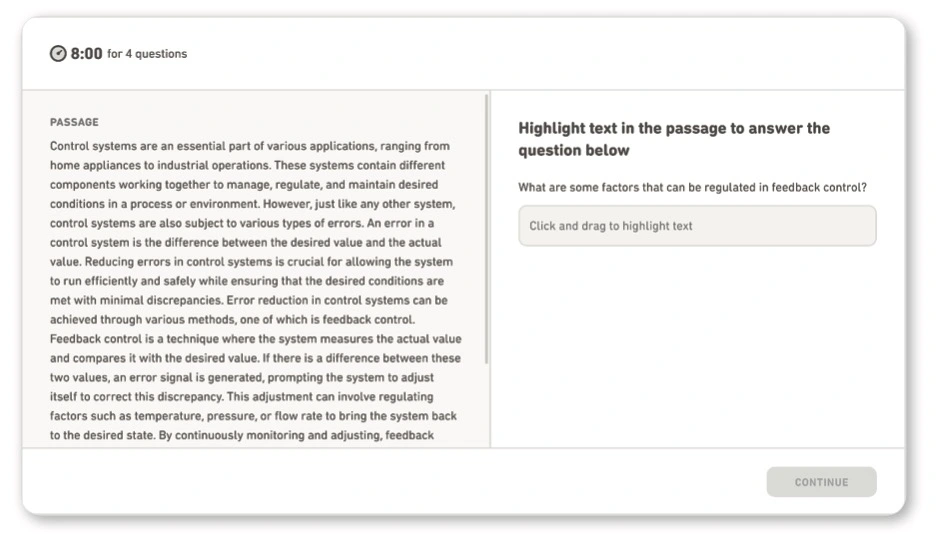
3. Highlight the Answer – First time
You are asked a specific question about the text content and must click and drag to highlight (select) the exact part of the text that answers that question. You should not highlight too much or too little, only the relevant portion.
4. Highlight the Answer – Second time
Similar to the previous one but with a different question about another part of the text.
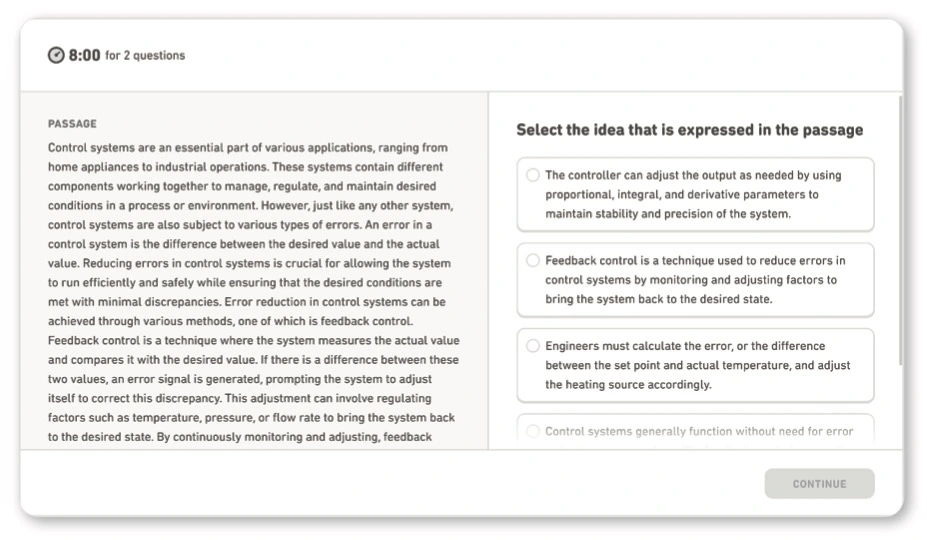
5. Identify the Idea
Now you have seen the full text. You are presented with several statements and must select which one best expresses the main or central idea of the entire passage.
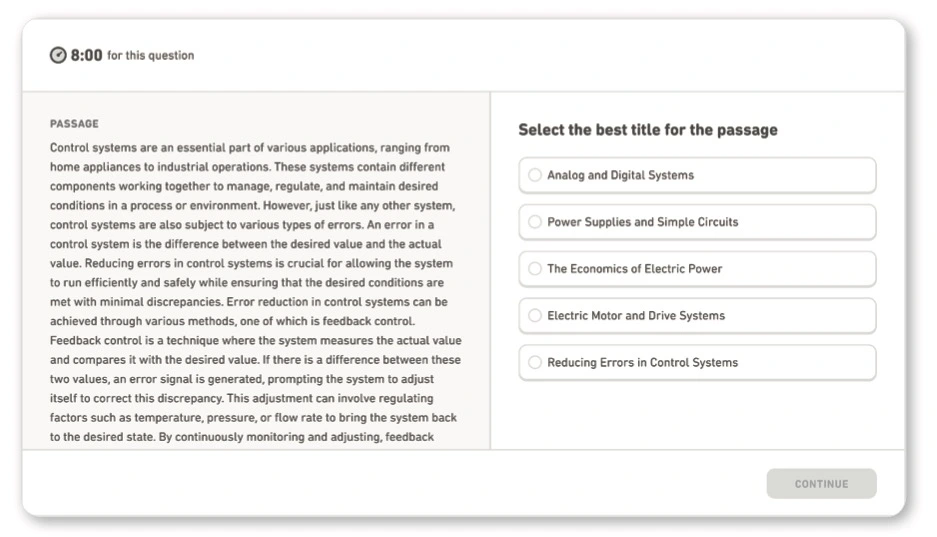
6. Title the Passage
Finally, you must choose the most suitable title for the entire text from several options.
Key strategies:
- Each question reveals more information about the text, so use the accumulated knowledge from previous questions for the next ones
- In Complete the Sentences, read the whole sentence before choosing the word; context is fundamental
- For Complete the Passage, look for logical connectors and thematic coherence between the first and second half
- In Highlight the Answer, be precise: select only the relevant portion, not entire paragraphs or too little text
- For Identify the Idea and Title the Passage questions, you need to understand the text globally, not just specific details; think about the main message, not secondary aspects
- Manage your time well: do not get stuck on one question; you have approximately 1-1.5 minutes per question on average
- Read new sections of the text carefully when they appear, as they will contain crucial information for the following questions
6.2. Listening
DET listening tasks assess your ability to understand spoken English in different contexts. They include transcribing sentences and understanding conversations. Let’s look at each type:
6.2.1. Listen and Type
This is a direct dictation task. You listen to a sentence in English and must transcribe exactly what you hear, word for word.
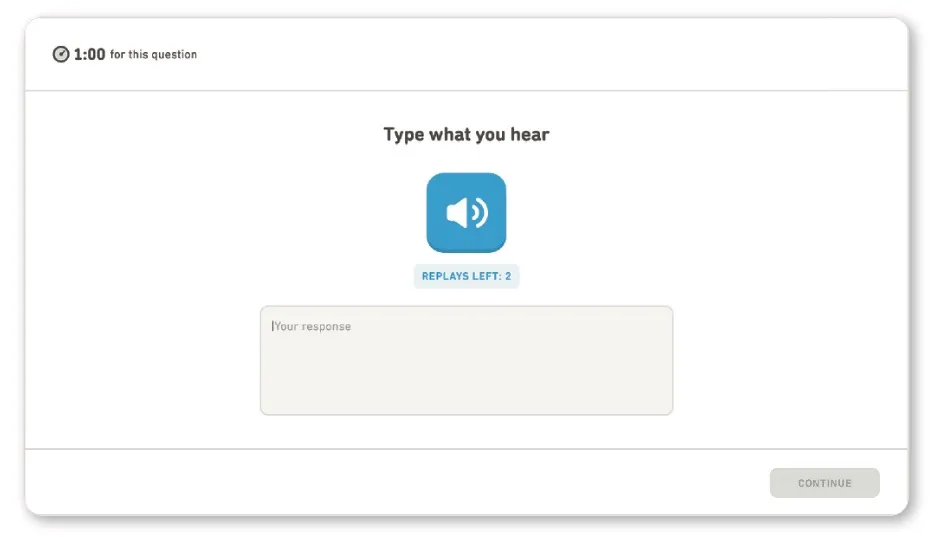
Time: 1 minute per sentence | Frequency: 6-9 sentences | Adaptive: Yes
How it works: an audio sentence is played and you can listen to it up to 3 times by clicking the play button. You must write exactly what you hear in the text box.
Example:
Audio: «My artistic journey began when I was young.»
You must write: My artistic journey began when I was young.
Key strategies:
- First listen: try to capture the main content words (nouns, verbs, adjectives) and the general structure
- Second and third listen: complete the function words (articles, prepositions, conjunctions) and verify your transcription
- Pay close attention to punctuation and capitalisation: the first word must be capitalised and the sentence must end with a full stop
- Be careful with connected speech patterns: words that join together when speaking, like «going to» which sounds like «gonna» but you must write the full form
- Watch out for homophones: words that sound the same but are written differently (their/there/they’re, your/you’re, to/too/two)
- Use all 3 plays if you need them; there is no penalty for listening several times
- Leave time to check spelling, punctuation, and that you haven’t left out any words
6.2.2. Interactive Listening
This is another integrated and more complex task. You will listen to a scenario or conversation and perform three sequential activities related to that audio. It is one of the most realistic tasks in the exam because it simulates real communicative situations.
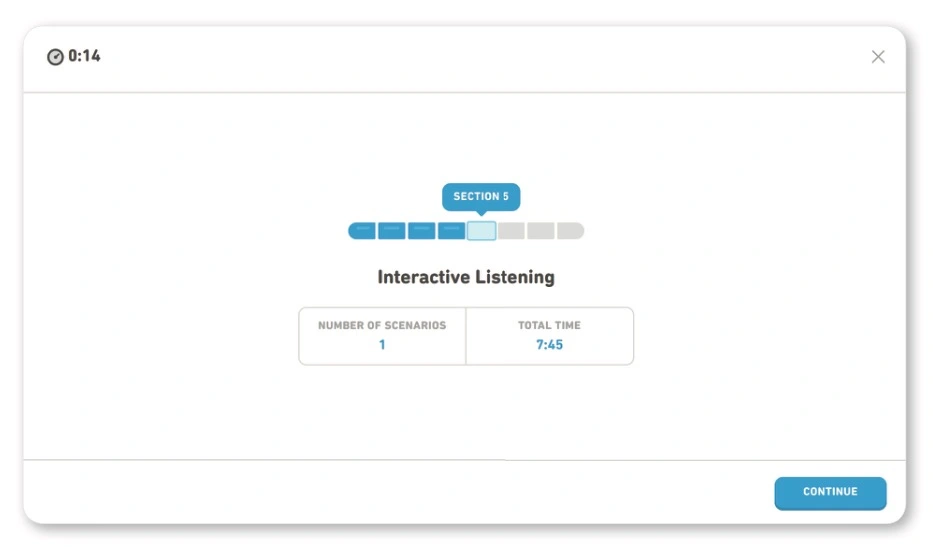
Time: 6:30 for Parts 1-2 + 75 seconds for Part 3 | Frequency: 2 complete sets | Adaptive: Yes
How it works: the task is divided into three consecutive parts based on the same audio scenario:
Part 1: Listen and Complete
You will listen to an introduction to the scenario (for example: «You are working on a research project with your professor…» or «You are talking to a colleague about an internship…»). This audio explains the situation and contains key information.
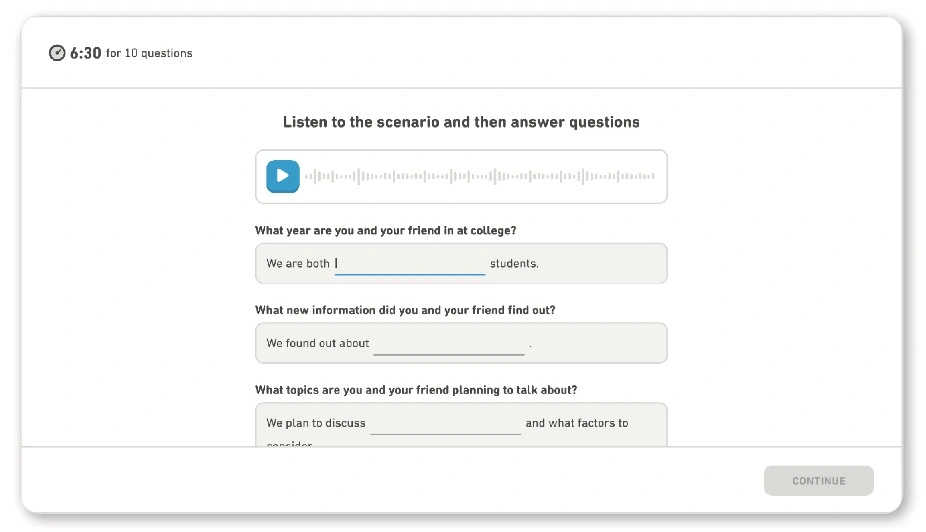
Afterwards, you will see several questions with blank spaces that you must complete by writing specific information you heard. For example:
- «Who are you completing the research project with?» → I’m completing it with my professor.
- «What are you unsure about?» → I’m unsure about what to do.
- «Why don’t you ask your professor for help?» → Because I’m not sure they will be able to help.
Important characteristics:
- You can play the audio as many times as you need
- Spelling does not have to be perfect, but the meaning must be accurate
- Don’t write too much or too little; answer concisely and directly
Part 2: Listen and Respond
Now you will participate in a simulated conversation. A character (represented by audio and an avatar) will speak to you and you must select the best response from several options to maintain the conversation.
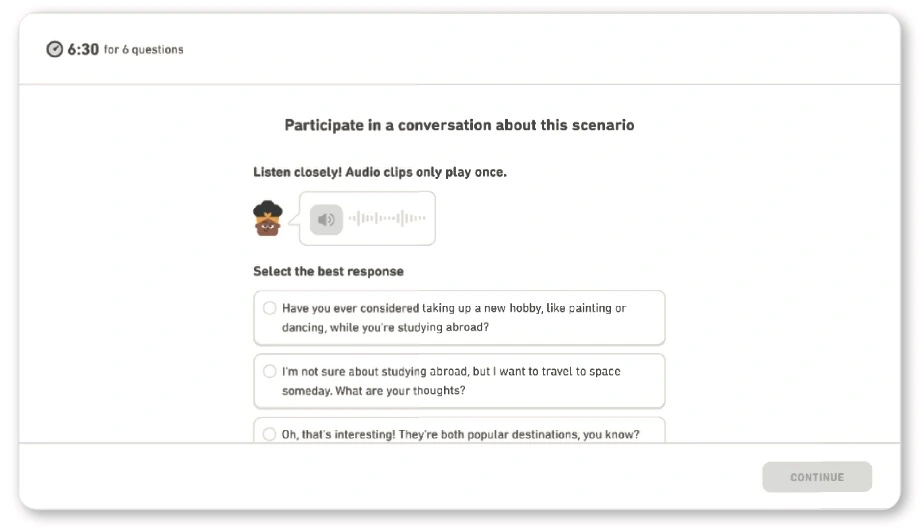
There are between 4 and 6 conversation exchanges. Each time the character speaks, you must choose your response from a menu of options. If you choose an incorrect response, the system shows you the correct one (and you can use that information for the following responses!).
Common themes include:
- Asking for help or advice
- Giving recommendations
- Planning activities
- Making requests
- Solving everyday problems
Part 3: Summarize the Conversation
Finally, you must write a brief summary of the conversation you just had in Part 2. You have 75 seconds to write it.
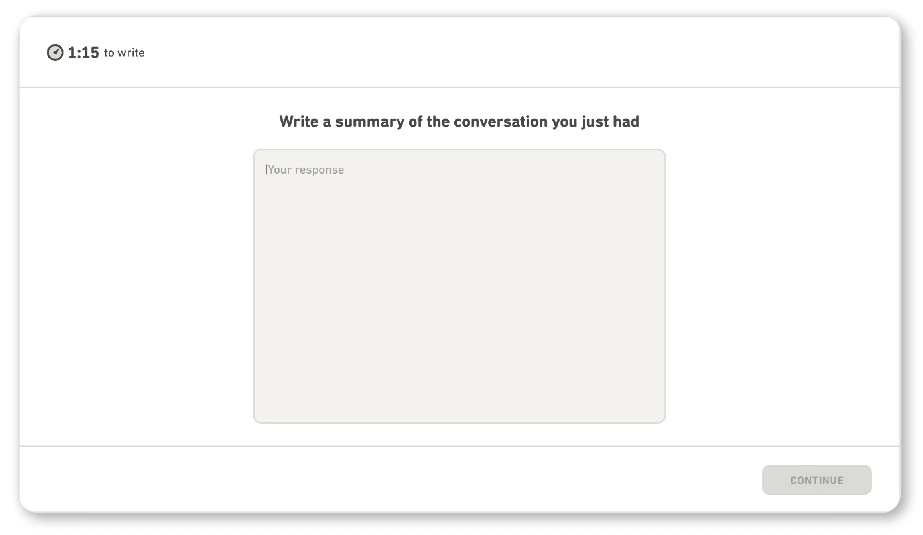
Your summary should include:
- The main theme of the conversation
- Your role in it
- The key problem or question
- The result or conclusion
You can write in the first person («I talked with…») or in the third person («Two students discussed…»). The important thing is to use complete sentences, not bulleted lists.
Key strategies:
- Listen to the initial scenario very carefully: it sets the context for everything that follows
- In Part 1, you can listen to the audio as many times as you need, so take advantage of it to capture all the details
- For Part 2, choose responses that are consistent with the scenario and the natural flow of the conversation; think about what you would say in that real situation
- If you make a mistake in a response in Part 2, pay attention to the correction the system shows you and use it as a guide for the next responses
- Reserve enough time in Parts 1-2 to write a good summary in Part 3; do not spend all your time on the first sections
- For the summary, use information from previous questions; you already know who is involved, what the problem is, and what was discussed
- The summary must be concise but complete: 3-5 sentences are usually sufficient
6.3. Writing
Writing tasks assess your ability to communicate in English in writing. They range from brief descriptions to longer structured responses. Let’s look at each type:
6.3.1. Write About the Photo
This is a quick written description task. You are shown a photograph and must describe what you see in it within a limited time.
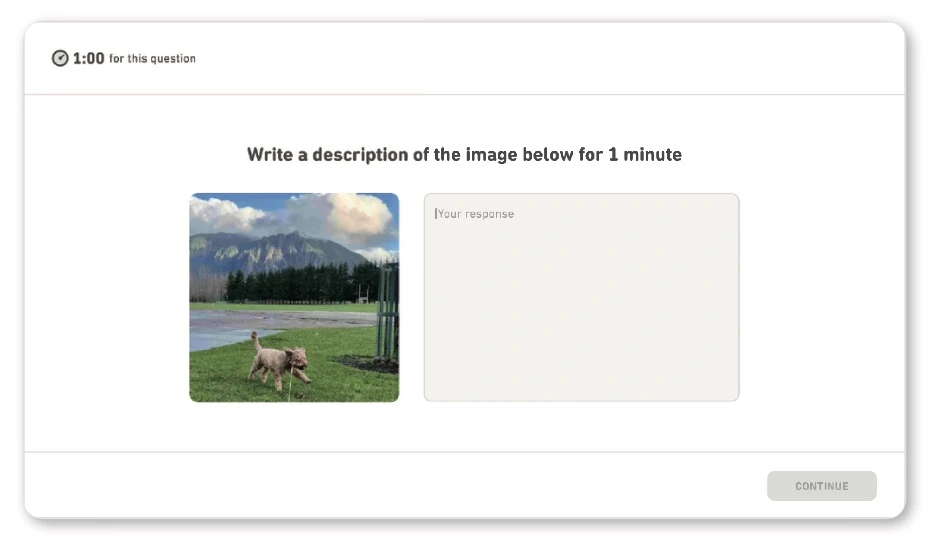
Time: 1 minute per photo | Frequency: 3 photos | Adaptive: No
How it works: an image appears on the screen (it can be of people, places, objects, everyday scenes, landscapes, etc.) and you have exactly 1 minute to write a description of what you see.
Example of photo: An image of a street with a yellow tram, old buildings, and a person walking.
Example response: «The image shows a narrow cobblestone street in what appears to be a historic European city. A bright yellow tram is travelling down the tracks in the centre of the street. On both sides, there are tall, colourful buildings with traditional architecture. In the foreground, a single person is walking along the sidewalk. The sky is partly cloudy, suggesting it might be late afternoon.»
Key strategies:
- Go beyond simply labelling what you see («There is a street. There is a tram.»); describe details, actions, atmosphere, and context
- Avoid long, generic introductions like «In this picture I can see many things…»; get straight to the point and describe
- Write in complete sentences with correct grammar and punctuation
- Use descriptive vocabulary: adjectives (colourful, narrow, bright), adverbs, and prepositional phrases (in the foreground, to the left)
- If you don’t know the exact word for an object, describe it: «a vehicle for public transportation» instead of trying to guess a word you don’t know
- Try to fill the entire minute; the more you write (with quality), the more you demonstrate your level
- Structure your description logically: start with an overview and then add specific details
6.3.2. Interactive Writing
This task simulates a real writing situation where you respond to a message or question, and then answer a related follow-up question. It is a two-part task that assesses your ability to develop ideas in writing coherently.
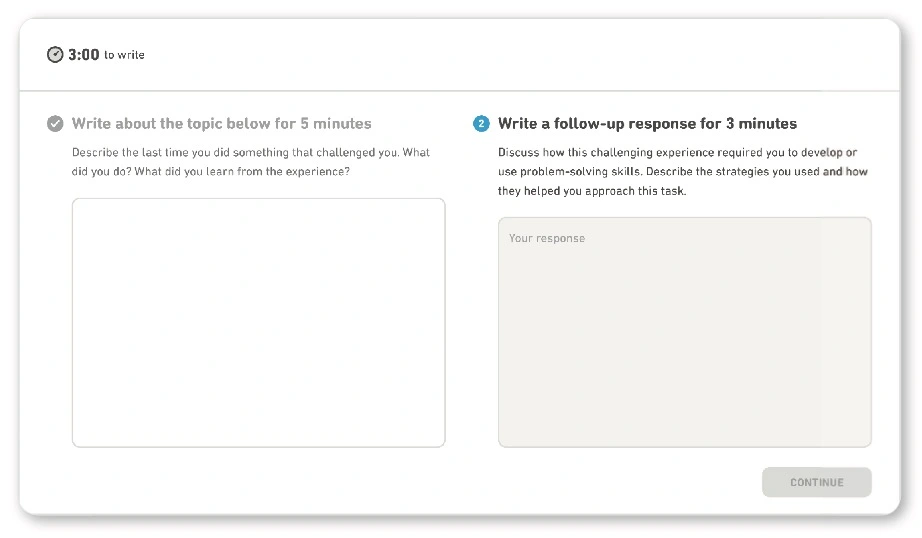
Time: 5 minutes (Part 1) + 3 minutes (Part 2) | Prep: 30 seconds | Frequency: 1 set | Adaptive: No
How it works: first you have 30 seconds to read the prompt and plan your response. Then you write two related but different texts:
Part 1 (5 minutes): You are presented with a situation or question and must respond in writing. For example: «Describe the last time you did something that challenged you. What did you do? What did you learn from the experience?»
Part 2 (3 minutes): After completing Part 1, a related follow-up question appears asking for different information. For example: «Discuss how this challenging experience required you to develop or use problem-solving skills. Describe the strategies you used and how they helped you approach this task.»
It is important to note that Part 2 asks something different from Part 1, so you cannot simply repeat what you already wrote.
Key strategies:
- Use the 30 seconds of preparation to plan the main points you want to cover
- Part 2 asks about something different from Part 1, so do not repeat the same information; expand, deepen, or address a different aspect
- Both parts are assessed together to determine the overall quality of your writing, so maintain a high level in both
- Show variety: use diverse vocabulary and varied grammatical structures (simple, compound, complex sentences)
- Organise your ideas logically with appropriate connectors (First, Additionally, However, As a result, etc.)
- Reserve the last 30-60 seconds of each part to check spelling, grammar, and punctuation
- Do not worry if you do not finish with an elaborate conclusion; it’s better to write well about the main points than to add a rushed conclusion
6.3.3. Writing Sample
This is your writing sample that will be sent directly to universities along with your score. It is your chance to demonstrate your ability to write in a structured, coherent, and persuasive way on a given topic.
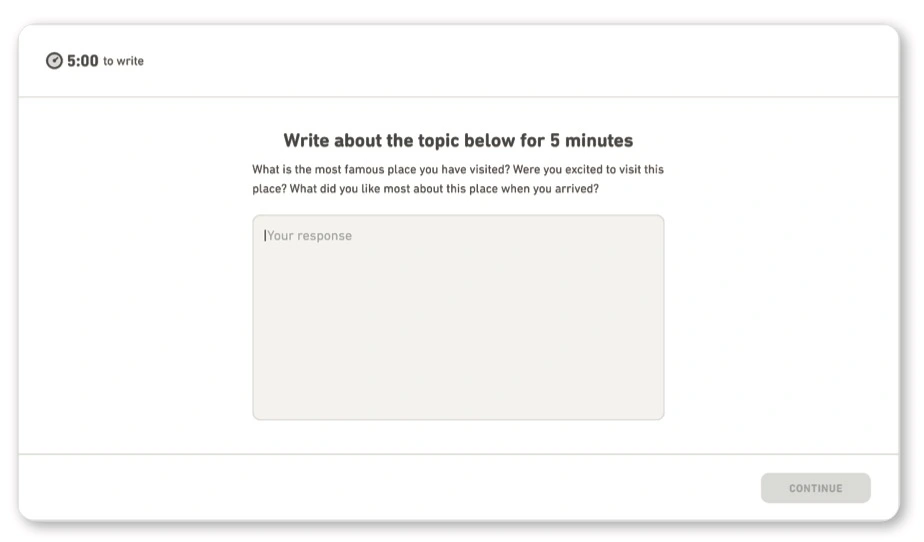
Time: 5 minutes | Prep: 30 seconds | Frequency: 1 | Adaptive: No
How it works: you are presented with a topic or question asking for your personal experience or opinion. You have 30 seconds to read and think, and then 5 minutes to write your response.
Example prompt: «Due to the invention of cell phones, people can communicate via text messages. Describe the ways texting has changed how we communicate.»
Special characteristics:
- This task DOES NOT score directly in your 10-160 total
- However, it is sent to all institutions when you share your results
- University admissions officers read it to qualitatively assess your writing
- It can be a decisive factor in competitive admissions processes
Key strategies:
- Remember that universities will read this: it is your written introduction, so give your best effort
- Structure your response clearly: introduction (introduce the theme), body (develop ideas with examples), conclusion (close the argument)
- Support your opinions with specific examples or solid reasoning; do not stick to generalities
- Use the 30 seconds of preparation to mentally outline your key points: what 2-3 main ideas do you want to communicate?
- Demonstrate sophistication in your writing: vary sentence length, use precise vocabulary, employ appropriate connectors
- Reserve at least 30 seconds at the end to check spelling, grammar, and punctuation; careless errors can give a bad impression
- Do not worry as much about length as about quality; it’s better to have a shorter but well-written text than a long one with errors
6.4. Speaking
Speaking tasks assess your ability to communicate verbally in English. They include descriptions, responses to questions, and simulated conversations. All are recorded, so ensure your microphone works well. Let’s look at each type:
6.4.1. Speak About the Photo
Similar to Write About the Photo, but oral. You are shown a photograph and must verbally describe what you see during the available time.
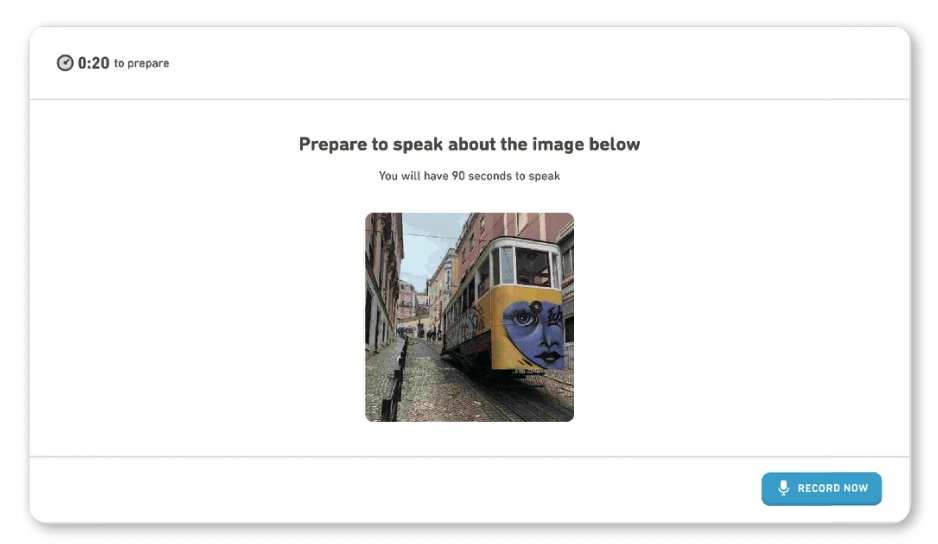
Time: 90 seconds to speak | Prep: 20 seconds | Frequency: 1 photo | Adaptive: No
How it works: an image appears on the screen. You have 20 seconds to observe it and think about what you are going to say. Then you click «Record Now» and have 90 seconds to speak describing the image.
Photo characteristics: they are real images of people, animals, or everyday scenes (not IA-generated images). They can show diverse situations: landscapes, activities, public places, domestic scenes, etc.
Key strategies:
- During the 20 seconds of preparation: identify the main subject, the setting, and any notable action or detail
- Start with a general description («This image shows…») and then add specific details
- Use the full 90 seconds: the more you speak (coherently), the more you demonstrate your oral ability
- If you don’t know the exact word for something, describe it with other words: «a large animal with four legs» instead of blocking
- Include logical inferences about the context or environment: «It looks like it might be early morning because…»
- Vary your vocabulary and grammatical structures; do not repeat the same words constantly
- Speak clearly and at a moderate pace; do not rush, but do not make pauses that are too long either
- It is normal to make some brief pauses to think; that is natural when speaking
6.4.2. Read, Then Speak
In this task, you read a written prompt that asks you a question about personal experiences or opinions, and then you respond orally.
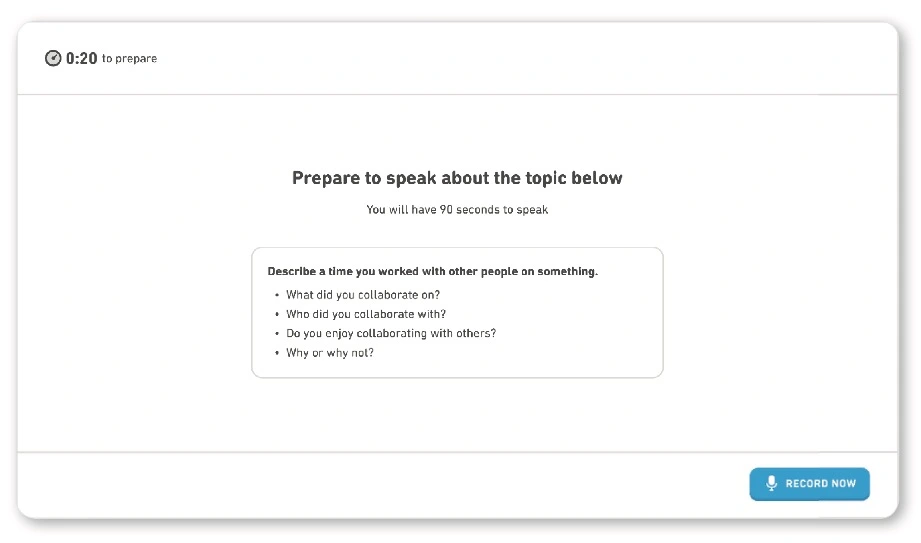
Time: 90 seconds to speak | Prep: 20 seconds | Frequency: 1 | Adaptive: No
How it works: a written prompt is presented on the screen (for example: «Describe a time you worked with other people on something. What did you collaborate on? Who did you collaborate with? Do you enjoy collaborating with others? Why or why not?»). You have 20 seconds to read and think, and then 90 seconds to speak.
Often the prompt includes several guiding questions or bullet points indicating which aspects you should cover in your response.
Key strategies:
- Use the preparation time to identify the key points you must address in your response
- If the prompt includes several bullet points or sub-questions, try to answer all of them (although not necessarily in the same order)
- Speak naturally; do not try to force complex vocabulary that you wouldn’t normally use
- Organise your response logically: brief introduction, development of ideas, conclusion (if you have time)
- Maintain a steady pace; brief pauses to think are acceptable, but try not to stay silent for more than 2-3 seconds
- The prompt remains visible on the screen while you record, so you can consult it if you lose your thread
- Use connectors to organise your speech: First, Additionally, For example, As a result, In conclusion
6.4.3. Interactive Speaking
This task simulates a real conversation. A Duolingo character (represented by an avatar and audio) will ask you questions about two different topics (3 questions per topic), and you must respond orally to each one.
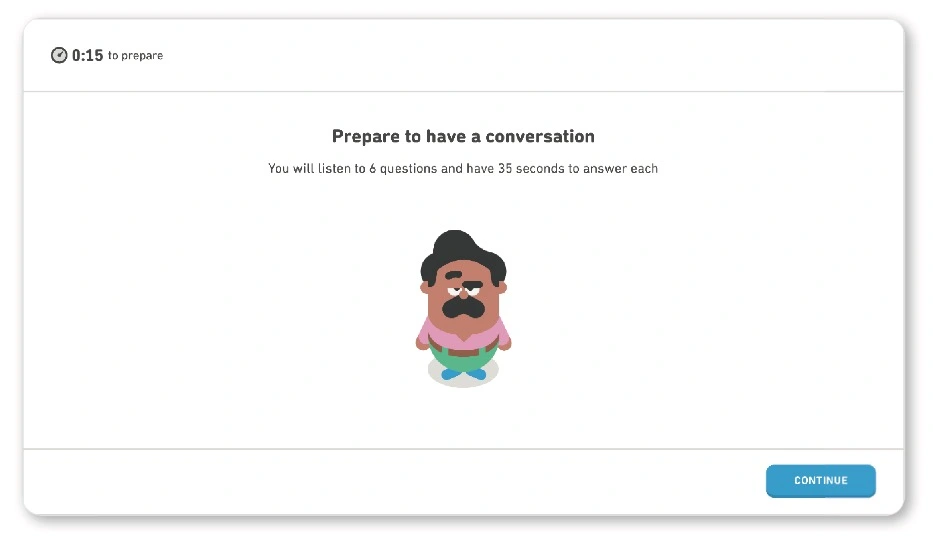
Time: 35 seconds per question | Frequency: 6 questions in total (2 topics × 3 questions) | Adaptive: Yes
How it works: the character asks you a question in audio (for example, about your hobbies, your daily routine, your future plans, etc.). You listen to the question and then have 35 seconds to respond orally. Then they ask you another related question, and so on.
The questions adapt according to your performance: if you respond well, the following ones may be more complex or profound.
Important characteristics:
- You can only listen to each question once (it cannot be repeated)
- You must click on «Record Now» before starting to speak
- You have exactly 35 seconds to respond to each question
- After 3 questions on one topic, it switches to a second topic with 3 new questions
Key strategies:
- Listen carefully: you only have one chance to hear each question
- Click «Record Now» immediately after listening to the question to not waste time
- If you do not fully understand the question, respond on the general topic in the best way possible; it’s better to say something relevant than to remain silent
- Speak with confidence even if your answers are not perfect; fluency and the willingness to communicate are important
- Use all the available time (35 seconds); if you finish very early, elaborate more or give additional examples
- Respond directly and naturally, as you would in a real conversation
- The questions are usually on everyday and personal topics, so relax and be yourself
6.4.4. Speaking Sample
This is your speaking sample which will be sent directly to universities in video format along with your score. It is your chance to demonstrate your speaking ability more extensively and show some of your personality.
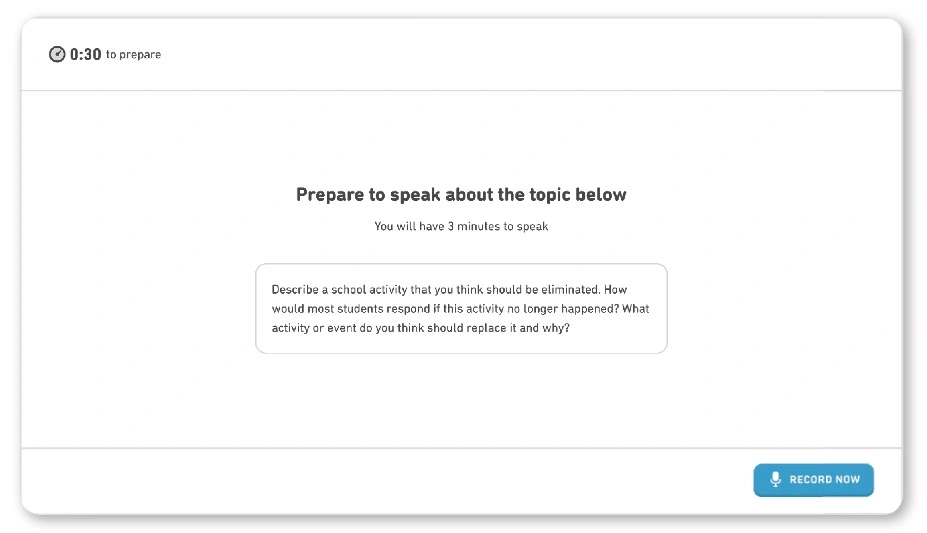
Time: 3 minutes to speak | Prep: 30 seconds | Frequency: 1 | Adaptive: No
How it works: you listen to a question on a topic of personal experience or opinion (similar to Read, Then Speak but with more time). You have 30 seconds to think and then 3 full minutes to respond. This response is recorded on video.
Example prompt: «Imagine that your supervisor has offered you a choice between two positions. One consists of tasks that you do really well, while the other would be more challenging and involve learning new skills. Which do you prefer? Why? Give specific reasons for your answer.»
Special characteristics:
- This task DOES NOT score directly in your 10-160 total
- However, it is sent in video format to all institutions when you share your results
- Admissions officers watch and listen to it to qualitatively assess your speaking ability
- It is an opportunity for universities to «get to know you» beyond the numbers
Key strategies:
- This is your longest speaking task: manage your time and pace well
- Plan the main points during the 30 seconds of preparation (e.g., point 1, point 2, point 3, conclusion)
- Speak as long as you can in a relevant way; 3 minutes may seem like a lot, but it goes fast
- The prompt remains visible on the screen, so you can consult it if you lose your thread
- Remember: admissions officers will watch this video. Maintain a natural tone and eye contact with the camera
- Structure your response: introduction (state your position), development (arguments and examples), conclusion (summarise your main point)
- Show variety in your language: use diverse vocabulary, different verb tenses, and varied grammatical structures
- Do not worry if you make a small mistake; what matters is the overall communication and your ability to express yourself coherently
7. Assessment criteria
Understanding how your answers are evaluated will help you better focus your preparation and performance in the exam. The DET uses artificial intelligence models specifically trained to evaluate language according to clear linguistic criteria. Let’s see what aspects are valued in writing and speaking tasks.
7.1. Criteria for Writing
Writing tasks are evaluated according to four main criteria:
| Criterion | What is evaluated |
|---|---|
| Content |
Relevance: Does your text answer the question posed? Completeness: Do you address all the requested aspects? Appropriate style: Is the tone and register suitable? Idea development: Do you elaborate on your points with examples and details? |
| Discourse Coherence |
Clarity: Is what you write easily understood? Cohesion: Do you use appropriate connectors between ideas? Logical progression: Do ideas flow in an orderly fashion? Structure: Is there an introduction/conclusion and well-organised paragraphs? |
| Grammar |
Variety of structures: Do you use different sentence types (simple, compound, complex)? Grammatical accuracy: Are verb tenses, agreements, etc., correct? Punctuation: Do you correctly use full stops, commas, and capital letters? |
| Lexis |
Vocabulary diversity: Do you avoid constantly repeating the same words? Sophistication: Do you use vocabulary appropriate for the academic level? Precision: Do you choose the right words to express your ideas? Spelling: Do you write the words correctly? |
To obtain a high score in writing, you need to demonstrate competence in all these criteria. It is not enough to have good grammar if your text does not answer the question, nor to have relevant ideas if the expression is confusing or contains many errors.
7.2. Criteria for Speaking
Speaking tasks are evaluated according to six main criteria (there are more than in writing because specific aspects of oral communication such as fluency and pronunciation are added):
| Criterion | What is evaluated |
|---|---|
| Content |
Relevance: Does your speech answer the question? Completeness: Do you address the requested points? Appropriate style: Is the tone suitable? Development: Do you elaborate on your ideas with details? |
| Discourse Coherence |
Clarity: Is what you say easily understood? Cohesion: Do you use appropriate connectors? Logical progression: Do ideas flow in an orderly manner? |
| Fluency |
Appropriate speed: Do you speak at a natural pace (neither too fast nor too slow)? Natural pauses: Are pauses logical or do they interrupt communication? Few fillers/repetitions: Do you avoid excessive filler words («um», «uh», «like»)? |
| Grammar |
Variety of structures: Do you use different grammatical constructions? Grammatical accuracy: Are verb tenses, agreements, etc., correct? |
| Lexis |
Vocabulary diversity: Do you avoid repeating the same words? Sophistication: Do you use vocabulary appropriate for the academic level? Appropriate choice: Do you choose the right words for the context? |
| Pronunciation |
Intelligibility: Are you clearly understood? Individual sounds: Do you correctly pronounce English phonemes? Word stress: Do you stress the correct syllable in words? Intonation: Do you use appropriate intonation patterns for sentences/questions? |
It is important to highlight that you do not need to have a native accent to get a good score in pronunciation. What is valued is intelligibility: that you are understood clearly even if you have a Spanish, Latin American, or any other regional accent. The crucial thing is that pronunciation does not interfere with communication.
8. International recognition and acceptance
One of the most frequent questions I receive is: «Do they really accept the DET in good universities?» The answer is a resounding yes. The Duolingo English Test has experienced spectacular growth in international recognition in recent years.
Figures and global reach
According to updated data from Duolingo:
- More than 6,000 programmes and institutions worldwide currently accept the DET for admission
- This number includes some of the most prestigious and selective universities on the planet
- Recognition has grown exponentially since 2020, especially after the pandemic when many institutions were looking for flexible alternatives to face-to-face exams
United States
Acceptance in the USA is particularly impressive:
- All Ivy League universities accept the DET: Harvard, Yale, Princeton, Columbia, Penn, Dartmouth, Brown, and Cornell
- Elite business schools such as Harvard Business School, Wharton (Penn), Chicago Booth, Kellogg (Northwestern), Stanford GSB, MIT Sloan
- Hundreds of high-level public and private universities in every state
Canada
Canada has been one of the countries with the highest adoption of the DET:
- University of Toronto, University of British Columbia, McGill University
- Virtually all major Canadian higher education institutions
- The DET is particularly popular for study permit applications in Canada
United Kingdom and Ireland
Recognition in English-speaking countries in Europe is also solid:
- United Kingdom: Imperial College London, King’s College London, University of Edinburgh, University of Manchester, and many others
- Ireland: Trinity College Dublin, University College Dublin, among others
Australia and New Zealand
Major universities in Oceania also accept the DET:
- Australian National University, University of Melbourne, University of Sydney
- University of Auckland, Victoria University of Wellington
Continental Europe, Asia, and Latin America
Outside the traditional English-speaking world, numerous universities use the DET to assess the English proficiency of international students:
- Europe: universities in Germany, France, Netherlands, Switzerland, Spain, and other countries with programmes taught in English
- Asia: institutions in Japan, South Korea, Singapore, Hong Kong, etc.
- Latin America: prestigious universities offering international programmes or assessing language proficiency
Use for visas
In the migration field, the situation is more variable:
- Study permits: some countries allow the use of the DET as evidence of language proficiency for student visa applications, especially when the admitting university accepts the exam
- Canada: many Canadian institutions use the DET in their admission processes, which facilitates study permit applications
- United States: US universities that accept the DET can support F-1 visa applications with that certification
- Specific government visas: for certain work or residency visas requiring English tests classified as «Secure English Language Tests» (SELT), the DET is not yet on the official lists of some governments (such as the UK for Tier 2 type visas)
Recommendation: always check the specific requirements of your target programme and the type of visa you will need. The best way to do this is:
- Consult the website of the university and the specific programme you are applying for
- Use Duolingo’s official institution search tool: englishtest.duolingo.com/institutions
- Contact the admissions office directly if you have doubts
- Verify the visa requirements of the destination country
9. Official resources and preparation
To prepare properly for the DET and ensure you have the most up-to-date information, it is fundamental that you consult official Duolingo resources. Here is a complete guide to finding everything you need:
Official Duolingo resources
- Main exam website: englishtest.duolingo.com
- General information about the exam
- Registration and purchase of exam attempts
- Sending results to institutions
- Access to your account and certificates
- Free practice questions: on the DET platform itself, you will find examples of each type of question that you can take for free to familiarise yourself with the format
- Official blog and help centre: the Duolingo blog publishes explanations about scoring, security, exam updates, and preparation tips
- Institution search: englishtest.duolingo.com/institutions
- Tool to search and filter universities by country, study level, and academic area
- Updated database of institutions that accept the DET
- Identification requirements by country: englishtest.duolingo.com/ids
Recommended preparation resources
In addition to free official resources, there are specialised platforms that offer more complete and structured preparation. For example, DETPractice.com is an official Duolingo English Test Gold Partner and offers:
- More than 18,000 practice questions that simulate the real exam
- Complete mock tests under authentic conditions
- Artificial intelligence evaluation providing instant and personalised feedback
- Specific strategies for each type of question
Other similar platforms also offer preparation materials, online courses, and specialised DET tutoring.
Tips for effective preparation
- Familiarise yourself with all question types: use official samples and practice platforms to get to know each format
- Practise with limited time: the DET is a fast exam, so train under time pressure
- Record yourself speaking and listen to your recordings: this helps you identify areas for improvement in pronunciation, fluency, and idea organisation
- Read your written texts aloud: it will help you detect grammatical and coherence errors
- Expand your academic vocabulary: the DET uses academic and informative contexts, so familiarise yourself with vocabulary from science, technology, society, etc.
- Take full mock exams: practise the whole exam at least 2-3 times before the real day to manage time and reduce anxiety
- Verify your technical setup: test your camera, microphone, connection, and secondary camera configuration in advance
10. General tips for exam day
Exam day can cause nerves, but with good technical and mental preparation, everything will go smoothly. Here are my best tips as an examiner and tutor:
Environment preparation
- The night before:
- Ensure your room is tidy and free of prohibited materials
- Prepare your physical identity document
- Fully charge your mobile (secondary camera) or have the charger at hand
- Notify the people you live with not to interrupt you for 1-2 hours
- The day of the exam:
- Choose a time when you are rested and alert (avoid taking the exam very late at night)
- Eat something light before to have energy without feeling heavy
- Go to the toilet before starting (you cannot pause the exam once it begins)
- Light your face well from the front; avoid having bright windows behind you that create shadows
Technical checklist
Before purchasing or starting the exam, verify:
- ☑ Computer: working correctly, with operative front camera
- ☑ Internet connection: stable (preferably wired)
- ☑ DET application: downloaded and installed (you must use the official desktop app, not the browser)
- ☑ Microphone and speakers: tested and with good volume
- ☑ Mobile as secondary camera: fully charged or plugged in, with «Do Not Disturb» activated
- ☑ Mobile position: placed so it records your screen, keyboard, and upper body (practise the placement before)
- ☑ Single monitor: any secondary screen disconnected
- ☑ Single keyboard and mouse: only one of each connected
- ☑ Earphones put away: do not use them, your ears must be visible
- ☑ Smartwatch put away: take off any smartwatch
- ☑ Clear room: no papers, books, or additional electronic devices in sight
- ☑ Identity document: physical and valid according to your country
- ☑ Restart computer: close all applications and browser extensions before opening the DET app
Time management during the exam
- Do not get stuck on a single question: if something is very difficult, make your best attempt and move on; the adaptive format will adjust
- Use all the time in production tasks: in Write About the Photo, Speak About the Photo, etc., take advantage of every second available to demonstrate your level
- Manage times for Interactive Listening and Interactive Reading: these are long tasks with multiple sub-questions; do not spend too much time on the first questions and then rush through the last ones
- Leave time to check: especially in written tasks, reserve 10-20 seconds at the end to check spelling and grammar
Stress management
- Breathe deeply: if you feel anxiety during the exam, take a deep breath in the seconds between questions
- Remember it is adaptive: if questions seem difficult, it might be a sign you are doing well and the system is increasing the level
- Do not judge yourself during the exam: concentrate on doing your best in each task without thinking about how you did in previous ones
- Have confidence in your preparation: if you have practised all question types and familiarised yourself with the format, you are ready
What to do if something goes wrong
- If you lose internet connection: the application will try to reconnect automatically. If you cannot continue, contact Duolingo support as soon as possible with evidence of the problem
- If there is a serious technical problem: take screenshots if possible and immediately contact the DET help centre to request a new attempt
- If someone interrupts you involuntarily: try to continue if possible; explain the situation to support if the incident was recorded by the cameras
- If you accidentally violate a rule: (for example, someone briefly enters the room), complete the exam and then contact Duolingo explaining the situation truthfully
Support contact: you can contact the DET support team through their help centre at englishtest.duolingo.com if any problem arises before, during, or after the exam.
11. Frequently asked questions
Throughout my years preparing students for the DET, these are the questions I am asked most frequently:
How many times can I take the exam?
You can purchase up to 3 exam attempts in any 30-day period. If you buy a bundle of 2 exams, you have 21 days to take the first one, and then an additional 21 days after receiving the result of the first one to take the second.
How much does the DET cost?
The international standard price is 70 USD (dollars) and it is available on the official page at the time of purchase and is usually considerably more affordable than IELTS or TOEFL. Duolingo occasionally updates prices, so check the official website for the most current information.
Can I use earphones?
No. It is strictly forbidden to use earphones, headphones, or any audio device. Your ears must be visible at all times for both cameras. You can use your computer’s built-in speakers or external speakers.
Can I take notes?
No. You cannot use paper, pen, or any material to take notes during the exam. Everything must be done mentally or directly on the computer when the task requires it (for example, when writing).
What happens if I lose my internet connection?
The DET application will attempt to reconnect automatically if there is a brief interruption. If the disconnection is prolonged and you cannot complete the exam, you must contact Duolingo support immediately (with evidence of the problem if possible) so they can evaluate your case and potentially offer you a new attempt.
How do I send my results to universities?
Once you receive your certified results (approximately 48 hours after the exam), you can send them for free and without limits to as many institutions as you wish directly from your account on the DET platform. You simply search for the institution, select the specific programme (if applicable), and send your certificate digitally.
Which universities accept the DET in Spain/Latin America?
More and more universities in Spain and Latin America that offer English-taught programmes or assess language proficiency accept the DET. To find out if your target university accepts it, use the official institution search tool at englishtest.duolingo.com/institutions or contact the admissions office of the programme you are interested in directly.
How long are results valid for?
DET results are valid for 2 years from the date you took the exam. However, some institutions may have their own policies regarding the acceptable age of results, so always check with your target programme.
Can I see my answers after the exam?
For security reasons and to protect the integrity of the exam, you cannot see your specific answers or the questions you were asked after completing the test. What you will receive is your overall score and subscores, which give you an overview of your performance.
Do I need a minimum level to take the exam?
There is no minimum level required to take the DET. The exam is adaptive and can assess from beginner level (A1) to advanced (C2). However, if your goal is university admission, verify what minimum score your target programme requires (most ask for between 100-120 or higher, equivalent to B2-C1).
12. Conclusion
The Duolingo English Test represents a significant evolution in language proficiency certification. Its modern, adaptive, and flexible format has made it an increasingly popular alternative to traditional exams like IELTS or TOEFL, without sacrificing academic rigour or international recognition.
Throughout this guide, you have learned everything essential about the DET:
- Its structure in three phases: verification, adaptive test, and production samples
- The 13 main types of questions you will encounter in reading, listening, writing, and speaking
- The scoring system with an overall score and individual and integrated subscores
- Technical and environmental requirements (especially the mandatory secondary camera)
- Strict rules you must follow for your exam to be certified
- Assessment criteria used by AI to score your answers
- The wide recognition of the exam in more than 6,000 global institutions
- Specific strategies for each type of task
Next steps
If you are considering taking the DET, these are the steps I recommend you follow:
- Verify that your target universities accept the DET: use the official institution search
- Assess your current level: take the free practice questions on the official platform to get an approximate idea
- Identify your goal: what score do you need? Most competitive university programmes ask for 110-130+
- Prepare in a structured way: familiarise yourself with all question types, practise under limited time, and take complete mock exams
- Verify your technical setup: test all your equipment (computer, cameras, microphone, connection) in advance
- Purchase and schedule your exam: when you feel ready, buy the exam and take it at a time when you are rested and alert
- Trust your preparation: on exam day, breathe, concentrate, and demonstrate everything you know
Final reflection
Remember that the DET, like any language exam, is a tool to demonstrate communicative competence, not an end in itself. What matters is your real ability to use English in academic and professional contexts. The exam simply certifies that skill.
So, while you prepare, focus not only on «passing the exam» but on genuinely improving your English: read articles in English, listen to podcasts, practise writing about varied topics, and speak with natives or fellow students. This real improvement will naturally translate into a better score in the DET, and most importantly, it will prepare you to succeed in your international studies.
The path to your academic goal may seem challenging, but with the right preparation and mindset, the Duolingo English Test is an excellent option to certify your English level quickly, flexibly, and with international recognition.
I hope this complete guide has been useful to you and has given you all the information and confidence you need to face the DET successfully.
And until the next article, don’t forget to keep smiling!