
How to Write a Formal Letter for the C2 Proficiency (CPE) [2026 Guide]
Learn how to write a formal letter for C2 Proficiency (CPE) with expert guidance, original examples, useful phrases and assessment criteria. Complete 2026 guide.

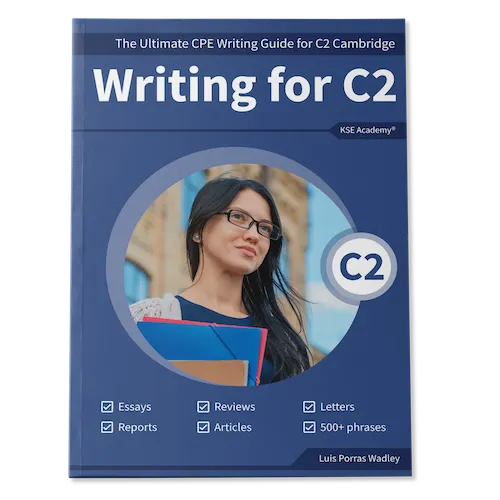
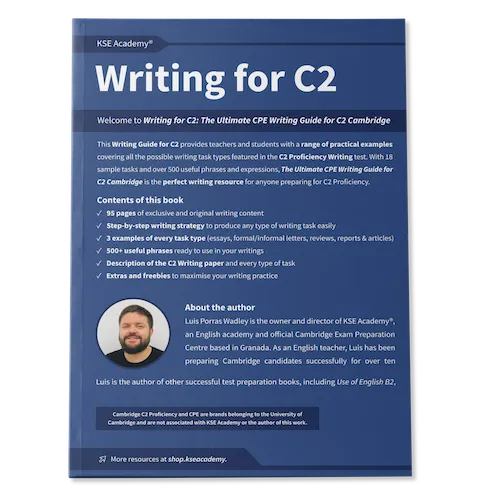
Table of contents
The C2 Proficiency Writing paper is undoubtedly one of the most challenging components of the Cambridge exam, and within Part 2, the formal letter stands as one of the most frequently chosen tasks by candidates. Unlike informal correspondence, where you can adopt a more relaxed and personal tone, the C2 formal letter demands distance, precision, and linguistic sophistication. In this comprehensive guide, I’m going to explain exactly how to write a formal letter for the C2 Proficiency (CPE), with original examples, advanced expressions, and expert advice so you can achieve the highest possible marks. Ready to master this task? Let’s dive in!
What is a Formal Letter in the C2 Proficiency?
A formal letter (or formal email—Cambridge uses both terms interchangeably) in C2 Proficiency is a piece of written correspondence addressed to a person or institution with whom you do not have a close personal relationship. The purpose typically involves requesting information, lodging a complaint, applying for a position, responding to an article in a publication, or addressing an institutional matter.
At C2 level, you’re expected to demonstrate complete command of formal register conventions in English. This means your letter must exhibit sophisticated vocabulary, complex grammatical structures, impeccable organisation, and a tone that is consistently appropriate for the specified context. The examiners are looking for near-native competence—your writing should hold the target reader’s attention with ease whilst fulfilling all communicative purposes.
It’s worth noting that C2 Proficiency does not require you to include dates or postal addresses in your letters. You should focus entirely on the salutation, content, and sign-off.
When Will You Be Asked to Write a Formal Letter in the CPE?
As you’ll already know, the C2 Proficiency Writing paper consists of two parts. Part 1 is compulsory (it’s always an essay), whilst in Part 2 you must choose one task from three options. These options can include: article, letter (formal or informal), report, or review.
Therefore, the formal letter option won’t always appear in your exam, but it’s just as likely to be included as any other task type.
You can expect to be asked to write formal letters to, for example, the editor of a newspaper or magazine, to the director of an international company, or to a school or college principal[cite](#tm-cite:0|engxam.com). When the formal letter does appear, it’s absolutely fundamental that you recognise it immediately and apply the appropriate register from the very first word.
Main Characteristics of a C2-Level Formal Letter
To achieve the maximum marks in the C2 Proficiency Writing assessment, your formal letter must meet certain level and style expectations. Let’s examine the defining characteristics:
Purpose and Context
The purpose of your formal letter will depend entirely on the specific task instructions. Common scenarios include:
- Application letters: Applying for a job, volunteering position, scholarship, or academic programme
- Letters of complaint: Addressing poor service, defective products, or unsatisfactory experiences
- Letters of enquiry: Requesting specific information about services, programmes, or opportunities
- Letters to editors: Responding to published articles, expressing viewpoints on public issues, or contributing to debate
- Letters to authorities: Addressing local councils, educational institutions, or governmental bodies
The target reader will invariably be someone you’re not personally acquainted with: a director, an editor, a principal, or an institutional representative.
Register and Tone
This is where C2-level candidates must truly demonstrate their mastery. The register and tone of your formal letter must be consistently appropriate, sophisticated, and professional. Here’s what this entails:
- Professional distance: Maintain objectivity and avoid overly personal or emotional language
- Sophisticated vocabulary: Employ precise, advanced lexis rather than common, everyday words
- No contractions: Write «I am», «do not», «cannot», and «will not» instead of «I’m», «don’t», «can’t», and «won’t»
- Formal verbs over phrasal verbs: Prefer «enquire» over «ask about», «establish» over «set up», «obtain» over «get»
- Complex grammatical structures: Demonstrate your range through passive constructions, inversion, cleft sentences, and advanced modal usage
- Courtesy and tact: Even when complaining, maintain politeness and diplomacy
Understanding the Register Spectrum: Not all formal letters require the same degree of formality. There exists a spectrum from very formal to neutral-formal, and your choice should reflect the specific context:
| Level of Formality | When to Use | Language Features |
|---|---|---|
| Very Formal | Letters to senior officials, company directors, academic institutions, government bodies | Highly sophisticated vocabulary, passive voice, impersonal constructions, extremely polite modal usage («I should be most grateful if…») |
| Formal | Letters to editors, professional applications, formal complaints to companies | Advanced vocabulary, mix of active and passive voice, polite but direct expressions («I am writing to express…») |
| Neutral-Formal | Letters to newspaper editors on general topics, enquiries about public services | Professional but accessible language, predominantly active voice, straightforward courtesy («I would like to enquire about…») |
Key Principle: When in doubt, err on the side of greater formality. It’s better to be overly formal than insufficiently formal in a C2 Proficiency letter.
Structure of a Formal Letter for C2 Proficiency
Even though formal letters demand sophistication, they must also be perfectly organised. A clear structure is fundamental to achieving high marks in the Organisation criterion. Here’s the ideal framework:
Salutation
The opening salutation depends on whether you know the recipient’s name:
- If you know the name: «Dear Mr Thompson,» or «Dear Ms Richardson,» (Use title + surname only)
- If you don’t know the name: «Dear Sir or Madam,» or «To whom it may concern,»
- For newspaper editors: «Dear Editor,» is perfectly acceptable
Important note: If you’re writing to a woman and don’t know whether she uses Mrs or Miss, use Ms, which is appropriate for both married and single women.
Opening Paragraph
Your introductory paragraph should immediately and clearly establish why you are writing. This is not the place for lengthy preambles or unnecessary pleasantries. State your purpose directly but politely:
- «I am writing with regard to…»
- «I am writing in response to your advertisement…»
- «I am writing to express my concern about…»
- «I wish to draw your attention to…»
At C2 level, your opening should also subtly establish the tone and demonstrate your sophisticated command of English. Consider beginning with a brief contextual statement before declaring your purpose.
Main Body Paragraphs
The body of your letter will develop the points requested by the task. Typically, you’ll have 2-3 main paragraphs, each addressing a specific aspect of the task instructions. Each paragraph should:
- Focus on one main idea: Don’t mix multiple unrelated points in a single paragraph
- Be well-developed: Provide specific details, examples, or reasoning
- Use sophisticated connectors: «Furthermore», «Moreover», «In addition», «Conversely», «Nevertheless»
- Maintain the formal register throughout: No lapses into informality
Remember: Most letters in English are not very long, so keep the information to the essentials and concentrate on organising it in a clear and logical manner rather than expanding too much[cite](#tm-cite:1|engxam.com).
Closing Paragraph
Your closing paragraph should achieve several objectives:
- Summarise your main point or request (if appropriate)
- Express gratitude for the reader’s time or consideration
- State your expectation (e.g., for a response, action, or consideration)
- Offer availability for further communication if relevant
Typical closing expressions include:
- «I look forward to hearing from you at your earliest convenience.»
- «Should you require any further information, please do not hesitate to contact me.»
- «I would be grateful for your prompt response to this matter.»
- «Thank you in advance for your time and consideration.»
Sign-off
The closing formula must match your opening salutation. This is a strict convention in English formal correspondence:
- If you opened with «Dear Sir or Madam» or «To whom it may concern»: Close with «Yours faithfully,»
- If you opened with the recipient’s name (e.g., «Dear Mr Thompson»): Close with «Yours sincerely,»
- For newspaper editors: Either «Yours faithfully,» or «Yours sincerely,» is acceptable
Follow the closing formula with your full name on the next line. Do not include a signature (this is a typed letter).
How to Write a C2 Formal Letter Step by Step
Now that we understand the characteristics and structure, let’s examine the precise process you should follow when tackling a formal letter task in the exam:
- Step 1: Analyse the task meticulously (2-3 minutes)
Read the instructions carefully and identify: (a) Who you’re writing to (this determines your level of formality); (b) Why you’re writing (the purpose); (c) The 3 specific points you must address (there are usually three); (d) The appropriate register. Underline or mentally note these elements. - Step 2: Plan your content (3-4 minutes)
Decide exactly what you’ll say for each required point. Jot down key vocabulary or expressions you want to include. Plan your paragraph structure: opening + 2-3 body paragraphs + closing. Don’t start writing until you have a clear plan. - Step 3: Write the appropriate salutation
Choose the correct opening based on whether you know the recipient’s name. Remember, this will determine your closing formula. - Step 4: Craft a purposeful opening paragraph
State clearly why you’re writing. At C2 level, you might begin with a brief contextual statement before your main purpose: «Having read with considerable interest your recent article on urban development, I am writing to express an alternative perspective on…» - Step 5: Develop the main body paragraphs
Address each required point in a separate paragraph. Use sophisticated vocabulary and complex structures. Employ formal connectors to link ideas. Be specific and provide well-developed arguments or information. - Step 6: Write an effective closing paragraph
Summarise if appropriate, express gratitude, state your expectation, and/or offer further availability. This should feel like a natural conclusion to your letter. - Step 7: Apply the correct sign-off and signature
Match your closing formula to your opening salutation. Sign with your full name (you may use a fictitious name if you prefer). - Step 8: Review and refine (3-5 minutes)
Check for errors in grammar, spelling, and punctuation. Verify that you’ve addressed all required points. Ensure your register is consistently formal throughout. Confirm your letter is within the 280-320 word range.
Complete Example of a C2 Formal Letter
Theory is essential, but seeing how it applies in practice is invaluable. Let’s examine an original, complete example created specifically for this guide.
Task Instructions (Example 1)
You have read an article in a national newspaper proposing that all city centres should be completely pedestrianised, with all motor vehicles banned from urban cores. Whilst you appreciate the environmental concerns raised, you believe the article fails to consider several practical implications and alternative solutions.
Write a letter to the newspaper editor presenting your perspective on this issue. In your letter you should:
- Acknowledge the environmental concerns whilst explaining the practical challenges of complete pedestrianisation
- Discuss how such a policy would affect different groups in society
- Suggest alternative approaches that might achieve environmental goals more realistically
Write your letter.
Write your answer in 280-320 words in an appropriate style.
Task Analysis
Before writing, let’s identify the key elements:
- Type of writing: Formal letter
- Target reader: Newspaper editor (formal register, but not extremely formal)
- Topic: Urban pedestrianisation policy
- Your position: Acknowledge concerns but offer counter-arguments and alternatives
- Points to address:
- Practical challenges of complete pedestrianisation (whilst acknowledging environmental concerns)
- Effects on different societal groups
- Alternative, more realistic approaches
Model Answer
Dear Editor,
I am writing in response to the article published on 3rd February advocating the complete pedestrianisation of urban centres. Whilst I wholeheartedly acknowledge the pressing need to address vehicular emissions and urban air quality, I believe the proposed solution warrants more nuanced consideration.
The environmental imperatives outlined in your article are indeed compelling; however, a blanket ban on motor vehicles presents considerable practical challenges. Many city centres house essential services—hospitals, care facilities, and emergency services—that require immediate vehicular access. Furthermore, the logistics of deliveries to businesses, waste collection, and maintenance operations cannot be overlooked. Without comprehensive alternative infrastructure, complete pedestrianisation risks creating significant operational disruptions that could undermine the very urban vitality the policy seeks to protect.
Moreover, such a policy would disproportionately affect certain societal groups. Elderly citizens and individuals with mobility impairments, for whom even short distances can present formidable challenges, would find their access to city centre amenities severely restricted. Similarly, small business owners relying on customer convenience and delivery access might face economic hardship, potentially accelerating the decline of independent retailers already struggling to compete with online commerce.
Rather than an absolute prohibition, I would advocate for graduated, evidence-based measures. Low-emission zones with progressive restrictions, coupled with substantial investment in public transport infrastructure and park-and-ride facilities, could achieve environmental objectives whilst maintaining accessibility. Additionally, designated time windows for commercial vehicles and exemptions for essential services would balance environmental concerns with practical necessities.
Environmental stewardship and urban functionality need not be mutually exclusive. I trust your publication will consider featuring diverse perspectives on this important debate.
Yours faithfully,
Victoria Ashworth
Why This Letter Achieves C2 Level
Let’s analyse the specific elements that make this formal letter exemplary for C2 Proficiency:
- Consistently appropriate register: The letter maintains a formal, professional tone throughout without a single lapse into informality. Notice the absence of contractions and the use of sophisticated vocabulary.
- Sophisticated vocabulary (C2 level): «wholeheartedly acknowledge», «pressing need», «warrants more nuanced consideration», «environmental imperatives», «blanket ban», «considerable practical challenges», «comprehensive alternative infrastructure», «urban vitality», «disproportionately affect», «formidable challenges», «accelerating the decline», «graduated, evidence-based measures», «progressive restrictions», «substantial investment», «mutually exclusive».
- Complex grammatical structures: The text employs advanced structures including: subordinate clauses («Whilst I wholeheartedly acknowledge…»), passive constructions («cannot be overlooked»), complex noun phrases («the logistics of deliveries to businesses, waste collection, and maintenance operations»), relative clauses («individuals with mobility impairments, for whom even short distances…»), and conditional structures.
- Formal connectors and discourse markers: «Whilst», «however», «Furthermore», «Moreover», «Similarly», «Rather than», «Additionally». These create sophisticated cohesion and logical flow.
- Complete coverage of all points: The letter systematically addresses all three required elements: (1) practical challenges whilst acknowledging environmental concerns (paragraphs 1-2); (2) effects on different societal groups (paragraph 3); (3) alternative approaches (paragraph 4).
- Clear structure: Opening paragraph establishes purpose and position, three body paragraphs develop specific points, closing paragraph summarises position and thanks the reader.
- Appropriate tone: The letter is respectful and diplomatic whilst presenting counter-arguments. It acknowledges the validity of environmental concerns before presenting alternative perspectives—a sophisticated rhetorical approach.
- Precise length: The text contains approximately 295 words, comfortably within the 280-320 range.
- Correct conventions: Appropriate salutation («Dear Editor,») and sign-off («Yours faithfully,» as the letter didn’t use a specific name).
Language and Expressions for C2-Level Formal Letters
To achieve C2 level in your formal letter, you need to master certain linguistic elements that distinguish sophisticated writing from merely competent writing. Let’s examine these in detail:
Sophisticated Vocabulary for C2
At C2 level, your vocabulary should demonstrate precision, range, and sophistication. Here are some sample transformations from B2/C1 to C2 level vocabulary:
| B2/C1 Level | C2 Level |
|---|---|
| very important | paramount, pivotal, imperative, crucial |
| difficult situation | predicament, quandary, conundrum |
| I completely agree | I wholeheartedly concur, I am in complete accord |
| many problems | myriad challenges, multifaceted issues |
| make worse | exacerbate, compound, aggravate |
| reduce | diminish, mitigate, alleviate |
| show | demonstrate, illustrate, exemplify, elucidate |
| important part | integral component, fundamental element |
| think carefully | contemplate, deliberate, scrutinise |
| suitable | apposite, apt, fitting, judicious |
Advanced Grammatical Structures
The formal register at C2 level favours more complex grammatical structures. Some of the most valuable include:
- Passive voice for impersonal tone:
«It has been brought to my attention that…»
«The matter cannot be overlooked…»
«Such concerns should be addressed without delay…» - Inversion for emphasis and formality:
«Not only does this policy overlook practical concerns, but it also…»
«Under no circumstances should such measures be implemented without…»
«Were the proposal to be accepted, significant ramifications would ensue…»
«Seldom have I encountered such a problematic approach…» - Cleft sentences for emphasis:
«It is precisely this aspect that requires further consideration…»
«What concerns me most is the potential impact on…»
«It was the lack of consultation that prompted me to write…» - Complex noun phrases:
«My extensive experience in community development and urban planning…» (instead of «I have worked a lot in community development»)
«The council’s disregard for public consultation procedures…» (instead of «The council didn’t ask people what they thought») - Formal conditional structures:
«Should you require further clarification, I would be delighted to provide it…»
«Were the committee to consider alternative approaches…»
«Had I been aware of these circumstances earlier…» - Subjunctive mood:
«I recommend that the proposal be reconsidered…»
«It is essential that this matter be addressed…»
«I propose that the committee convene…»
Formal Connectors and Discourse Markers
Sophisticated connectors are essential for creating coherent, flowing text. At C2 level, you should employ a wide range:
- To add information: Furthermore, Moreover, In addition, Additionally, What is more, Equally importantly, By the same token
- To contrast: However, Nevertheless, Nonetheless, Conversely, On the contrary, Notwithstanding, That said, Having said that
- To show cause and effect: Consequently, Therefore, Thus, Hence, Accordingly, As a result, For this reason
- To concede: Whilst, Although, Admittedly, Granted, Albeit, Despite the fact that
- To specify or clarify: As regards, With regard to, Concerning, In terms of, With respect to, Regarding, Vis-à-vis
- To illustrate: For instance, To illustrate this point, By way of example, A case in point
Avoiding Common Pitfalls
Even advanced candidates sometimes make errors that undermine the formal register. Here are key pitfalls to avoid:
- Using contractions: Never write «I’m», «don’t», «can’t», «won’t», «shouldn’t». Always use the full form in formal letters.
- Over-reliance on phrasal verbs: Whilst some neutral phrasal verbs are acceptable, prioritise single-word formal verbs. Replace «put off» with «postpone», «find out» with «ascertain» or «discover», «set up» with «establish».
- Overly emotional language: Avoid words like «terrible», «awful», «rubbish», «amazing». Use more measured expressions: «highly unsatisfactory», «deeply concerning», «exceptionally impressive».
- Vague, general words: Replace «nice», «good», «bad», «things», «stuff» with precise vocabulary: «commendable», «exemplary», «inadequate», «measures», «provisions».
- Exclamation marks: These have no place in formal letters. Full stops and occasional question marks (for rhetorical questions) are sufficient.
Useful Phrases for Each Part of a C2 Formal Letter
Below, you’ll find a comprehensive bank of expressions organised by function. Memorising and practising these will significantly enhance your formal letter writing:
Opening Formulas
- I am writing with regard to…
- I am writing in response to your advertisement/article concerning…
- I wish to express my concern regarding…
- I am writing to draw your attention to…
- I am writing to enquire about…
- Having read with considerable interest your article on…
- I wish to bring to your attention a matter of some urgency…
- I am compelled to write concerning…
- I am writing to express my profound disappointment/appreciation regarding…
- As a concerned resident/citizen/customer, I am writing to…
Stating Your Purpose
- The purpose of this letter is to…
- I am writing with a view to…
- My principal objective in writing is to…
- I should like to bring to your attention…
- I wish to put forward an alternative perspective on…
- I feel compelled to raise several concerns regarding…
Making Requests and Enquiries
- I would be most grateful if you could…
- I should be obliged if you would…
- I wonder if you would be kind enough to…
- Could you please provide me with information concerning…
- I should like to enquire whether…
- It would be most helpful if you could clarify…
- I would appreciate receiving further details regarding…
- Might I enquire as to whether…
- I am keen to ascertain whether…
Expressing Opinions and Recommendations
- I firmly believe that…
- It is my considered opinion that…
- I would contend that…
- From my perspective, it is evident that…
- I would strongly recommend that…
- It would be judicious to…
- I would advocate for…
- It is imperative that…
- I would propose the following measures…
- Might I suggest that…
Complaints and Concerns
- I am writing to express my profound dissatisfaction with…
- I regret to inform you that…
- I was extremely disappointed to discover that…
- It has been brought to my attention that…
- I feel compelled to point out that…
- The service/product has fallen considerably short of expectations…
- I must draw your attention to several shortcomings…
- I trust you will appreciate the gravity of this situation…
- In light of these circumstances, I request…
- I would expect appropriate recompense/rectification…
Closing Formulas
- I look forward to hearing from you at your earliest convenience.
- I await your response with interest.
- I would be grateful for your prompt attention to this matter.
- Should you require any further information, please do not hesitate to contact me.
- I trust you will give this matter your urgent consideration.
- Thank you in advance for your time and consideration.
- I remain at your disposal should you require further clarification.
- I trust your publication will consider featuring diverse perspectives on this matter.
- I eagerly anticipate your response.
Additional Examples of C2 Formal Letters
To provide you with further references and demonstrate the variety of approaches possible, here are two additional complete examples with entirely original content.
Example 2: Letter to a Newspaper Editor
Task instructions:
You have read an article in a national newspaper arguing that secondary schools should abolish traditional examinations entirely and replace them with continuous assessment methods. The article claims that examinations cause excessive stress and fail to measure students’ true abilities.
Write a letter to the newspaper editor. In your letter you should:
- Acknowledge the concerns about examination stress whilst presenting the benefits of traditional assessment methods
- Discuss potential drawbacks of relying solely on continuous assessment
- Propose a balanced approach that incorporates both assessment methods
Write your letter.
Write your answer in 280-320 words in an appropriate style.
Model Answer:
Dear Editor,
I am writing in response to the article published on 12th February advocating the complete abolition of traditional examinations in secondary education. Whilst I acknowledge the legitimate concerns regarding examination-related anxiety, I believe the proposed wholesale abandonment of formal assessment warrants more balanced consideration.
Admittedly, examination pressure can be considerable, and some students undoubtedly struggle with high-stakes testing environments. However, traditional examinations offer distinct advantages that should not be dismissed lightly. They provide objective, standardised measurements that enable fair comparison across diverse educational contexts—a crucial consideration for university admissions and employment opportunities. Furthermore, examinations cultivate valuable skills in time management, knowledge consolidation, and performance under pressure—competencies that remain highly relevant in professional and academic contexts.
Conversely, exclusive reliance on continuous assessment presents its own challenges. Such systems can inadvertently increase sustained pressure, as every assignment assumes heightened significance. Moreover, continuous assessment creates substantial additional workload for teachers already stretched by administrative demands, potentially compromising the quality and consistency of evaluation. There are also concerns regarding academic integrity, as the less controlled nature of coursework assignments may facilitate plagiarism or excessive parental intervention.
Rather than adopting an all-or-nothing approach, I would advocate for a judicious combination of both methods. A hybrid system—perhaps weighting final examinations at 60-70% alongside continuous assessment components—would harness the strengths of each approach whilst mitigating their respective weaknesses. This balanced model would maintain objective benchmarking capabilities whilst acknowledging students’ sustained effort and development throughout their courses.
Educational policy benefits from nuanced solutions rather than wholesale revolutions. I trust your publication will continue to feature diverse viewpoints on this important debate.
Yours faithfully,
Dr Eleanor Pemberton
Example 3: Formal Application Letter
Task instructions:
You have seen an advertisement for an international cultural exchange programme seeking participants to represent your country abroad for six months. The programme involves living with a host family, working part-time in the community, and giving presentations about your home country’s culture.
Write a letter of application. In your letter you should:
- Explain why this opportunity appeals to you and what you hope to gain from it
- Describe your relevant qualifications, experience and personal qualities
- Outline what unique perspective or skills you could contribute to the programme
Write your letter.
Write your answer in 280-320 words in an appropriate style.
Model Answer:
Dear Sir or Madam,
I am writing to express my strong interest in the International Cultural Exchange Programme advertised in the February edition of Global Opportunities. As a recent graduate in Cultural Anthropology with extensive experience in cross-cultural communication, I believe this programme aligns perfectly with both my academic background and personal aspirations.
This opportunity appeals to me profoundly for several reasons. Having devoted my undergraduate studies to examining cultural exchange dynamics, I am keenly aware that theoretical understanding must be complemented by lived experience. Immersing myself in a foreign community whilst simultaneously serving as a cultural ambassador for my own country represents an invaluable opportunity to bridge academic knowledge with practical application. Moreover, I am convinced that such intensive cross-cultural engagement would cultivate the intercultural competence essential for my intended career in international development.
As regards my qualifications, I graduated with First Class Honours in Cultural Anthropology from the University of Edinburgh, where my dissertation examined integration challenges facing international exchange participants. Additionally, I have volunteered extensively with refugee support organisations, facilitating cultural orientation workshops and providing language assistance—experiences that have honed my communication skills and cultural sensitivity. Fluent in English, Spanish, and conversational French, I am well-equipped to adapt to diverse linguistic environments.
In terms of my potential contribution, my background in both traditional and contemporary British culture—having grown up in rural Scotland before studying in Edinburgh and subsequently living in London—enables me to present a nuanced, multifaceted perspective on British identity. Furthermore, my experience designing and delivering presentations at university symposia has prepared me well for the public speaking components of the programme.
I would be honoured to represent my country through this exemplary initiative and would welcome the opportunity to discuss my application further.
Yours faithfully,
Fiona MacLeod
Common Mistakes in C2 Formal Letters (and How to Avoid Them)
Even highly proficient candidates sometimes make errors that can cost them valuable marks. Here are the most common pitfalls and how to avoid them:
- Using contractions: This is the single most common error in formal letters. Never write «I’m», «don’t», «can’t», «won’t», «shouldn’t», «wouldn’t» in a formal letter. Always use the full form. This error immediately signals to the examiner that you haven’t mastered formal register conventions.
- Mixing registers: If you start with a formal tone, you must maintain it throughout. Don’t suddenly introduce colloquial expressions like «loads of», «a lot of», «really», or informal idioms. Consistency is paramount.
- Being too emotional or personal: Avoid expressions like «I’m really upset», «It’s absolutely terrible», or «I’m incredibly excited». Instead, use more measured language: «I am deeply concerned», «This situation is highly unsatisfactory», «I am most enthusiastic about».
- Incorrect salutation/sign-off pairing: Remember the rule: «Dear Sir or Madam» must close with «Yours faithfully»; «Dear Mr/Ms [Name]» must close with «Yours sincerely». Confusing these is a serious error that demonstrates unfamiliarity with formal correspondence conventions.
- Not addressing all required points: Read the instructions carefully and ensure you’ve covered all 2-3 points mentioned in the task. Missing a point will significantly affect your Content mark.
- Over-reliance on basic vocabulary: At C2 level, repeatedly using simple words like «good», «bad», «nice», «important», «get» suggests insufficient range. Demonstrate your sophisticated vocabulary.
- Overly long or short letters: Significantly exceeding 320 words suggests you’re including irrelevant information; writing substantially fewer than 280 words indicates insufficient development. Aim for 280-320 words.
- Poor paragraph organisation: Each paragraph should have a clear purpose. Don’t create seven or eight very short paragraphs, nor should you write one or two extremely long ones. Aim for 4-5 well-developed paragraphs (opening + 2-3 body + closing).
- Repetitive vocabulary: Don’t use the same words repeatedly. If you’ve written «important» in paragraph one, use «crucial», «vital», «significant», or «paramount» in subsequent paragraphs.
- Grammatical errors that impede communication: Whilst minor slips are acceptable at C2 level (they occur as slips, not systematic errors), mistakes that confuse the reader will affect your Language mark. Proofread carefully.
C2 vs C1 Formal Letters: What Makes the Difference?
One of the most frequently asked questions concerns what distinguishes a C2-level formal letter from a C1-level one. Let’s examine the key differences:
| Aspect | C1 Level | C2 Level |
|---|---|---|
| Vocabulary Range | Wide range of vocabulary including less common lexis, used appropriately | Wide range including less common lexis with fluency, precision, sophistication and style |
| Grammatical Complexity | Wide range of simple and complex forms with control and flexibility | Sophisticated, fully controlled and completely natural |
| Organisation | Well-organised, coherent whole using variety of cohesive devices with flexibility | Impressively organised using wide range of devices with complete flexibility |
| Communicative Effect | Uses conventions effectively to communicate straightforward and complex ideas | Complete command of conventions; communicates complex ideas in effective and convincing way |
| Errors | Occasional errors that don’t impede communication | Any inaccuracies occur only as slips |
| Reader Impact | Target reader is informed | Target reader is fully informed; text holds attention with ease |
Practical Comparison: The Same Content at C1 and C2 Levels
Let’s examine how the same basic idea might be expressed at each level:
Opening paragraph expressing concern about a local issue:
C1 Level:
«I am writing to express my concern about the recent decision to close the local library. I think this decision will have negative effects on the community, especially for elderly people and children who use the library regularly. Although I understand that the council faces financial difficulties, I believe this matter needs more careful consideration.»
C2 Level:
«I am writing to express my profound concern regarding the recent decision to close our local library. Whilst I appreciate the budgetary constraints facing the council, I would contend that this decision warrants more nuanced deliberation, particularly given the disproportionate impact it will have on vulnerable community members—notably the elderly and young people for whom the library constitutes an invaluable resource.»
Key differences:
- Vocabulary: C1 uses «concern», «negative effects», «financial difficulties»; C2 uses «profound concern», «disproportionate impact», «budgetary constraints», «constitutes an invaluable resource»
- Grammar: C1 uses simpler sentence structures; C2 employs complex subordination, dashes for parenthetical information, and sophisticated concessive clauses («Whilst I appreciate…»)
- Style: C1 is clear and appropriate; C2 demonstrates sophistication and precision that holds the reader’s attention
- Formality: C1 uses «I think»; C2 uses «I would contend» (more formal and tentative)
The Crucial C2 Distinguishing Features:
- Natural sophistication: At C2, sophisticated language use appears effortless and natural, not forced or overly ornate
- Stylistic flair: C2 writing demonstrates not just competence but style—an individual voice within the formal conventions
- Complete control: Complex structures are used with absolute accuracy and appropriacy
- Reader engagement: The writing holds the target reader’s attention «with ease»—it’s compelling, not merely adequate
Essential Assessment Checklist for Your C2 Formal Letter
Before considering your formal letter complete, whether during practice or in the actual exam, use this comprehensive checklist to ensure you’ve met all assessment criteria. This checklist is based on the official Cambridge C2 Proficiency Writing Assessment Scale.
1. Content (Are all parts of the task addressed?)
- ✅ Have I addressed all 2-3 points specified in the task instructions? (Check each one individually)
- ✅ Is all my content relevant to the task? (Have I avoided going off on tangents?)
- ✅ Is my target reader fully informed? (Have I provided sufficient detail and development?)
- ✅ Have I included any irrelevances or unnecessary information? (If yes, remove them)
2. Communicative Achievement (Is the style and tone appropriate?)
- ✅ Have I demonstrated complete command of formal letter conventions? (Correct salutation, appropriate structure, proper sign-off)
- ✅ Is the register consistently formal throughout? (No lapses into informality)
- ✅ Have I avoided all contractions? (No I’m, don’t, can’t, etc.)
- ✅ Does my letter communicate complex ideas in an effective and convincing way?
- ✅ Does my writing hold the target reader’s attention with ease? (Is it engaging, not just adequate?)
- ✅ Have I fulfilled all communicative purposes? (If the task asks me to request, complain, persuade—have I done so effectively?)
3. Organisation (Is the text well-structured and coherent?)
- ✅ Is my letter organised impressively and coherently? (Clear progression of ideas)
- ✅ Do I have appropriate paragraph structure? (Opening + 2-3 body paragraphs + closing)
- ✅ Does each paragraph have a clear focus? (One main idea per paragraph)
- ✅ Have I used a wide range of cohesive devices? (Sophisticated connectors: Furthermore, Nevertheless, Conversely, etc.)
- ✅ Do my cohesive devices demonstrate complete flexibility? (Varied and always appropriate)
- ✅ Is the connection between ideas clear and easy to follow?
- ✅ Have I used appropriate organisational patterns for a formal letter?
4. Language (Vocabulary and Grammar)
- ✅ Have I used a wide range of vocabulary including less common lexis?
- ✅ Does my vocabulary demonstrate fluency, precision, sophistication and style?
- ✅ Have I avoided repetition of basic words? (Varied synonyms throughout)
- ✅ Have I prioritised formal verbs over phrasal verbs? (enquire vs ask about, establish vs set up)
- ✅ Is my use of grammar sophisticated, fully controlled and completely natural?
- ✅ Have I included complex grammatical structures? (Passive voice, inversion, cleft sentences, advanced conditionals)
- ✅ Are my grammatical structures varied throughout? (Not relying on the same patterns)
- ✅ Are any errors present only as slips rather than systematic mistakes?
- ✅ Is my spelling and punctuation accurate?
5. Formal Letter Specific Conventions
- ✅ Have I used the appropriate salutation for my recipient? (Dear Sir or Madam / Dear Mr/Ms [Name] / Dear Editor)
- ✅ Does my opening paragraph clearly state why I’m writing?
- ✅ Have I used the correct sign-off paired with my salutation? (Yours faithfully / Yours sincerely)
- ✅ Have I included my name after the sign-off?
- ✅ Have I maintained professional distance throughout? (Not too personal or emotional)
6. Length and Presentation
- ✅ Is my letter between 280-320 words? (Count to verify)
- ✅ Is my handwriting legible? (If handwritten in the exam)
- ✅ Have I left appropriate spacing between paragraphs?
How to Use This Checklist:
- During practice: Go through this checklist methodically after completing each practice letter. Identify your weaknesses and work on improving them.
- In the exam: You won’t have time to check every single point, but mentally review the key categories (Content, Register, Organisation, Language) during your 3-5 minute review period.
- With peer assessment: Exchange practice letters with study partners and use this checklist to evaluate each other’s work constructively.
Complete Writing Guide for the C2 Proficiency
If you’ve found this article valuable and want to take your C2 Proficiency Writing preparation to the next level, I strongly recommend my comprehensive book Writing C2: The Ultimate CPE Writing Guide for C2 Cambridge.
This extensive guide of over 90 pages is a complete resource covering all types of C2 Proficiency writing: essays, formal letters, informal letters, reviews, reports, and articles. Inside, you’ll discover:
- 3 complete examples of each type of task, all written at authentic C2 level, demonstrating exactly what each text should look like
- Over 500 useful expressions organised by task type and communicative function, ready to incorporate into your own writing
- Complete descriptions of each text type with specific characteristics, recommended structures, and practical tips
- A step-by-step strategy for approaching any writing task with confidence, from initial analysis to final review
- Explanation of the assessment process with sample mark sheets you can photocopy and use to assess your own writing or that of your peers
- Additional resources and extras to maximise your writing practice
This guide is designed for both students preparing independently and English teachers seeking quality materials for their C2 students. All examples are original, authentic, and faithfully represent the level of sophistication expected in C2 Proficiency.
With regular practice using this guide, you’ll be significantly better prepared to tackle any C2 Proficiency writing task with confidence and achieve the marks you need. Get your copy here and elevate your writing to the next level.
I sincerely hope you’ve found this comprehensive guide on how to write a formal letter for C2 Proficiency extremely useful. If it has helped you, please don’t forget to share it with friends and family who are also preparing for this exam.
Until the next article, don’t forget to keep smiling!