
How to Write an Essay for C2 Proficiency (CPE) [2026 Guide]
Learn how to write the perfect Essay for the C2 Proficiency Writing. A complete guide with examples, structure, useful expressions, and expert advice.

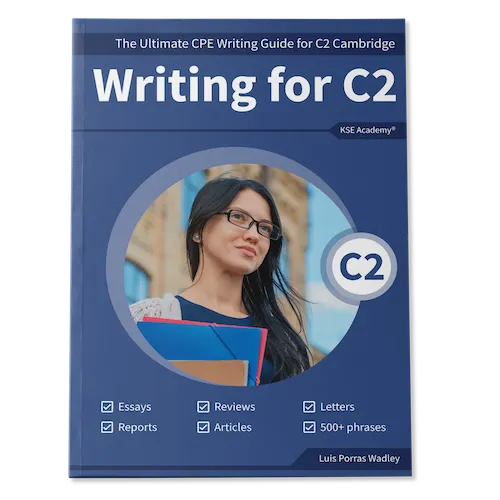
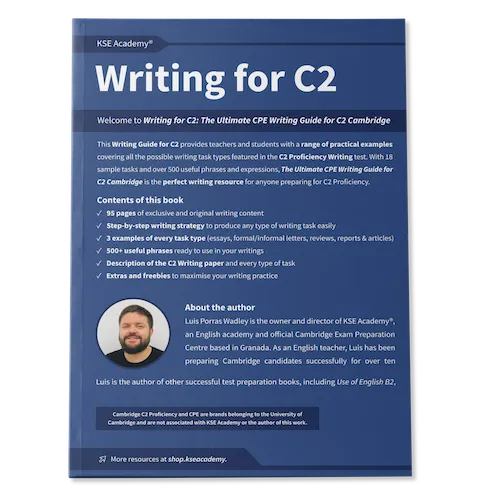
Table of contents
The C2 Writing is one of the most challenging parts of the Cambridge C2 Proficiency (CPE) exam, and the essay is the type of text that always appears in Part 1. Unlike other levels, the C2 essay requires you to demonstrate a near-native command of English, with the ability to summarise, evaluate and synthesise complex information in a sophisticated manner. In this article, I’m going to explain how to write an essay for C2 Proficiency step by step, with real examples and all the tips you need to achieve the best possible mark.
What parts does the C2 Proficiency Writing paper have?
The C2 Proficiency Writing consists of two parts, and you have a total of 1 hour and 30 minutes to complete both. Each part has its own specific characteristics and requirements:
- Writing Part 1: In this part, you will always have to write an essay. There are no options to choose from, so it is absolutely essential that you master this type of text. In the task, you are presented with two short texts (approximately 100 words each) that offer contrasting or complementary perspectives on a specific topic. Your job is to read both texts, identify the key points, summarise them, evaluate the arguments presented and express your own ideas on the topic. You should write between 240 and 280 words.
- Writing Part 2: In this part, you have 3 options to choose from, and the types of writing that may appear are the following: For Part 2, you should write between 280 and 320 words.
- Letter/Email (formal or informal)
- Report
- Review
- Article
As you can see, the essay in Part 1 is compulsory, so let’s dedicate all our efforts to understanding how to do it in the best possible way.
What is an essay?
An essay is a formal and academic text in which you analyse a topic, situation or problem from different points of view, considering multiple perspectives and presenting well-founded arguments. In the context of C2 Proficiency, the essay has a very important peculiarity: not only must you express your opinion, but you also have to summarise and evaluate two short texts that are provided in the instructions. That is, your essay must integrate the ideas from both texts, analyse them critically and then add your own reflections on the matter.
This type of essay is discursive, which means it must present a balanced and objective exploration of the topic in question, demonstrating your ability to synthesise complex information and communicate it in a clear and sophisticated way.
Differences between the C1 Advanced Essay and the C2 Proficiency Essay
Although in both C1 Advanced and C2 Proficiency Part 1 of the Writing consists of writing an essay, there are fundamental differences between the two that it’s important to know. The structure of the instructions and expectations are completely different:
| Aspect | C1 Advanced Essay | C2 Proficiency Essay |
|---|---|---|
| Input texts | There are no texts to read. You are given points or brief notes to develop. | Two texts of approx. 100 words each with contrasting or complementary perspectives. |
| Main task | Analyse and discuss 2 of the 3 points provided, plus one of your own. | Summarise and evaluate the key points from both texts and include your own ideas. |
| Word count | 220-260 words | 240-280 words |
| Focus | Discursive and argumentative, analysing different options or solutions. | Analytical and synthetic, integrating information from external sources and evaluating it critically. |
| Key skills | Argumentation, justification and expression of opinion. | Synthesis, critical evaluation, paraphrasing and comparison of perspectives. |
| Use of own words | Important, but not critical. | Essential. You must paraphrase and not copy from the original text. |
As you can see, the C2 essay requires not only that you express your opinion in a sophisticated way, but also that you demonstrate your ability to understand, summarise and evaluate complex information from academic texts. This makes it a greater challenge, but with adequate practice it is completely achievable.
How to Write an Essay for Cambridge C2 Writing
Now that you know what a C2 essay is and how it differs from the C1 essay, let’s look at the main characteristics your essay should have to achieve the highest mark:
- Purpose: The main objective of a C2 essay is to present a balanced and objective analysis of a topic, integrating and evaluating the perspectives presented in the two texts provided. It’s not simply about giving your opinion, but demonstrating your ability to synthesise complex information, evaluate arguments critically and communicate your own ideas in a sophisticated and well-founded manner.
- Tone and register: The essay is always a formal and academic text. You should use an objective and detached tone, avoiding colloquial expressions, contractions (such as don’t, can’t, won’t) and words that are too common or vague (such as things, stuff, get, nice, etc.). Your language should reflect a C2 level, with precise, sophisticated and varied vocabulary, as well as complex and well-controlled grammatical structures.
- Structure: A C2 essay must have a clear and well-organised structure. The most common is to include: In total, your essay should have between 4 and 5 well-differentiated paragraphs.
- Title: Although not mandatory, it is highly recommended to include a title that summarises the topic of the essay concisely.
- Introduction: Present the topic in a general way and establish the context of the debate or discussion.
- Development (2-3 paragraphs): This is where you summarise and evaluate the key points of each text. You can dedicate one paragraph to each perspective, or integrate both in a comparative analysis. It is essential that you use your own words and do not copy directly from the original texts.
- Conclusion: Summarise your final reflections, integrate your own opinion and close the essay in a coherent and elegant way.
- Opinion: Although in a discursive essay you must maintain a balanced and objective tone, it is also important that you express your own perspective. The most common approach is to do this in the last paragraph (the conclusion), but you can also integrate your opinion subtly throughout the development, provided it is well justified and founded on the arguments presented.
- Coherence and cohesion: Coherence is absolutely fundamental in a C2 essay. Your ideas must follow a logical and natural progression, connected by sophisticated connectors appropriate to the level (such as nevertheless, conversely, furthermore, consequently, on the flip side, etc.). The reader should be able to follow your line of argument effortlessly, feeling that each paragraph flows naturally to the next.
- Paraphrasing: One of the most important skills in the C2 essay is the ability to use your own words. The instructions always remind you «use your own words throughout as far as possible«. This means you cannot simply copy phrases from the original texts. You must reformulate them, using synonyms, different grammatical structures and varied expressions. This paraphrasing skill is key to demonstrating your command of the language at C2 level.
- C2-level language: Your essay must demonstrate sophisticated use of English. This includes:
- Advanced and precise vocabulary
- Complex grammatical structures (inversions, passives, advanced conditional structures, etc.)
- Variety of connectors and academic expressions
- Total control of grammar, with minimal or no errors
C2 Essay Example
Now that you know the main characteristics of a C2 essay, let’s look at a complete example. First, I’ll show you the task instructions and then a model answer with all its elements.
Sample C2 Essay Instructions
Read the two texts below.
Write an essay summarising and evaluating the key points from both texts. Use your own words throughout as far as possible, and include your own ideas in your answer.
Write your answer in 240-280 words.
The Case for Universal Basic Income
As automation and artificial intelligence continue to reshape the workforce, millions of jobs are at risk of disappearing. Universal Basic Income (UBI)—a regular, unconditional cash payment to all citizens—offers a potential solution to this looming crisis. Proponents argue that UBI would provide financial security, reduce poverty, and give people the freedom to pursue education, start businesses, or engage in creative endeavours without the constant pressure of survival. Moreover, by simplifying the welfare system, UBI could reduce bureaucracy and ensure that support reaches everyone who needs it, rather than getting lost in complex eligibility requirements.
The Pitfalls of Universal Basic Income
While Universal Basic Income may sound appealing in theory, critics warn that it could have devastating economic consequences. The cost of providing every citizen with a regular income would be astronomical, potentially requiring massive tax increases or cuts to essential public services like healthcare and education. Furthermore, there are concerns that UBI might discourage people from working, leading to labour shortages and reduced economic productivity. Sceptics also question whether a one-size-fits-all approach can truly address the diverse needs of different communities, arguing that targeted support programmes are more effective at helping those who genuinely need assistance.
Let’s analyse the main aspects of these instructions:
- Theme: The debate on Universal Basic Income, a highly topical social, economic and political issue.
- Two perspectives: The first text presents the arguments for UBI (financial security, poverty reduction, freedom, system simplification). The second text presents the arguments against (economic cost, possible work demotivation, lack of specificity).
- Your task: You must summarise the key points from both texts, evaluate the arguments presented and include your own ideas and reflections on the topic.
- Important considerations:
- You must use your own words, not copy directly from the texts
- You must maintain an objective and balanced tone
- You must integrate your own opinion in a well-founded way
- You must respect the word limit (240-280)
Sample C2 Essay Answer
Now let’s see how we would structure the answer to this task. The structure I’ll follow is as follows:
- Title: Brief and descriptive
- Introduction: Presentation of the topic and context of the debate
- Paragraph 2: Summary and evaluation of the arguments for UBI
- Paragraph 3: Summary and evaluation of the arguments against UBI
- Conclusion: Personal reflection and well-founded opinion
Universal Basic Income: A Viable Solution or Economic Fantasy?
As technological advancement accelerates and artificial intelligence increasingly permeates the labour market, the debate surrounding Universal Basic Income has intensified considerably. This policy proposal—which would provide unconditional regular payments to all citizens—has become a focal point in discussions about the future of work and social welfare systems.
Advocates of UBI present compelling arguments rooted in pragmatism and social justice. They contend that such a scheme would establish a financial safety net in an era where automation threatens to render vast swathes of the workforce obsolete. Beyond mere survival, proponents argue that UBI would liberate individuals to pursue entrepreneurial ventures, invest in their education, or engage in creative pursuits that might otherwise remain unaffordable luxuries. The streamlining of bureaucratic welfare systems represents an additional advantage, potentially ensuring more equitable distribution of resources.
Conversely, critics raise legitimate concerns about the economic viability of such an ambitious undertaking. The financial burden of providing every citizen with regular payments would be staggering, potentially necessitating either punitive taxation or the dismantling of crucial public services. Furthermore, sceptics question whether removing the incentive to work might inadvertently trigger labour shortages and diminish overall economic productivity. The one-size-fits-all nature of UBI also comes under scrutiny, with opponents arguing that more targeted interventions better address specific community needs.
On balance, whilst I acknowledge the fiscal challenges inherent in implementing UBI, I believe the concept warrants serious consideration as automation continues its inexorable advance. Perhaps a more nuanced approach—such as pilot programmes in regions particularly vulnerable to technological unemployment—could provide valuable empirical data whilst mitigating the risks of wholesale implementation. Ultimately, the discourse should focus less on whether UBI is perfect and more on how we can adapt our social safety nets to an increasingly automated world.
Let’s see why this essay is a good example of C2 Writing:
- Effective title: The title «Universal Basic Income: A Viable Solution or Economic Fantasy?» perfectly summarises the debate and generates interest in the reader.
- Clear introduction: The first paragraph establishes the context of the debate in a sophisticated way, using advanced vocabulary such as «accelerates, permeates, focal point«.
- Effective summary: Paragraphs 2 and 3 summarise the key points from both texts using constant paraphrasing. For example:
- Original text: «provide financial security» → Paraphrase: «establish a financial safety net«
- Original text: «jobs are at risk of disappearing» → Paraphrase: «automation threatens to render vast swathes of the workforce obsolete«
- Original text: «devastating economic consequences» → Paraphrase: «legitimate concerns about the economic viability«
- Critical evaluation: The essay doesn’t just summarise, but evaluates the arguments. For example, it describes the arguments for as «compelling arguments rooted in pragmatism and social justice» and the arguments against as «legitimate concerns«.
- Sophisticated connectors: C2-level connectors are used such as «beyond mere survival, conversely, furthermore, on balance, whilst, ultimately«.
- Complex grammatical structures: The essay includes advanced structures such as:
- Passive sentences: «would be provided«
- Structures with inversion: «Beyond mere survival, proponents argue that…«
- Complex conditional sentences: «such as pilot programmes… could provide valuable empirical data whilst mitigating…«
- C2-level vocabulary: The essay is full of sophisticated and precise vocabulary: «intensified considerably, focal point, pragmatism, liberate, swathes, obsolete, entrepreneurial ventures, staggering, punitive taxation, dismantling, inadvertently, inexorable advance, empirical data, wholesale implementation«, etc.
- Well-founded opinion: The conclusion presents a nuanced and well-argued personal opinion, proposing an intermediate solution (pilot programmes) that demonstrates critical thinking.
- Coherence and cohesion: Ideas flow naturally and logically from one paragraph to another, always maintaining the thread of the debate.
- Word count: The essay has 276 words, perfectly within the required range (240-280).
Another C2 Essay Example
So that you can practise and see different essay styles, here’s another complete example with instructions and answer.
Read the two texts below.
Write an essay summarising and evaluating the key points from both texts. Use your own words throughout as far as possible, and include your own ideas in your answer.
Write your answer in 240-280 words.
The Merits of Space Exploration
Investing in space exploration represents one of humanity’s most visionary endeavours. Beyond the immediate scientific discoveries, space programmes drive technological innovation that benefits society in countless ways—from satellite communications to medical advances. The search for life beyond Earth could fundamentally transform our understanding of existence itself, whilst the potential to mine asteroids for rare minerals or establish colonies on other planets offers solutions to resource scarcity and overpopulation. Moreover, space exploration inspires younger generations to pursue careers in science and engineering, fostering the innovation necessary to tackle future challenges.
Questioning Our Priorities in Space
Whilst the allure of space exploration is undeniable, we must question whether it should be a priority when pressing issues plague our own planet. The billions spent on rockets and space stations could instead address poverty, hunger, climate change, and inadequate healthcare systems. Critics argue that the benefits of space programmes are often overstated and primarily serve the egos of billionaires rather than humanity’s genuine needs. Furthermore, space exploration carries environmental costs, with rocket launches contributing to atmospheric pollution. Perhaps we should focus on making Earth sustainable and equitable before looking to the stars.
Space Exploration: Visionary Investment or Misguided Extravagance?
The allocation of substantial resources towards space exploration programmes remains one of the most contentious issues in contemporary policy debates. As humanity pushes the boundaries of cosmic discovery, questions arise about whether such ventures represent prudent investment or a distraction from more immediate terrestrial concerns.
Those championing space exploration emphasise its multifaceted benefits extending far beyond the realm of pure science. They highlight how space programmes catalyse technological breakthroughs with widespread earthly applications, from telecommunications infrastructure to medical innovations. The prospect of discovering extraterrestrial life or harnessing celestial resources presents tantalising possibilities for addressing fundamental questions about our existence and future sustainability. Additionally, advocates note the inspirational effect such endeavours have on aspiring scientists and engineers, cultivating the intellectual capital necessary for future progress.
Nevertheless, detractors raise compelling ethical questions about resource allocation. With billions channelled into cosmic ventures, critics contend that such funds would yield more immediate humanitarian dividends if redirected towards combating poverty, environmental degradation, or healthcare inadequacies. The argument that space exploration primarily serves the vanity projects of wealthy entrepreneurs rather than collective human welfare carries considerable weight. Furthermore, the environmental footprint of rocket launches undermines claims that these programmes benefit humanity’s long-term prospects.
In my assessment, this debate presents a false dichotomy. Rather than viewing space exploration and addressing earthly challenges as mutually exclusive, we should recognise how technological advances from space programmes often yield solutions to terrestrial problems. However, greater transparency regarding costs and benefits, alongside stricter environmental regulations for space activities, would be necessary to justify continued investment in this arena.
This second example demonstrates how you can approach a completely different topic whilst maintaining the same quality and structure. Note how different expressions and vocabulary are used, but the same level of sophistication, coherence and critical analysis that characterises a C2 essay is maintained.
Will I be penalised if I write under 240 words or over 280 words?
This is undoubtedly one of the most frequent questions students ask me, and the answer is: it depends. Examiners don’t count words word by word to penalise you automatically if you go over or under. However, the recommended word count (240-280 for the C2 essay) is carefully calculated so that you can fulfil all the requirements of the task completely and in a balanced way.
If you write less than 240 words, it’s very likely that your essay will lack the necessary depth. You may not have developed the arguments from both texts sufficiently, your analysis may be too superficial, or your conclusion may be too brief. All of this will negatively affect your score on the Content and Communicative Achievement criteria.
On the other hand, if you go considerably over the 280 words (say, 320, 350 or more), you’re probably including irrelevant information, unnecessary repetitions or details that don’t add value to your argument. This can make your essay lose focus and clarity, which would also negatively affect your mark.
My recommendation is that you try to stay within the recommended range, although it’s perfectly fine if you go over by about 10-15 words. The most important thing is that your essay meets all the requirements of the task, is well organised, is coherent and demonstrates a C2 level of English. If you meet all that and have 290 words instead of 280, don’t worry at all.
Explainer Video: How to Write a C2 Essay
The Best Guide for C2 Proficiency Writing with Examples and Useful Expressions
If you’ve found this article useful and want to take your preparation to the next level, I strongly recommend you take a look at my book «Writing for C2: The Ultimate CPE Writing Guide». This comprehensive guide has been specifically designed to help you master all the tasks in C2 Writing, not just the essay.
In this book you’ll find:
- 3 complete essay examples with detailed analysis
- 3 examples of each type of Part 2 Writing: Letters/Emails (formal and informal), Reports, Reviews and Articles
- More than 500 useful expressions organised by task type, ready to use in your writings
- Step-by-step strategy for approaching each type of task with confidence
- Complete description of the Writing Paper and how it’s assessed
- Sample mark sheet so you can self-assess your own writings
This book is perfect whether you’re a student preparing for the exam or a teacher looking for quality materials for your classes. You can get your copy at the C2 Proficiency Writing Guide.
I hope you’ve found this article useful and that you now have a much clearer understanding of how to write an essay for C2 Proficiency. Remember that the key lies in constant practice, reading good examples and familiarising yourself with the type of vocabulary and structures expected at this level. With dedication and the right resources, you’ll achieve the mark you deserve.
Best of luck with your preparation and see you in the next article! Don’t forget to keep smiling! 🙂