
C2 Proficiency (CPE) Writing: Complete Guide with Examples [Updated 2026]
Complete Guide for the Writing C2 Proficiency. Discover all types of CPE Writing with real examples, the best tips, and assessment descriptors.

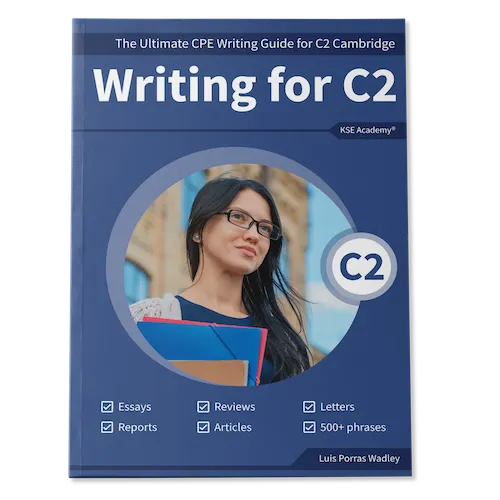
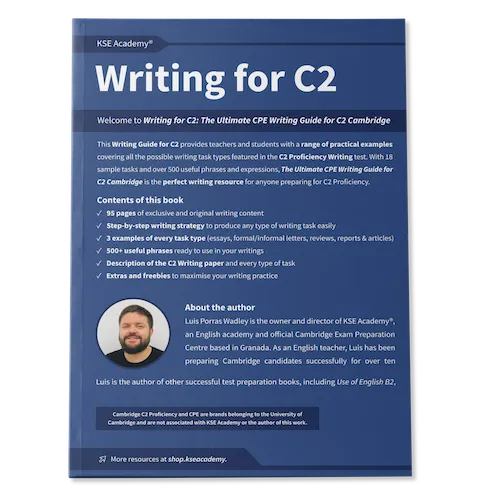
Table of contents
C2 Proficiency (CPE) Writing is the written production test of the highest level of Cambridge Assessment English examinations. As you’ll already know, C2 Proficiency Writing is just one of the 4 parts of the C2 Proficiency exam, formerly known as CPE (Certificate of Proficiency in English). Besides Writing, to complete a C2 Proficiency exam you must also complete the Reading and Use of English, Listening and Speaking parts. However, from my perspective as an English teacher and Cambridge Assessment English oral examiner, C2 Proficiency Writing is one of the most demanding parts, but also one of the most rewarding to master. For this reason, in this article I’m going to explain exactly what C2 Proficiency (CPE) Writing is like and I’m going to show you Writing examples for each type of task. Let’s get started!
C2 Writing: What is C2 Level Written Production
The name of the exam we’re talking about, C2 Proficiency, clearly specifies what level of English is expected of you. In this case, C2 level is the highest level established by the Common European Framework of Reference for Languages (CEFR). C2 level corresponds to command of the language comparable to that of an educated native speaker. As the CEFR specifies, a person with C2 level in written production:
Can summarise information from different spoken and written sources, reconstructing arguments and accounts in a coherent presentation.
Common European Framework, p. 24
At a general level, we can already see an important qualitative leap compared to lower levels. The phrases «summarise information from different sources» and «reconstructing arguments and accounts» are exclusive characteristics of this level. It is at C1, just below C2, where «complex subjects» is first mentioned, so it’s evident that at C2 level candidates will also deal with complex subjects in their writing.
If we delve deeper into the written production section of the CEFR, we’ll see that a candidate demonstrating C2 level:
- In overall written production:
- Can write clear, smoothly flowing, complex texts in an appropriate and effective style and a logical structure which helps the reader to find significant points.
- In creative writing:
- Can write clear, smoothly flowing, and fully engrossing stories and descriptions of experience in a style appropriate to the genre adopted.
- In reports and essays:
- Can produce clear, smoothly flowing, complex reports, articles or essays which present a case, or give critical appreciation of proposals or literary works. Can provide an appropriate and effective logical structure which helps the reader to find significant points.
As you can appreciate, C2 level Writing is tremendously demanding, with reader expectations that aim very high. This level represents complete mastery of the written language.
Cambridge’s C2 Proficiency exam is fully aligned with this C2 level of the Common European Framework, so in CPE Writing you’re expected to demonstrate all these linguistic competences.
What is C2 Proficiency Writing Like
C2 Proficiency Writing follows the pattern of other Cambridge exams, although adapted to the demands of the highest level. Candidates must write two texts in 1 hour and 30 minutes. The first text must be between 240 and 280 words, whilst the second must be between 280 and 320 words. These two texts are of different types, as we’ll see later, and the objective is for you to demonstrate a series of written linguistic mechanisms characteristic of C2 level Writing.
Unlike B2 First and C1 Advanced, in C2 Proficiency the first part of Writing has a special characteristic: you must read two input texts (of approximately 100 words each) and, based on them, write an essay that summarises, evaluates and integrates the ideas from both texts along with your own reflections.
Now let’s look at the different C2 Proficiency (CPE) Writing types with examples of each.
C2 Proficiency Writing Types
These are the different types of task you can encounter in the current CPE Writing:
- Part 1
- Essay (compulsory)
- Part 2 (choose 1 of 3 options)
- Informal Letter
- Formal Letter
- Review
- Article
- Report
These Writing types already appeared at lower levels (B2 First and C1 Advanced), but in C2 Proficiency a much higher level of linguistic sophistication, precision and naturalness is expected. Let’s look at each in detail.
C2 Proficiency Writing: Part 1 – Essay
In the first part of this Writing exam, you’ll need to write a discursive essay. In this part you have no choice: all candidates must write an essay compulsorily.
What’s particular about the C2 Proficiency essay is that you’re presented with two input texts (of approximately 100 words each) that offer contrasting or complementary perspectives on a specific topic. Your task consists of reading both texts, identifying the key points of each, and writing an essay that summarises these points, evaluates the arguments presented and expresses your own ideas on the topic. You’re expected to demonstrate C2 level linguistic competence by expanding on and integrating the language and ideas from the input texts into your writing.
A C2 Proficiency essay is a formal Writing type in which you’re expected to present a balanced, objective and sophisticated analysis of a complex topic, using advanced lexical and grammatical structures, as well as connectors appropriate for C2 level.
Below you can see what the instructions for an essay in C2 Proficiency look like:
Read the two texts below.
Write an essay summarising and evaluating the key points from both texts. Use your own words throughout as far as possible, and include your own ideas in your answer.
Write your answer in 240-280 words.
The Rise of Remote Work: A New Era of Productivity?
The shift towards remote work has been hailed as a revolutionary change in how we approach employment. Proponents argue that working from home eliminates lengthy commutes, reduces overhead costs for businesses, and allows employees greater flexibility to balance their professional and personal lives. Studies have shown that many remote workers report higher levels of job satisfaction and productivity, as they can structure their day around their peak performance hours and work in environments tailored to their preferences. Moreover, companies can tap into a global talent pool without geographical constraints, fostering diversity and innovation.
The Hidden Costs of Working from Home
Despite the apparent benefits, remote work presents significant challenges that cannot be overlooked. The blurring of boundaries between professional and personal life often leads to burnout, as employees find it difficult to «switch off» from work. The absence of face-to-face interaction can hinder collaboration, creativity, and the spontaneous exchange of ideas that often occurs in traditional office settings. Furthermore, remote work can exacerbate feelings of isolation and disconnect employees from company culture, potentially affecting team cohesion and long-term employee retention. Not everyone has access to adequate home office facilities, creating inequalities in working conditions.
As you can see, this is a Writing task that requires carefully reading both texts, identifying the key arguments, and then writing an essay that not only summarises these points, but also critically evaluates them and contributes your own substantiated perspective. All this in 240-280 words and with C2 level English.
C2 Proficiency Writing: Part 2
In this second part of Writing, you must write another text of 280-320 words, but this time you can choose between 3 different tasks. Although only 3 options appear in the exam, up to 5 different C2 Writing types can be presented: informal letter, formal letter, review, article or report.
Let’s look at an example of each C2 Proficiency Writing type, that is, the instructions.
C2 Writing: Informal Letter
Informal letters in C2 Proficiency are typically written to friends, family or close acquaintances. Although the tone is informal, you’re expected to demonstrate complete command of informal register in English, including natural idiomatic expressions, appropriate phrasal verbs and a fluid, spontaneous style.
A close friend from university, whom you haven’t seen for several years, has written to you saying they’re considering a major career change. They’re currently working in corporate law but are thinking about retraining as a therapist. They’ve asked for your honest opinion about whether this is a sensible decision, given their personality and circumstances.
Write a letter responding to your friend’s request.
Write your answer in 280-320 words in an appropriate style.
In this example, you’re asked to write an informal letter to a close friend giving your honest opinion about an important career change. Although it’s informal, you must demonstrate the ability to express complex ideas naturally, offer nuanced advice and maintain an appropriate tone for the relationship and the delicate subject being addressed.
C2 Writing: Formal Letter
Formal letters in C2 Proficiency can be application letters, complaint letters, enquiry letters, or letters addressed to newspaper editors, authorities, organisations, etc. The language must be sophisticated, precise and appropriately formal, demonstrating complete command of formal register conventions in English.
You recently read an article in a national newspaper arguing that governments should impose significant taxes on sugary drinks and fast food to combat obesity. While you agree that obesity is a serious public health issue, you believe the article’s proposed solution is overly simplistic and potentially counterproductive.
Write a letter to the editor presenting your perspective on this issue.
Write your answer in 280-320 words in an appropriate style.
In this case, you’re asked to write a formal letter to the editor of a newspaper presenting your perspective on a public health issue. You must demonstrate the ability to articulate complex arguments persuasively, maintain a respectful but firm tone, and structure your reasoning logically and convincingly, all with impeccable formal register.
C2 Writing: Review
A review in C2 Proficiency consists of critically evaluating a cultural product (exhibition, concert, restaurant, app, service, etc.). A sophisticated analysis is expected that goes beyond simple description, including critical evaluation, relevant comparisons and substantiated recommendations. The tone is usually standard or semi-formal.
An international arts and culture magazine is publishing a special edition on innovative museum experiences. They have invited readers to submit reviews of museums that challenge traditional exhibition formats or use technology in creative ways to engage visitors.
Write a review of an innovative museum you have visited, evaluating how effectively it engages visitors and whether it succeeds in making its subject matter accessible and compelling.
Write your answer in 280-320 words in an appropriate style.
This task asks you to write a review of an innovative museum you’ve visited. You must demonstrate the ability to describe the experience vividly and attractively, critically evaluate the museum’s effectiveness in engaging visitors, and offer a substantiated recommendation. The language must be sophisticated but accessible, with a tone that combines information and entertainment.
C2 Writing: Article
An article in C2 Proficiency is a text intended to inform, entertain or persuade readers about a specific topic of interest. Unlike a review, which focuses on evaluating something specific, an article has a broader scope and can explore ideas, trends, personal experiences or social issues. The register is usually standard.
An international lifestyle magazine is running a series called «Life Lessons from Unexpected Places». They are looking for articles in which writers reflect on a significant life lesson they learned from an unlikely source or experience.
Write an article describing an unexpected experience that taught you an important life lesson, explaining what you learned and how it has influenced your perspective or behaviour.
Write your answer in 280-320 words in an appropriate style.
In this example, you’re asked to write a reflective article about a life lesson learned from an unexpected source. You must demonstrate the ability to narrate attractively, reflect deeply on the meaning of the experience, and connect with readers genuinely. The style must be fluid, natural and engrossing, with a balance between the personal and the universal.
C2 Writing: Report
A report in C2 Proficiency is a formal, objective text that analyses a situation, evaluates options or makes recommendations based on factual information. Reports are usually addressed to superiors, organisations or committees, and must present information clearly, in a structured and professional manner, using sections with subheadings.
Your company is considering implementing a comprehensive employee wellbeing programme. As part of the human resources team, you have been asked to research different approaches to workplace wellbeing and produce a report evaluating their potential effectiveness and suitability for your organisation.
Write a report outlining different approaches to employee wellbeing, evaluating their advantages and potential challenges, and making recommendations for your company.
Write your answer in 280-320 words in an appropriate style.
This task asks you to write a professional report on workplace wellbeing programmes. You must demonstrate the ability to present information in a structured and objective manner, evaluate options critically, and make substantiated recommendations. The language must be formal, precise and professional, with a clear structure that facilitates reading (title, introduction, sections with subheadings, conclusion/recommendations).
C2 Proficiency (CPE) Writing Examples
In this section we’re going to see a C2 Writing response example for each type of task. The purpose is for you to familiarise yourself with each Writing type and get an idea of what’s expected of you in the exam. I’ve created these examples trying to reflect a solid C2 level, so you know what your Writing tasks should look like as a minimum. Remember that these examples respond to the instructions we saw in the previous section.
C2 Essay Example
A C2 Proficiency essay must summarise and evaluate the key points from both input texts, integrating these ideas with your own reflections in a coherent and sophisticated manner. Below you have a response to the essay about remote work we saw earlier:
Remote Work: Striking the Balance Between Flexibility and Connection
The debate surrounding remote work encapsulates one of the most significant transformations in contemporary employment practices. While the first text extols the virtues of working from home—citing enhanced productivity, improved work-life balance, and access to global talent—the second highlights often-overlooked drawbacks, including burnout, diminished collaboration, and widening inequalities in working conditions.
Both perspectives hold considerable merit. It is undeniable that remote work has liberated many employees from the tyranny of lengthy commutes and inflexible schedules, enabling them to craft working environments conducive to their individual needs. The ability to draw upon talent regardless of geographical location has indeed fostered unprecedented diversity in many organisations.
However, the second text rightly draws attention to the more insidious consequences of this shift. The erosion of boundaries between professional and personal life represents a genuine threat to wellbeing, whilst the loss of spontaneous, face-to-face interaction can stifle the very innovation that remote work proponents champion. Moreover, the assumption that everyone possesses adequate facilities for home working reveals a troubling blindness to socioeconomic disparities.
In my view, the future lies not in wholesale adoption of either model, but in embracing hybrid approaches that harness the benefits of remote work whilst mitigating its drawbacks. Organisations must consciously cultivate connection through regular in-person gatherings, establish clear boundaries to prevent burnout, and ensure equitable access to resources. Only through such nuanced implementation can we realise remote work’s potential without sacrificing the human elements that make collaborative endeavour meaningful.
As you can observe, this essay presents a balanced analysis of both perspectives, critically evaluating the arguments from each text and integrating a substantiated personal perspective. The language is sophisticated and precise, with complex grammatical structures and advanced vocabulary («extols the virtues», «tyranny of lengthy commutes», «more insidious consequences», «troubling blindness to socioeconomic disparities»). The structure is clear and logical, making it easy for the reader to follow the reasoning.
C2 Informal Letter Example
Below you have an informal letter example responding to the task about the friend considering a career change. Notice how, despite the informal and close tone, the language demonstrates complete command of English and addresses the topic with the sensitivity and depth it requires:
Dear Sarah,
It was absolutely lovely to hear from you after all this time, even if the circumstances are rather momentous! I’ve been mulling over your news about potentially retraining as a therapist, and I wanted to give you my honest take on it.
First off, I can absolutely see why you’re drawn to this path. You’ve always had this extraordinary ability to make people feel heard—even back at uni, you were the one we’d all turn to when things got rough. That quality is worth its weight in gold in therapy. And let’s be frank: I’ve heard you express frustration with corporate law for years now. The question isn’t whether you’d be good at therapy—I’m convinced you would be—but whether you’re prepared for what the transition entails.
Here’s where I’d urge caution. Retraining means a substantial financial investment and several years of study, all whilst your income drops significantly. Given that you’ve mentioned wanting to buy a house soon, the timing might be tricky. There’s also the emotional toll to consider. Therapy training can be gruelling, dredging up personal issues you might not be expecting to confront.
That said, life’s too short to stay in a career that’s draining your soul. If you’re seriously considering this, why not explore it further before committing? You could volunteer with a helpline, perhaps, or shadow a practising therapist to get a realistic sense of the day-to-day realities.
Whatever you decide, you know I’m in your corner. This is ultimately about what will make you feel fulfilled, and only you can determine that. Let’s meet up soon for a proper catch-up—I’d love to hear more about what’s prompted all this.
All my love,
Rachel
This example demonstrates complete command of informal register in English. The tone is warm and genuine («It was absolutely lovely», «Here’s where I’d urge caution», «life’s too short»), with natural idiomatic expressions («worth its weight in gold», «let’s be frank», «I’m in your corner»). Despite the informality, the content addresses complex ideas with maturity and sensitivity, offering a balanced perspective and practical advice. The structure is clear, with appropriate greeting and sign-off, opening paragraph, development of ideas and closing.
C2 Formal Letter Example
Below you have a formal letter example to the editor of a newspaper on the subject of taxes on unhealthy foods. Notice the sophisticated formal register and clear argumentative structure:
Dear Editor,
I write in response to your recent article advocating substantial taxation on sugary drinks and fast food as a means of combating obesity. Whilst I wholeheartedly acknowledge the gravity of the obesity crisis, I believe the proposed solution merits more critical scrutiny than your article afforded it.
The fundamental flaw in this approach lies in its assumption that price alone drives dietary choices. In reality, food selection is influenced by a complex interplay of factors: accessibility, nutritional literacy, time constraints, and cultural norms. For low-income families already struggling financially, such taxes would constitute a regressive burden, effectively punishing those with the fewest resources and alternatives. Research consistently demonstrates that taxation without complementary measures—improved nutrition education, better access to affordable healthy options, and restrictions on junk food marketing—yields limited long-term behavioural change.
Moreover, this punitive approach risks stigmatising individuals struggling with obesity rather than addressing the systemic issues that perpetuate unhealthy diets. The food industry’s aggressive marketing, particularly to children, and the proliferation of «food deserts» in deprived areas represent structural problems demanding structural solutions.
A more effective strategy would involve redirecting any revenue from such taxes into subsidising fresh produce, funding community cooking programmes, and implementing stricter regulations on food advertising. Without these supportive measures, taxation becomes merely a revenue-raising exercise that does little to address the root causes of poor nutrition.
I urge policymakers to adopt a more nuanced, compassionate approach that empowers rather than penalises those most affected by the obesity epidemic.
Yours faithfully,
Dr. James Thompson
This formal letter demonstrates exceptional command of formal register in English. The language is sophisticated and precise («I wholeheartedly acknowledge the gravity», «merits more critical scrutiny», «regressive burden», «complex interplay of factors»). The argumentation is structured and convincing, presenting a clear position supported by logical reasoning. The tone is respectful but firm, appropriate for a letter to the editor. The structure includes formal greeting and sign-off, introduction establishing context, development of arguments and conclusion summarising the position.
C2 Review Example
Below you have a review example of an innovative museum. Notice how it combines vivid description, critical analysis and substantiated recommendation with a tone that balances information and entertainment:
The Museum of Tomorrow: Where Technology Meets Contemplation
Rio de Janeiro’s Museum of Tomorrow (Museu do Amanhã) represents a paradigm shift in how museums engage with visitors. Rather than merely displaying artefacts, this striking waterfront building invites visitors on an immersive journey exploring humanity’s relationship with the planet and our potential futures.
What distinguishes this museum is its masterful integration of technology and narrative. Upon entry, visitors receive an electronic chip that personalises their experience throughout the five main areas: Cosmos, Earth, Anthropocene, Tomorrow, and Now. Interactive installations respond to visitors’ choices, creating a bespoke journey through complex themes including climate change, biodiversity, and technological advancement.
The Anthropocene section proves particularly compelling, employing floor-to-ceiling projections and haptic technology to convey humanity’s environmental impact with visceral immediacy. Rather than lecturing, it provokes genuine contemplation about individual and collective responsibility. The Tomorrow section challenges visitors to envision different futures based on present-day decisions—an approach that transforms passive observation into active engagement.
However, the museum’s reliance on technology occasionally overshadows content. Some installations prioritise spectacle over substance, and technical glitches can disrupt the carefully crafted narrative flow. Moreover, the personalisation feature, whilst innovative, sometimes creates bottlenecks at popular exhibits.
Nevertheless, the Museum of Tomorrow succeeds admirably in making urgent global issues accessible and compelling. Its strength lies not in providing definitive answers but in fostering the critical thinking necessary for visitors to formulate their own responses to civilisation’s most pressing challenges.
For anyone seeking a museum experience that challenges conventions and stimulates meaningful reflection rather than simply educating, this is an unmissable destination.
This review demonstrates sophisticated and balanced analysis. The language is rich and varied («paradigm shift», «visceral immediacy», «provokes genuine contemplation», «prioritise spectacle over substance»), with vivid descriptions that bring the experience to life. The structure is clear, with an attractive title, introduction establishing context, development paragraphs analysing different aspects, critical evaluation of limitations, and conclusion with substantiated recommendation. The tone is informative but accessible, with a fluid style that maintains reader interest.
C2 Article Example
Below you have an article example about a life lesson learned from an unexpected source. Notice how it combines personal narrative, deep reflection and a universal message with a fluid, natural style:
What My Neighbour’s Garden Taught Me About Patience
For years, I was the epitome of impatience. Everything needed to happen immediately—career advancement, fitness goals, even friendships. I’d become so fixated on destinations that I’d forgotten how to appreciate journeys. Then I met Margaret, my eighty-three-year-old neighbour, and her extraordinary garden.
Margaret’s garden wasn’t remarkable for its size or exotic plants. What made it special was the meticulous care she lavished upon it, day after day, year after year. I’d watch her from my window, tending to seedlings that wouldn’t bloom for months, pruning trees whose benefits she might never see.
One afternoon, curiosity got the better of me. «Doesn’t it frustrate you,» I asked, «investing so much time in something with such delayed gratification?» Her response has stayed with me ever since. «My dear,» she said, «the garden isn’t the destination—it’s the companion. Each day I spend here is its own reward.»
That simple observation fundamentally altered my perspective. I’d been so focused on outcomes that I’d rendered the present merely instrumental—a means to future ends. Margaret’s garden embodied a different philosophy: one that found value in process, pleasure in care itself, and meaning in the daily ritual rather than the eventual harvest.
Since then, I’ve tried to cultivate my own version of Margaret’s patience. Rather than berating myself for not having achieved certain goals, I’ve learnt to appreciate the incremental progress. I’ve discovered that most worthwhile endeavours—mastering a skill, building relationships, personal growth—resemble gardening more than purchasing: they require sustained attention, can’t be rushed, and unfold according to their own timeline.
Margaret has since moved to assisted living, but her lesson remains rooted firmly in my life. In our culture of instant gratification, perhaps we all need a garden to tend—a reminder that some of life’s richest rewards come not from arriving quickly but from travelling attentively.
This article demonstrates a fluid, natural and engrossing style. The narrative is attractive and personal («For years, I was the epitome of impatience», «curiosity got the better of me»), with deep reflections that connect the personal with the universal. The language is sophisticated but accessible («meticulous care she lavished», «rendered the present merely instrumental», «unfold according to their own timeline»). The narrative structure is effective, with an engaging introduction, development that explores the experience and its meaning, and conclusion that closes with a universal reflection. The tone balances the anecdotal with the reflective, creating a text that informs, entertains and inspires.
C2 Report Example
Below you have a report example on workplace wellbeing programmes. Notice the formal structure with subheadings, objective and professional language, and clear presentation of information and recommendations:
Employee Wellbeing Programme: Evaluation and Recommendations
Introduction
This report examines various approaches to workplace wellbeing programmes, evaluating their effectiveness and suitability for our organisation. The findings are based on research into current best practices and consideration of our company’s specific context and employee demographic.
Holistic Wellness Programmes
Comprehensive programmes addressing physical, mental, and financial wellbeing have demonstrated significant benefits. Companies implementing such schemes report reduced absenteeism (15-25%), improved employee satisfaction, and enhanced productivity. These programmes typically include gym memberships, mental health support, nutrition guidance, and financial literacy workshops.
However, comprehensive programmes require substantial investment—both financial and administrative—and risk overwhelming employees with options. There is also evidence that utilisation rates vary considerably, with certain demographics engaging more than others, potentially exacerbating existing inequalities.
Flexible Working Arrangements
Flexible working—including remote options, flexitime, and compressed working weeks—has emerged as one of the most valued wellbeing initiatives. Research indicates that flexibility significantly improves work-life balance and reduces stress, particularly for employees with caring responsibilities.
The challenge lies in ensuring equity across different roles, as not all positions permit remote working. There is also potential for flexible arrangements to blur boundaries between work and personal life, inadvertently increasing rather than reducing stress.
Mental Health Support
Dedicated mental health resources, including confidential counselling services and mental health first aiders, address an increasingly recognised workplace need. Such initiatives help destigmatise mental health issues and provide crucial support.
The limitation is that these are predominantly reactive rather than preventive measures, and some employees remain reluctant to utilise them due to lingering stigma.
Recommendations
Based on this analysis, I recommend implementing a phased approach combining flexible working arrangements (which involve minimal cost and deliver high value) with enhanced mental health support. Subsequently, we should introduce selected elements of holistic wellness programmes based on employee feedback gathered through surveys.
This strategy balances cost-effectiveness with impact whilst ensuring our approach remains responsive to employees’ actual needs rather than assumed preferences.
This report demonstrates a clear professional structure with title, subheadings for each section (Introduction, development sections, Recommendations), and formal, objective language. The presentation of information is balanced, evaluating both advantages and limitations of each approach («However», «The challenge lies in», «The limitation is that»). The language is precise and appropriate for a professional context («substantial investment», «inadvertently increasing», «predominantly reactive rather than preventive», «balances cost-effectiveness with impact»). The recommendations are specific, substantiated and practical.
C2 Proficiency (CPE) Writing: How It’s Assessed
Any C2 Proficiency Writing task is assessed according to 4 fundamental assessment criteria, just as in B2 First and C1 Advanced. These are: Content, Communicative Achievement, Organisation and Language. Each of these criteria is assessed by trained Cambridge English examiners, and a band scale from 0 to 5 is used. Let’s look at what each criterion consists of:
- Content: This section assesses whether you’ve completed the task satisfactorily, that is, whether you’ve done everything that was asked. In the case of the Part 1 essay, this means you’ve adequately summarised the key points from both texts, evaluated the arguments presented, and included your own ideas relevantly. In Part 2, it means you’ve addressed all the points specified in the instructions and that the content is appropriate for the purpose and target reader. To obtain a good score, your content must be relevant, fully developed and adequately inform the reader.
- Communicative Achievement: This criterion assesses how appropriate your Writing is with respect to the proposed task, particularly in terms of register and tone. Examiners consider whether you’ve used language appropriate for the specific purpose and audience of the task. For example, if you’re writing a formal letter to the editor of a newspaper, the register must be formal and the tone respectful but firm. If it’s an informal letter to a friend, the language must be natural and close but without ceasing to demonstrate C2 level. At this level, complete control of the conventions of the genre (essay, letter, review, article, report) and sophisticated use of language to achieve the desired effect on the reader is expected.
- Organisation: This section assesses how you’ve structured your Writing and whether it presents logical and coherent progression. Examiners analyse whether your text is well organised into appropriate paragraphs, whether ideas flow naturally and logically, and whether you’ve used appropriate cohesion mechanisms (connectors, references, lexical substitution, etc.) to link sentences and paragraphs. At C2 level, impeccable organisation is expected that facilitates reader comprehension, with an effective logical structure that helps the reader identify significant points. Texts must flow naturally and sophisticatedly, with smooth transitions between ideas.
- Language: In this section, your grammar, vocabulary and linguistic accuracy are assessed. Examiners analyse the range and complexity of the grammatical structures you use, the richness and precision of your vocabulary, and the degree of correctness in your use of the language. At C2 level, consistent command of complex grammatical structures, broad, precise and sophisticated vocabulary, and infrequent errors that, when they occur, barely affect communication are expected. Language must be natural, idiomatic and appropriate for C2 level, demonstrating control of the language comparable to that of an educated native speaker.
The scoring system uses bands ranging from 0 to 5, where:
- Band 0: Assigned when the response doesn’t meet any of the task requirements.
- Bands 1 and 2: Indicate that the response doesn’t reflect the competence expected of C2 Proficiency level.
- Band 3: Can be considered threshold level performance that meets the minimum criteria for passing.
- Bands 4 and 5: Represent good and excellent performance respectively, demonstrating solid or exceptional command of C2 level.
Scores are assigned as whole numbers, without the possibility of half bands. Each criterion is assessed independently, so it’s possible to obtain different bands in each of the four criteria.
Tips for C2 Proficiency (CPE) Writing
As with other parts of C2 Proficiency, for Writing there are essential strategies that will help ensure your writing meets the requirements examiners are looking for. However, since we’re talking about the highest level of Cambridge certification, these tips go beyond the basics. Below I present my fundamental recommendations:
- Read the essay input texts multiple times and with analytical attention. In Writing Part 1, you must summarise, evaluate and integrate ideas from two texts. Don’t rush. Read each text at least twice: first to grasp the general idea, and then to identify specific arguments and tone. Underline or note key points. Remember that it’s not simply about paraphrasing the texts, but about synthesising their ideas, evaluating them critically and adding your own substantiated perspective. The ability for critical analysis is fundamental at this level.
- Plan meticulously before writing. At C2 level, planning is absolutely crucial. Dedicate at least 5-10 minutes to planning each task. For the essay, decide which key points from each text you’ll include, how you’ll relate them, and what perspective of your own you’ll contribute. For Part 2 tasks, outline the complete structure: introduction, development (with the specific points you must cover) and conclusion. Good planning guarantees coherence, balance between paragraphs, and that you don’t forget any required point. Additionally, it will help you stay within the word limit.
- Master the register and conventions of each text type. At C2 level, it’s not enough to write well in English; you must demonstrate complete control of the conventions of each genre. An essay must sound academic and objective; an informal letter must be natural and spontaneous but sophisticated; a formal letter must be polite, precise and appropriately distant; a report must be structured and professional; an article must be attractive and informative; and a review must balance description, analysis and recommendation. Read examples of each type to internalise their characteristics. Examiners particularly value the ability to adapt your style to the specific context.
- Demonstrate linguistic range and sophistication, but without artificiality. At C2 you’re expected to use precise and varied vocabulary, complex grammatical structures (inversion, clefts, complex passives, advanced modals, etc.), and sophisticated connectors. However, the language must sound natural, not forced. Don’t use obscure words just to use difficult vocabulary; use the most precise and appropriate language to express exactly what you want to say. Real sophistication is demonstrated in precision, naturalness and communicative effectiveness, not in the use of recherché words that don’t fit the context.
- Develop your ideas with depth and nuance. At C2 level it’s not enough to present ideas; you must develop them fully, with nuance, relevant examples, and consideration of different perspectives when appropriate. Avoid simplistic statements or unsubstantiated generalisations. For example, instead of saying «Remote work is good because people can work from home», a C2 writer would say: «While remote work offers undeniable advantages in terms of flexibility and reduced commuting time, its benefits are unevenly distributed and depend significantly on individual circumstances, adequate home facilities, and the nature of one’s work.» The ability to express complex ideas with precision and nuance is a defining characteristic of C2 level.
- Manage your time wisely. You have 90 minutes for two tasks. A reasonable distribution would be: 40-45 minutes for Part 1 (including reading, planning, writing and revision) and 45-50 minutes for Part 2 (including planning, writing and revision). Don’t devote too much time to one task at the expense of the other. If you get stuck on an idea, leave it temporarily and continue; you can return later if you have time left. The important thing is to complete both tasks to a good standard.
- Revise meticulously. Reserve at least 5 minutes at the end of each task to revise. Read your text as if you were the examiner. Look for agreement errors, incorrect verb tenses, spelling errors, inadequate punctuation, and sentences that don’t make sense or are incomplete. Also check that you’ve covered all required points, that the structure is logical, that you’ve used appropriate connectors, and that the register is consistent and appropriate. At C2 level, errors must be scarce, so each revision can make the difference between a band 3 and a band 4 or 5.
- Read extensively in English to absorb models of sophisticated writing. The best way to improve your Writing at C2 level is to constantly read well-written texts in English: quality articles in newspapers such as The Guardian, The Economist or The New York Times; academic essays; novels by recognised authors; professional reviews. Pay attention to how these writers structure their arguments, how they develop complex ideas, what vocabulary they use, how they vary their sentence structure. Constant exposure to high-quality English is fundamental to developing the linguistic sensitivity necessary for C2 level.
Guide to C2 Proficiency Writing with Examples and Useful Expressions
If you want to take your C2 Proficiency Writing preparation to the next level, I strongly recommend the C2 Proficiency Writing book I’ve written specifically for students preparing for this exam.
Writing C2: The Ultimate CPE Writing Guide for C2 Cambridge is a comprehensive guide of over 90 pages that covers all the Writing types that appear in the exam: essays, formal/informal letters, reviews, reports and articles. In it you’ll find:
- Detailed description of C2 Writing Part 1 and Part 2
- Complete description of each Writing task type
- 3 examples of each task type (essays, formal letters, informal letters, reviews, reports and articles), all at authentic C2 level
- Over 500 useful expressions ready to use in your writings, organised by task type and communicative function
- A step-by-step strategy to approach any Writing task with confidence
- Explanation of how Writing is assessed and a sample mark sheet you can photocopy and use to assess your own writings or those of your classmates
- Extras and additional resources to maximise your Writing practice
This guide is designed for both students preparing independently and English teachers looking for quality materials for their C2 students. The examples you’ll find in the book are authentic, original and faithfully represent the level of sophistication expected in C2 Proficiency.
Ideally, you should use the examples in the book as models for your own Writing tasks, making use of the useful expressions provided at the end of each section. With regular practice using this guide, you’ll be much better prepared to approach C2 Proficiency Writing with confidence and obtain the score you need.
Summary of C2 Proficiency Writing Types
To finish, here’s a summary table with the main characteristics of each C2 Proficiency Writing type. This table will serve as a quick reference when you’re preparing for the exam:
| Style | Purpose | Title | Subheadings | Paragraphs | Common Topics | |
|---|---|---|---|---|---|---|
| Essay | Formal | Inform Discuss Debate Evaluate |
✓ | ✗ | 4-5 | Environmental issues Financial topics Friends and family Education Work and economy Entertainment Technology and society |
| Letter | Formal or Informal | React Apply Complain Recommend Inform Decide |
✗ | ✗ | 3-4 + formulae |
Letter to a friend Application letter Enquiry letter Letter of complaint Letter to the editor |
| Review | Standard | Inform Entertain Describe Recommend Persuade |
✓ | ✗ | 4-5 | Film review Book review Restaurant review Concert review Event review Museum review |
| Article | Standard | Inform Entertain Recommend Persuade |
✓ | ✗ | 4-5 | Personal experiences Current affairs Social issues Scientific discoveries Cultural trends |
| Report | Formal | Inform Propose Decide |
✓ | ✓ | 4-5 | Learning programme Work experience programme Work environment Exchange experience Service evaluation |
Well, after this extensive article you should now have a much clearer idea of what C2 Proficiency Writing is like and what’s expected of you in each type of task. Remember that reaching C2 level is an extraordinary achievement that requires dedication, constant practice and regular exposure to high-quality English. But with proper preparation, it’s a perfectly achievable goal.
If you have any questions about C2 Proficiency Writing, don’t hesitate to leave me a comment below. I’ll be delighted to help you in any way I can.
Best of luck with your preparation and don’t forget to keep smiling!