
How to Write an Informal Email for the C1 Advanced (CAE) [Guide 2026]
Master informal emails for the Writing C1 Advanced (CAE). Learn the structure, vocabulary, phrasal verbs, and read real examples to ensure a good grade.

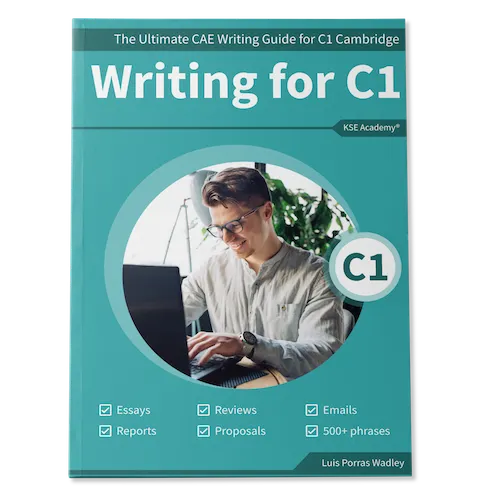
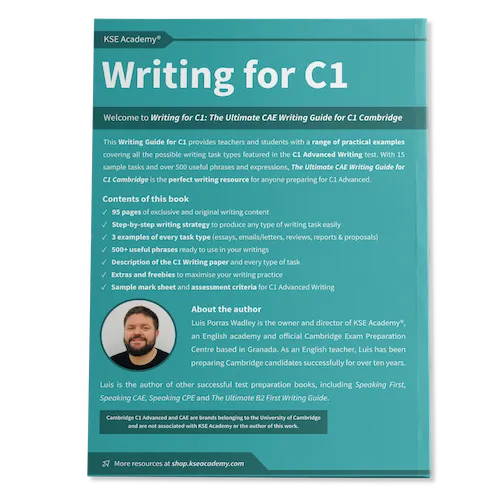
Table of contents
If you are preparing for the Cambridge C1 Advanced exam, you will know that the Writing part can be one of the most feared, but also one where it is easiest to secure points if you know the rules of the game well. In this article, we are going to focus on one of the most popular options in Part 2 of the C1 Writing: the informal email (or also informal letter).
Even though we write emails every day, doing so for a C1 level exam requires demonstrating a command of the language that goes beyond a simple «Hello, how are you?». You need specific vocabulary, phrasal verbs, idioms and a solid structure. Ready to learn how to write a top-notch email? Let’s go!
What is an informal email or letter in the C1 Advanced?
In the C1 Advanced exam, an informal email or letter is a text addressed to a person with whom you have a close or familiar relationship. The main objective is usually to respond to a previous letter from that person, in which they ask you for advice, information, or tell you some news.
For the purposes of the exam, an email and a letter are exactly the same thing. There is no difference in the format or the content. Cambridge uses both terms interchangeably in this part, so the rules we will see here apply to both formats.
When will you be asked to write an informal email in the CAE?
As you probably already know, because I have explained it to you a few times 😅, the CAE Writing has two parts. Part 1 is compulsory (an essay), but in Part 2 you have to choose one task from three options. These options can include: review, report, proposal, formal email/letter or informal email/letter.
Therefore, the informal email option will not always appear, but it is just as likely to show up as the other options. And if it does, it is a fantastic opportunity to show off with natural and expressive language!
Main characteristics of an informal email for C1
To get the maximum score, your text must meet certain expectations of level and style:
- Purpose and context: You will normally have to advise, persuade, explain a complex situation or suggest plans. The context will always be responding to a friend, family member or close colleague.
- Informal tone and register: This is where you must demonstrate warmth. You must sound like a friend or a relative, not like a robot. The use of contractions, exclamation marks, idioms, phrasal verbs and a conversational tone is expected.
- Differences between formal and informal email: Unlike formal texts, here you can (and should) use phrasal verbs, idioms and address the reader directly (direct address).
Structure of an informal email for the C1 Advanced
Even if it is informal, the text must be perfectly organised. Chaos does not score well with Cambridge. This is the ideal structure:
- Initial greeting: An affectionate or close opening formula.
- Opening paragraph: You react to your friend’s news or the reason for the email.
- Main paragraphs (body of the email): Here you develop the points requested by the task (advice, explanations, etc.). Each main idea should go in a separate paragraph.
- Closing paragraph: An excuse to end the conversation and mention future contact.
- Sign-off and signature: A final formula appropriate to the relationship.
How to write an informal email step by step
Let’s break down the process so you don’t go blank in front of the exam paper:
- Step 1: Analyse the task and extract the key information. Underline who is writing to you, what relationship you have and, above all, the 3 points (there are usually 3) that you must address compulsorily.
- Step 2: Plan your response. Decide what you are going to say in each point. Do not improvise as you go or the text will lose coherence.
- Step 3: Write the appropriate greeting. Something simple like «Hi [name]», «Hello [name]», «Dear [name]» or «Dearest [name]» works well. Also, as it is an informal email, if it is for a friend or colleague, you can use «Hey [name]».
- Step 4: Draft the introduction. Do not get straight to the point. Ask how they are and comment, if you have any information, on something about their previous email («Great to hear from you!»).
- Step 5: Develop the main points. Use informal connectors to link ideas and make sure you answer everything you are asked.
- Step 6: Close the email naturally. Do not cut the text off abruptly. Use a transition phrase («I’d better get going…»).
- Step 7: Choose the appropriate sign-off. «Best wishes«, «Hugs«, «Take care«, «Lots of love«, «Love«, followed by your name.
Complete example of an informal email for the CAE
Theory is all well and good, but let’s see how it applies in practice with an original example created specifically for this guide.
Task instructions
You have received an email from an English friend, Sarah, who is moving to your city next month for work.
«I’m so excited about moving to your city! The job offer came out of the blue, but I couldn’t say no. I need your advice, though. I’m looking for a place to live, but I don’t know which neighbourhoods are best for someone my age. Also, I’m a bit worried about making new friends since I won’t know anyone but you. Do you have any suggestions on how to meet people outside of work? Finally, I’d love to try the local food properly – where should we go for my first dinner there?»
Write your email in reply to Sarah. Write your answer in 220 – 260 words in an appropriate style.
Task analysis
In this task, we must respond to Sarah by covering these three points:
- Recommend suitable neighbourhoods to live in.
- Suggest ways to make friends outside of work.
- Propose a place or plan to try the local food.
Commented model response
Hi Sarah!
How’s it going? I was absolutely over the moon when I read your email! It’s fantastic news that you got the job. I honestly can’t wait to have you here in Madrid. It’s been ages since we last hung out!
Regarding your flat hunt, if I were you, I’d steer clear of the city centre. It’s ridiculously pricey and way too noisy. You might want to check out the Chamberí neighbourhood instead. It’s vibrant, full of young professionals, and just a stone’s throw from the centre. Plus, you’ll get more bang for your buck there.
As for meeting people, don’t fret! You’re super sociable, so you’ll fit right in. A great way to widen your circle is to join a hiking club or language exchange events. There are loads of them happening every week. It’s a win-win because you’ll meet locals and expats while doing something fun. And obviously, I’ll introduce you to my gang as soon as you land!
Finally, about that dinner… leave it to me! For a proper culinary experience, we simply have to go to Casa Lucio. They make the most mouth-watering broken eggs you’ll ever taste (like scrambled eggs, only better!). It’ll be on me, as a welcome gift!
Anyway, I’d better dash now. Keep me posted on your arrival dates so I can pick you up at the airport.
See you soon!
Alex
Why does this informal email work well for C1? I will explain below:
- Idiomatic vocabulary (C1/C2): It uses expressions like «over the moon» (very happy), «out of the blue» (in the task, we respond to it), «stone’s throw» (very close) or «bang for your buck» (good value for money).
- Phrasal Verbs: Essential for the informal register. Examples: «hung out», «steer clear of», «fit in», «be on me», etc.
- Integrated advanced grammar: Use of the conditional for advice («If I were you, I’d…») and emphatic structures («It’s a win-win because…»).
- Coherence: The paragraphs are well linked with informal markers like «Regarding…», «As for…», «Finally…».
Language and expressions for informal emails at C1 level
To achieve that naturalness typical of a native speaker, you need to nourish your text with certain linguistic elements:
Contractions and colloquial language
Do not write «I am writing to tell you». Instead, use «I’m writing to tell you». The use of contractions is compulsory in this register. Words like «stuff» (things), «reckon» (believe/think) or «fancy» (feel like) are very useful.
Essential phrasal verbs
- Catch up: («We need to catch up soon!»)
- Make up for: («I’ll make up for missing your party.»)
- Put up with: («I don’t know how you put up with that boss.»)
- Turn out: («It turned out to be a great day.»)
Appropriate idiomatic expressions
A couple of well-placed idioms demonstrate a high level, but do not overdo it or it will sound forced.
- «To be in the same boat»
- «To play it by ear»
- «To keep someone in the loop»
Informal connectors
Forget about «Therefore» or «Furthermore». Use:
- Anyway, / Anyways, (to change topic or close).
- Besides, / Plus, (to add information).
- Though (at the end of the sentence, meaning «however»). E.g.: «It was expensive. The food was good, though.»
Useful phrases for each part of the informal email
Greetings and openings
- Hi John, / Hey Mary,
- How’s life treating you?
- Thanks a million for your email / It was great to hear from you.
- Sorry I haven’t written for ages / for yonks, but I’ve been snowed under with work.
Reacting to good news
- I’m absolutely thrilled to hear that…
- What fantastic news! You must be over the moon.
- I’m so happy for you!
Reacting to bad news
- I was so sorry to hear about…
- It sounds like you’re having a tough time.
- Don’t let it get you down.
Giving advice and suggestions
- If I were in your shoes, I’d…
- You might want to try…
- Why don’t you…?
- Have you thought about…?
Making requests informally
- Could you do me a massive favour?
- I was wondering if you could give me a hand with…
- Do you think you could…?
Introducing new topics
- Oh, by the way…
- Speaking of [topic]…
- As for [topic]…
Sign-offs and closings
- I’d better get going / I’ve gotta dash.
- Can’t wait to see you.
- Drop me a line soon.
- All the best / Best wishes / Lots of love (only very intimate).
Additional examples of informal email tasks
To give you more references, here are two other complete examples with their respective model answers, covering different typical exam themes.
Example 2: Advising on a difficult decision
Task instructions:
You have received an email from your friend, Mark. He is thinking about quitting his stable job to travel the world for a year, but he is terrified that it might ruin his future career prospects. He has asked for your advice.
Reply to Mark’s email. Tell him what you think he should do, give reasons for your opinion, and suggest a possible compromise or alternative to calm his fears.
Write your email in 220 – 260 words.
Model response:
Hey Mark,
Thanks for reaching out, mate! It’s always great to hear from you, even if you sound like you’re stuck between a rock and a hard place right now. Honestly, I’m not surprised you’re thinking about travelling; you’ve always had itchy feet!
Listen, if I were in your shoes, I wouldn’t think twice: go for it! You’re only young once, right? I understand your concerns about your career, but I honestly believe that taking a gap year won’t ruin your prospects. Quite the opposite, actually. Nowadays, employers really value the soft skills you pick up while travelling, like adaptability and problem-solving. It might even make your CV stand out from the crowd when you come back.
Besides, staying in a job you’re not passionate about just for the sake of stability is a recipe for disaster. You don’t want to burn out or look back in twenty years with regrets, do you? Taking a break to recharge your batteries could give you a fresh perspective on what you really want to do professionally.
However, if you’re still freaking out about quitting cold turkey, why don’t you ask for a sabbatical? Many companies are open to offering unpaid leave to retain talent. That way, you’d have the adventure of a lifetime but with a safety net waiting for you upon your return. It sounds like the best of both worlds, doesn’t it?
Anyway, let me know what you decide. Whatever you choose, I’m sure you’ll land on your feet!
Best,
David
Example 3: Invitation and catching up
Task instructions:
You are helping to organise a reunion for your old university class. Write an email to your former classmate, Julie, who now lives abroad.
In your email, you should invite her to the reunion giving details of the event, persuade her to come by mentioning who else will be there, and briefly update her on your own life (work/personal) since you last spoke.
Write your email in 220 – 260 words.
Model response:
Hi Julie!
Long time no see! How is life treating you over there in Canada? I hope you’re keeping well and not freezing to death! I’ve been meaning to write to you for ages, but I’ve been snowed under with work lately.
I’m writing because we’re finally organising a class reunion next month! Can you believe it’s been five years since we graduated? We’ve booked the private room at The Golden Lion—that pub we used to love near campus—for Saturday the 15th. It’s going to be a proper trip down memory lane, and you simply have to be there. The party wouldn’t be the same without you; after all, you were always the life and soul of our nights out!
I know it’s a long way to travel, but pretty much everyone is coming. Even Sarah and Mike are flying in from London, and they’re dying to see you. We were talking about you just the other day, actually. It would be the perfect opportunity to catch up properly with the whole gang.
As for me, things are pretty hectic but exciting. I finally took the plunge and started my own graphic design business last year. It was scary at first, but it’s turning out really well. I’m working crazy hours, but being my own boss is priceless. I’m also engaged now—to Tom! Crazy, right?
Anyway, please say you’ll come! You can crash on my sofa if you need a place to stay.
Big hugs,
Laura
Common mistakes when writing informal emails (and how to avoid them)
- Mixing registers: Do not start with «Hi mate» and finish with «Yours sincerely». Maintain consistency.
- Being too simple: Informal does not mean «low level». You must demonstrate that you have a C1 by using rich vocabulary, even if it is colloquial.
- Not covering all points: Make sure you have answered the 3 things requested by the task.
- Going over the word count (or staying too short): Try to stay within the 220-260 word range.
Differences between formal and informal emails
It is vital not to confuse these two types of writing. If you want to know more about the other side of the coin, take a look at our guide on the formal email. Here is a detailed comparison so that you do not make register errors:
| Aspect | Informal email (Friend/Relative) | Formal email (Boss/Institution) |
|---|---|---|
| Tone objective | Close, emotional, subjective and relaxed. You seek to connect. | Distant, objective, polite and professional. You seek to inform or request. |
| Initial greeting | Hi, Hey, Dear [First name] | Dear Mr/Ms [Surname], Dear Sir/Madam, To whom it may concern |
| Contractions | Essential: I’m, don’t, won’t, can’t, it’s. | To avoid: Always use the full form (I am, do not, will not). |
| Vocabulary and verbs | Frequent use of Phrasal Verbs (go on, turn up) and colloquial words (chat, ask for). | Preference for verbs of Latin origin and sophisticated vocabulary (continue, attend, discuss, request). |
| Grammatical structures | Active voice, shorter sentences, direct questions, exclamation marks (!). | Passive voice (to be impersonal), long and complex sentences, indirect questions. |
| Connectors | Anyway, Besides, Plus, So, But. | Therefore, Furthermore, Additionally, However, Consequently. |
| Idiomatic expressions | The use of Idioms is highly valued (over the moon, give a hand). | Colloquial idioms are avoided. The language must be literal and precise. |
| Sign-off | Best wishes, Take care, Hugs, All the best. | Yours sincerely (if you know the name), Yours faithfully (if you don’t). |
Note on personality: In the informal email, examiners value your text having «soul». You can make jokes, use irony (carefully) or show genuine enthusiasm. That makes the reader engage!
Checklist: Review your informal email before handing it in
Before considering your email finished, pass it through this filter. We have adapted the official Cambridge checklist for C1 specifically for the Informal Email task. If you check all the boxes, your pass is much closer.
1. Content
- ✅ Have I covered the 3 points of the task? (Make sure you haven’t forgotten any questions from your friend).
- ✅ Have I added my own details? (Do not answer with monosyllables; expand your ideas with reasons or brief examples).
- ✅ Is the length appropriate? (The text should be between 220 and 260 words. Less is insufficient; much more may include irrelevance).
2. Communicative Achievement
- ✅ Is the tone informal and close? (It should look like you are writing to a friend, not a teacher).
- ✅ Have I used personality and emotion? (Use of exclamation marks, humour or empathetic phrases like «I’m so happy for you!»).
- ✅ Have I fulfilled the communicative function? (If advice is asked for, have I advised? If suggestions are asked for, have I suggested?).
3. Organisation
- ✅ Are there clear paragraphs? (Greeting + Opening + Paragraph per idea + Closing + Sign-off).
- ✅ Have I used informal connectors? (Use «Anyway», «So», «Plus», «By the way» instead of «However» or «Furthermore»).
- ✅ Does the text flow naturally? (Ideas must be logically connected).
4. Language
- ✅ Have I used contractions? (Essential: I’m, don’t, won’t, it’s).
- ✅ Have I included phrasal verbs? (Try to include at least 2 or 3, such as catch up, look forward to, get along).
- ✅ Have I used any idiomatic expression (idiom)? (E.g.: Over the moon, piece of cake, give a hand).
- ✅ Is there grammatical variety? (Mix simple sentences with more complex structures like conditionals, passives or inversions, but keep them sounding natural).
Complete Writing guide for the C1 Advanced
Do you want to secure a pass in the C1 Writing? If you liked this explanation, you will love my complete guide for the C1 Writing: Writing C1: The Ultimate CAE Writing Guide for C1 Cambridge. It is the best resource you will find for sale with examples of all types of texts, lists of advanced vocabulary, error correction exercises and step-by-step templates so you don’t have to improvise on exam day. It is the tool thousands of people use to succeed in the C1 Advanced Writing.
👉🏻 Get the best C1 Writing book here
I hope this guide has been useful for you to master the art of the informal email. Remember that you can download this article in PDF by clicking the button at the top of the page to review it whenever you want.
And until the next article, don’t forget to keep smiling!