
How to Write a Report for B2 First (FCE) Writing
In this article, I will teach you how to write a report for the B2 Writing exam. Everything you need to know, from start to finish, along with an exclusive guide for B2 writings.

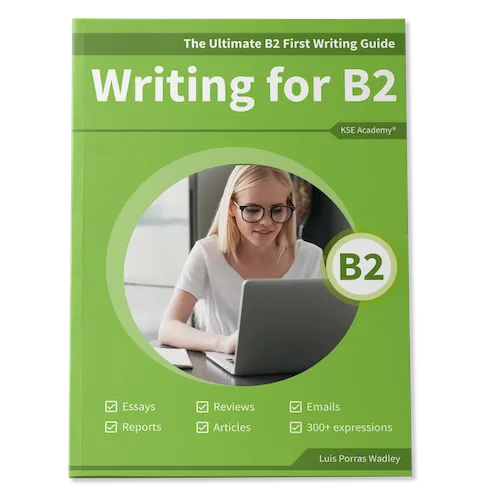
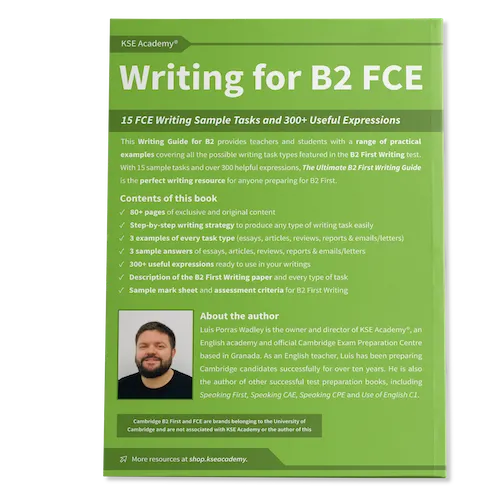
Table of contents
As I have already explained in other articles on this website, the B2 First (FCE) Writing has 2 tasks. The first task is always an essay, while in the second you have to choose between 3 options. These can be: informal or formal email/letter, article, review or report. In this post I am going to show you exactly how to write a report for the FCE or Cambridge B2 First.
How to write a report for FCE Writing Part 2
What is a report?
A report is a type of Writing where a past event or experience is analysed, and usually, suggestions or recommendations are offered to improve that event or experience.
Furthermore, it is one of the typical Writing tasks for B2 First (FCE), C1 Advanced (CAE) and C2 Proficiency (CPE).
Characteristics of a report
Below we will look at some of the main characteristics of this type of Writing, as it is a text with very peculiar characteristics that make it unique both visually and structurally.
- Purpose of a report: As we saw in the previous section, the objective of a report is to inform about something, especially an event or an experience that has taken place in the past. Furthermore, a report analyses a topic point by point and generally highlights relevant positive and negative aspects, and offers recommendations to improve the negative aspects.
- Tone and linguistic register: A report must always be formal. Generally, it is a text that we are going to write for a superior: a teacher, a boss, a manager, etc. Therefore, the tone and register must always be formal. Although at B2 level it is not necessary to use very advanced formal English phrases, it is advisable to carry out basic formal English measures such as avoiding contractions, not using very generic words like “good” or “thing”, writing from a neutral point of view, etc.
- Opinions: Generally, opinions in the form of personal reflection are not included in a report. That is, we will have to analyse something from our point of view, but being as objective as possible. Therefore, and also to make it more formal, we tend to avoid expressing our personal opinion as we would in an article or a review. Although this, as with almost all Writing, will always depend on the context, the topic and the approach of the report.
- Recomendations: One of the basic parts of any report is the recommendations or suggestions. Since it is a text in which we analyse different points of a past event or experience, we will always have to offer some recommendation for improvement. In fact, the prompt usually mentions the need to offer a recommendation.
- Common topics: Although it is difficult to find a typical topic for reports, it is true that topics such as excursions or sightseeing tours, exchange programmes, things a visitor to your city can do or find, etc are often repeated.
- Word count: Like all B2 Writings, the report should have approximately 140-190 words.
Structure of Report B2 First
As I mentioned before, one of the things that makes the report unique is its structure. This is because it includes a series of elements that do not appear in any other type of Writing. Furthermore, it is important to highlight two general things before looking at the structure of a report for the FCE:
- A report will have a main title and a heading for each section or paragraph. Each of these headings simply describes the topic of the paragraph or section it introduces.
- The first and last paragraphs can always be Introduction and Recommendations/Conclusion, although it is obviously not mandatory.
Below, you can see a typical structure of an FCE report:
- Title: This is an objective and descriptive title of the report’s content.
- Introduction: Here the objective of the report (what it is about) and what points will be analysed are briefly explained.
- Point 1: First aspect to analyse.
- Point 2: Second aspect to analyse.
- Point 3: Third aspect to analyse. We won’t always have 3 points, as it depends on the content and the task instructions. 🙂
- Recommendations or conclusion: This last point can be approached in two ways:
- 1) As recommendations: offering ideas to improve the shortcomings expressed in points 1-3. In this case, each point has only talked about the good or bad things about the topic we are analysing, without offering any recommendations or suggestions.
- 2) As a conclusion: offering a summary of everything expressed in points 1-3. That is, if in points 1-3 we have not made recommendations for improvement, it is necessary that the last section is about recommendations. However, if each point already offers a recommendation, it is not necessary to repeat it at the end, so we can write a summary as a conclusion.
Example of a B2 report
Now that we know the characteristics of this type of FCE Writing, let’s look at an example of a B2 level report. We will first analyse instructions for this type of task and, subsequently, we will look at a B2 report model.
FCE report instructions
Below are the instructions for a task to write a report, taken from this book (without permission, sorry!):
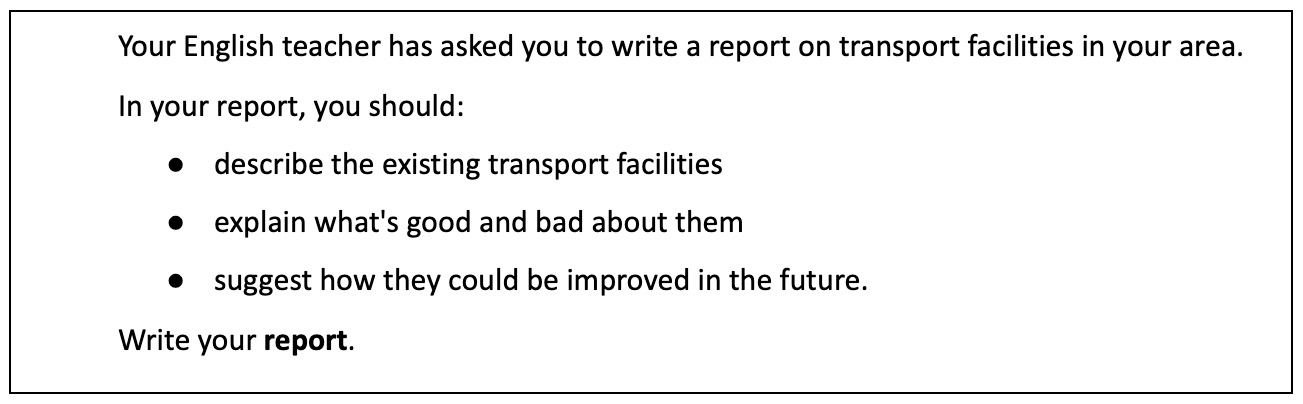
If we read the instructions carefully, we can deduce the following:
- Type of Writing: report
- Target reader: your teacher
- Topic: transport facilities in your area
- Points:
- Point 1: describe existing transport facilities
- Point 2: what’s good
- Point 3: what’s bad
- Recommendations: suggest how they could be improved
Having these points clear will make it relatively easy not to miss any when we start writing. On the other hand, although I have decided to divide the points like this, it can be done in other ways: by transport, by advantages and disadvantages, etc. I have simply chosen the easiest way according to the instructions’ approach. 🙂
B2 Report response model
Below you can read a report model written for the above instructions.
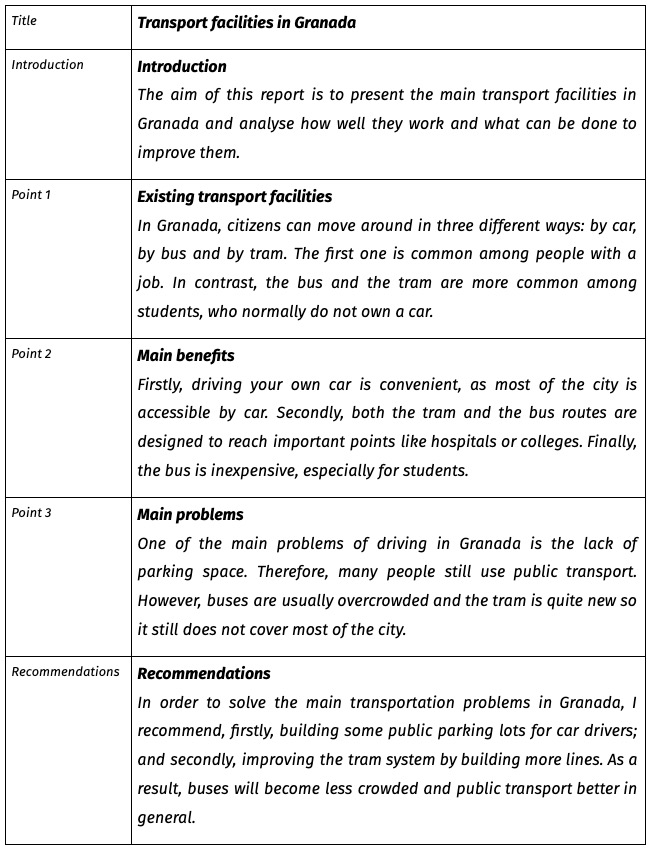
In this response model, the structure of a report for B2 First (FCE) can be seen very clearly, with its title, introduction, main points and recommendations. While there are other equally correct ways to write this response, this is a good example to understand how to write a report (report).
In the above response, we can see the following:
- Clear visual presentation: I always place a lot of emphasis on this aspect, and I consider it fundamental. Obviously, in the exam you won’t present it in the form of a table or with bold text as I have done. I have done this so you can see exactly how I have followed the structure. But you should use titles, paragraphs and spaces correctly so that, at first glance, the examiner knows how your text is organised. In fact, as you won’t be able to use bold text in the exam, you can use capital letters for the title and headings. This will show the division clearly. And remember, no endless blocks of words without paragraphs or spaces!
- Objective of each paragraph/section: Each section is introduced by its title, which perfectly summarises the content we are about to read. This is fundamental as it provides a logical organisation to the text and facilitates its reading and, above all, its comprehension.
- Tone: This is a formal or standard register. Notice that there are no contractions or informal terms. Furthermore, I only explicitly include myself in the text in the recommendations, when I say “I recommend…”. Finally, it is worth noting that the lexicon of the text, in general, is quite standard and the tone is very aseptic, without any emotion, hehe.
Useful expressions for a report
While there isn’t a list of expressions or vocabulary for writing reports for B2 level, I can recommend certain basic things that should appear. Let’s see:
- Expressions for the introduction:
- The aim of this report is to present… / to analyse…
- The purpose of this report is to outline… / to talk about…
- In this report, we will go over… / we will see how…
- Expressions for listing points:
- Firstly, / Secondly,
- In the first place,
- As regards…, / Regarding…,
- Finally,
- Expressions for contrast:
- However,
- On the other hand,
- In contrast,
- Expressions for purpose, reason, and consequence:
- Therefore,
- For this/that reason,
- As a result,
- As a consequence,
- In order to…,
Obviously, this list can be made much more extensive, as there are many synonyms and ways to say the same thing. The important thing is that these types of expressions appear to cohere the text and achieve a coherent and appropriate progression of ideas at B2 level.
Will I be penalised if I write more than 190 words?
No. No. No. I never get tired of saying this, hehe. Cambridge does not penalise you based on word count. However, the word count is usually representative of whether or not you have been able to express what is asked of you within the length estimated by Cambridge. That is, if you write much less than 140 words, you are probably not covering all the ideas appropriately, or you might even be missing some. On the other hand, if you write much more than 190 words, you are probably rambling too much with the ideas, being a bit repetitive, or including points that are not being asked for. And those two things are indeed penalised, but they are not based on the word count itself. Note that my example has 218 words, and I would not be penalised for it. 🙂
Guide to FCE Writing with PDF examples
Although I will publish more articles explaining how to do each type of writing, I encourage you to download the official KSE Academy guide to FCE Writing. In this guide you will find the following:
- How to write an essay and 3 examples
- How to write an article and 3 examples
- How to write a review and 3 examples
- How to write a report and 3 examples
- How to write an email or letter and 3 examples
- More than 300 useful expressions for B2 First (FCE) Writings
You can also purchase the 2nd edition of this guide, in paperback format, on Amazon.
Did you find this post useful? Share it with other English students and teachers and subscribe to our news blog newsletter to stay up to date with everything. Follow us on Facebook and YouTube, and don’t forget to keep smiling!