
Writing B2 First (FCE): Complete Guide with Examples
Are you going to take the FCE but still don’t know what the Writing B2 First is like? In this article, I will explain everything you need to know about the Writing section of the FCE.

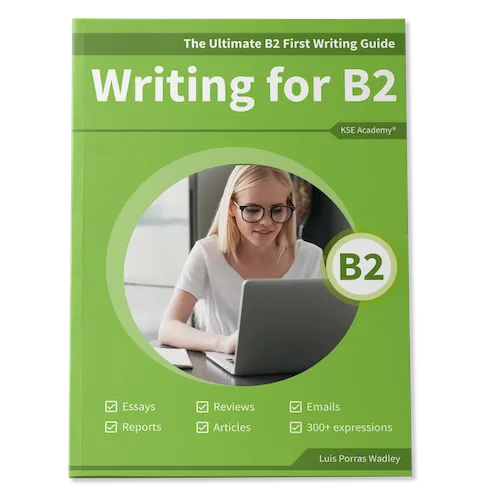
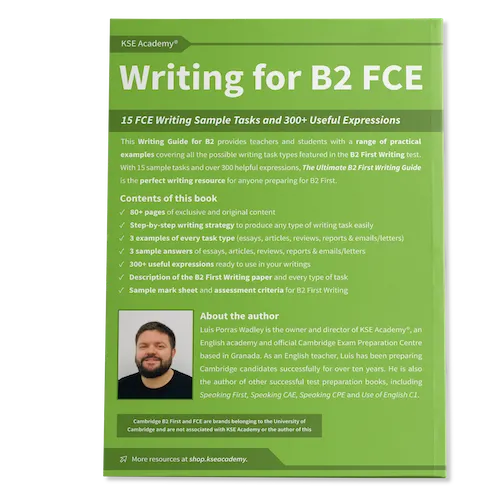
Table of contents
The B2 First (FCE) Writing is one of the most popular Writing exams available worldwide today. As you may already know, the B2 First Writing is just one of the 5 parts of the B2 First exam, formerly known as FCE. In addition to Writing, to complete an FCE exam you have to take the Use of English, Reading, Listening and Speaking parts. However, from my point of view as an English teacher and Cambridge Assessment English exam trainer, the B2 First Writing is one of the easiest parts to do and, above all, to improve in a relatively short period of time. Therefore, in this post I am going to explain exactly what the B2 First (FCE) Writing is like and I will show you a Writing example of each type of FCE Writing. Let’s get started!
Writing B2: What the B2 Level Is
The name of the exam we are talking about, B2 First, clearly specifies what level of English is expected from you. In this case, the B2 level is an upper-intermediate level, marked and defined by the Common European Framework of Reference for Languages (CEFR). According to this document, and regarding Writing (written expression), a person with a B2 level:
Can produce clear, detailed texts on a wide range of subjects and can defend a point of view on general subjects, explaining the advantages and disadvantages of various options.
If we delve a little deeper into the written expression section, we will see that the CEFR specifies that a candidate demonstrating a B2 level:
- In general:
- Writes clear, detailed texts on a variety of subjects related to their field of interest, synthesising and evaluating information and arguments from a number of sources.
- In creative writing:
- Writes clear, detailed descriptions of real or imaginary events and experiences in clear, well-structured texts, marking the relationship between ideas and following established conventions of the chosen literary genre.
- Writes clear, detailed descriptions on a variety of subjects related to their field of interest. Can write a review of a film, book or play.
- In writing reports and essays:
- Writes essays and reports which develop an argument systematically, highlighting significant points and offering relevant supporting details.
- Can evaluate different ideas or solutions to a problem.
- Writes essays or reports which develop an argument, giving reasons in support of or against a particular point of view and explaining the advantages and disadvantages of various options.
- Can synthesise information and arguments from a number of sources.
As you can see, a B2 level Writing is no walk in the park, as there are quite broad expectations regarding written language skills.
And since we already know what level a B2 Writing should have, let’s now move on to what the B2 First Writing is like, looking at some examples of FCE Writing exercises taken from the official website of Cambridge Assessment English.
What the B2 First Writing is Like
For the FCE Writing, since 2015, candidates have to write two texts in 1 hour and 20 minutes, and each text must be between 140 and 190 words. These two texts, as we will see later, are different types of Writing. In them you are expected to demonstrate your level using lexical and grammatical structures typical of a B2 level Writing.
In the specific case of the B2 First (FCE) Writing, this part of the exam is divided into two tasks with different types of Writing that we will see below.
Types of B2 Writing
- Part 1
- Essay
- Part 2
- Article
- Email (informal or formal) or letter (informal or formal)
- Review
- Report
Writing B2 First: Part 1 – Essay
In the first part of this Writing exam, you will have to write an essay. In this part you only have one task option and you will always have to write an essay.
An essay is a very common type of B2 Writing in many academic fields. Obviously, in an English exam it is not expected that your essay will be 2,000 words long, but rather that you demonstrate your B2 level of English with a relatively short text, 140 – 190 words. Furthermore, the way this task is presented is always the same. Below you can see what the instructions are for an essay exercise in the FCE:
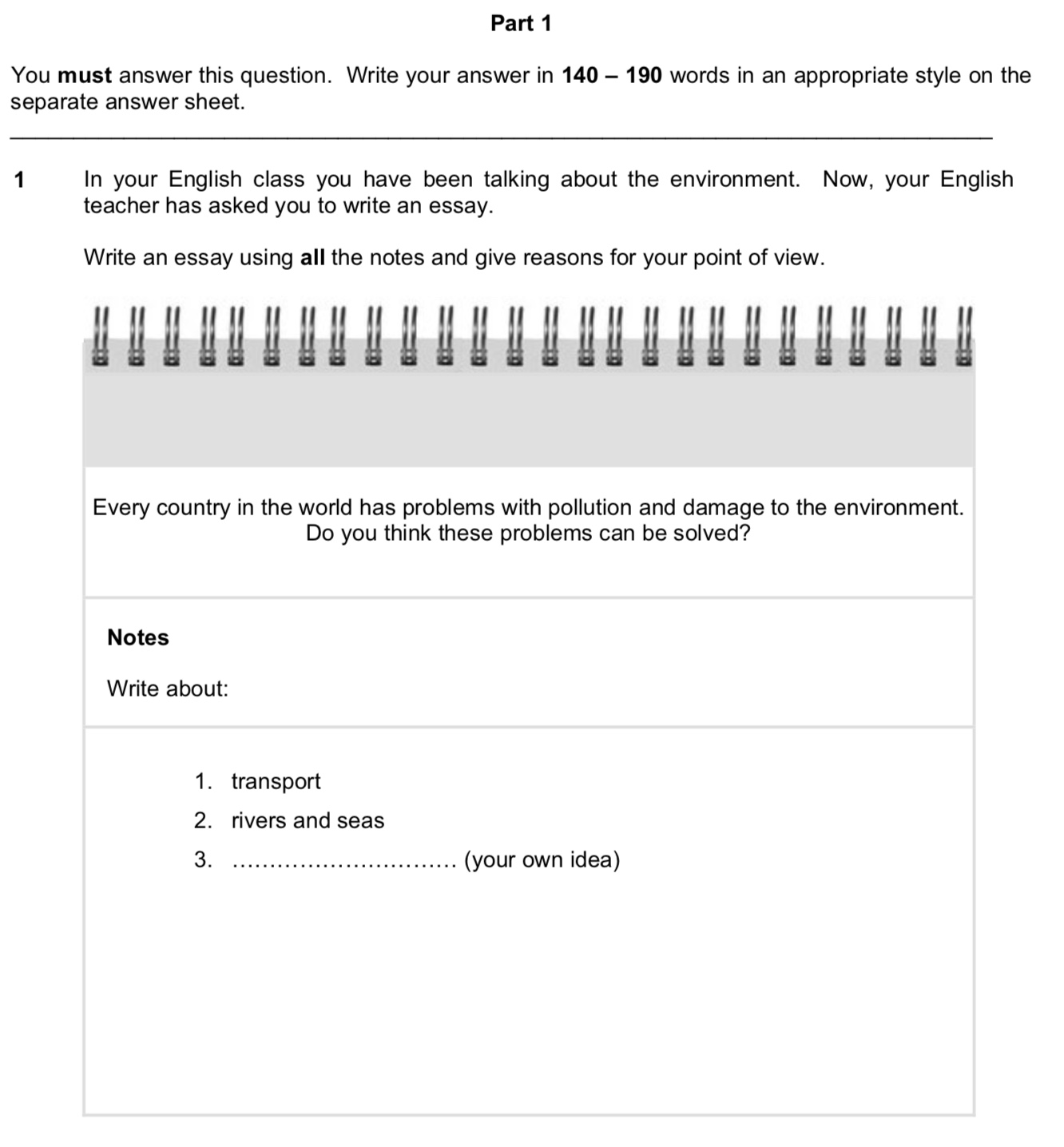
As you can see, the idea is that, before writing an essay, in your supposed English class you have been talking about some important current topic, such as money, technology, friends, hobbies, the environment, etc. Then, at the request of your supposed English teacher, you must write an essay following the notes you have supposedly taken during the discussion. To do this, in the B2 First exam, you are given 2 fixed ideas that you must talk about, and you must add another idea of your own. If you are interested in knowing how to do this task perfectly, here I explain exactly cómo escribir un essay para el Writing B2.
Let’s move on to the second part now.
Writing B2 First: Part 2
In this part, as a candidate, you have to write another text of 140 to 190 words, but this time you can choose between different types of Writing. Specifically, there are 5 types of B2 Writing, of which 3 will appear in Part 2. Let’s look at an example of each type of B2 First Writing, that is, of the task prompt.
Writing B2 First: Article
The aim of an FCE article is to make you write about a topic you like or are an expert on. For this reason, an example of a task for an article is usually something like this:
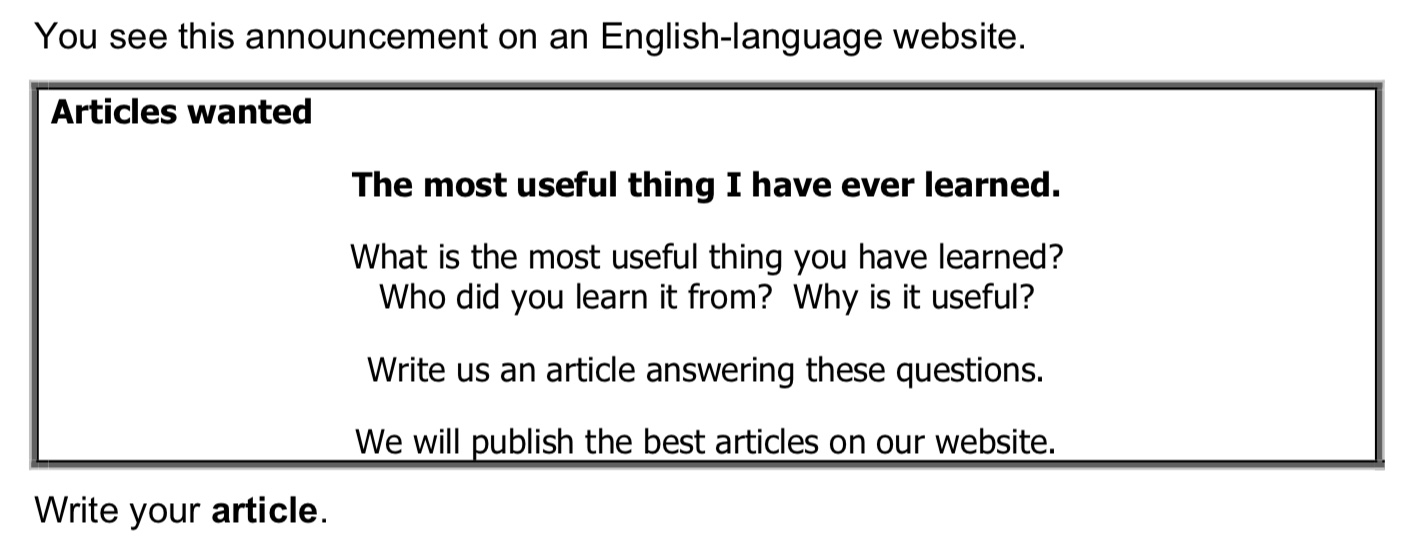
In the following post I explain how to write an article for B2 First. There you have all the information!
Writing B2 First: Review
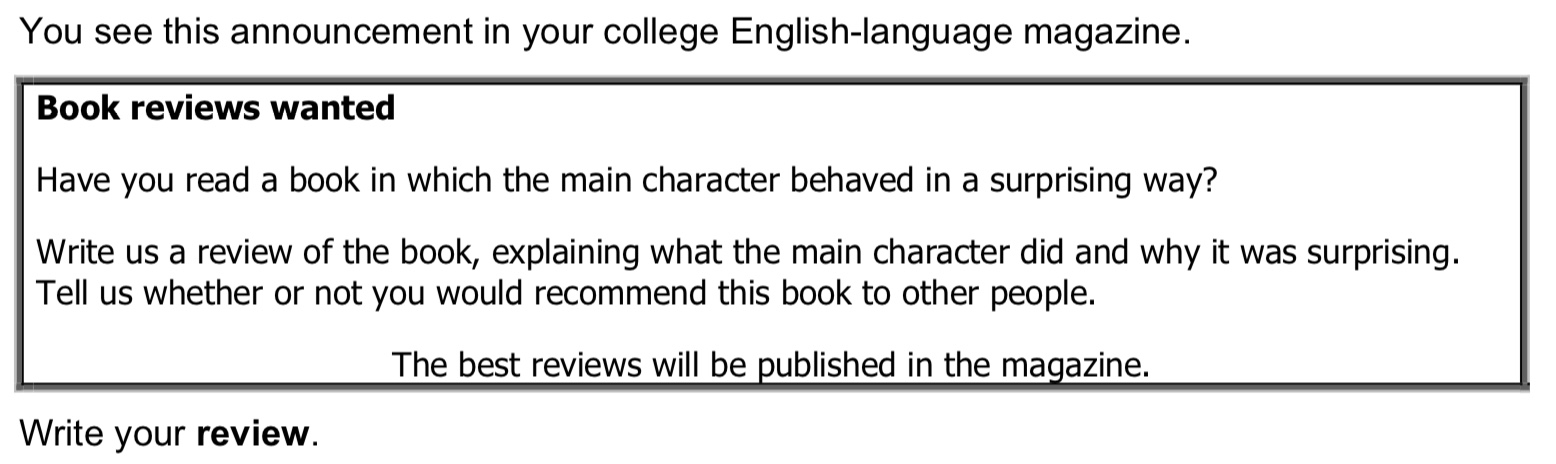
Another typical type of B2 Writing is the review. In this case, it is a task similar to the article, but it is usually about something much more specific, as you are asked to write an evaluation of an object, a film, a series, a television programme, etc. In this article you can see how to write a review for B2 First.
Here is an example of a task prompt:
Writing B2 First: Report
This is one of the types of B2 Writing that candidates tend to be less familiar with. However, from my point of view, it is one of the simplest. It is a report, which is simply an objective evaluation of an experience you have had. For example, you may be asked to write a report about an excursion or a tourist visit, or about an exchange programme, or about things a visitor to your city can do, etc.
Let’s look at an example of a report task:
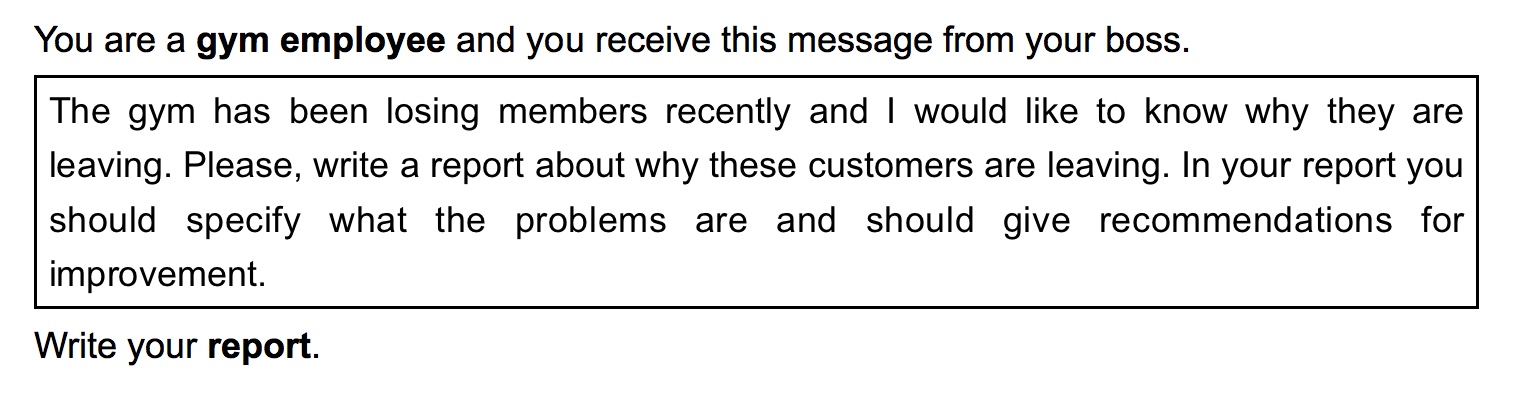
As you can see, it is a Writing task that requires a formal tone, as it is normally addressed to a superior. Later we will see a report example.
Writing B2 First: Letter & Email
In this section we will only see an example of an email, as for practical purposes a letter and an email are basically the same, only changing the electronic format for paper, or vice versa.
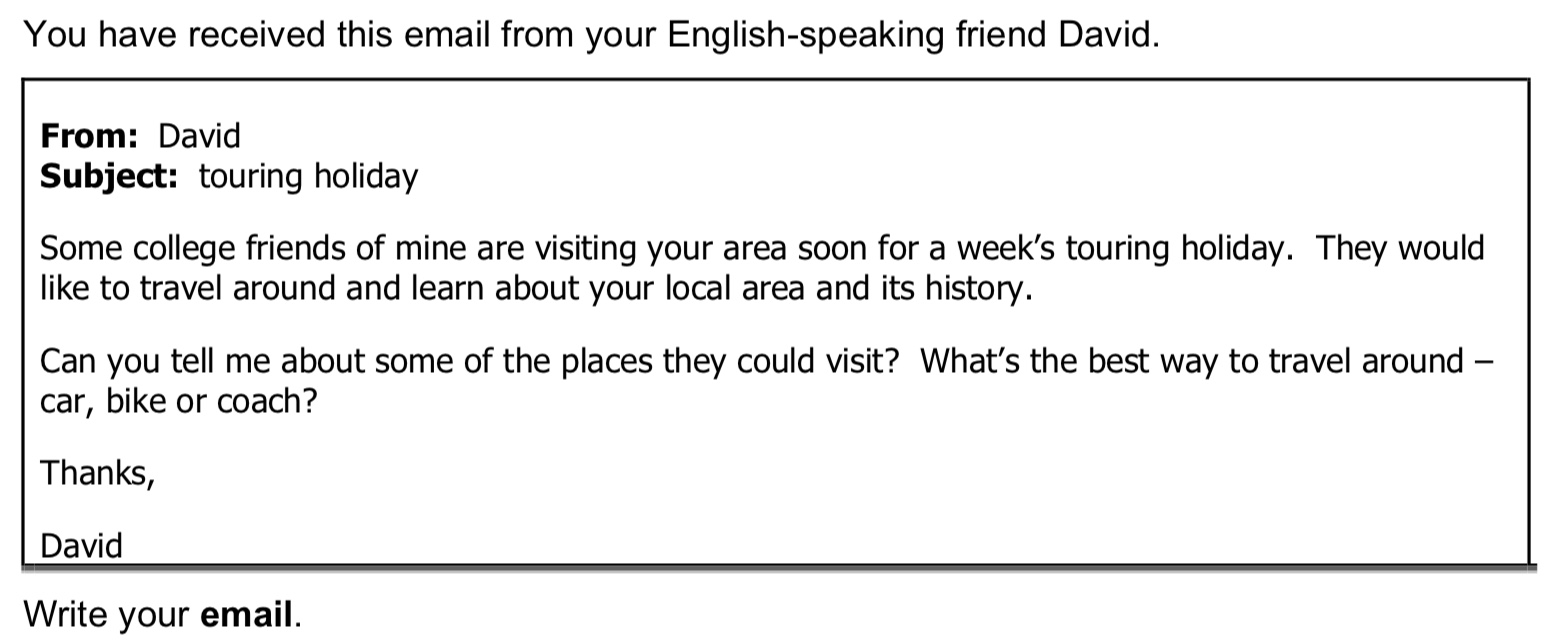
In the case that you are asked to write an email in the FCE Writing, there may be cases where you have to write an email to a friend, write a letter applying for a job or requesting information, or write an email complaining about something, etc.
Here is a typical example of a B2 Writing task.
Learn how to write an informal email for B2 with this post.
Now that we have seen examples of each task type, let’s move on to seeing an example of each type of B2 writing, that is, appropriate answers for the writing tasks.
B2 First (FCE) Writing Examples
In this section we are going to see a B2 Writing example for each type of Writing. The purpose of this is for you to become familiar with each type of Writing and get an idea of what is expected of you in the exam. Furthermore, I have tried to simulate a B2 level, neither too strong nor too weak, so that you know what your Writing tasks should look like, at a minimum. Let’s start.
Example of B2 Writing Essay
An essay, generally, must be a formal Writing in which 3 ideas are discussed in an organised manner, using connectors and appropriate language for the context and the topic being dealt with. Below you have an essay example on a very recurring topic in this type of exam: protecting the environment.
Protecting the Environment
One of the things that worries people most nowadays is the environment. In the last few decades, humans have been polluting way too much, which has had a negative effect on the environment. For this reason, we must protect it from now on.First, we ought to start paying attention to the 3 Rs: reduce, reuse and recycle. By doing so, we will reduce the quantity of rubbish, we will not throw away so many things and we will be able to recycle most of our waste.
Second, a very good idea is to stop using cars so much and start cycling or walking a little more. For example, instead of commuting by car, we can try to do it on foot or by bike.
Finally, if we really want to change things, we should teach young pupils about the dangers of contamination and pollution. It’s the only way to change the future, because they are the future citizens of the world.
In conclusion, I believe that if we do these three things, we can still prevent humans from destroying the environment.
Example of B2 Writing Article
Below you have an example of an article about a topic that interests me: the internet. As you can see, it is a piece written with an informal/standard tone, in which I include myself throughout, as everything I say is a personal opinion. Furthermore, I include some recommendations and finish the article with a question addressed to the reader.
The Internet: A Great Invention
The Internet has changed the way we live. It started as something that we could access only through a computer, but nowadays it is everywhere, and I love it!
One of the cool things about the world wide web is that you can look up anything you want and find out the answer straight away. Isn’t that fantastic? For example, imagine you are arguing with your friends about how to do something. Easy solution! Go online and find the answer.
However, the greatest thing about the Internet is how you can learn tons of things very cheaply or even for free! In fact, my favourite website is www.udemy.com, where people register to teach and learn about different things: music, website design, making apps, history, etc. So I totally recommend it to everyone!
In conclusion, the Internet has a lot of great things. For me, the best are finding information and learning online. What about you? What are your favourite things about it?
Example of B2 Writing Review
The following example is of a film review. As you can see, it is a text very similar to articles (the tone, grammar, punctuation, etc.), but in this case I describe a film I have seen and liked. In a film review you should talk about the plot, the characters/actors, and you should offer a recommendation to the reader.
Layer Cake
Did you know that Daniel Craig was already famous before playing James Bond? In fact, my favourite Daniel Craig movie is called “Layer Cake”, which he did a long time before becoming the most famous spy in the world.
Set in central London, “Layer Cake” tells the story of a drug dealer (played by Craig) and how he tries to give up his drug empire. However, not everything goes as planned and he gets into some serious trouble with some of his business partners.
The main characters are wonderfully played by the actors, who give an exceptional performance. However, some of the secondary roles seemed a little dull and two-dimensional.
As for the plot, it’s a real nail-biter, as you never know what is going to happen with the main characters. In fact, you will never be able to guess the ending!
If you are a fan of action movies, I completely recommend that you watch this film. I am sure you will have a great time and it will be an unforgettable movie.
Example of B2 Writing Report
In this section you have a report example. This is the answer to the task presented in the previous section about the gym that is losing customers. As can be seen at a glance, the structure of a report is very specific, as apart from the title, each paragraph or idea is actually a subsection introduced by a subtitle. In addition to that, the language is relatively formal and very objective.
Improving Our Gym
Introduction
The aim of this report is to explain the main reasons why members are leaving the gym. After interviewing some clients, we have identified some serious problems.
Limited opening hours
Some members have complained that the gym opens a little late for them. For this reason, workers cannot exercise before going to work. If the gym opened at 7 a.m., clients could exercise easily before going to work.
The changing rooms
Many of the lockers are broken so customers cannot leave their belongings in a safe place. Also, some of the showers are not working properly so members have to queue before having a shower. In order to solve this, I suggest replacing all lockers and showers immediately.
Lack of parking spaces
Some previous members have joined gyms which have a parking lot. Although we cannot build a parking lot, we can offer a parking area for bicycles. As a result, this might encourage members to use their bikes to come to the gym.
Conclusion
To sum up, I believe that if we take care of these problems, members will be happier and will decide to stay with us.
Example of B2 Writing Informal Email
Here is an informal email addressed to “my friend” Jack. The important thing about any email or letter, apart from the language, is the structure. Notice how in this type of B2 Writing we need: a greeting, an opening paragraph, paragraphs with main ideas, a closing paragraph, a farewell, and a signature. In this case, as it is an example of an informal email, the language is quite colloquial, as I am on familiar terms with my friend.
Dear Jack,
It’s great to hear from you after so long! How are you doing? I’m so excited about your visit next summer. Let me give you some tips so you can get ready.
First of all, there are some places which you can’t miss! For example, here in Granada you should totally visit the Alhambra, an ancient Muslim palace.
It was nominated to become one of the new seven wonders of the world. Also, don’t forget to check out St Nicholas viewpoint – you’ll have the best views of the Alhambra and the whole city.
As for clothes, remember that it can get super hot in Granada, especially for foreigners! So forget about long sleeves or trousers and just pack some shorts, T-shirts and sandals. Oh, and remember to bring a cap, too!
By the way, do you have a place to stay? If you want, I could put you up in my place. I have a spare room and it would be great to have you here.
Anyway, I must dash now. Drop me a line soon and let me know what you think.
Best wishes,
Carlos
Example of B2 Writing Formal Letter
The structure of a letter is exactly the same as the email we have just seen. In this case, however, it is an example of a formal letter for B2 First. You can quickly see a very formal greeting and farewell, no contractions, less colloquial connectors, etc.
Dear Sir or Madam,
I am writing with regard to the advertisement posted in yesterday’s newspaper about the camp for diabetic children. I would like to take part as a volunteer, if it is possible.
As you can see in my résumé, I completed a degree in nursing, so I am qualified to teach children about it. Besides, I suffer from diabetes, so I am quite familiar with this illness and how to deal with it.
Furthermore, I have some experience organising entertaining events for children, as I worked at a regular camp for children last summer. For this reason, I am capable of organising and playing fun games with children.
Finally, I must say that I can speak 3 languages, since I have spent some time abroad, in England and Germany. Therefore, apart from Spanish, I am fluent in English and German.
Can I ask about the duration of the camp? What is the daily timetable?
I look forward to hearing from you.
Yours faithfully,
José
B2 First (FCE) Writing: How it is Assessed
Any FCE Writing task is assessed based on 4 fundamental assessment criteria. These are: Content, Communicative Achievement, Organisation, and Language. Let’s look briefly at what each one consists of:
- Content: This section evaluates how well you have completed the task, i.e., whether you have done what was asked. In this regard, it is important that you address each point proposed in the exercise and that the information you write adequately covers each point and the task in general.
- Communicative Achievement: This assessment criterion focuses on how appropriate your Writing is in relation to the proposed exercise. In this sense, the style and register you have used are particularly important.
- Organisation: Is your writing logical and well structured? Great, then you will get a good mark in this section. In general, any B2 Writing should be divided into coherently interconnected paragraphs, with coherent and well-cohesive sentences, offering a logical progression that is easy to follow. To do this, you must use a series of connectors and cohesive grammatical structures typical of a B2 level.
- Language: In this section, of course, it is about your grammar and vocabulary being at a B2 level and that you do not make too many linguistic errors.
Tips for the B2 First (FCE) Writing
Like every part of the B2 First, for the Writing there are a series of essential strategies that will help your writing meet the requirements that the examiners are looking for. In general, I always recommend the following:
- Make an outline before writing. Never start writing without knowing what you are going to talk about. Making notes on how you are going to organise your Writing is essential for it to be coherent and easy for the reader to follow. Furthermore, you will avoid exceeding the word count and having one paragraph much longer than another, resulting in an unbalanced Writing.
- Always think about who will read the Writing. And I don’t mean the examiner, but who your target reader is. For example, if you are going to write an article for your school magazine, the tone you should use will be informal, but if it is a letter applying for a job, you will have to sound more serious and formal. Therefore, always pay attention to who your reader will be.
- Write a draft and improve it until you reach the final version. Writing everything perfectly the first time is very difficult. For this reason, you should write a first draft, which you will then rewrite a thousand times (lol). In this way, you will improve different aspects of your Writing such as vocabulary and grammar, add connectors, correct mistakes, see if it is coherent, and much more. This is essential, I’m serious.
- Clearly define the paragraphs in each Writing. It may seem trivial, but defining the paragraphs makes the Writing, besides being organised, visually appealing, which will make a good impression on the reader.
- Write with knowledge. Look, you are in an English exam where you have to show what you know. That is, when you write, try to show off by intentionally using certain structures. You’ve studied conditionals, haven’t you? So include a conditional. And comparatives? Also, so include a comparative sentence. Do you remember that topic about the environment you saw with your English teacher? Great, then include words like *greenhouse effect*, *acid rain*, etc. Try to show off, come on, that’s what we’re here for! lol
- Review before finishing. Obviously, never submit a Writing exercise without reviewing. You have to act as a self-proofreader, looking for possible typos, spelling mistakes, agreement errors, etc. By reviewing you will avoid very silly and common mistakes that could negatively affect your mark.
Guide for the B2 First Writing with examples
Although I am going to publish more articles explaining how to do each type of writing, if you don’t want to wait you can purchase the official KSE Academy guide for the FCE Writing. In this guide you will find the following:
- How to write an essay and 3 examples
- How to write an article and 3 examples
- How to write a review and 3 examples
- How to write a report and 3 examples
- How to write an email or letter and 3 examples
- Over 300 useful expressions for the FCE Writing
Want to see an extract? Here you go. 🙂
Well then, I think you should now have a much clearer idea of what the B2 First Writing is like. Even so, if you still have any doubts, don’t hesitate to leave me a comment and ask me anything you want, as that’s what I’m here for, to help you.