Writing A2 Key (KET): Complete Guide with Examples [Updated 2026]
Master the Writing section of the A2 Key (KET) with tips, examples, and assessment criteria to achieve an excellent score in your exam.

Table of contents
A2 Key (KET) is one of the most popular exams from Cambridge Assessment English, especially as a first step in English certification. As a Cambridge exam trainer, I can assure you that A2 Key Writing is one of the most accessible parts of the exam, and with the right preparation, you can achieve an excellent score. Although A2 Key combines Reading and Writing in the same paper, in this post, we will focus exclusively on A2 Writing, which represents 30 of the 60 total points in Paper 1.
Writing A2: what is the level?
As the name of the exam suggests, A2 Key, an elementary level is expected according to the Common European Framework of Reference for Languages (CEFR). At this level, a candidate should be able to:
Write short, simple notes and messages relating to matters in areas of immediate need. Can write very simple personal letters, for example thanking someone for something.
In the context of A2 Writing, this means you should be able to:
- In general:
Write a series of simple phrases and sentences linked with simple connectors like «and», «but» and «because».
- In correspondence:
Write short, simple notes, messages and forms involving basic personal information, such as names, addresses, phone numbers, nationality, etc.
- In creative writing:
Write about everyday aspects of their environment, e.g. people, places, a job or study experience. Can write very short, basic descriptions of events, past activities and personal experiences.
As you can see, A2 level Writing is quite accessible, as it focuses on everyday situations and basic communication.
What is A2 Key Writing like?
In the Writing part of the A2 Key, candidates have to complete two tasks that are part of Paper 1 (Reading and Writing), which has a total duration of 1 hour. It is recommended to spend approximately 20 minutes on Writing, leaving 40 minutes to complete the 5 parts of the Reading.
The two parts of the Writing are:
- Writing Part 6: Short email or note (minimum 25 words)
- Writing Part 7: Story based on pictures (minimum 35 words)
With these tasks, you must demonstrate that you can communicate in writing in everyday situations using appropriate grammatical structures and vocabulary for the A2 level.
Types of A2 Writing
A2 Key Writing: Part 6 – Email or short note
In the first part of the Writing, you have to write an email or a short note of at least 25 words. What does «at least 25 words» mean? It means that this is the minimum for your answer to be evaluated, but ideally, you should write between 25-40 words to ensure you include all the necessary information without going on for too long.
Task characteristics:
- Text type: Informal email or note to a friend
- Word count: 25 words or more
- Score: 15 points
- Points to cover: You must respond to 3 specific elements indicated in the task
Let’s now look at a real example of the task from A2 Key Writing Part 6:
Task example:
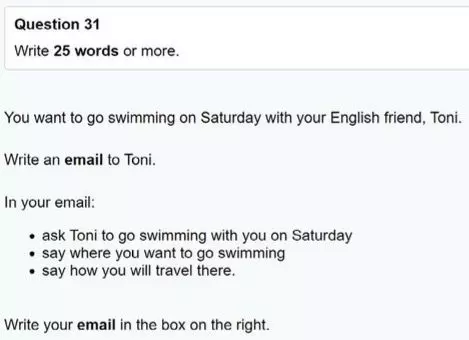
Important aspects of this task:
- You will always be writing to a friend or family member, so the tone should be informal and friendly
- The bullet points tell you exactly what you must include in your email, so it’s impossible not to know what to write
- You must respond to all three points indicated
- It is advisable to use your own words instead of copying exactly from the prompt
A2 Key Writing: Part 7 – Story based on pictures
In this second part, you have to write a short story of at least 35 words based on three pictures provided to you. This task requires a bit more creativity and narrative vocabulary.
Task characteristics:
- Text type: Short story
- Word count: 35 words or more
- Score: 15 points
- Visual elements: 3 pictures showing the sequence of the story
Task example:
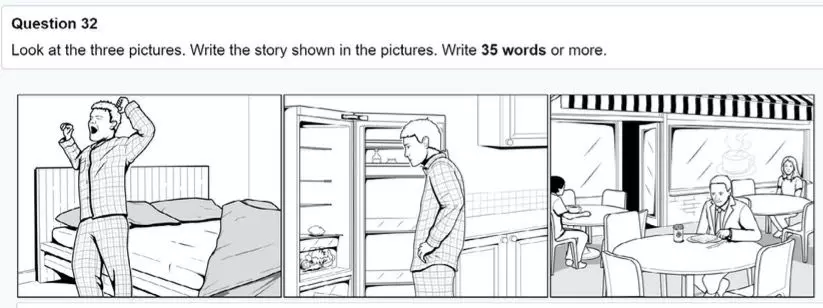
Important aspects:
- You must refer to all three pictures in your story
- Your story must have a coherent beginning, middle and end
- Use past tenses (mainly past simple)
- Include basic temporal connectors like «then», «after that», «finally»
Examples of A2 Key (KET) Writing
Now let’s look at real examples with their evaluations so you understand exactly what the examiners expect.
A2 Writing Part 6 Example: Email
Excellent Answer (15/15 points):
Hi Toni!
Saturday will be a nice weather, so I want to go swimming. Do you want to go with me? I want to visit pool in a park. We can travel there on bus, because it is faster and not expensive. What do you think about this plan?
Alex
Examiner comment: Excellent attempt. All three elements are fully communicated, so the reader would be fully informed. The text is coherent, with a variety of connectors (so, there, because, this plan). Vocabulary is used appropriately. The only errors are with articles and do not affect meaning.
Content: 5 | Organisation: 5 | Language: 5 | Total: 15
Good Answer (12/15 points):
Hi Toni,
Tomorrow is Saturday, so let’s go to swimming together. I want to go swimming pool at new sports centre. Do you like this place? We will travel to swimming pool by bus because pupils are cheaper.
Examiner comment: Good attempt. All three elements are communicated. The reader would, in general, be informed. The text is coherent, but «so» and «this place» are the only connectors. Grammatical forms are well controlled (Let’s go, I want to, Do you like, We will travel). Vocabulary is appropriate, although there is too much repetition of the prompt’s lexis.
Content: 4 | Organisation: 4 | Language: 4 | Total: 12
Satisfactory Answer (9/15 points):
Hi Toni,
I want to swim to golden beach on Saturday because is sunny day. We can go with a car from my father. Are you agree?
Examiner comment: Satisfactory attempt. It is not clear if the candidate has invited Toni to swim, but the other points are covered. The text is coherent, but «because» is the only connector. There is some control of grammatical forms (I want to swim, We can go), but errors (swim to golden beach, a car from my father) hinder communication.
Content: 3 | Organisation: 3 | Language: 3 | Total: 9
A2 Writing Part 7 Example: Story
Excellent Answer (15/15 points):
Tom woke up at 7 o’clock. He washed his face and he wanted to make breakfast, but he saw that there were nothing in the fridge, so he went to the restaurant and ate a toast.
Examiner comment: Excellent attempt. All content points are covered; the reader is fully informed. The text is coherent thanks to the effective use of basic connectors. Vocabulary is used appropriately and correctly. Simple grammatical forms (past simple, want to, prepositions) are used correctly with only 2 errors that do not impede understanding (there were nothing, ate a toast).
Content: 5 | Organisation: 5 | Language: 5 | Total: 15
Good Answer (12/15 points):
A man waked up and go in the kitchen, he searched something to eat for breakfast but he didn’t like what he had in his house. So the man went to a café and he had breakfast here.
Examiner comment: Good attempt. All points are covered, although the first image receives minimal treatment. The text is generally coherent thanks to basic connectors (but, so, and). Vocabulary is appropriate and correct. Simple grammatical forms are used with some control (he didn’t like what he had, went to a café), but there are examples of lack of control (waked up and go, searched something to eat).
Content: 4 | Organisation: 4 | Language: 4 | Total: 12
Satisfactory Answer (10/15 points):
In the morning the man get up. He go to a kitchen and he do a Breakfast, but in his fridge the milk doesn’t stay. The man decide to go a bar and he order the Breakfast.
Examiner comment: Satisfactory attempt but not all parts of the story are clearly communicated. The description of image 2 is not clear due to vocabulary errors (do a Breakfast, the milk doesn’t stay). There is some attempt at organisation using simple connectors (but, and). There is appropriate use of basic vocabulary (in the morning, get up, kitchen, fridge, decide, order). Word order and prepositions are well controlled, but there is a lack of control of basic verb forms.
Content: 4 | Organisation: 3 | Language: 3 | Total: 10
A2 Key Writing: how it is evaluated
All A2 Key Writings are evaluated according to 3 fundamental criteria. Each criterion is worth up to 5 points, for a total of 15 points per task:
Content
This refers to how well you have completed the task. To obtain a good score:
- Respond to all points indicated in the instructions
- Provide sufficient information for each point
- Ensure that your message is clear and the reader can fully understand what you want to communicate
Scoring:
- 5 points: All elements are fully communicated
- 3-4 points: All elements are present but some need more development
- 1-2 points: Elements are missing or not clearly communicated
- 0 points: Content is irrelevant or there is no attempt
Organisation
This criterion evaluates the coherence and structure of your text:
- Use basic connectors like «and», «but», «because», «so», «then», «after that»
- Organise your text logically with a clear beginning, middle and end (especially in stories)
- Ensure that ideas flow naturally from one to another
Scoring:
- 5 points: Coherent text with effective use of connectors
- 3-4 points: Generally coherent text with some basic connectors
- 1-2 points: Limited organisation, few or no connectors
- 0 points: No apparent organisation
Language
This criterion evaluates your grammar and vocabulary:
- Use appropriate vocabulary for the A2 level
- Control basic grammatical structures (present simple, past simple, can/could, prepositions)
- Errors should not impede communication – small grammar mistakes are fine if the message is clear
- Vary your language – do not exactly copy the words from the prompt
Scoring:
- 5 points: Appropriate vocabulary, good grammatical control, minimal errors that do not impede understanding
- 3-4 points: Generally appropriate vocabulary, reasonable grammar control, some errors
- 1-2 points: Limited basic vocabulary, limited grammatical control, frequent errors
- 0 points: Inadequate vocabulary and grammar, communication very difficult
Tips for A2 Key Writing
As a Cambridge exam trainer, these are my essential tips to improve your A2 Key Writing:
General tips for both parts:
- Familiarise yourself with the tasks. Before the exam, you should perfectly know what the two Writing parts are like so you don’t waste time reading instructions on the day of the exam.
- Manage your time well. Spend approximately 20 minutes on the entire Writing (about 10 minutes per task). Do not let the Writing take too much time away from the Reading.
- Write the appropriate number of words. Aim to write a bit more than the minimum (30-40 words for Part 6, 40-50 for Part 7), but without overdoing it too much. This ensures you include all the information without adding irrelevant content.
- Use clear handwriting. If you take the paper-based exam, ensure your handwriting is legible. Examiners cannot evaluate what they cannot read.
- Always check your work. Leave 1-2 minutes at the end to check for basic errors: subject-verb agreement, verb tenses, simple spelling.
For the Email/Note (Part 6):
- Practise writing short emails regularly. Write to friends by email in English, even if they are short messages.
- Learn opening and closing phrases. Have expressions ready like:
- Opening: «Hi [name]!», «Dear [name],»
- Closing: «See you soon!», «Take care!», «Write back soon!»
- Signature: Your name
- Respond to all three points. Carefully read each bullet point and ensure you include a response for all three. You can make marks or quick notes before writing.
- Use simple connectors. Words like «and», «but», «because», «so» will make your email flow better.
- Paraphrase when you can. Try to use your own words instead of copying exactly from the prompt.
For the Story (Part 7):
- Observe the three pictures carefully. Before writing, look at the three pictures and think about the whole story: what happens first?, what problem is there?, how does it end?
- Use past tenses. Stories are generally written in the past (mainly past simple): «woke up», «went», «was», «had».
- Include temporal connectors. Use words like:
- To start: «One day», «Yesterday», «Last week»
- To continue: «then», «after that», «next»
- To finish: «finally», «in the end», «at last»
- Practise writing short stories. Read simple stories in English and write your own stories based on pictures or everyday situations.
- Invent simple details. You can add a name to the character, the time of day, or how they felt – this makes your story more interesting without complicating it.
- Ensure you mention all three pictures. Your story must include elements from each of the three pictures provided.
Long-term preparation:
- Write regularly. Practise both types of Writing every week. Constant practice is the key to improvement.
- Build your basic vocabulary. Learn vocabulary related to everyday topics: family, hobbies, food, travel, daily routines.
- Review basic grammar. Ensure you control: present simple, past simple, present continuous, can/could, prepositions of place and time, articles (a/an/the).
- Read evaluated examples. Study examples of answers with different scores to understand what examiners are looking for.