
Speaking A2 Key (KET): Practical Guide with Tips and Examples [Updated 2026]
All you need to know about the Speaking A2 Key: structure, real examples and practical advice. The best guide updated to 2026 to pass the KET Speaking test.

Table of contents
The A2 Key (KET) Speaking test is the oral examination component of Cambridge English’s A2 level exam. It’s one of the 4 parts that make up this basic English exam, designed to assess your ability to communicate in simple everyday situations. Although many candidates feel nervous about the oral exam, don’t worry: in this post I’m going to explain in detail what the A2 Key Speaking test is like, what’s expected of you in each part, and I’ll give you practical tips so you can approach the exam with confidence.
A2 Speaking: What is A2 Level
Before getting into the exam itself, it’s essential that you understand what having an A2 level of English means and what’s expected of you orally. To do this, as I always do on this website, I’m going to refer to the Common European Framework of Reference for Languages (CEFR), which is the official document that defines language levels in Europe.
A2 level falls within the Basic User category, at the level called Waystage. Let’s see what the CEFR says about this level regarding oral expression:
Overall:
- Can communicate in simple and routine tasks requiring a simple and direct exchange of information on familiar and routine matters.
- Can describe in simple terms aspects of his/her background, immediate environment and matters in areas of immediate need.
Spoken interaction:
- Can interact with reasonable ease in structured situations and short conversations, provided the other person helps if necessary.
- Can manage simple, routine exchanges without undue effort; can ask and answer questions and exchange ideas and information on familiar topics in predictable everyday situations.
- Can communicate in simple and routine tasks requiring a simple and direct exchange of information on familiar and routine matters to do with work and free time.
- Can handle very short social exchanges but is rarely able to understand enough to keep conversation going of his/her own accord.
Understanding a native speaker interlocutor:
- Can understand enough to manage simple, routine exchanges without undue effort.
- Can generally understand clear, standard speech on familiar matters directed at him/her, provided he/she can ask for repetition or reformulation from time to time.
- Can understand what is said clearly, slowly and directly to him/her in simple everyday conversation; can be made to understand, if the speaker can take the trouble.
Conversation:
- Can establish social contact: greetings and farewells; introductions; giving thanks.
- Can generally understand clear, standard speech on familiar matters directed at him/her, provided he/she can ask for repetition or reformulation from time to time.
- Can participate in short conversations in routine contexts on topics of interest.
- Can express how he/she feels in simple terms, and express thanks.
- Can handle very short social exchanges but is rarely able to understand enough to keep conversation going of his/her own accord, though he/she can be made to understand if the speaker will take the trouble.
- Can use simple everyday polite forms of greeting and address.
- Can make and respond to invitations, suggestions and apologies.
- Can say what he/she likes and dislikes.
Informal conversation with friends:
- Can generally identify the topic of discussion around him/her when it is conducted slowly and clearly.
- Can discuss what to do in the evening, at the weekend.
- Can make and respond to suggestions.
- Can agree and disagree with others.
- Can discuss everyday practical issues in a simple way when addressed clearly, slowly and directly.
- Can discuss what to do, where to go and make arrangements to meet.
Formal discussion and meetings:
- Can generally follow changes of topic in formal discussion related to his/her field which is conducted slowly and clearly.
- Can exchange relevant information and give his/her opinion on practical problems when asked directly, provided he/she receives some help with formulation and can ask for repetition of key points if necessary.
- Can say what he/she thinks about things when addressed directly in a formal meeting, provided he/she can ask for repetition of key points if necessary.
Goal-oriented co-operation:
- Can understand enough to manage simple, routine tasks without undue effort, asking very simply for repetition when he/she does not understand.
- Can discuss what to do next, making and responding to suggestions, asking for and giving directions.
- Can indicate when he/she is following and can be made to understand what is necessary, if the speaker takes the trouble.
- Can communicate in simple and routine tasks using simple phrases to ask for and provide things, to get simple information and to discuss what to do next.
Transactions to obtain goods and services:
- Can deal with common aspects of everyday living such as travel, lodgings, eating and shopping.
- Can get all the information needed from a tourist office, as long as it is of a straightforward, non-specialised nature.
- Can ask for and provide everyday goods and services.
- Can get simple information about travel, use public transport: buses, trains, and taxis, ask and give directions, and buy tickets.
- Can ask about things and make simple transactions in shops, post offices or banks.
- Can give and receive information about quantities, numbers, prices, etc.
- Can make simple purchases by stating what is wanted and asking the price.
- Can order a meal.
Information exchange:
- Can understand enough to manage simple, routine exchanges without undue effort.
- Can deal with practical everyday demands: finding out and passing on straightforward factual information.
- Can ask and answer questions about habits and routines.
- Can ask and answer questions about pastimes and past activities.
- Can give and follow simple directions and instructions, e.g. explain how to get somewhere.
- Can communicate in simple and routine tasks requiring a simple and direct exchange of information.
- Can exchange limited information on familiar and routine operational matters.
- Can ask and answer questions about what they do at work and in free time.
- Can ask for and give directions referring to a map or plan.
- Can ask for and provide personal information.
Interviewing and being interviewed:
- Can make him/herself understood in an interview and communicate ideas and information on familiar topics, provided he/she can ask for clarification occasionally, and is given some help to express what he/she wants to.
- Can answer simple questions and respond to simple statements in an interview.
As you can see after reading all these official CEFR descriptors, A2 level speaking is a basic level designed for you to manage in everyday, simple and routine situations. The key words that define this level are: simple, routine, everyday, familiar, direct and predictable. You’re not expected to maintain complex conversations or use advanced grammar, but simply to be able to communicate in a basic way in predictable day-to-day situations.
What is the A2 Key Speaking Test Like
Now that you know what’s expected of a candidate with A2 level speaking, let’s see exactly what the A2 Key Speaking exam is like. This oral exam is designed to assess your ability to communicate in English in everyday situations, and it has very specific characteristics that you should know before taking it.
The A2 Key Speaking test has the following general characteristics:
- Duration: 8-10 minutes in total.
- Number of parts: 2 parts.
- Format: Normally conducted in pairs (two candidates).
- Examiners: There are two examiners present in the room. One of them is the Interlocutor, who asks you questions and speaks with you during the exam. The other is the Assessor, who doesn’t speak during the exam but simply observes and assesses your performance.
- Interaction: During the exam you’ll need to interact with both the Interlocutor and your partner candidate.
- Assessment: Both examiners will assess you according to different criteria that we’ll see later.
The exam consists of 2 main parts, each divided into phases. Let’s now look at each of these parts in detail.
KET Speaking Part 1
Part 1 of the A2 Key Speaking test lasts 3-4 minutes and is designed for you to introduce yourself and talk about yourself in a simple way. This part is divided into two phases.
Part 1 – Phase 1
In the first phase, the Interlocutor greets you, collects your mark sheets, introduces him/herself along with the Assessor, and then asks you some basic introductory questions. This phase is always the same in all exams, so you can prepare for it in advance.
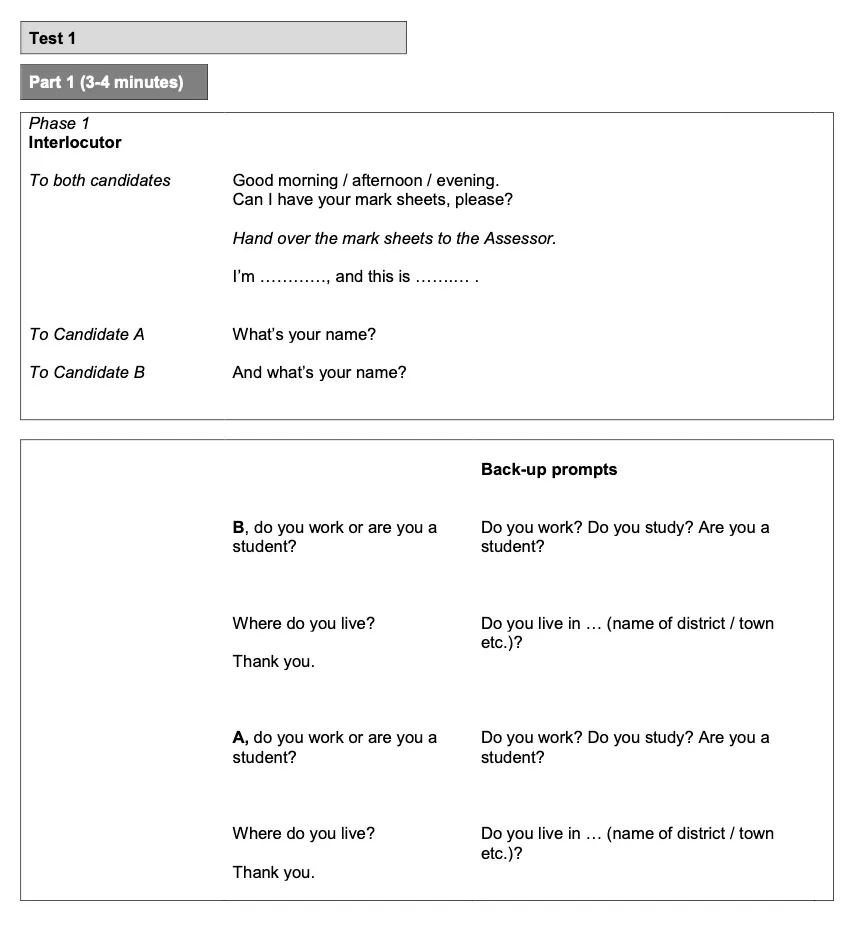
As you can see in the Interlocutor’s script, the questions in this phase are very basic and predictable:
- You’ll be asked your name.
- You’ll be asked your surname.
- You’ll be asked if you work or study.
- You’ll be asked where you live.
These are simple questions about personal information that any A2 level candidate should be able to answer without problem. The good thing about this phase is that, being always the same, you can have your answers prepared (though without memorising them word for word so they sound natural).
Part 1 – Phase 2
In the second phase, the Interlocutor introduces two different topics and asks more varied questions about each topic. These questions are about aspects of your daily life, your likes, your experiences, your activities, etc. They also include an Extended Response question in each topic, where you’re expected to give a slightly longer answer (at least 2-3 sentences in a row).
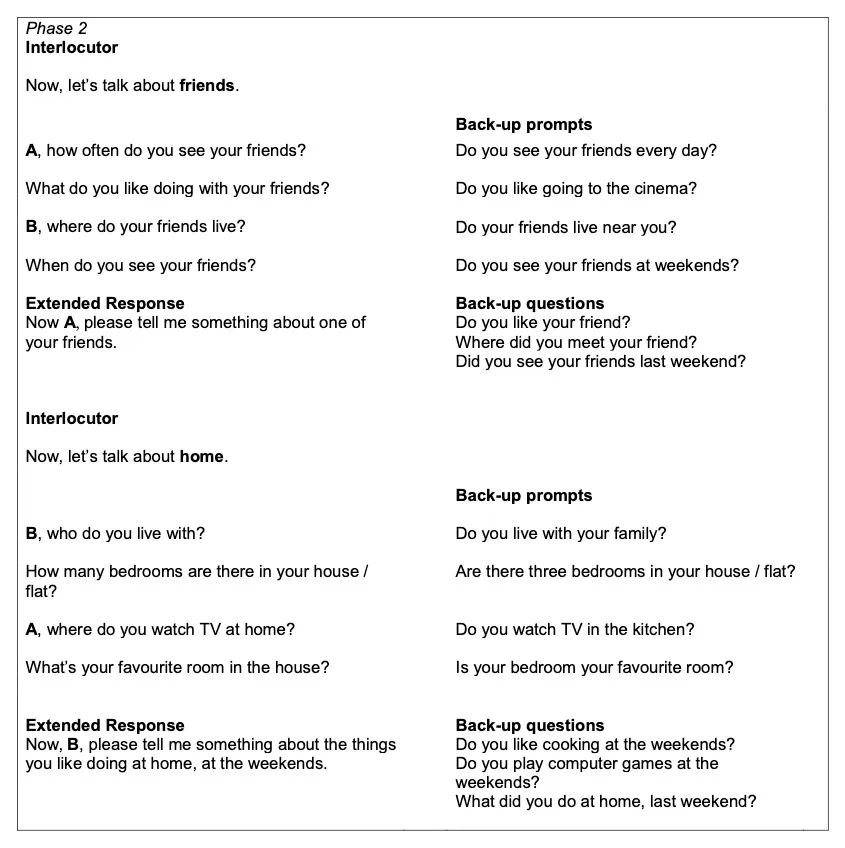
In the example you can see above, the two topics are friends and home. The Interlocutor asks questions alternating between the two candidates, and each candidate must answer the questions directed at them. At the end of each topic, there’s an extended response question where you’re expected to speak a bit more about that topic.
The questions in this phase are varied, but always revolve around familiar and everyday topics appropriate for A2 level: friends, family, home, work, studies, hobbies, food, sports, etc.
KET Speaking Part 2
Part 2 of the A2 Key Speaking test lasts 5-6 minutes and consists of a conversation between the two candidates based on visual prompts. It’s also divided into two phases.
Part 2 – Phase 1
In the first phase of Part 2, the Interlocutor places in front of you a page with several images on a specific topic (for example, different places to eat). Then he/she asks you to talk together about those images, expressing whether you like them or not and giving simple reasons.
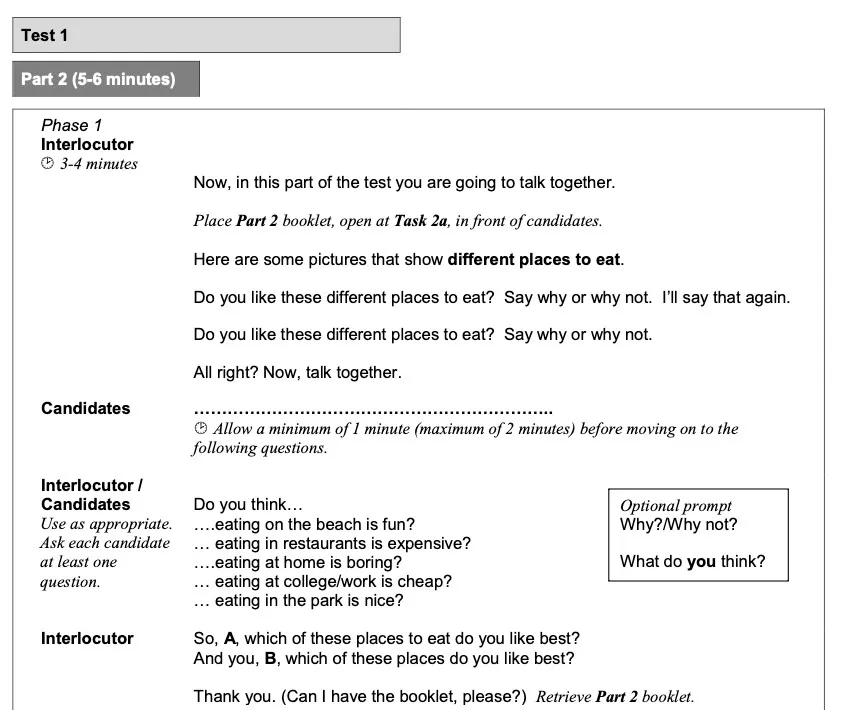
The aim of this phase is for the candidates to talk to each other for 1-2 minutes, expressing your opinions about the different options that appear in the images. The Interlocutor can ask you questions using adjectives from the images if you need help maintaining the conversation, but ideally you should interact naturally with each other.
In the example above, the images show different places to eat: in the park, on the beach, in a restaurant, in a college/work cafeteria, and at home. Candidates must talk about these options, saying which they like and which they don’t, and why.
At the end of this phase, the Interlocutor asks each of you which is your favourite option.
Part 2 – Phase 2
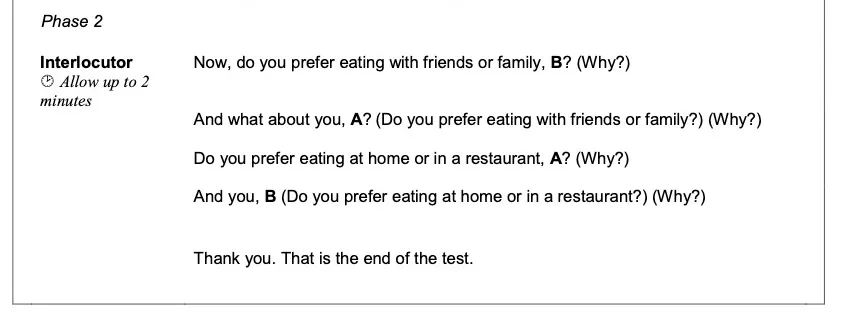
In the second phase of Part 2, the Interlocutor removes the images and asks broader questions related to the topic of the previous phase. These questions are more personal and allow candidates to speak more freely about their preferences and experiences.
As you can see in the example, the questions in this phase are related to the topic of eating (which was the topic of the images in phase 1), but are more general and personal:
- Do you prefer eating with friends or family?
- Do you prefer eating at home or in a restaurant?
The Interlocutor asks these questions alternating between the two candidates, allowing you both to participate and express your opinions.
A2 Key (KET) Speaking Examples
Now that you know the structure and format of the exam, let’s look at specific conversation examples so you can better understand how it works in practice. I’m going to simulate dialogues between the Interlocutor and two candidates (Candidate A and Candidate B) using the questions and images we’ve seen previously.
A2 Key Speaking: Part 1
Let’s now see a complete example of what Part 1 of the exam would be like, with both phases:
Part 1 – Phase 1
Interlocutor: Good morning / afternoon / evening.
Candidates A & B: Good morning / afternoon / evening.
Interlocutor: Can I have your mark sheets, please? (Candidates hand over the sheets) Thank you. I’m Sarah Johnson, and this is my colleague, Mark Thompson. (The Assessor smiles and nods)
Interlocutor: What’s your name?
Candidate A: My name’s Elena.
Interlocutor: And what’s your name?
Candidate B: I’m Pablo.
Interlocutor: Elena, do you work or are you a student?
Candidate A: I’m a student.
Interlocutor: Where do you live, Elena?
Candidate A: I live in Madrid.
Interlocutor: Thank you. Pablo, do you work or are you a student?
Candidate B: I work. I work in a shop.
Interlocutor: Where do you live, Pablo?
Candidate B: I live in Madrid too, in the centre.
Interlocutor: Thank you.
Part 1 – Phase 2
Interlocutor: Now, let’s talk about friends. Elena, how often do you see your friends?
Candidate A: I see my friends every day at school.
Interlocutor: What do you like doing with your friends?
Candidate A: I like going to the cinema with them, or we sometimes go shopping.
Interlocutor: Pablo, where do your friends live?
Candidate B: My friends live near my house, in the same area.
Interlocutor: When do you see your friends?
Candidate B: I see my friends at weekends, usually on Saturday.
Interlocutor: Now Elena, please tell me something about one of your friends.
Candidate A: Well, my best friend is called Ana. She’s very funny and we like the same music. We met at school five years ago and we do lots of things together.
Interlocutor: Thank you. Now, let’s talk about home. Pablo, who do you live with?
Candidate B: I live with my family, with my parents and my brother.
Interlocutor: How many bedrooms are there in your house?
Candidate B: There are three bedrooms in my flat.
Interlocutor: Elena, where do you watch TV at home?
Candidate A: I watch TV in the living room, with my family.
Interlocutor: What’s your favourite room in the house?
Candidate A: My favourite room is my bedroom because it’s quiet and I can study there.
Interlocutor: Now, Pablo, please tell me something about the things you like doing at home, at the weekends.
Candidate B: At weekends at home, I like playing computer games in my room. I also like cooking with my mother on Sunday. Sometimes I watch films with my brother.
Interlocutor: Thank you.
Useful Expressions for A2 Speaking Part 1
Now that you’ve seen an example conversation from Part 1, I’m going to give you a list of useful expressions you can use to answer the Interlocutor’s questions. Remember that this is A2 level, so the expressions are simple and straightforward.
Talking about yourself:
- My name’s…
- I’m…
- I’m … years old.
- I’m a student.
- I work in/at…
- I live in… (city/town)
- I live with my family/parents/friends.
Talking about frequency:
- every day
- every week/weekend
- once/twice a week
- at weekends
- on Saturdays
- sometimes
- usually
- often
Talking about likes:
- I like (doing)…
- I love (doing)…
- I don’t like (doing)…
- I enjoy (doing)…
- My favourite… is…
Describing people and places:
- He/She is very funny/nice/friendly.
- It’s big/small/quiet/beautiful.
- There is/are…
- I have…
Connecting ideas (basic connectors):
- and
- but
- because
- also
- too
- or
- sometimes
Tips for A2 Speaking Part 1
Now I’m going to give you some practical tips so your Part 1 goes smoothly:
- Prepare your basic answers: Since Phase 1 is always the same, you can prepare your answers in advance about your name, where you live, whether you work or study, etc. But don’t memorise them word for word, because it will sound unnatural.
- Don’t just answer with «yes» or «no»: Always try to give a complete answer. For example, if they ask you «Do you like your friends?», don’t just say «Yes», but rather «Yes, I like my friends because they are very funny.»
- For the Extended Response, say at least 2-3 sentences: When asked to talk about something (for example, «tell me something about one of your friends»), try to give an answer of at least 2-3 sentences. It doesn’t need to be very long, but it should be somewhat more extensive than normal answers.
- If you don’t understand something, ask them to repeat it: There’s no problem in saying «Sorry, can you repeat, please?» or «I don’t understand.» It’s better to ask for clarification than to remain silent or answer something that doesn’t make sense.
- Use simple but appropriate vocabulary: Don’t try to use very complicated words that you don’t know well. It’s better to use simple vocabulary correctly than advanced words incorrectly.
- Relax and smile: Remember that the examiner isn’t there to catch you out, but to assess your level. A positive attitude and a smile always help.
- Answer with complete sentences: Try to use complete sentences rather than very short answers. For example, instead of just saying «Madrid», say «I live in Madrid.»
A2 Key Speaking: Part 2
Now let’s see an example of what Part 2 of the exam would be like, with its two phases. Remember that in this part you mainly have to talk to each other (the two candidates), not to the examiner.
Part 2 – Phase 1
Interlocutor: Now, in this part of the test you are going to talk together. (Places the images in front of the candidates) Here are some pictures that show different places to eat. Do you like these different places to eat? Say why or why not. I’ll say that again. Do you like these different places to eat? Say why or why not. All right? Now, talk together.
(The candidates look at the images for a few seconds)
Candidate A: So, what do you think about eating on the beach?
Candidate B: I think eating on the beach is nice because you can see the sea. What about you?
Candidate A: Yes, I like it too. It’s fun. Do you like eating in the park?
Candidate B: Mmm, I don’t know. Sometimes it’s nice, but sometimes there are insects. What do you think?
Candidate A: I think it’s good for a picnic with friends. And eating at home? Do you like it?
Candidate B: Yes, I like eating at home because the food is healthy and it’s cheaper. What about eating in a restaurant?
Candidate A: I like eating in restaurants but it’s expensive. It’s good for special days.
Candidate B: Yes, I agree. And what about the college cafeteria? Do you like it?
Candidate A: It’s OK. It’s quick and easy, but the food is not very good.
Candidate B: Yes, that’s true.
(After 1-2 minutes, the Interlocutor intervenes)
Interlocutor: So, Elena, which of these places to eat do you like best?
Candidate A: I think I like eating on the beach best because it’s relaxing and fun.
Interlocutor: And you, Pablo, which of these places to eat do you like best?
Candidate B: I like eating at home best because the food is better and it’s comfortable.
Interlocutor: Thank you.
Part 2 – Phase 2
(The Interlocutor removes the images)
Interlocutor: Now, do you prefer eating with friends or family, Pablo?
Candidate B: I prefer eating with my family because we talk about our day and it’s nice.
Interlocutor: And what about you, Elena? Do you prefer eating with friends or family?
Candidate A: I like both, but I prefer eating with friends because we have fun and laugh a lot.
Interlocutor: Do you prefer eating at home or in a restaurant, Elena?
Candidate A: I prefer eating at home because my mum cooks very well and it’s more relaxing.
Interlocutor: And you, Pablo? Do you prefer eating at home or in a restaurant?
Candidate B: I prefer eating in a restaurant sometimes because I like trying new food, but usually I eat at home.
Interlocutor: Thank you. That is the end of the test.
Useful Expressions for A2 Speaking Part 2
Part 2 requires you to interact with your partner, so it’s essential that you know expressions for asking opinions, giving your opinion, agreeing or disagreeing, etc. Here’s a list of useful expressions for this part:
Starting the conversation:
- What do you think about…?
- Do you like…?
- Shall we start?
- Let’s talk about…
Giving your opinion:
- I think…
- I like… because…
- I don’t like… because…
- I prefer… because…
- In my opinion,…
- For me,…
Asking your partner’s opinion:
- What do you think?
- What about you?
- Do you like…?
- Do you agree?
- And you?
Agreeing:
- Yes, I agree.
- I think so too.
- Yes, that’s true.
- Me too.
- Yes, you’re right.
Disagreeing (politely):
- I don’t know…
- Maybe, but…
- I’m not sure…
- I don’t think so.
- I prefer…
Giving reasons:
- because…
- because it’s…
- It’s good/bad/nice/expensive/cheap/healthy…
Keeping the conversation going:
- What about…?
- And… ?
- Also,…
- Yes, but…
Tips for A2 Speaking Part 2
Here are some important tips to help Part 2 go well:
- Talk to your partner, not to the examiner: This part consists of you talking to each other. Look at your partner, ask them questions, answer their questions. The examiner is only there to observe.
- Don’t be afraid to start: If your partner doesn’t start the conversation, start it yourself. You can say something simple like «What do you think about eating on the beach?» or «Do you like this one?»
- Ask your partner questions: It’s very important not to give a monologue. After giving your opinion, ask your partner what they think. Use expressions like «What about you?» or «Do you agree?»
- You don’t need to talk about all the images: It’s not necessary to talk about all the options that appear in the images. It’s better to talk well about 3-4 options than to try to talk about all of them superficially.
- Give reasons when expressing your opinion: Don’t just say «I like it» or «I don’t like it». Say why. For example: «I like eating on the beach because it’s fun and relaxing.»
- Help your partner if they need it: If you see that your partner goes quiet or doesn’t know what to say, help them by asking a simple question.
- Don’t worry if the examiner interrupts you: After 1-2 minutes, the examiner will interrupt you to ask the final questions of Phase 1 and then those of Phase 2. This is completely normal and part of the exam.
- Be polite and positive: Even if you disagree with your partner, be polite. You can say «Maybe, but I prefer…» instead of «No, you’re wrong.»
- Keep the conversation natural: Don’t take overly long turns. Alternate with your partner naturally, as if you were having a real conversation.
How the A2 Key (KET) Speaking Test is Assessed
One of the questions my students ask me most is: «How am I going to be assessed in the Speaking test?» And it’s normal, because unlike the other parts of the exam where you simply mark correct or incorrect answers, in Speaking the assessment is more subjective. That’s why I want to explain exactly what examiners take into account when assessing you.
The A2 Key Speaking test is assessed according to 4 main categories, and each examiner has a different role:
- The Assessor (the examiner who doesn’t speak) assesses three categories: Grammar and Vocabulary, Pronunciation, and Interactive Communication.
- The Interlocutor (the examiner who speaks with you) assesses only the Global Achievement.
Let’s now look in detail at each of these categories:
- Grammar and Vocabulary: Your ability to use appropriate vocabulary and simple grammatical structures (present simple, past simple, basic questions, comparatives) to talk about everyday situations is assessed. Perfection isn’t expected, but basic control of grammar and vocabulary relevant to the task is.
- Pronunciation: The main criterion is intelligibility, that is, whether you’re understood well when you speak. Interference from your mother tongue is accepted as long as it doesn’t negatively affect communication. Different varieties of English (British, American, Australian, etc.) are accepted.
- Interactive Communication: Your ability to maintain simple exchanges with the interlocutor and with your partner through questions and answers is assessed. Short answers (1-7 words) are sufficient in most cases, except in the extended response in Part 1 (2-3 utterances). Asking for repetition or clarification when needed is valued positively.
- Global Achievement: This mark is given by the interlocutor and reflects your overall effectiveness in all parts of the test. It focuses on your ability to convey meaning and communicate in familiar everyday situations, regardless of specific grammatical or pronunciation errors.
Well, that’s everything. I hope this complete guide to the A2 Key Speaking test has helped you understand exactly what the exam is like, what’s expected of you in each part, and how you can prepare in the best possible way. Remember that A2 is a basic level, so don’t stress about trying to speak perfectly or at an advanced level. The important thing is that you can communicate in a simple and natural way in everyday situations, and that you demonstrate you can interact with other people in English.
If you practise regularly, prepare your basic answers, learn the useful expressions I’ve given you, and follow the tips in this guide, I’m sure your A2 Key Speaking test will go brilliantly.
And until next time, don’t forget to keep smiling! 😊