A2 Key (KET) Reading: A Complete Guide for Teachers and Candidates
Discover everything about the Reading section of the A2 Key (KET): the 5 parts of the exam, examples, practical tips, and strategies to pass successfully.

Table of contents
The A2 Key is one of the most popular Cambridge exams among young learners and adults who are starting their English learning journey. It is the first step in the Cambridge Assessment English exams and represents a basic but fundamental level. In this article, I will explain everything you need to know about the Reading for the A2 Key (KET), which is part of the Reading and Writing paper for this elementary-level exam.
A2 Reading: What is the level like?
As I always do in these types of guides, first we will look at exactly what is expected in terms of reading (reading) according to the Common European Framework of Reference for Languages (CEFR), and then I will focus on the Reading exam itself.
In Reading (comprehension), an A2 level speaker can usually understand short, simple texts on everyday topics and locate specific and predictable information (for example, timetables, prices, directions).
What you can understand at A2 level
- Brief texts with frequent vocabulary on immediate needs (shopping, work, family, environment).
- Concrete information in everyday materials (adverts, menus, signs, brochures, timetables).
- Simple messages and very basic personal correspondence (for example, short notes or emails with direct language).
Typical A2 difficulties
- Comprehension usually decreases if the text is long, uses complex structures, or includes abstract or infrequent vocabulary.
- It is also common to rely more on context, cognates, and keywords than on a «fine» understanding of all the nuances.
Common exam tasks (A2)
- «Matching» adverts/signs with needs («Where can I buy X?»).
- True/false or multiple-choice questions about short texts (descriptions, emails, notes).
- Locating data: date, time, place, price, requirement, instruction.
As you can see, at a Reading A2 level, you are expected to understand very basic and everyday texts. Notice that the words «brief», «simple», «everyday», «frequent use», etc., are highlighted. It’s a fundamental yet accessible level for anyone starting with English.
And now that we know the A2 level of reading comprehension as defined by the CEFR, let’s review the A2 Key Reading exam, with its updated format.
What the A2 Key Reading is Like
The A2 Key Reading has the following characteristics:
- Duration: 1 hour (shared with Writing)
- Parts: 5 Reading parts
- Number of items: 30 Reading questions
- Score: 30 points in total
Important note: Although the Reading and Writing are done in the same paper and share the one-hour duration, in this article we will only talk about the Reading. I recommend dedicating approximately 40 minutes to the Reading, leaving about 20 minutes for the Writing.
A2 Key: Reading Part 1
The first part of the A2 Key Reading consists of 6 multiple-choice questions with 3 possible answers (A, B, or C). Each question is an image with a short message: it could be a sign, an advertisement, a text message, a brief email, product information, etc. You have to interpret each message and choose the appropriate answer, the only one that corresponds to the message in the image.
Below is an example of Reading Part 1 for the A2 Key:
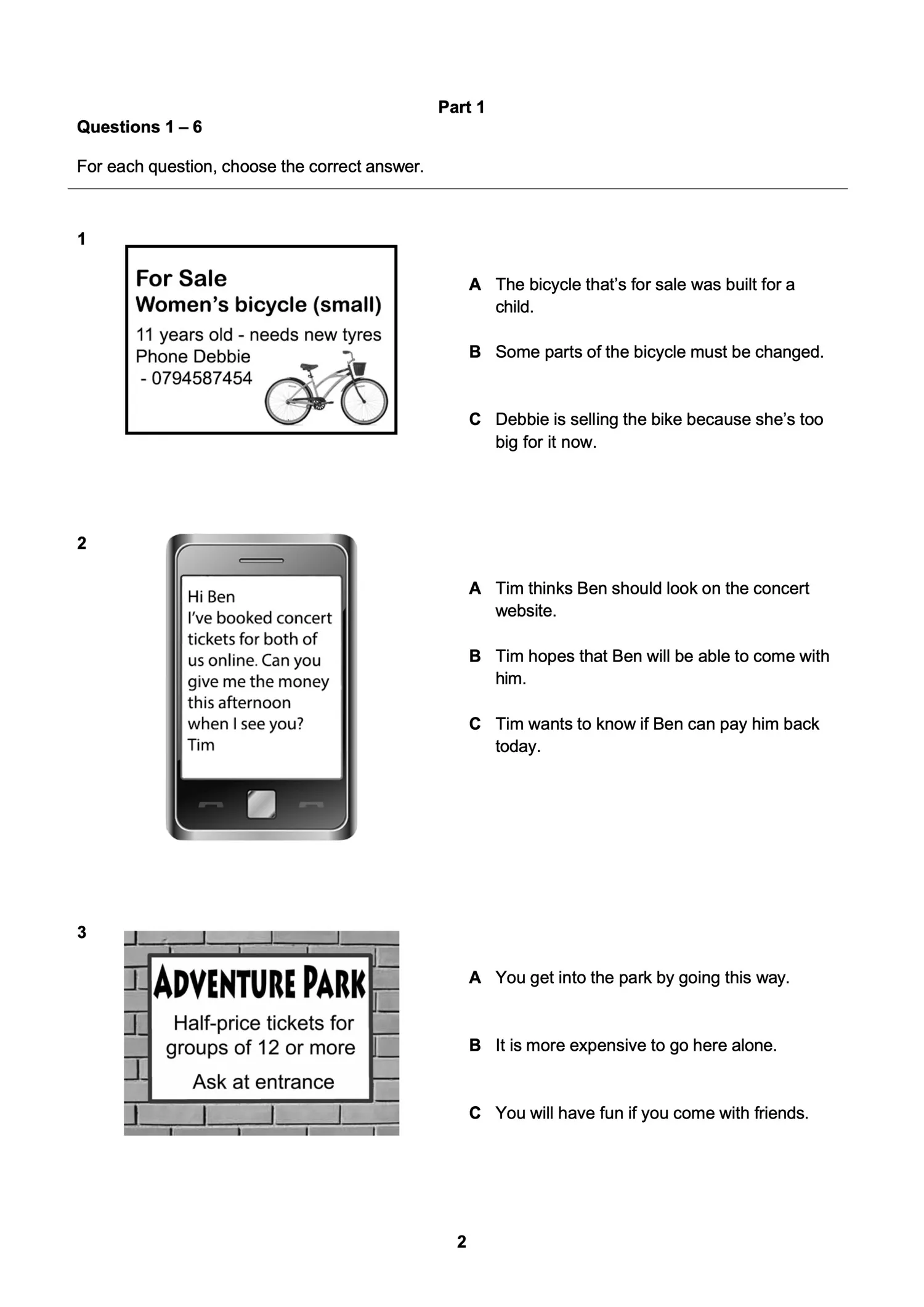
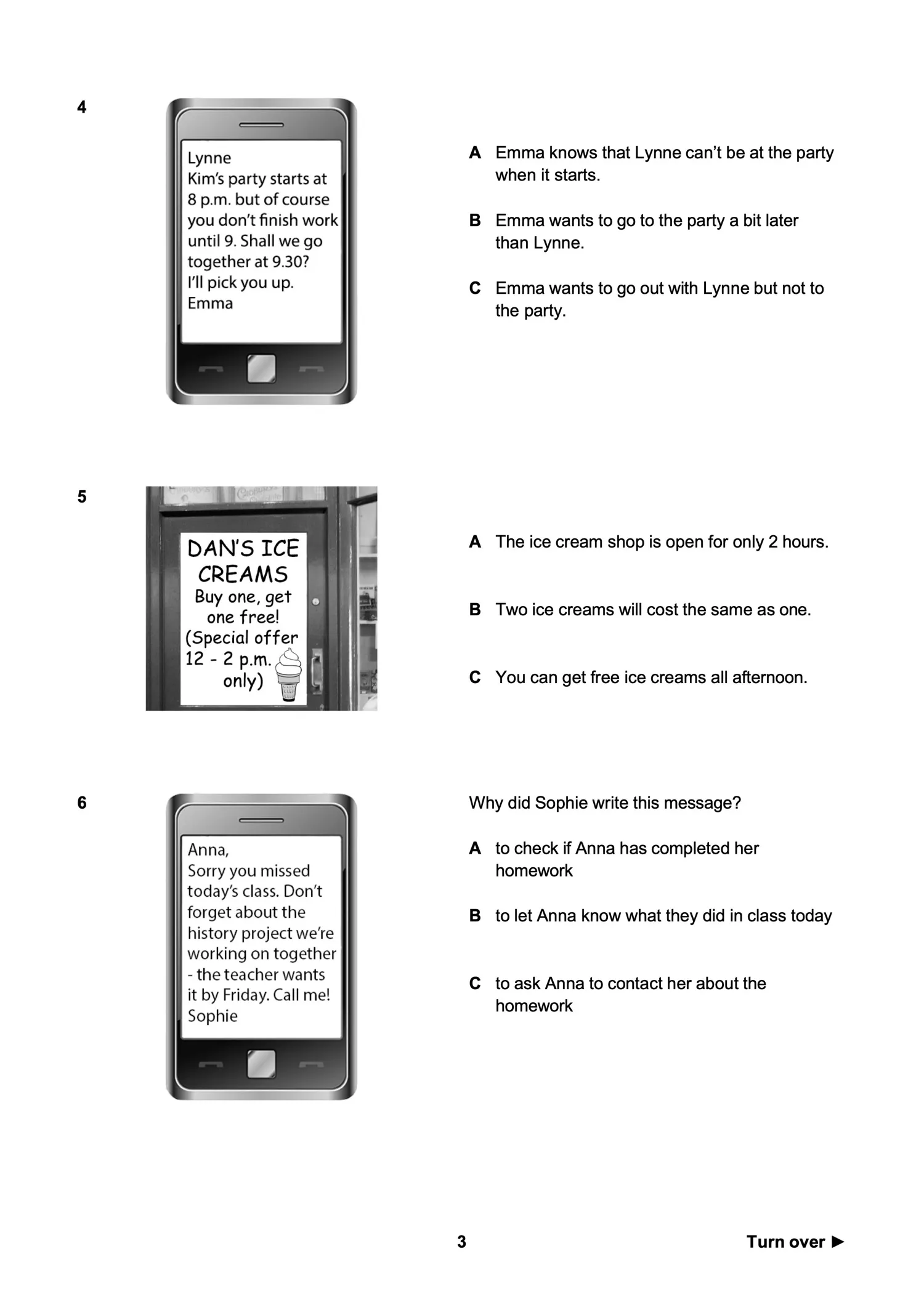
The focus of this part is on understanding specific messages and very short texts from the real world. Vocabulary and grammar are very important here, as there is little context from which to infer meaning. Therefore, if you don’t know a key word in one of the messages, you may not understand the correct meaning.
In my experience as a teacher, this part is usually quite manageable for students, although some questions can be tricky if not read carefully.
A2 Key: Reading Part 2
Part 2 of the A2 Key Reading is a multiple-matching task.
In this case, you have to read 7 questions and then 3 short texts on the same topic. The questions might be about people looking for something specific, or about specific needs. The three texts offer related information, such as descriptions of places, products, activities, etc.
What you have to do is match each of the 7 questions with one of the 3 texts (A, B, or C). Obviously, some texts will be used more than once.
Below is an example of A2 Reading Part 2:
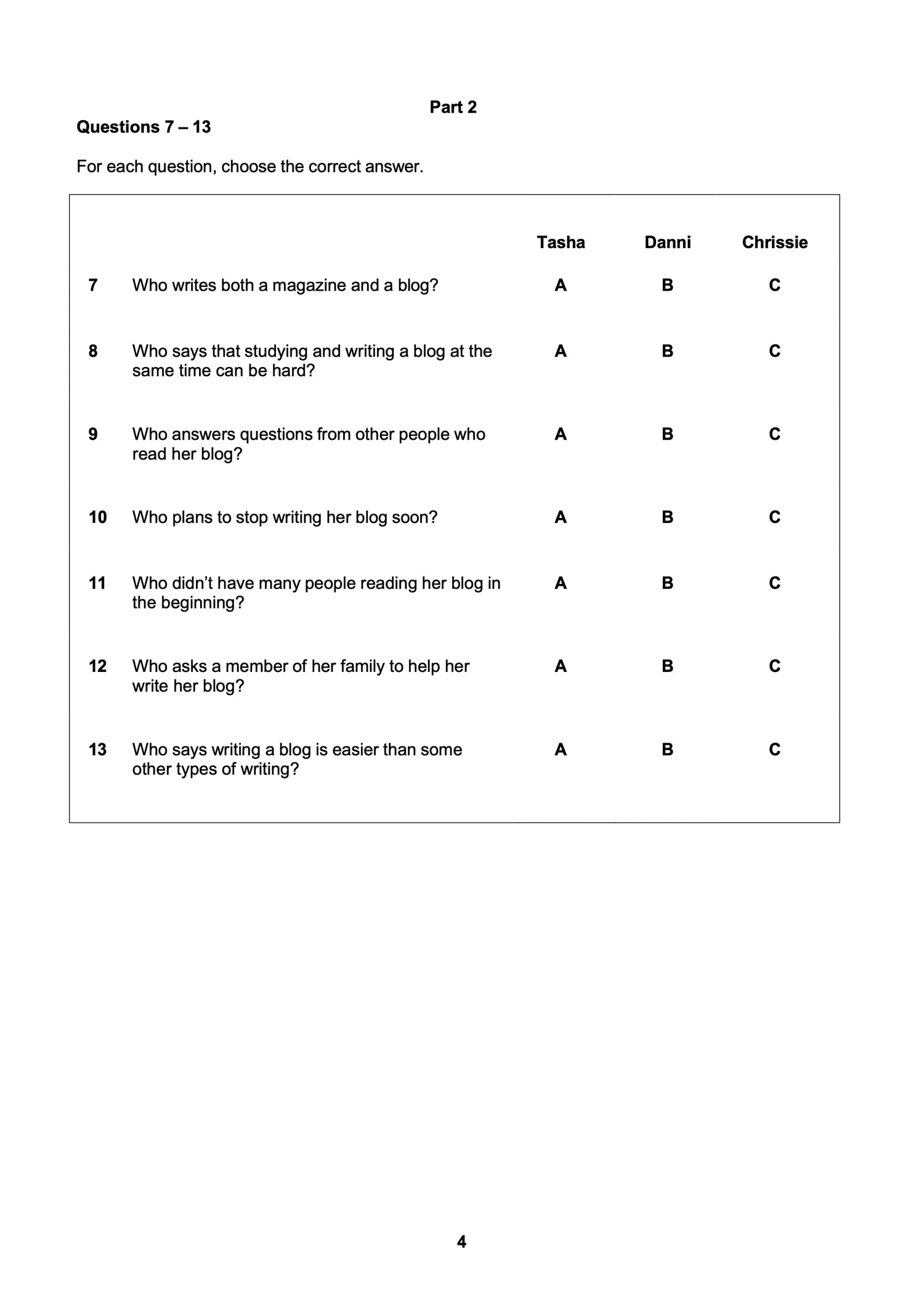
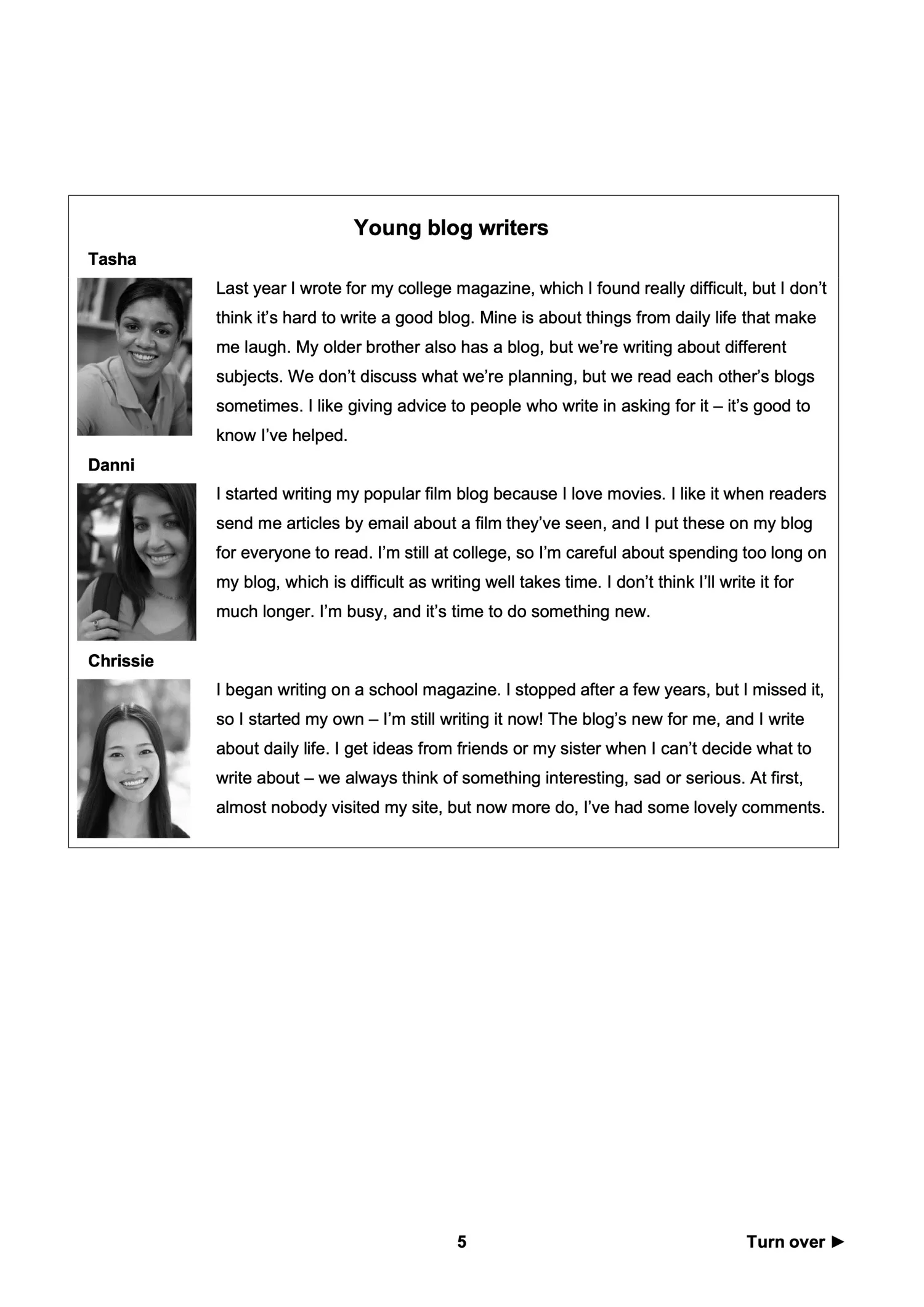
The easiest way to do this type of activity is to first focus on the questions and underline the key points that will give you the answer. For example, if a question says «Who wants to find a place that is open in the evening?«, you should look for information in the texts about evening opening hours.
Afterwards, you will have to search the three texts for information that best matches each question.
A2 Key: Reading Part 3
Reading Part 3 of the A2 Key is a classic task of a text with multiple-choice questions. In this case, it is a medium-length text (longer than in the previous parts) with 5 multiple-choice questions with 3 possible answers (A, B, or C).
This text could be an adapted article from a magazine, a blog, a short story, or information about a person or event. The questions assess both the understanding of specific details and the overall comprehension of the text.
Let’s look at an example of a text with multiple-choice questions:
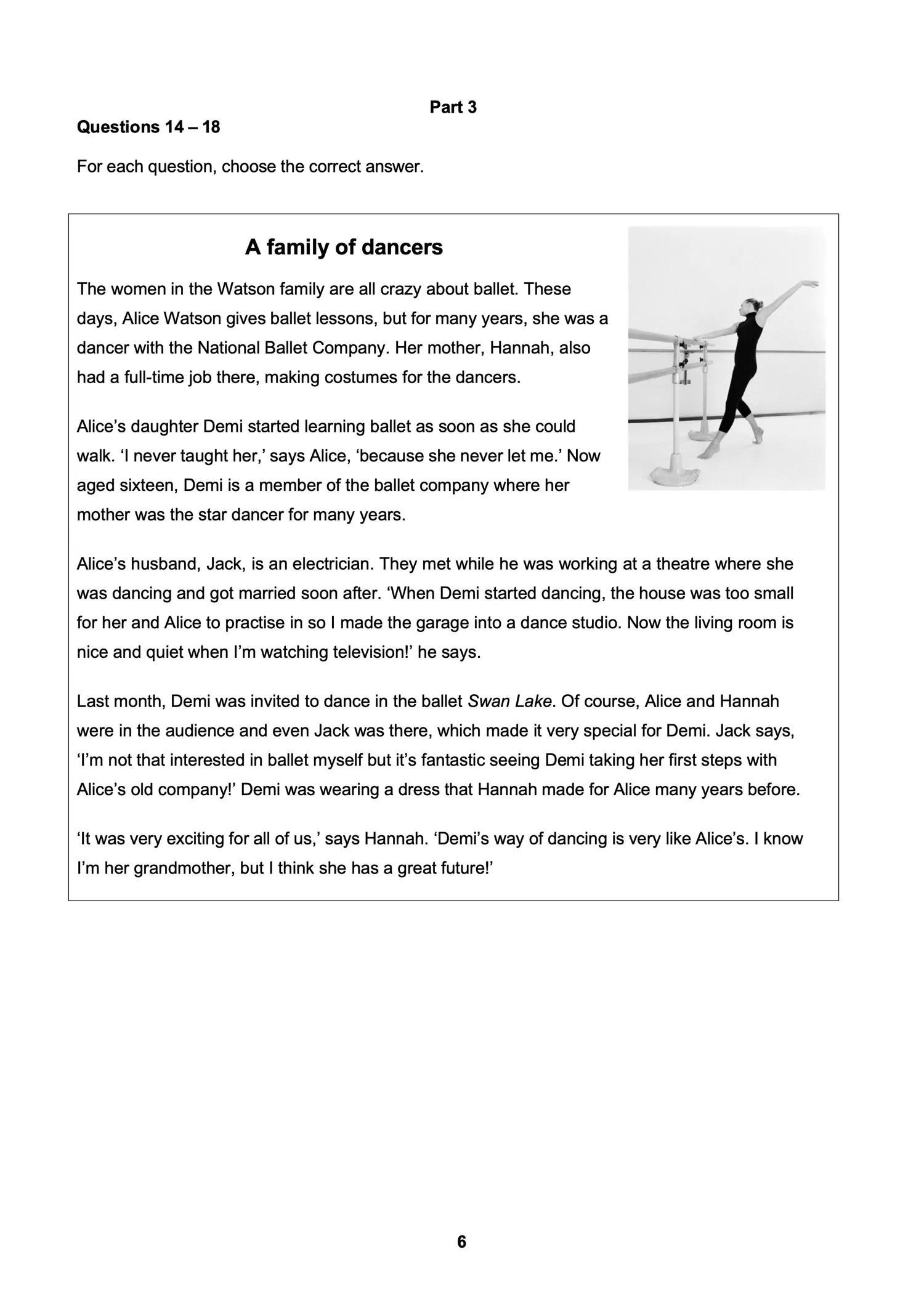
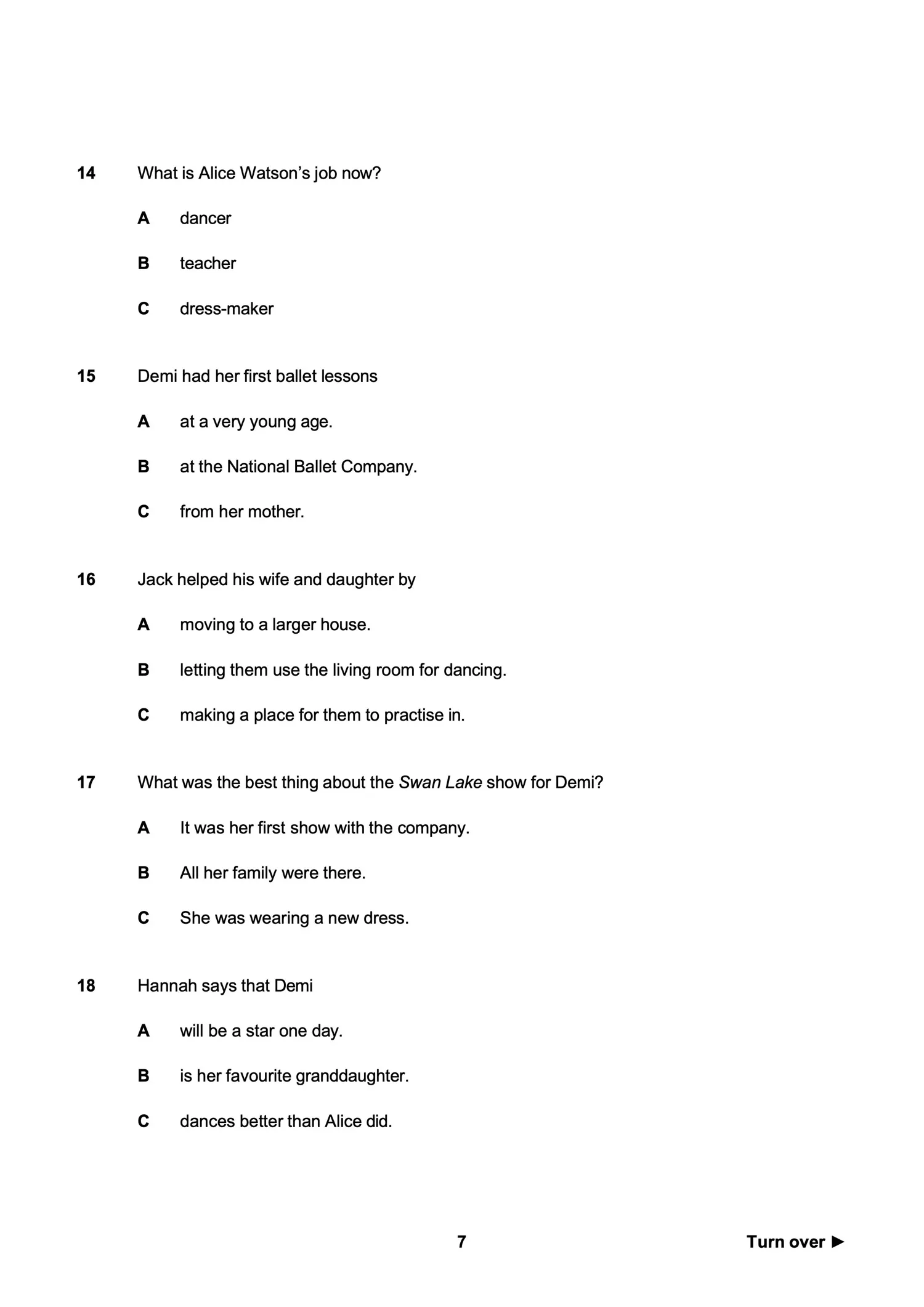
My advice for this part is to first skim the text to get a general idea of what it’s about. Then, read the questions one by one and go back to the text to find the specific information you need. Don’t try to remember the entire text by heart.
A2 Key: Reading Part 4
Part 4 of the A2 Key Reading is a vocabulary-in-context exercise.
In this part, candidates have to read a text with 6 gaps. For each gap, there are 3 word options (A, B, or C), and only one is correct. The text is usually informative or narrative, and the missing words are mainly vocabulary (nouns, verbs, adjectives, adverbs), although there may also be some grammatical words.
Let’s see an example:
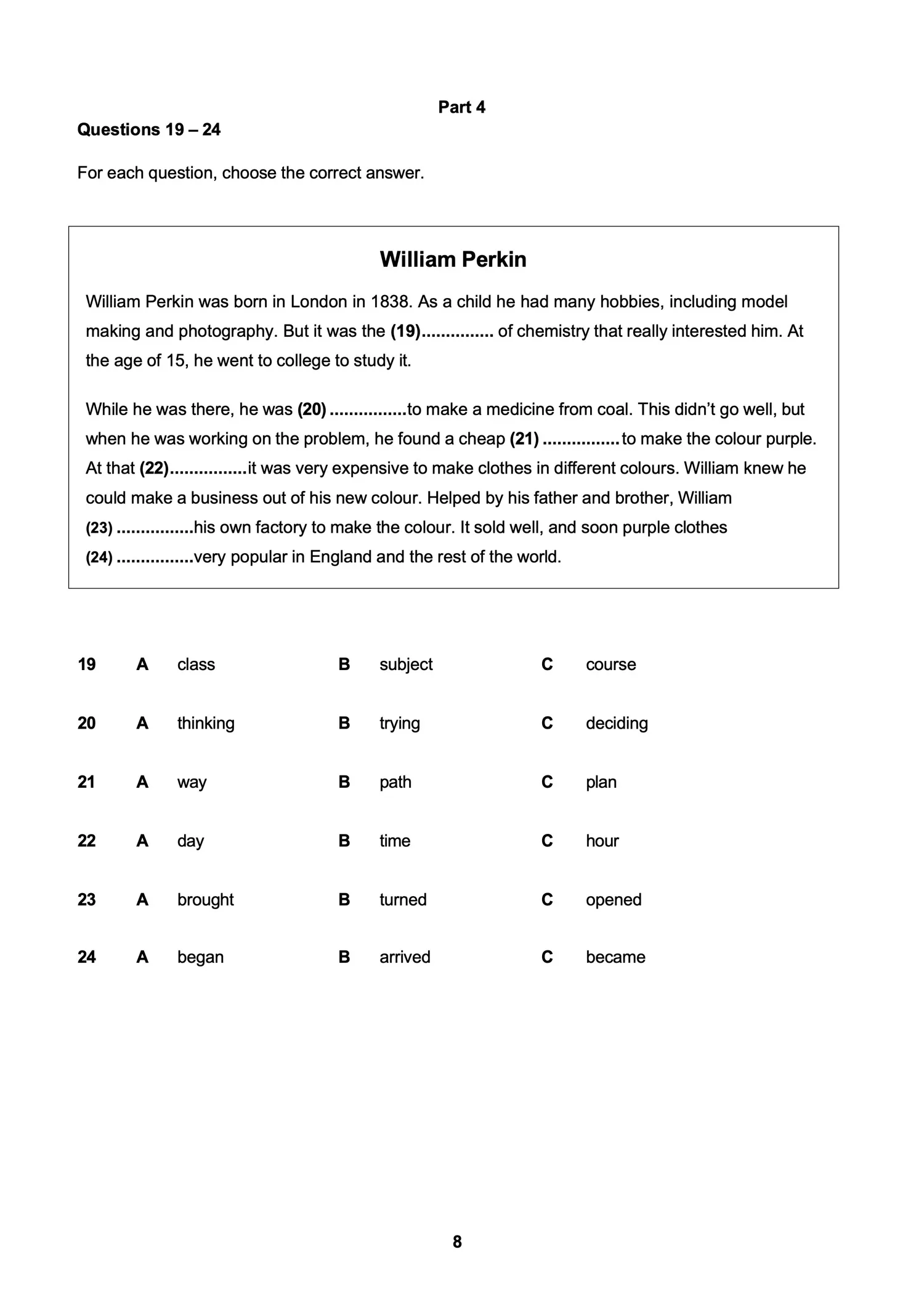
The important thing in this part is to read the entire sentence where the gap is, not just the words immediately before and after. Sometimes the context of the whole sentence, or even the paragraph, will help you choose the correct word.
It is also essential that, once all the gaps are filled, you reread the entire text to make sure it makes sense.
A2 Key: Reading Part 5
And we come to the final part of the A2 Key Reading. In this part, you have to fill 6 gaps in a text, which is usually an email or message. In each gap, you can write only one word, and this time you are not given options.
Basically, this part is assessing your basic grammatical knowledge of English. The words you will need to use will be mainly grammatical words such as prepositions, articles, pronouns, auxiliary verbs, conjunctions, etc.
Here is an example:
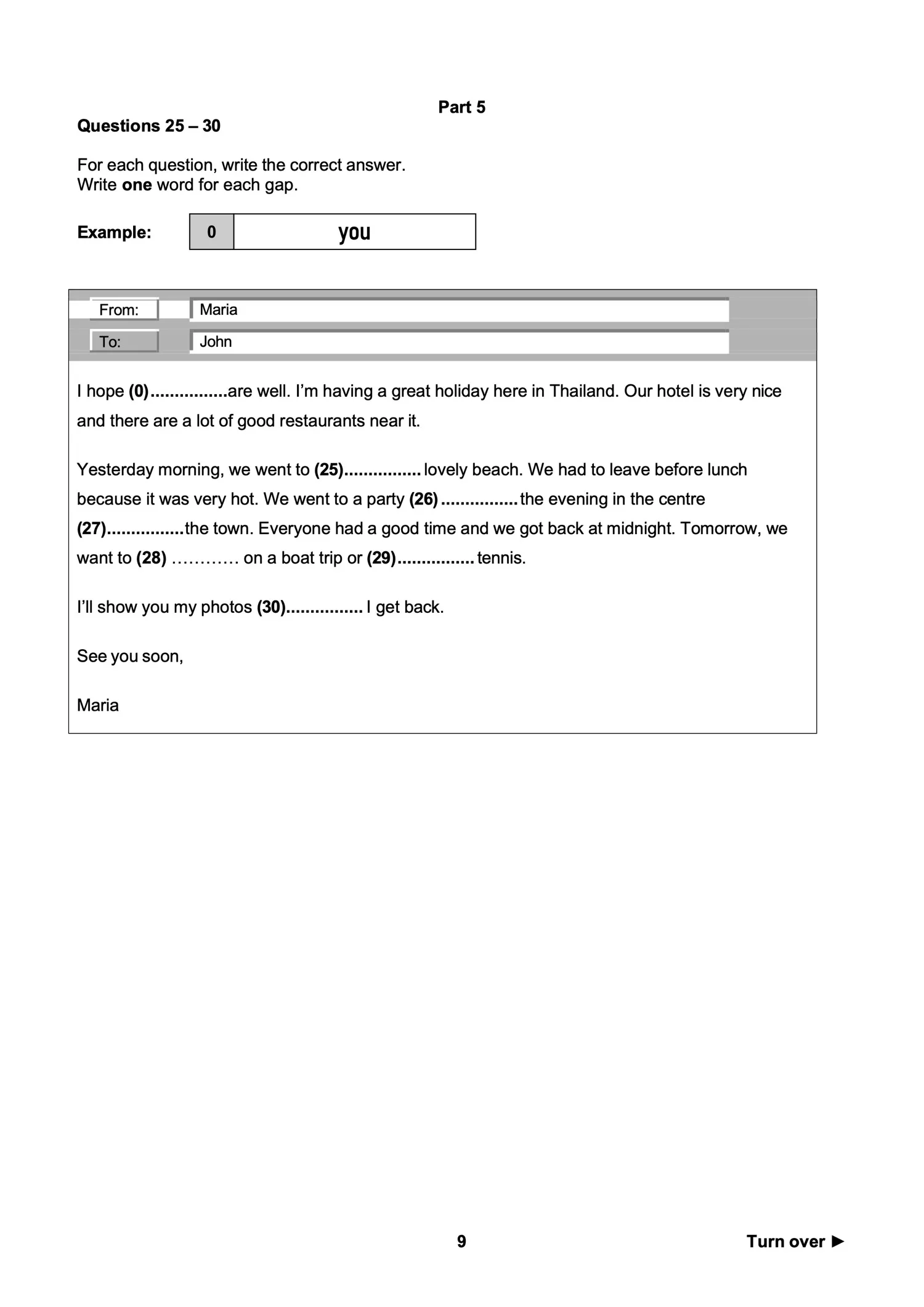
To do well in this part, it is essential that you read the entire text first to understand the context. Then, for each gap, think about what type of word is missing (a preposition? an article? a pronoun?) and write the word that makes the most sense.
Important: The spelling must be correct. If you spell a word incorrectly, you will not get the point even if the word is the correct one.
How the A2 Key Reading is Assessed
To know if you have passed this part of the A2 Key is very simple, as each question is worth 1 point. Since there are 30 Reading questions in total, the maximum score is 30 points.
However, the Reading and Writing paper counts as a single paper in the exam, and the points are combined with the Writing points to give a total score. In general, you need to get approximately 70% of the answers correct across the entire Reading and Writing paper to pass with an A2 level.
I recommend that you read more information about how the A2 Key is assessed in general, where I explain part by part how the scoring for the entire exam works.
Tips for the A2 Key Reading
Reading is a fundamental skill that is often neglected, especially when students are more concerned with Speaking or Listening. However, improving your Reading is easier than you think. Here are my best tips and strategies:
- Read a lot and regularly: It’s obvious, but few people actually do it. I don’t recommend reading materials far above an A2 level, so forget about reading Harry Potter in English for now. The best thing is to read graded readers at an A2 or Pre-Intermediate level. These books are specially written or adapted for English learners and are perfect for your level.
- Read short real-world texts: Messages on social media, signs, advertisements, simple instructions, restaurant menus, etc. Get used to reading these types of texts in English in your daily life. You can change the language of your mobile phone to English, for example.
- Practise skimming and scanning: Skimming is reading quickly to get the general idea, and scanning is looking for specific information. Both techniques are fundamental for the exam. Practise by reading texts and timing yourself.
- Underline key information: In the exam, you can underline or make marks on the question paper (not on the answer sheet). This will help you enormously, especially in Parts 2, 3, and 4.
- Don’t obsess over unknown words: At the A2 level, it’s normal to find words you don’t know. The important thing is to learn to guess the meaning from the context, or simply to ignore words that are not important for answering the questions.
- Watch series and films with English subtitles: Reading subtitles will help you improve your reading speed and learn vocabulary in context. For an A2 level, I recommend simple series or films, or even content for children, which usually has more basic language.
- Do timed practice exercises: Get used to doing the Reading tasks while timing yourself. Remember that you have approximately 40 minutes to complete the 5 parts of the Reading, so practise managing your time.
- Read the instructions very carefully: In the exam, make sure you read what is being asked of you in each part. Use the examples to better understand the task.
- Create thematic vocabulary lists: Organise new vocabulary by topics (food, travel, hobbies, work, etc.). This will help you remember it better and activate it more easily when you need it.
In summary, the A2 Key Reading is a very manageable part of the exam if you practise regularly and become familiar with the format. You don’t need a very advanced level of English, but you do need to be comfortable reading simple, everyday texts in English.
Remember that the key is constant practice and exposing yourself to written English as much as possible in your day-to-day life. Good luck with your preparation!
And don’t forget to keep smiling!