
A2 Key Listening Guide for Teachers and Candidates
Complete guide to succeed in the A2 Key (KET) Listening: format, 5 parts of the exam, examples, assessment, and practical tips.

Table of contents
The A2 Key is one of the most popular Cambridge exams among young people and adult students who are starting their journey in learning English. It is the first step within the Cambridge Assessment English exams and represents a basic but fundamental level. In this article, I am going to explain everything you need to know about the Listening part of the A2 Key (KET), one of the most important papers of this elementary level exam.
A2 Listening: What is the level?
As I always do in these types of guides, first we will look at exactly what is expected in terms of listening comprehension (listening) according to the Common European Framework of Reference for Languages (CEFR), and then I will focus on the Listening exam itself.
In Listening (auditory comprehension), an A2 level speaker can understand key words and grasp the general idea of clear, slow messages on everyday and predictable topics, provided there is repetition or visual support.
What you can understand at A2 level
- Simple and clear instructions (in person or recorded).
- Basic information in public announcements or short recordings (timetables, prices, dates, places).
- Slow and clear conversations about familiar topics (personal introductions, shopping, directions, small talk).
- Identify speaker, location, situation, and general topic in short dialogues.
Typical A2 difficulties
- The natural speed of the language: A2 requires a rhythm slower than natural.
- Unfamiliar accent or non-standard pronunciation.
- Background noise or low-quality audio greatly reduces comprehension.
- Unfamiliar vocabulary or complex grammatical structures: even if it’s short, new words make it harder.
Common exam tasks (A2)
- Matching: listening to short dialogues and pairing them with images, topics, or options.
- True/false or multiple choice questions about information from short recordings.
- Gap filling: writing numbers, dates, times, names, or keywords after listening.
- Ordering: listening to events or instructions and arranging them in sequence.
Characteristics of A2 audio
- Duration: segments typically between 30–90 seconds.
- Pace: slow and clear, with pauses between phrases.
- Accents: standard or neutral (no very strong dialects).
- Topic: real but predictable situations (shop, station, school, home, basic work).
As you can see, at a Listening A2 level, you are expected to understand basic, everyday audio. Notice that the words «simple», «everyday», «slowly», «clarity», etc., are highlighted. It’s a fundamental yet accessible level for anyone starting with English.
And now that we know the A2 level of listening comprehension as defined by the CEFR, let’s review the A2 Key Listening exam, with its updated format.
What the A2 Key Listening exam is like
The A2 Key Listening exam has the following characteristics:
- Duration: Approximately 30 minutes (including 6 minutes to transfer answers in the paper-based exam, or 2 minutes to review in the digital exam)
- Parts: 5 Listening parts
- Number of items: 25 Listening questions
- Score: 25 points in total (1 point per question)
- Important: Each audio is heard TWICE
Important note: In the paper-based exam, you will have 6 minutes at the end to transfer your answers to the answer sheet. In the digital exam, you will have 2 minutes to review your answers at the end of the test.
A2 Key: Listening Part 1
The first part of the A2 Key Listening exam consists of 5 multiple-choice questions with 3 possible answers (A, B or C). Each question includes a short audio (a brief dialogue or monologue) and three images. You have to listen to each recording twice and choose the image that best answers the question.
The audios are very short (around 20-30 seconds each) and usually deal with everyday situations: where to meet someone, what time it is, what the weather is like, how much something costs, etc.
Below is an example of A2 Key Listening Part 1:
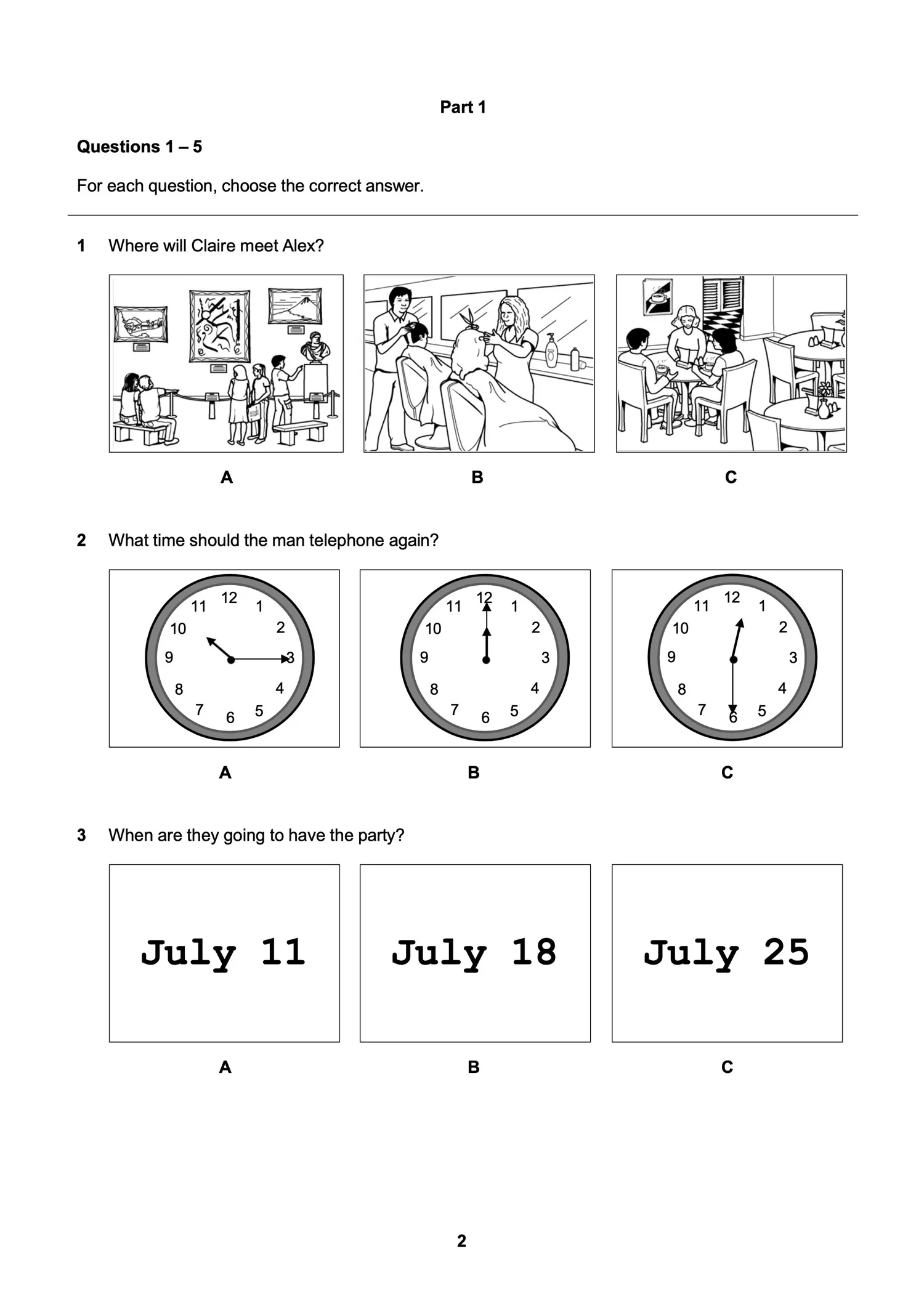
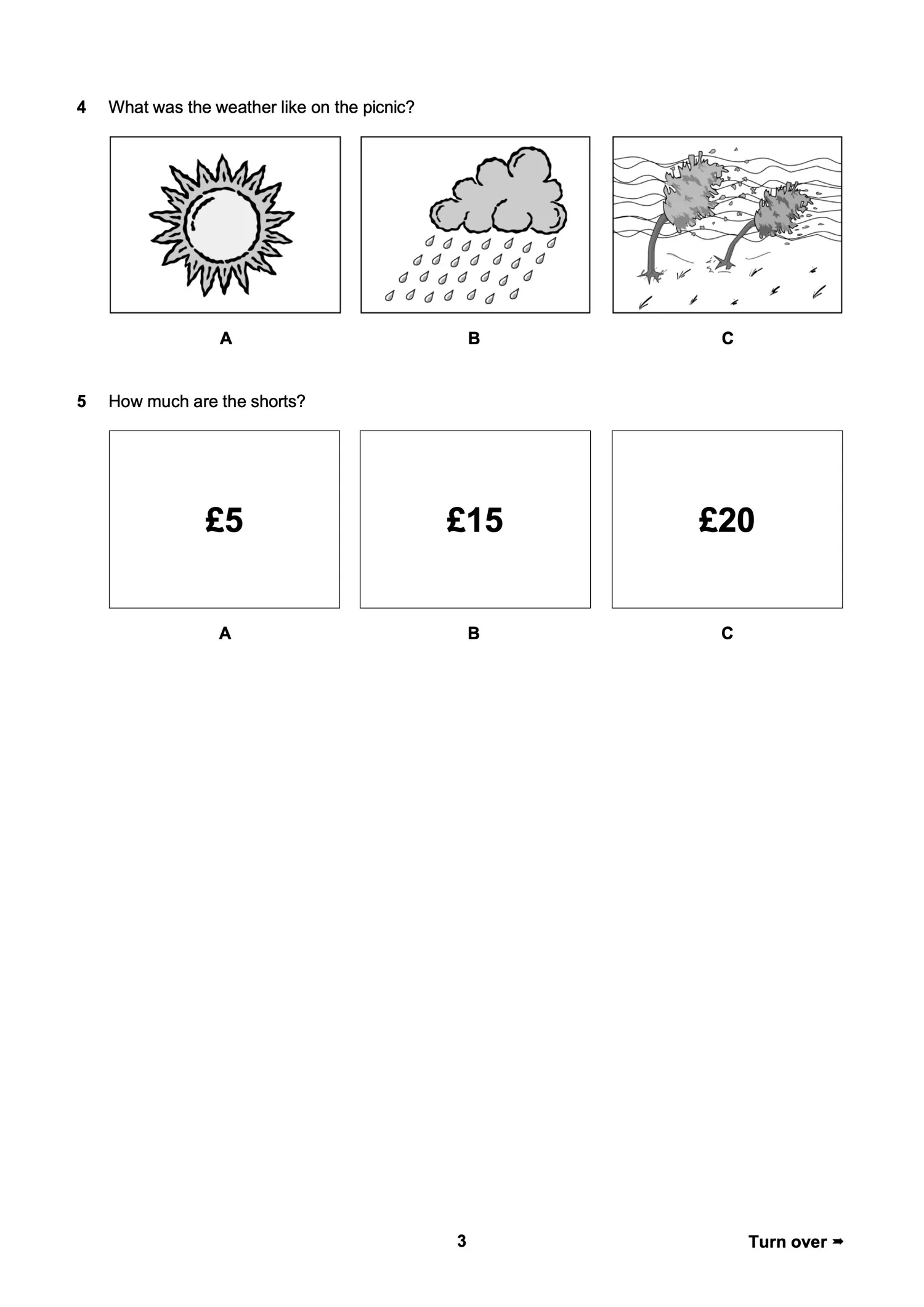
The focus of this part is on understanding key specific information in very short dialogues. It is essential that you listen carefully both times, because the key information usually appears in a very specific way.
In my experience as a teacher, this part is usually quite accessible for students, although it is important to read the question carefully before listening to the audio to know what specific information to look for.
A2 Key: Listening Part 2
Part 2 of the A2 Key Listening exam is a gap-fill task.
In this part, you have to listen to a monologue (a single person speaking) and complete 5 gaps on a notes page. The information you have to write may be: a word, a number, a date, or a time.
The monologue is usually about practical information: event announcements, information about summer jobs, timetables, instructions, etc.
Below is an example of A2 Listening Part 2:
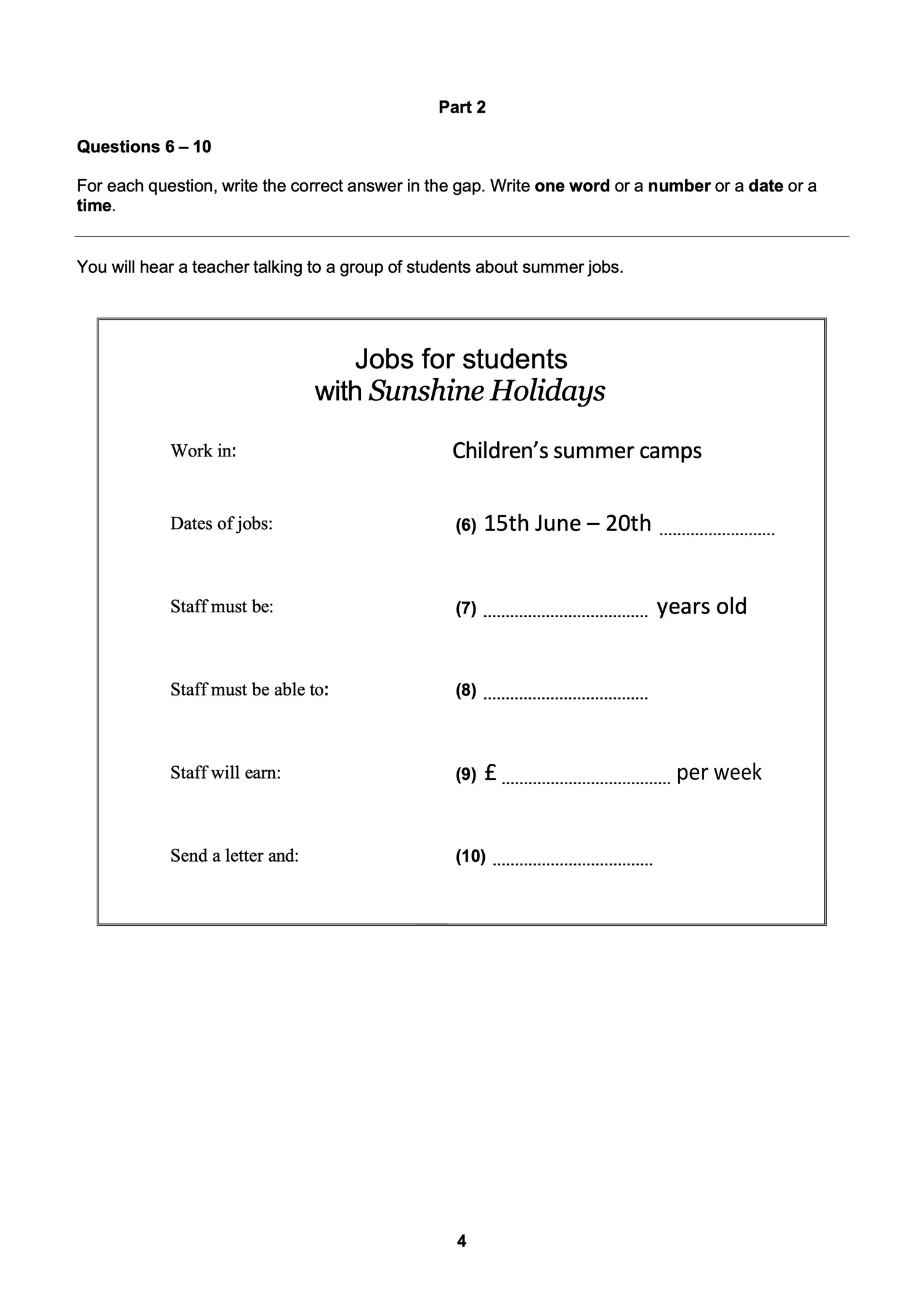
The important thing in this part is to write correctly the information you hear. If the word is spelt out in the recording, you must write it exactly as it is spelt. For common words that are not spelt out, it is also necessary to write them correctly.
My advice is to use the first listen to write down the answers, and the second to check that they are correctly written and that you have not missed any.
A2 Key: Listening Part 3
Part 3 of the A2 Key Listening exam is another multiple-choice question task, but this time with a longer audio.
In this part, you will hear an informal conversation between two people and you will have to answer 5 multiple-choice questions with 3 options each (A, B or C).
The questions assess your understanding of detailed information, and may also include questions about the speakers’ opinions and attitudes.
Let’s look at an example of Listening Part 3:
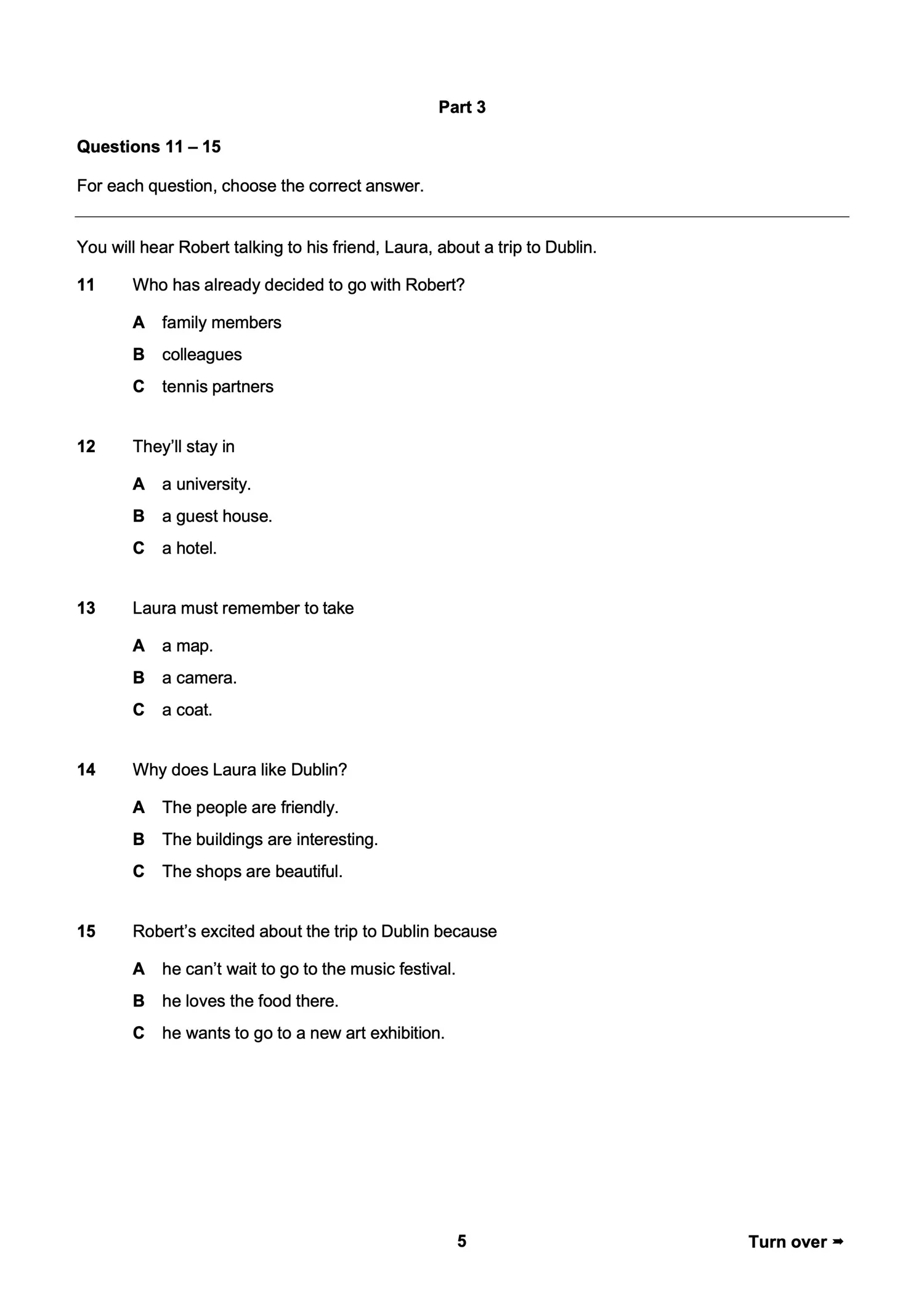
My advice for this part is to read the questions before listening to the audio, to know what specific information you need to look for. During the first listen, try to grasp the general idea and choose the answers. During the second listen, check your answers paying attention to specific details.
Important: The answers come from both speakers, so you need to pay attention to both.
A2 Key: Listening Part 4
Part 4 of the A2 Key Listening exam consists of 5 very short independent audios.
Each audio can be a monologue or a brief dialogue, and for each one there is a multiple-choice question with 3 options (A, B or C). The objective of this part is to identify the main idea, the general message or the topic of each recording.
Questions about attitudes, opinions, or agreements between speakers may also appear.
Here is an example:
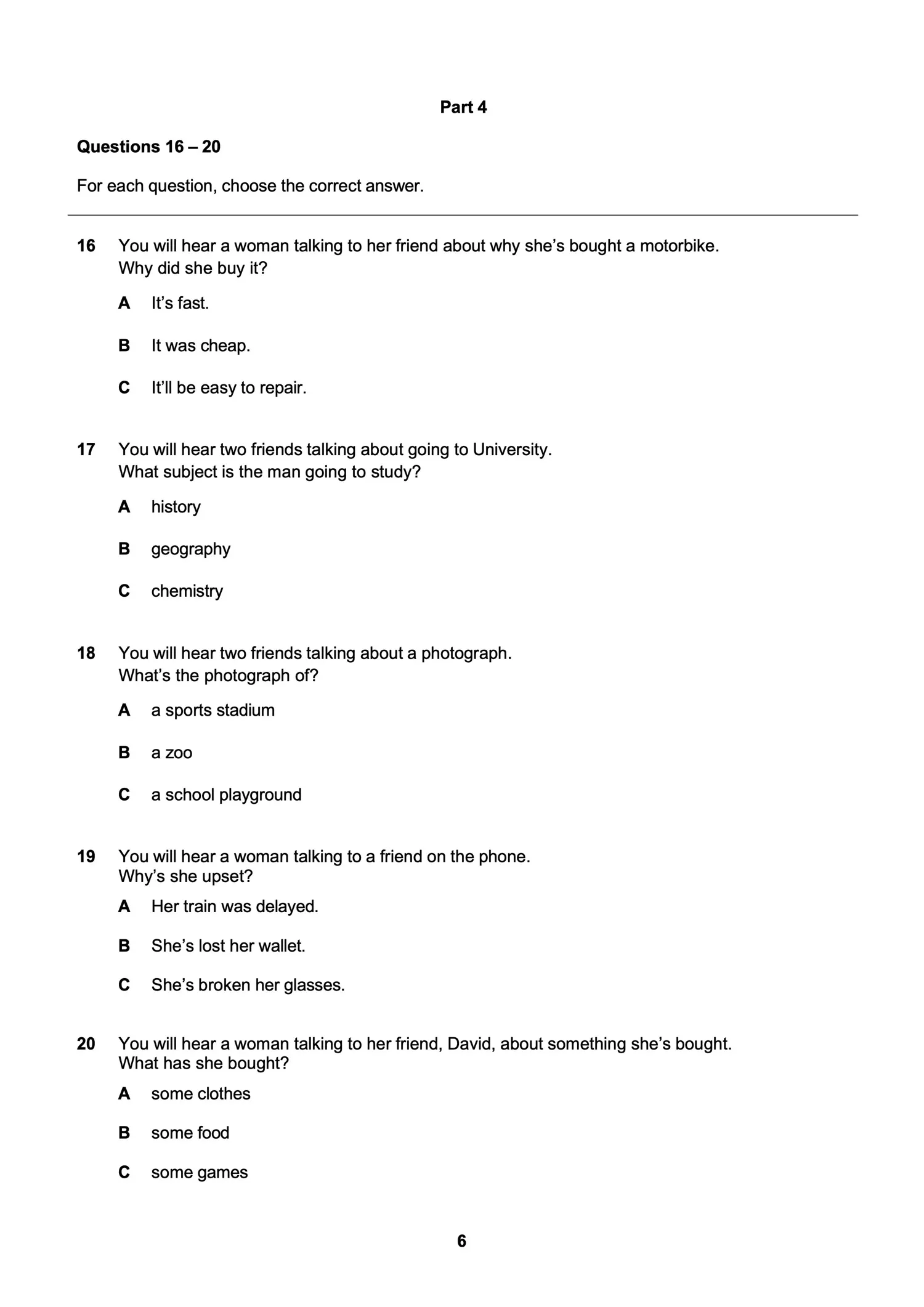
To do well in this part, it is essential that you read the question and options before listening to each audio. During the first listen, try to grasp the general idea. During the second listen, confirm your answer paying attention to the details.
This part can be a little more difficult because the audios are very short and you have to quickly grasp the main idea.
A2 Key: Listening Part 5
And we come to the last part of the A2 Key Listening exam. In this part, you have to listen to a longer conversation between two people who know each other and complete a matching task.
You will have to match 5 items from one list with 8 options from another list. For example, matching people with the food they are going to bring to a party, or activities with days of the week.
Here is an example:
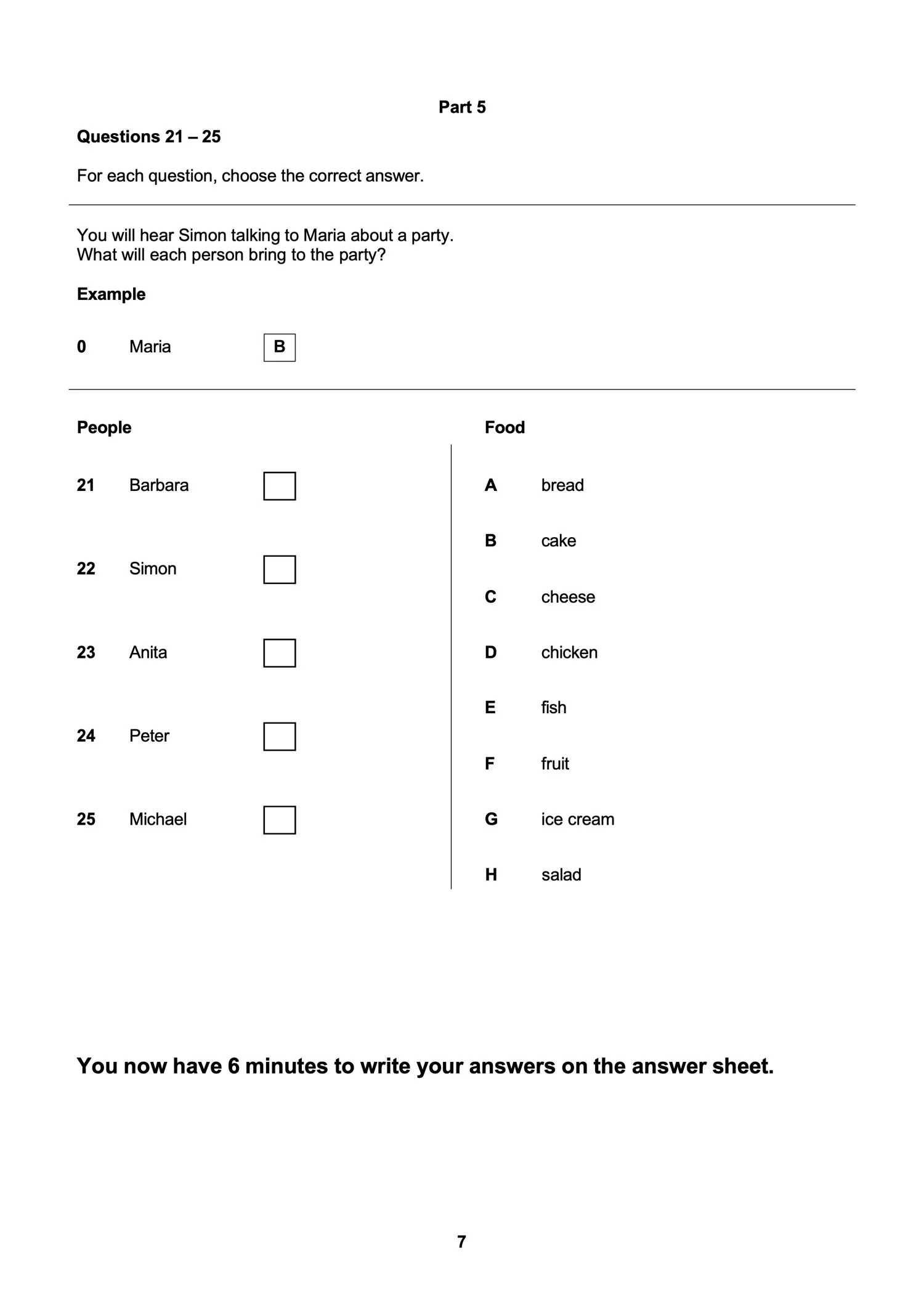
To do well in this part, it is important to read both lists before listening to the audio. Notice that all the words in each list belong to the same semantic field (for example, types of food, or family members).
During the first listen, try to match the items. During the second listen, check your answers paying attention to the specific information.
How the A2 Key Listening exam is assessed
To find out if you have passed this part of the A2 Key is very simple, as each question counts 1 point. Since there are 25 Listening questions in total, the maximum score is 25 points.
Listening is one of the three papers of the A2 Key exam, along with Reading and Writing, and Speaking. Each paper contributes to the final exam grade.
In general, you need to obtain approximately 70% of the correct answers across the entire exam to pass with an A2 level (i.e., to get a Grade A, B or C).
I recommend that you read more information about how the A2 Key is assessed in general, where I explain part by part how the scoring of the complete exam works.
Tips for the A2 Key Listening exam
Listening comprehension is a skill that is often difficult for Spanish students, because they are not used to listening to English regularly. However, improving your Listening is simpler than you think if you follow a consistent routine. Here are my best tips and strategies:
- Listen to English every day: It’s obvious, but few people actually do it. It doesn’t have to be hours and hours, but it does need to be consistent. You can listen to simple podcasts, YouTube videos, songs, etc. The important thing is that the material is suitable for your level.
- Get used to different accents: The exam includes a variety of standard native accents (British, American, Australian, etc.). Practise listening to different accents so you are not surprised in the exam.
- Read the questions before listening: In the exam, there is always time to read the questions before each audio. Use this time to find out what specific information you need to look for.
- Use the two listens intelligently: On the first listen, try to grasp the general idea and answer the questions. On the second listen, check your answers and pay attention to the details you missed.
- Don’t obsess over unknown words: At A2 level, it’s normal to come across words you don’t know. The important thing is that you learn to grasp the general meaning without understanding every single word.
- Watch series and films with English subtitles: Watching audiovisual content with English subtitles (not Spanish) will greatly help you improve your listening. For an A2 level, I recommend simple series or films, or even content for children.
- Practise with real exams: It is essential that you practise with official A2 Key exams to familiarise yourself with the format, the type of audios and the level of difficulty. Cambridge offers free official material on its website.
- Don’t leave answers blank: In the exam, if you don’t know an answer, try to guess. You don’t lose marks for incorrect answers, so it’s always better to try.
- Pay attention to numbers, dates and times: Especially in Part 2, it is very common that you have to write numbers, dates or times. Practise listening and writing this type of information.
- Pay attention to spelling in Part 2: Remember that in Part 2 you have to write the answers, and the spelling must be correct. If you spell a word incorrectly, you will not be given the mark even if the word is correct.
In summary, the A2 Key Listening exam is a very accessible part of the exam if you practise regularly and become well-acquainted with the format. You do not need a very advanced level of English, but you do need to be comfortable listening to simple, everyday conversations in English.
Remember that the key is constant practise and exposing yourself to spoken English as much as possible in your daily life. Good luck with your preparation!
And don’t forget to keep listening!