Football Vocabulary in English
Discover the essential football vocabulary in English: basic terms, plays, positions, and useful phrases for any conversation or match.

Table of contents
I’m not a massive football fan myself, although I enjoy watching the odd match every now and then, but if you’re the type of person who loves watching Premier League games, discussing Manchester City’s goals or Manchester United’s blunders (ouch!) with your mates, or you simply want to understand what the commentator is saying, this article is for you.
Football is one of the most universal topics of conversation out there, and mastering its vocabulary in English will open up a world of possibilities, from… possibly heated… debates to unexpected connections with people from all over the planet.
In this article, we are going to go through the essential football vocabulary in English, from the most basic terms to the expressions used by the most die-hard fans. Get ready to talk about football like a true English hooligan.
Why Learn Football Vocabulary in English?
Imagine you’re in a pub in London, a match is being shown on the telly, and everyone is shouting «What a tackle!» or «He’s offside!». If you don’t know the vocabulary, you’ll be left completely out of the conversation. But if you master these terms, you’ll be able to join the debate, give your opinion on a controversial penalty, and even make friends in a matter of minutes.
Furthermore, football is a recurring theme in Cambridge exams, especially in the speaking and listening parts. Knowing this vocabulary will not only help you pass with flying colours but will also allow you to enjoy sports commentary, podcasts, articles, and videos in English without missing a single detail.
Finally, football is culture. Learning its vocabulary in English connects you with millions of people who share your passion for the beautiful game. It is a natural, fun, and effective way to improve your English while doing something you truly love.
Key Football Terms and Expressions in English
Here comes the good stuff. We are going to break down the essential vocabulary you need to speak about football in English fluently. We have organised it into categories to make it easier to digest and memorise.
Basic Football Words in English
Let’s start with the fundamentals. These are the words that form the basis of any conversation about football in English.
| English | Spanish |
|---|---|
| Football / Soccer | Fútbol |
| Match / Game | Partido |
| Pitch | Campo de fútbol |
| Goal | Gol / Portería |
| Ball | Balón |
| Referee | Árbitro |
| Linesman / Assistant referee | Juez de línea |
| Team | Equipo |
| Player | Jugador |
| Manager / Coach | Entrenador |
| Fan / Supporter | Aficionado / Hincha |
| Half-time | Descanso |
| Extra time | Prórroga |
| Penalty shootout | Tanda de penaltis |
A curious fact: in the United Kingdom, we say «football», while in the United States, they prefer «soccer». If you want to sound British, always use «football».
Typical Expressions You’ll Hear During Matches
When you watch a match in English, you’ll hear expressions that go beyond basic vocabulary. Here are the most common ones so you don’t miss a thing:
| Expression | Spanish Meaning |
|---|---|
| Kick-off | Saque inicial |
| Offside | Fuera de juego |
| Free kick | Tiro libre |
| Penalty | Penalti |
| Corner (kick) | Córner / Saque de esquina |
| Throw-in | Saque de banda |
| Yellow card | Tarjeta amarilla |
| Red card | Tarjeta roja |
| Foul | Falta |
| Handball | Mano |
| Own goal | Gol en propia puerta / Autogol |
| Hat-trick | Triplete (tres goles de un mismo jugador) |
| Clean sheet | Portería a cero |
| Injury time / Stoppage time | Tiempo añadido / Descuento |
Practical example: «The referee showed him a red card for that terrible foul!» (¡El árbitro le mostró tarjeta roja por esa falta terrible!)
Player Positions and Roles on the Pitch
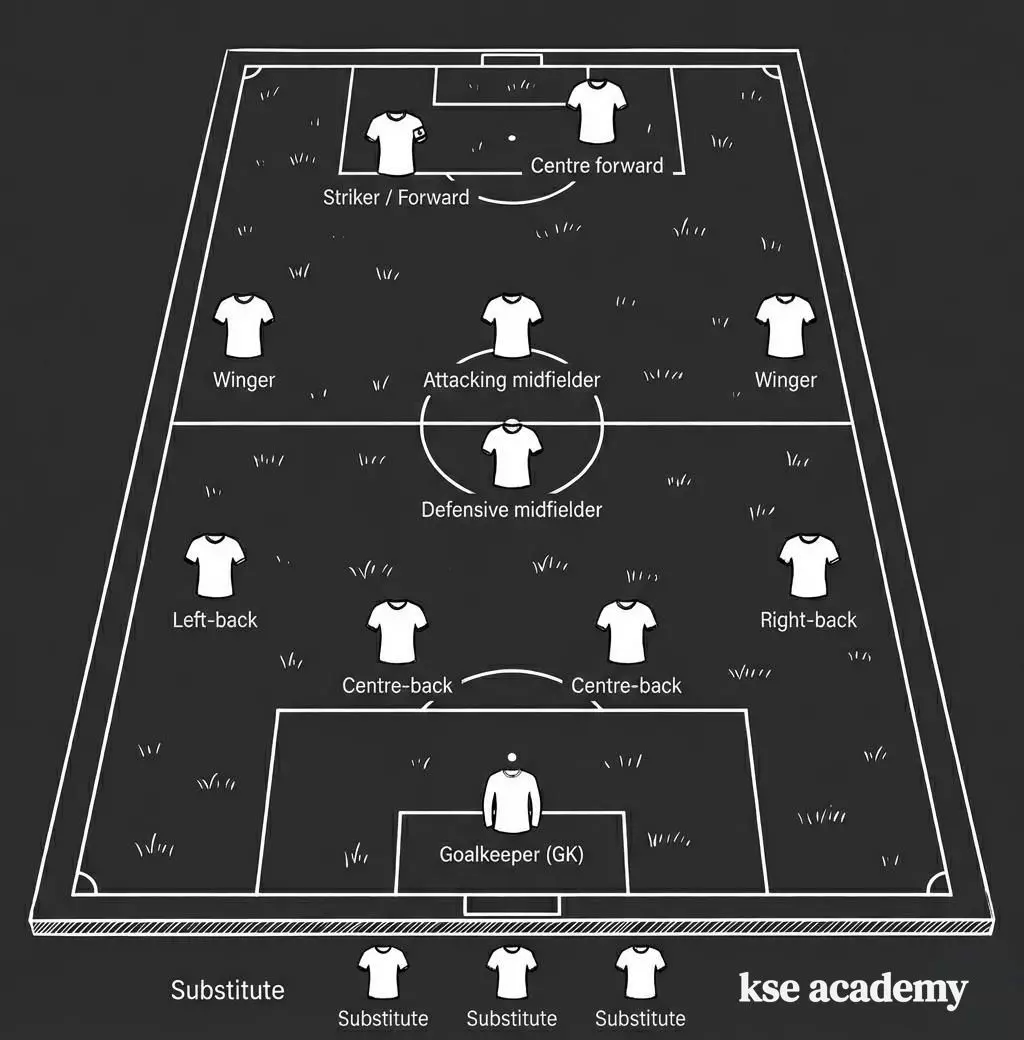
Knowing the positions is fundamental for understanding match tactics and commentary. Here are the main positions on the pitch:
| Position | Spanish |
|---|---|
| Goalkeeper (GK) | Portero |
| Defender | Defensa |
| Centre-back | Defensa central |
| Full-back | Lateral |
| Right-back / Left-back | Lateral derecho / Lateral izquierdo |
| Wing-back | Carrilero |
| Midfielder | Centrocampista |
| Defensive midfielder | Mediocentro defensivo / Pivote |
| Attacking midfielder | Mediapunta |
| Winger | Extremo |
| Striker / Forward | Delantero |
| Centre forward | Delantero centro |
| Captain | Capitán |
| Substitute | Suplente |
Example: «The striker scored a brilliant goal in the final minute!» (¡El delantero marcó un gol brillante en el último minuto!)
Common Actions and Plays
Now let’s look at the actions you’ll see time and time again in any match. These are the words you need to describe what’s happening on the pitch:
| Action | Spanish |
|---|---|
| To pass | Pasar (el balón) |
| To shoot | Disparar / Chutar |
| To score | Marcar (un gol) |
| To tackle | Entrar / Hacer una entrada |
| To dribble | Regatear |
| To cross | Centrar |
| Header | Cabezazo / Remate de cabeza |
| To save | Parar / Hacer una parada |
| To clear | Despejar |
| Bicycle kick / Scissor kick | Chilena |
| Volley | Volea |
| Backheel | Taconazo |
| Nutmeg | Caño / Túnel |
| One-two / Wall pass | Pared |
| Through ball | Pase en profundidad |
A term you’ll love: «nutmeg». It literally means a type of spice, but in football, it’s used to describe when you put the ball through someone’s legs. Quite curious, isn’t it?
Useful Phrases for Talking About Football in English
You already know the basic vocabulary, but how do you use it in real conversations? Here are some practical phrases you can use when talking about football with natives or when you want to comment on a match.
Talking About Results and Matches
These phrases will help you talk about how the match went, who won, and what the score was:
| English | Spanish |
|---|---|
| What’s the score? | ¿Cómo van? / ¿Cuál es el resultado? |
| Who won the match? | ¿Quién ganó el partido? |
| It was a draw. | Fue un empate. |
| They won 3-1. | Ganaron 3-1. |
| We got thrashed / hammered. | Nos dieron una paliza. |
| It was a close match. | Fue un partido muy reñido. |
| They dominated the entire game. | Dominaron todo el partido. |
| We scraped a win. | Ganamos por los pelos. |
| The final score was 2-2. | El resultado final fue 2-2. |
| They’re top of the league. | Están primeros en la liga. |
Commenting on Plays and Controversies in English
Football wouldn’t be the same without controversies, right? Here are phrases to give your opinion on disputed plays:
| English | Spanish |
|---|---|
| That was a clear penalty! | ¡Eso fue penalti claro! |
| The referee made a terrible decision. | El árbitro tomó una decisión terrible. |
| He was clearly offside. | Estaba claramente en fuera de juego. |
| That should have been a red card. | Eso debería haber sido tarjeta roja. |
| What a brilliant save! | ¡Qué parada brillante! |
| He dived! That wasn’t a foul. | ¡Se tiró! Eso no fue falta. |
| The goalkeeper was caught sleeping. | Pillaron al portero desprevenido. |
| What a tackle! He won the ball cleanly. | ¡Qué entrada! Ganó el balón limpiamente. |
| That was a howler from the keeper. | Eso fue un error garrafal del portero. |
| He hit the woodwork! | ¡Le dio al palo! |
Contextual example: «Did you see that tackle? The referee should have shown a red card, it was reckless!» (¿Viste esa entrada? El árbitro debería haber mostrado tarjeta roja, ¡fue temeraria!)
Phrases for Cheering or Debating with Friends
When you’re watching a match with friends or at the stadium, these are the phrases you’ll hear (and shout):
| English | Spanish |
|---|---|
| Come on! | ¡Vamos! |
| Go on, my son! | ¡Venga, tío! (expresión muy británica) |
| What a goal! | ¡Qué golazo! |
| Get in! | ¡Sí! (cuando metes gol) |
| Man on! | ¡Cuidado, tienes uno detrás! |
| Shoot! | ¡Dispara! |
| Pass it! | ¡Pásala! |
| Your lot were rubbish today. | Tu equipo estuvo malísimo hoy. |
| We’re going to win the league! | ¡Vamos a ganar la liga! |
| They’re going down! | ¡Van a descender! |
| We absolutely battered them. | Les dimos una paliza. |
| I’m gutted we lost. | Estoy destrozado porque perdimos. |
Tip: the expression «your lot» is very British and is used to refer to someone’s team in an informal way. For example: «Your lot played brilliantly today!» (¡Tu equipo jugó brillantemente hoy!)
Practical Exercises: How to Use Football Vocabulary in Context
Theory is all well and good, but now it’s time to practise. Here are some exercises to put everything you’ve learned to the test. Don’t worry, this is just a friendly match!
Exercise 1: Complete the sentences
Complete the following sentences with the correct word from the list. Each word can only be used once:
Available words:
referee • hat-trick • save • penalty • red • clean • manager • offside
- The ______________ blew the whistle to start the match.
- He scored a ______________ by netting three goals in one game.
- The goalkeeper made an incredible ______________ to prevent the goal.
- That was a clear ______________! The referee should have pointed to the spot.
- The player received a ______________ card for his dangerous tackle.
- They managed to keep a ______________ sheet, not conceding any goals.
- The ______________ gave tactical instructions from the sideline.
- He was caught ______________ when he received the pass.
Answers at the end of this section.
Exercise 2: Translate into English
Translate these sentences into English using football vocabulary:
- El delantero marcó un gol increíble en el último minuto.
- El árbitro expulsó al jugador por conducta violenta.
- Fue un partido muy reñido que terminó en empate.
- El portero hizo una parada espectacular.
- El centrocampista dio una asistencia perfecta al extremo.
Answers at the end of this section.
Exercise 3: Real-life situation
Imagine you are commenting on this match with a British friend. What would you say in these situations?
- Your team has just scored a spectacular goal.
- The referee didn’t award a crystal-clear penalty for your team.
- An opposing player dived in the box without anyone touching him.
- Your team is losing 3-0 at half-time.
- The rival goalkeeper made a massive blunder that allowed an easy goal.
Possible answers at the end of this section.
Answers:
Exercise 1:
- referee
- hat-trick
- save
- penalty
- red
- clean
- manager
- offside
Exercise 2:
- The striker scored an incredible goal in the last minute.
- The referee sent the player off for violent conduct.
- It was a very close match that ended in a draw.
- The goalkeeper made a spectacular save.
- The midfielder provided a perfect assist to the winger.
Exercise 3 (possible answers):
- «What a goal! Get in! That was absolutely brilliant!»
- «That was a clear penalty! The referee made a terrible decision!»
- «He dived! That wasn’t a foul at all!»
- «We’re getting hammered here. We need to improve in the second half.»
- «What a howler from the keeper! He was caught sleeping!»
Extra Resources for Learning Football Vocabulary in English
Learning football vocabulary doesn’t have to be boring. In fact, it can be one of the most entertaining ways to improve your English. Here are some resources to help you keep practising:
1. Watch matches in English
The best way to learn football vocabulary is by watching matches with English commentary. The Premier League is perfect for this. You can start by watching matches with English subtitles and, bit by bit, remove them once you feel more comfortable. Pay attention to how the commentators describe the plays, the positions, and the referee’s decisions.
2. Football podcasts in English
There are hundreds of football podcasts in English. Some of the most popular ones are The Football Ramble, The Totally Football Show, and Men in Blazers. Listening to them while you commute or exercise is an excellent way to familiarise yourself with vocabulary and colloquial expressions.
3. Read sports articles
Websites like BBC Sport, The Guardian (football section), or Sky Sports publish daily articles about football. Reading them will help you see how vocabulary is used in a written context and you’ll become familiar with more formal and journalistic expressions.
4. Football games in English
If you like video games, playing FIFA or Football Manager in English is a really fun way to learn vocabulary. The commentary during matches, the menus, and the player descriptions are full of football terminology that you’ll absorb without even realising it.
5. Social media and forums
Follow Premier League teams on Twitter, Instagram, or Facebook. The posts are in English and you’ll see how fans use the vocabulary naturally. You can also join forums like Reddit (r/soccer) where matches and news are debated in English.
6. Vocabulary apps
Apps like Quizlet or Anki allow you to create your own flashcards with the football vocabulary you’ve learned in this article. Spend 10 minutes a day reviewing them and you’ll see how your retention improves.
7. Practise speaking
Last but not least: practise speaking. Look for language exchanges with natives who like football, join conversation groups, or simply comment on matches in English with friends who are also learning. Oral practice is fundamental for vocabulary to move from your passive memory to your active memory.
End of the Match Article
Football is much more than a sport; it is a universal language that connects people from all over the world. Mastering its vocabulary in English will not only open doors for you in everyday conversations but will also help you enjoy this game we are so passionate about much more.
Now that you have all the tools you need to talk about football in English like a true «football fan», remember: the key is in constant practice. Watch matches in English, read sports articles, listen to podcasts and, above all, don’t be afraid to use this vocabulary in real conversations. Football is the perfect topic to break the ice and make friends anywhere in the world.
And until the next article, don’t forget to keep smiling!