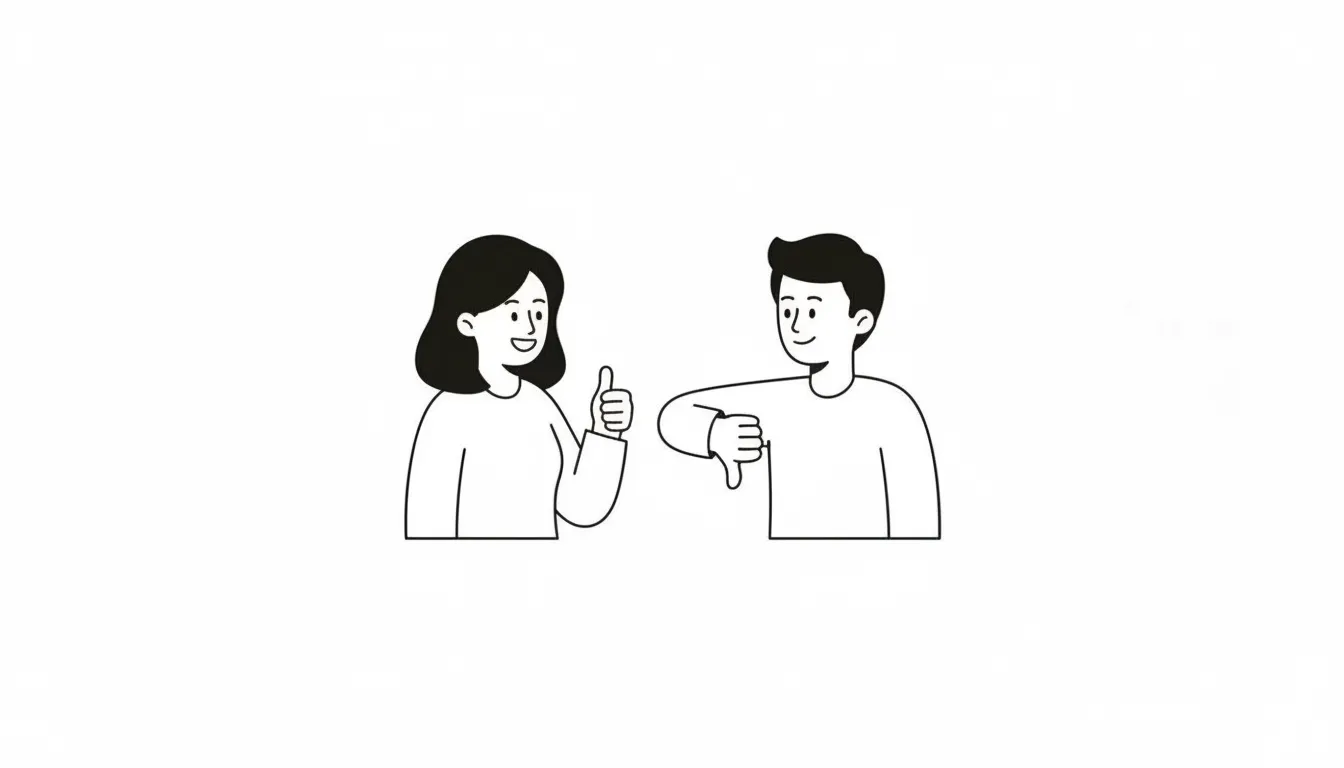
How to Express Agreement and Disagreement
Here’s an awesome list of expressions to agree and disagree in English. They are essential to communicate properly with others.

Table of contents
When producing language, whether it be speaking or writing, one of the most important language functions is that of agreeing and disagreeing. This language funciton is essential because it allows speakers to negotiate meaning and reach agreements while communicating with others. For this reason, in todays quick post, I’m going to teach you how to express agreement and disagreement in English with a comprehensive list of expressions that allow you to agree and disagree with others. Also, I will show you a few expressions to express your opinions, as this is very closely linked to how we agree or disagree with others.
How to express agreement
In this section you have a series of expressions to show you how you can agree in English in many different ways. My advice is that you read through them, choose 5 or 6 that you particularly like and that you learn them by heart. Also, I recommend stop using simply «I agree with you», as this is terribly simple and, if you’re trying to pass a Speaking B2 or Speaking C1, it will definitely not be enough. So let’s take a look.
- I (completely / really / totally / absolutely / honestly / truly) agree with you (on that)
- I really think / believe so, too.
- I couldn’t agree more.
- I have come to the same conclusion.
- I hold the same opinion.
- I have no objection whatsoever.
- I see what you mean and I (must) agree with you.
- I see it that way, too.
- I share your opinion / view.
- I was just going to say that.
- You’re (completely / totally / absolutely) right.
- You have a point there.
- You’ve made a good point.
- We are of one mind (on…)
- We are of the same mind (on…)
- That’s (so / completely / absolutely / undeniably) true.
- That’s a really good point.
- Yeah, that’s just it.
- Fair enough.
- Yes, of course.
- No doubt about it.
How to express partial agreement
Sometimes, when discussing something in speaking or writing form, we may agree with some aspects of what is being discussed, but not necessarily 100%. In those cases we can use some expressions to say that we agree, but not completely, that is, we partially agree. Let’s take a look at a few examples:
- I agree with you up to a point.
- I see what you mean, but…
- That idea is OK, but…
- I understand that, but…
How to express disagreement
Now, we will take a look at some disagreement expressions. In this case, I ought to tell you that whenever we disagree with someone, it migh sound quite rude if we simply say «I don’t agree». For this reason, I have added 4 opening expressions that make disagreement sound more polite. So when you take a look at the list that follows, try to combine one of the 4 expressions in the first level which one of the various expressions in the second level. For example: (1)I’m afraid (2)I don’t share your view.
Here’s a good list of expressions to disagree in English:
- I’m afraid…
- I’m sorry but…
- You may be right, but…
- That might be true, but…
- I beg to differ.
- I don’t agree with you on that / what you say.
- I don’t think you’re right.
- I don’t share your view.
- I think otherwise.
- I take a different view.
- I believe your argument doesn’t hold water.
- I´m not sure I agree with you.
- that doesn’t make much sense to me.
- that’s not always the case
- that’s not always / necessarily true.
How to express opinions in English
Finally, I believe it is important to be able to reason why you’re agreeing or disagreeing with someone. Therefore, being able to express your opinion properly is just as essential. So here’s a list of expressions that will help you agree and disagree properly in English, and I’ve divided them into three different categories depending on how these expressions are constructed:
- I/It + verb…
- I think / consider / find / feel / believe / suppose / presume / assume that…
- I would say that…
- I have the feeling that…
- I have no doubt that…
- I hold the opinion / view that…
- I take the view that…
- I guess that…
- I bet that…
- I gather that
- I am under the impression…
- I am of the opinion that…
- I am sure / certain that…
- It goes without saying that…
- It seems to me that…
- It is my impression that…
- In/From/To my…
- In my opinion,…
- In my view,…
- In my eyes,…
- From my point of view,…
- From my viewpoint,…
- To my mind,…
- To be honest,…
- My opinion / view / belief / impression is that…
- My own feeling on the subject is that…
- My personal view is that…
- Other
- As far as I’m concerned,…
- As for me / As to me…
- As I see it…
- The way I see it…
- Personally speaking,…
I hope all of these expressions to agree and disagree come in handy. Remember, that communication is all about interacting with others, so you should really make an effort to communicate accurately and appropriately with others. Finally, I also recommend using some of these expressions in your Writing tasks for B2 and C1, especially.
Jesús says:
Good shit, bro!
Luis @ KSE Academy says:
Awesome!
Andries van Renssen says:
Is there a standard practice for options about degrees of (dis)agreements for questionnaires?
Luis @ KSE Academy says:
Hi! I’m not sure what you’re asking, hehe. Could you explain it further, please?
benito says:
muy interesante la página me la apunto en la libreta
0639804991 says:
LOve it dude yolo
Alex says:
Great work.
Thank you.
I’ll use it for my students
Irene says:
You’re the best! Thank you so much.