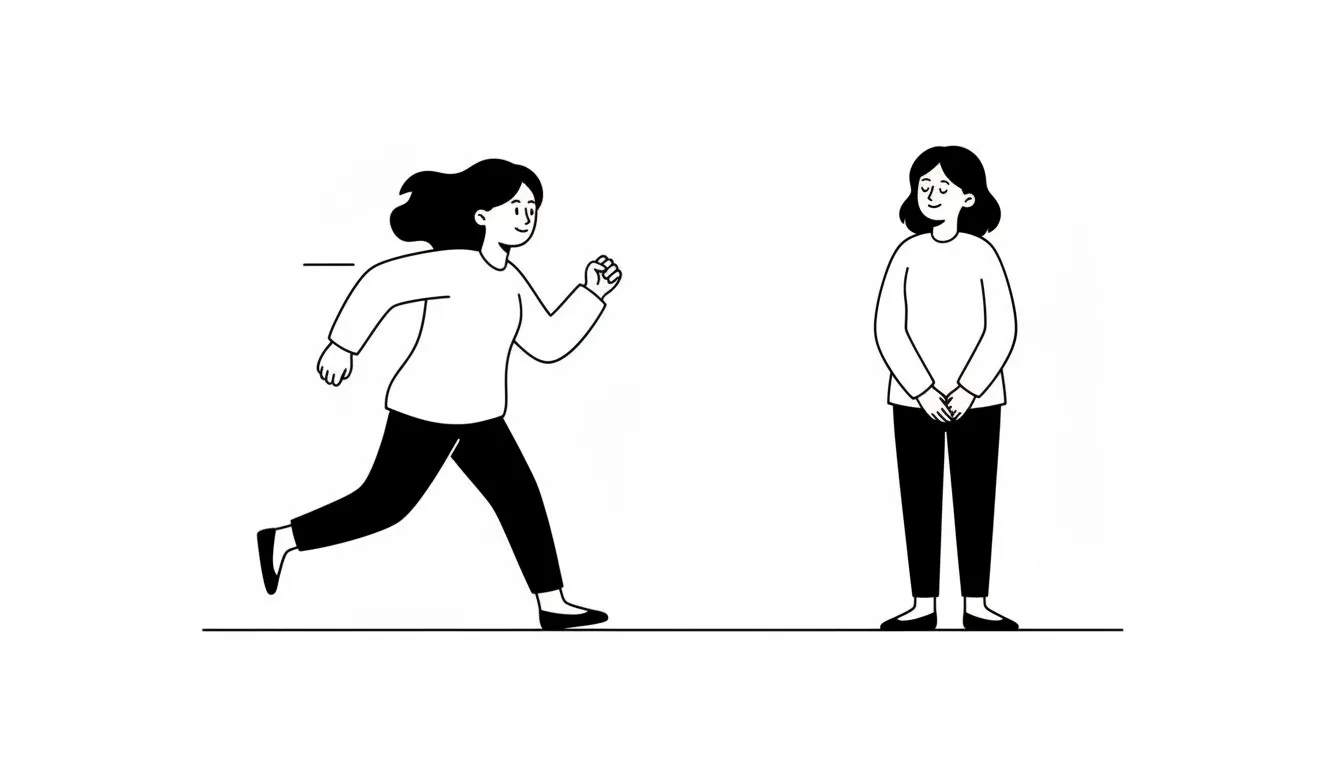
Present Simple vs Present Continuous
Discover the key differences between Present Simple and Present Continuous in English. Practical examples, common mistakes, and tips to never confuse them again.

Table of contents
Have you ever sent an email in English saying «I work on your project» when you actually meant to say that you were working on it at that moment? Or perhaps you’ve said «I’m loving this song» without knowing that, technically, that’s not how we say it in English. If something similar has happened to you, don’t worry: you’re not alone. In fact, confusion between the Present Simple and the Present Continuous is one of the most common mistakes amongst English learners, especially Spanish speakers.
And the thing is, although these two verb tenses seem straightforward, choosing the correct one can completely change the meaning of what you’re saying. That’s why, in this article, I’m going to explain exactly what differentiates them, when to use each one, and how to avoid the most typical mistakes.
What’s the main difference between Present Simple and Present Continuous?
The key difference is this: the Present Simple is used to talk about habitual actions, routines or permanent situations, whilst the Present Continuous is used for actions that are happening right now or temporary situations.
For example:
- I work from home. (Present Simple – it’s my usual situation)
- I’m working from home today. (Present Continuous – just today, temporarily)
Now let’s delve deeper into each of these verb tenses so you never have doubts again.
Brief definition of the Present Simple
The Present Simple is one of the most basic verb tenses in English and is mainly used to talk about actions that occur regularly, general facts or permanent situations.
Present Simple examples:
- I drink coffee every morning.
- She works in a bank.
- They live in Madrid.
- Water boils at 100 degrees.
- My brother plays football on Saturdays.
As you can see, all these sentences describe habitual situations, routines or universal truths.
Brief definition of the Present Continuous
The Present Continuous (also called Present Progressive) is used to talk about actions that are happening at this moment, temporary situations or plans for the near future.
Present Continuous examples:
- I’m reading a book right now.
- She’s working from home this week.
- They’re watching a film at the moment.
- My brother is studying for his exams these days.
- We’re meeting Laura tomorrow. (confirmed plan)
Notice that all these actions are happening now, are temporary, or are already confirmed plans.
Comparison table: Present Simple vs Present Continuous
So you can see it at a glance, here’s a table that summarises the main differences:
| Aspect | Present Simple | Present Continuous |
|---|---|---|
| Main use | Routines, habits, permanent situations | Actions in progress, temporary situations |
| Example | I work in an office. | I’m working on a project. |
| Frequency | Always, usually, often, never, every day | Now, right now, at the moment, today, this week |
| Formation | Subject + verb (base form) | Subject + am/is/are + verb-ing |
| Temporary situation | ❌ No | ✅ Yes |
| Permanent situation | ✅ Yes | ❌ No |
| Future plans | ❌ No (generally) | ✅ Yes (if confirmed) |
Key differences between Present Simple and Present Continuous
Now that we’ve got the definitions clear, let’s delve deeper into the specific differences between these two verb tenses.
Habitual actions vs actions in progress
This is the most important difference and the one you’ll use most in your day-to-day life.
Present Simple → What you do habitually, your routine
- I go to the gym three times a week.
- He reads the newspaper every morning.
Present Continuous → What you’re doing right now
- I’m going to the gym right now.
- He’s reading the newspaper at the moment.
The key is to ask yourself: is it something I do regularly or is it something that’s happening right now?
Permanent situations vs temporary situations
Another fundamental difference is the duration of the situation.
Present Simple → Permanent or long-term situations
- I live in Barcelona. (it’s my usual residence)
- She works as a teacher. (it’s her profession)
Present Continuous → Temporary situations
- I’m living in Barcelona for a few months. (temporarily)
- She’s working as a waitress this summer. (only temporarily)
Notice how the meaning changes depending on the verb tense you use. In Spanish we sometimes use the same verb tense for both situations, but in English it’s important to distinguish.
Future plans vs routines
Here comes one of the differences that surprises students most: the Present Continuous can be used to talk about future plans that are already confirmed.
Present Simple → Fixed timetables, established routines
- The train leaves at 8 pm. (fixed timetable)
- My class starts at 9 am every Monday. (routine)
Present Continuous → Personal plans already confirmed
- I’m meeting John tomorrow. (confirmed plan)
- We’re flying to London next week. (we’ve already got the tickets)
The difference is that the Present Simple is used for established timetables (trains, classes, scheduled events) whilst the Present Continuous is used for personal plans you’ve already organised.
State verbs: when NOT to use the Present Continuous
This is a crucial point that many students overlook: there are certain verbs that are almost never used in the Present Continuous. They’re called state verbs (stative verbs) and they describe mental states, emotions, possession or perceptions, not actions.
Common state verbs:
- Emotions and feelings: love, like, hate, prefer, want, need
- Possession: have (when it means «to own/possess»), own, belong
- Perception: see, hear, smell, taste
- Thought: think (when it means «to believe»), believe, know, understand, remember, forget
- Others: be, seem, appear, cost, contain
Correct and incorrect examples:
❌ I’m loving this song.
✅ I love this song.
❌ She’s knowing the answer.
✅ She knows the answer.
❌ They’re having a car. (when it means to possess)
✅ They have a car.
✅ They’re having dinner. (here «have» is an action, not possession, so it CAN be used in the continuous)
Important exception: Some state verbs can be used in the Present Continuous when they change meaning and become actions. For example:
- I think you’re right. (believe – state)
- I’m thinking about changing jobs. (actively thinking – action)
Key words that help you choose
A practical way to know which verb tense to use is to pay attention to the time expressions that accompany the verb. Here’s a quick list:
Present Simple signals:
- Always
- Usually
- Often
- Sometimes
- Never
- Every day/week/month
- On Mondays/Tuesdays…
- Once/twice a week
Present Continuous signals:
- Now
- Right now
- At the moment
- Currently
- Today
- This week/month
- These days
- At present
Comparative example:
- I usually work from the office. (Present Simple – always)
- I’m working from home today. (Present Continuous – today)
Common mistakes when using these verb tenses
After years of teaching English and examining hundreds of students in Cambridge exams, I’ve seen the same mistakes over and over again. Here are the most typical ones so you can avoid them:
Mistake 1: Using Present Continuous with state verbs
❌ Incorrect: I’m knowing the answer.
✅ Correct: I know the answer.
Why it happens: In Spanish we say «estoy sabiendo» or «estoy queriendo» in some colloquial contexts, but in English state verbs almost never take the continuous form.
Mistake 2: Using Present Simple for actions happening now
❌ Incorrect: Wait a moment, I talk on the phone.
✅ Correct: Wait a moment, I’m talking on the phone.
Why it happens: Because in Spanish we can say «hablo por teléfono» for both the habit and the current action, but in English we need to differentiate.
Mistake 3: Forgetting the third person «s» in Present Simple
❌ Incorrect: She work in a hospital.
✅ Correct: She works in a hospital.
Why it happens: In Spanish verbs don’t change according to the person, so it’s easy to forget to add that «s».
Mistake 4: Using Present Continuous for permanent situations
❌ Incorrect: I’m living in Spain since I was born.
✅ Correct: I’ve lived in Spain since I was born. / I live in Spain.
Why it happens: Because the Present Continuous in English always implies temporality, and for permanent situations we need the Present Simple or Present Perfect.
Mistake 5: Confusing «always» with Present Continuous for complaints
✅ Correct (but with nuance): He’s always complaining about everything!
This is a special case: when we use «always» with the Present Continuous, we’re usually expressing irritation or complaint about something that happens too frequently.
- You’re always losing your keys! (and it annoys me)
- He’s always talking in class. (in a negative way)
Mistake 6: Using «do/does» as auxiliary in Present Continuous
❌ Incorrect: Does she working now?
✅ Correct: Is she working now?
Why it happens: Because we mix up the structures of the two verb tenses. Remember: Present Continuous uses «am/is/are» as auxiliary, not «do/does».
Present Simple vs Present Continuous exercises
Conclusion
And that’s it for my guide on the differences between the Present Simple and the Present Continuous. As you’ve seen, although they seem like simple verb tenses, understanding when to use each one is fundamental for expressing yourself correctly in English.
The key is to always ask yourself: am I talking about a habit/permanent situation or something that’s happening now/temporarily? With that simple question, you’ll get it right 90% of the time.
Also remember to pay attention to state verbs (which almost never take the continuous form) and to the key words that indicate which verb tense you need.
Has this article been useful to you? If you want to have it to hand at all times, click the «DOWNLOAD AS PDF» button that you’ll find at the top and you’ll be able to download it for free by subscribing to my newsletter. That way you’ll receive more content like this directly in your email.
And if you have any questions or want to share your own experience with these verb tenses, leave me a comment below. I love reading your questions and experiences. 😊
Until the next article, don’t forget to keep smiling!