Gradable and Non-Gradable Adjectives
Learn the difference between gradable and non-gradable adjectives. Are you very tired or exhausted? Are you hungry or starving? Learn more here!

Table of contents
English vocabulary is so rich that using always the same words will eventually make you sound a little lame. A way to avoid this is to use all sorts of adjectives, which will make your vocabulary richer and will make you sound more natural (if used appropriately) and more educated. So in today’s post, I’ll be explaining briefly gradable and non-gradable adjectives in English and how to use them. What are they? Why those names? 🤔
Gradable adjectives
We say an adjective is gradable when it can be graded, that is when it can be given different degrees of “strength”. For instance, if we take the adjective “big”, we can say that something is “a little big”, “quite big”, “very big” or “extremely big”, among other possibilities. Therefore, “big” is a gradable adjective.
Non-gradable adjectives
We say an adjective is non-gradable when it can’t be graded, that is when it can’t be given different degrees of “strength”. This usually happens when we have an adjective which already has an extreme, absolute or classifying meaning. Take the adjective “huge”, for example. In this case we can’t say “a little huge” or “quite huge” or any other degree, as “huge” already means “extremely big”. However, we do have adverbs that collocate with these adjectives. Normally we can use words like “completely” or “absolutely”. The table below, taken from EnglishClub, offers further adverbs which you can use according to whether the adjective has an extreme, absolute or classifying meaning.
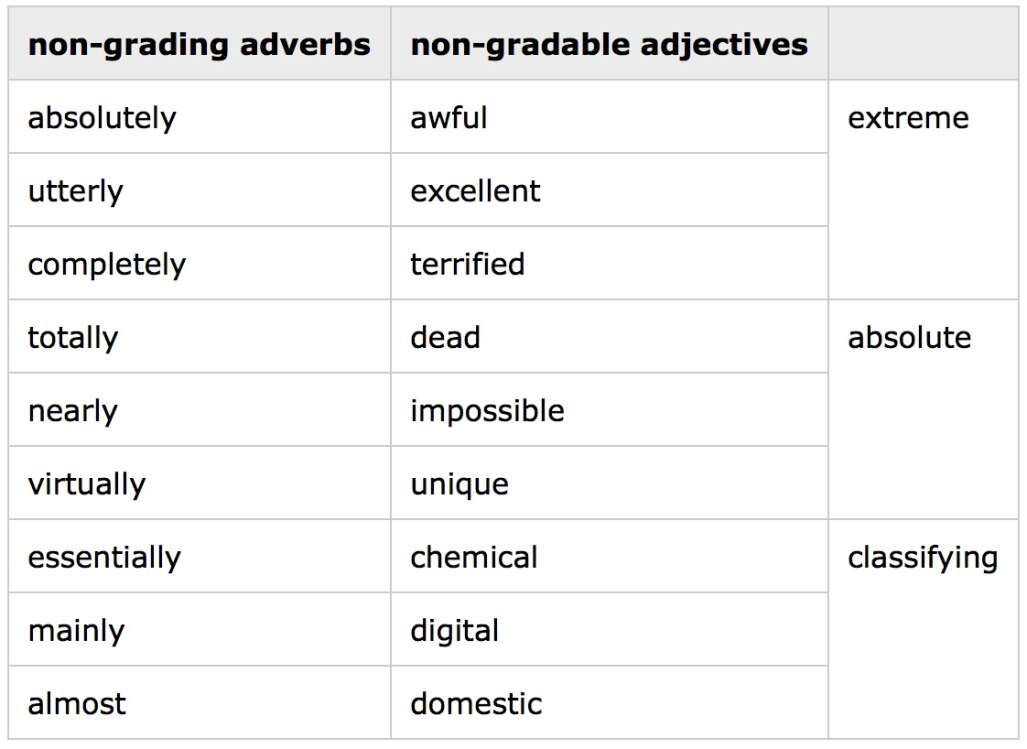
This distinction is usually quite obvious, but you may find the use of specific adverbs a little tricky. A way around this tiny problem is to use the adverb “really“, which collocates with both gradable and non-gradable. However, I only recommend doing this when it’s an oral situation in which you don’t have to prove your level of English to anyone. If it’s an exam, though, try to show off by using as wide a range of vocabulary as you can, okay?
List of gradable and non-gradable adjectives
What follows is an example of gradable and non-gradable adjectives paired together, so you see how, on many occasions, we can use one adjective instead of using «very» + adjective. Take a look at this list:
| GRADABLE ADJECTIVES | NON-GRADABLE ADJECTIVES |
|---|---|
| big | huge, enormous |
| small | tiny |
| tired | exhausted |
| hungry | starving |
| excited | thrilled |
| afraid | terrified, petrified |
| warm, hot | boiling, scorching |
| cool, cold | freezing |
| good | great, awesome |
| bad | terrible, awful |
| old | ancient |
| angry | furious |
| interesting | fascinating |
| beautiful | gorgeous |
| dirty | filthy |
So I hope this comes in handy in the future. I hope you start giving the word “very” a break. I hope you start saying “exhausted” instead of “very tired”, or “tiny” instead of “very small”, or “terrified” instead of “afraid”, or “starving” instead of “hungry”, and so on.
If you enjoyed this post and found it useful, don’t forget to comment and share, and take a look at our English Grammar section. You can follow KSE Academy on Facebook and YouTube. And in the meantime, don’t forget to Keep Smiling!
Cristina says:
Awesome post. Keep up the great job, we’ll be grateful to you…. Thanks!!
Luis @ KSE Academy says:
Hey, thanks a bunch for your awesome comment! 🙂
Maria Angeles Bello says:
Very good article, and very useful as well. Thanks.
Rocio says:
Thanks so much, it is more easy with your explanation.
Marcela says:
The class was absolutely fascinating!