The time in English: how to say it, how to write it, and examples with a clock
Learn how to tell the time in British and American English. In this post, I give you examples in Spanish and English, along with clocks.

Table of contents
Knowing **how to tell the time in English** is relatively easy. However, you might be surprised by the number of intermediate to advanced students I’ve encountered who have had problems expressing the time in English. The main issue is that it’s something you won’t practise much naturally if you don’t live in an English-speaking country. Therefore, it’s important to learn it well and practise it regularly. I can’t help you with the practice right now, but I will explain exactly how to tell the time in English, both in British and American English.
Telling the time in British English (BrE)
To understand and know how to express the time in British English, we must be clear on the following concepts:
- There are 3 essential terms for telling the time:
- *o’clock* (on the hour): used for exact hours (XX:00).
- past (and): used for times from the hour (not included) up to half past (XX:01 – XX:30).
- to (until): used for times between half past and the hour, i.e., from half past onwards (XX:31 – XX:59).
- There are 4 main reference points:
- on the hour: *o’clock*
- quarter past: *quarter past*
- half past: *half past*
- quarter to: *quarter to*
- If it is **on the hour**, we say the number of the **hour followed by *o’clock***.
- Example: twelve o’clock (12:00) would be *twelve o’clock*.
- If the **time is not on the hour**, **the minutes (m) are said before the hour (h)**.
- Example: ten past twelve (12:10) is *ten past twelve*.
- From half past (>30 min), **we count the minutes remaining until the next hour**, just like in Spanish.
- Example: a quarter to twelve (11:45) is *quarter to twelve*.
Examples of the time in Spanish and British English (BrE)
- **7:00:**
- 🇪🇸 Son las siete.
- 🇬🇧 **It’s seven o’clock.** ⬅️
- **7:05:**
- 🇪🇸 Son las siete y cinco.
- 🇬🇧 It’s five past seven. / It’s five minutes past seven.
- **7:10:**
- 🇪🇸 Son las siete y diez.
- 🇬🇧 It’s ten past seven. / It’s ten minutes past seven.
- **7:15**
- 🇪🇸 Son las siete y cuarto.
- 🇬🇧 **It’s quarter past seven.** ⬅️
- **7:20**
- 🇪🇸 Son las siete y veinte.
- 🇬🇧 It’s twenty past seven. / It’s twenty minutes past seven.
- **7:25**
- 🇪🇸 Son las siete y veinticinco.
- 🇬🇧 It’s twenty-five past seven. / It’s twenty-five minutes past seven.
- **7:30**
- 🇪🇸 Son las siete y media.
- 🇬🇧 **It’s half past seven.** ⬅️
- **7:35**
- 🇪🇸 Son las ocho menos veinticinco.
- 🇬🇧 It’s twenty-five to eight. / It’s twenty-five minutes to eight.
- **7:40**
- 🇪🇸 Son las ocho menos veinte.
- 🇬🇧 It’s twenty to eight. / It’s twenty minutes to eight.
- **7:45**
- 🇪🇸 Son las ocho menos cuarto.
- 🇬🇧 **It’s quarter to eight.** ⬅️
- **7:50**
- 🇪🇸 Son las ocho menos diez.
- 🇬🇧 It’s ten to eight. / It’s ten minutes to eight.
- **7:55**
- 🇪🇸 Son las ocho menos cinco.
- 🇬🇧 It’s five to eight. / It’s five minutes to eight.
- **8:00:**
- 🇪🇸 Son las ocho.
- 🇬🇧 **It’s eight o’clock.** ⬅️
What do you think? Is it all clear? I think so. By the way, I’ve used this arrow ⬅️ to indicate the four essential reference points on the clock (on the hour, quarter past, half past, and quarter to).
Telling the time in American English (AmE)
Americans, as always, have a simplified approach to English, which makes it easier for those of you who are learning. Therefore, in American English:
- The hours are said first, then the minutes.
- Example: four twenty (4:20) is said *four twenty*.
- *Half past, quarter past*, and *quarter to* are not commonly used.
- When it’s a time between the hour (XX:00) and ten past (XX:10), we use *oh* for the zero before the minutes.
- Example: four oh five (4:05) is said *four oh five*.
Now let’s look at the same examples from above, but in American English (AmE).
Examples of the time in Spanish and American English (AmE)
- **7:00:**
- 🇪🇸 Son las siete.
- 🇬🇧 **It’s seven o’clock.** ⬅️
- **7:05:**
- 🇪🇸 Son las siete y cinco.
- 🇬🇧 It’s seven oh five.
- **7:10:**
- 🇪🇸 Son las siete y diez.
- 🇬🇧 It’s seven ten.
- **7:15**
- 🇪🇸 Son las siete y cuarto.
- 🇬🇧 It’s seven fifteen.
- **7:20**
- 🇪🇸 Son las siete y veinte.
- 🇬🇧 It’s seven twenty.
- **7:25**
- 🇪🇸 Son las siete y veinticinco.
- 🇬🇧 It’s seven twenty-five.
- **7:30**
- 🇪🇸 Son las siete y media.
- 🇬🇧 It’s seven thirty.
- **7:35**
- 🇪🇸 Son las ocho menos veinticinco.
- 🇬🇧 It’s seven thirty-five.
- **7:40**
- 🇪🇸 Son las ocho menos veinte.
- 🇬🇧 It’s seven forty.
- **7:45**
- 🇪🇸 Son las ocho menos cuarto.
- 🇬🇧 It’s seven forty-five.
- **7:50**
- 🇪🇸 Son las ocho menos diez.
- 🇬🇧 It’s seven fifty.
- **7:55**
- 🇪🇸 Son las ocho menos cinco.
- 🇬🇧 It’s seven fifty-five.
- **8:00:**
- 🇪🇸 Son las ocho.
- 🇬🇧 **It’s eight o’clock.** ⬅️
It’s important to know that although we’re differentiating between American and British English time-telling here, both forms are understood by everyone. Additionally, the American form tends to be more informal, while the British form is also used in more formal contexts.
Time-related vocabulary in English
Below are English expressions related to time.
Important times of the day
- **Midday (12:00):** midday / noon
- Example: *I’m meeting Joanne at noon.*
- **Midnight (00:00):** midnight
- Example: *The offer expires at midnight.*
Periods and important expressions of the day
- **Mid-morning:** mid-morning
- **Mid-afternoon:** mid-afternoon
- **In the morning:** in the morning
- **In the afternoon:** in the afternoon
- **In the evening:** in the evening
- **At night:** at night
- **During the day:** during the day
- **During the night:** during the night
How to ask the time in English
Asking the time in English is very easy. We generally use only two forms:
- *What time is it? It’s five o’clock.*
- *What’s the time? Seven thirty.*
To ask what time it is, you don’t need to overcomplicate it. And to respond, we simply say *It’s…* or directly say the time, if it’s okay to be a bit more informal.
However, if you want to ask *What time (does something happen)?* we would say it very similarly, but adding the event we want to know the time about. For example:
- *What time is the film? It’s at five o’clock.*
- *What time are we meeting John? At seven thirty.*
As you can see, in this case, when responding we say *It’s at + time*, or simply *At + time*, if we want to be briefer.
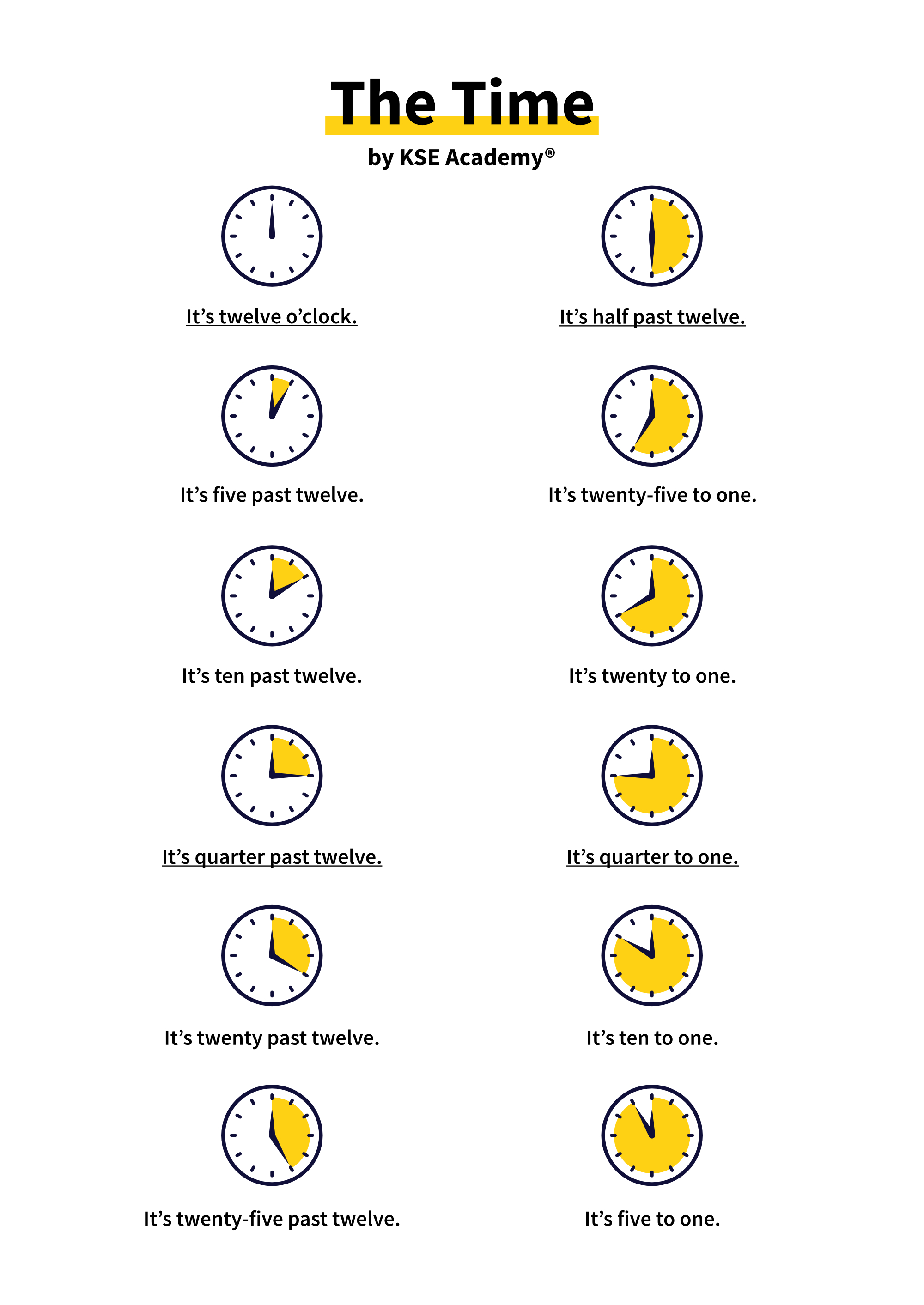
Summary of telling the time in English with a clock
Don’t forget to download this article in PDF to use it offline. 😉
It’s time to go…
What did you think of this article? I hope you found it very useful.
If you have any questions, leave me a comment 👇🏻
And until the next post, *don’t forget to keep smiling!*