Difference between YOUR and YOU’RE
Still unsure about the difference between YOUR and YOU’RE? 🤷🏼♂️ Well, don’t worry. Here I explain once and for all how YOUR and YOU’RE differ. 😎

Table of contents
Right. Let’s get serious. Some people are messing up with English grammar and it’s time to make them stop. Seriously. Is it possible that there are still people who don’t know the difference between YOUR and YOU’RE? It sounds like a joke, but it’s true. But hey, no problem, here’s good old Lewis, from KSE Academy, to explain the difference between YOUR and YOU’RE. And if you’re one of those who still don’t know the difference… 🤦🏼♂️🤦🏼♂️🤦🏼♂️ pay attention, because I’m not explaining it again, alright? 😫
Difference between YOUR and YOU’RE
What YOUR means and when it is used
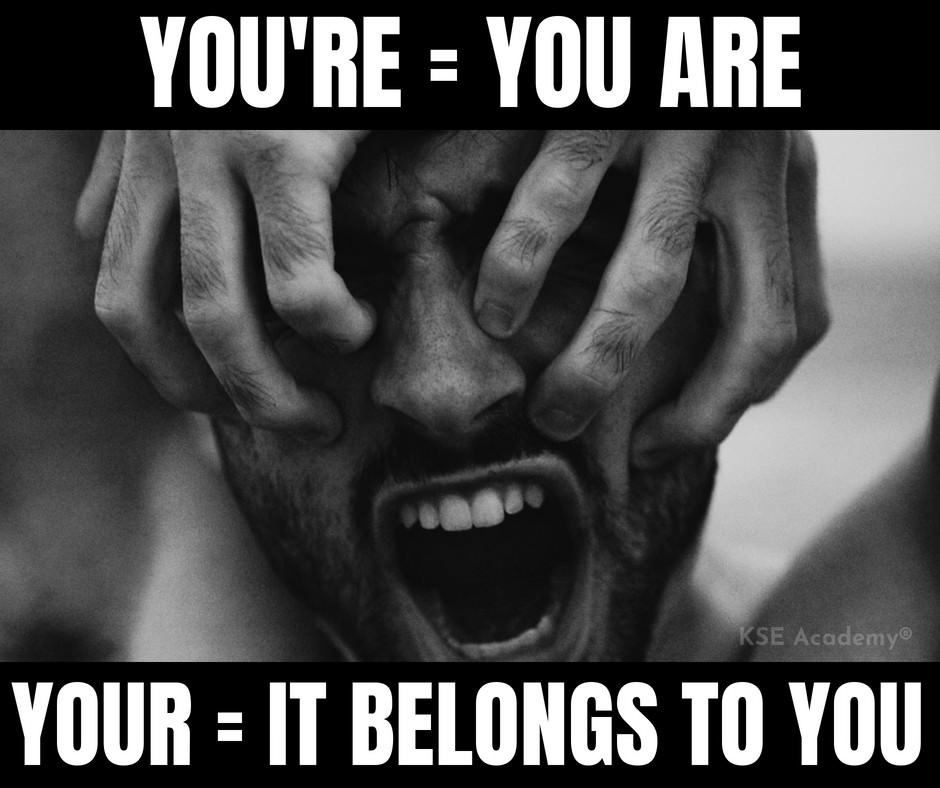
Let’s start with YOUR. The word «your», pronounced /jɔː/ (I pronounce it like that, at least, with a long «o»), means «tu» (your). And not «tú» with an accent like in you are a pain, but «tu» without an accent like in don’t tell me your life story. That is, YOUR is a possessive determiner that indicates something belongs to you. Let’s look at a few examples:
Have your parents come to visit you?
Your dog just bit me!
Did you forget to bring your mobile phone?
I saw your sister the other day.
Your teacher is not coming today.
It’s your responsibility to know the difference.
As you can see, «your» is used before a noun, indicating that that noun is yours, so to speak.
What YOU’RE means and when it is used
On the other hand, we have the contraction YOU’RE. Because yes, it is indeed a contraction, that is, two words that we have contracted to pronounce as one. Curiously (not really), YOU’RE is pronounced the same as YOUR. But mate, both in English and Spanish we have loads of homophones (words that sound the same but are spelled differently).
YOU’RE means «you are», that is «tú eres» or «tú estás«. And do you see how I emphasise «tú»? Because in this case «tú» is a personal pronoun, not a possessive determiner, you idiot! 🦑 Let’s look at several examples:
You’re the most amazing person I’ve ever met.
You’re coming to the party, right?
I told him you’re arriving late.
I’ll tell you when you’re here.
You’re absolutely right!
I’m sorry, but you’re staying home.
In these cases, «you’re» is used to say «you are» or «you’re», so it can be followed by different things like a noun (the most amazing person) or a verb in -ing (coming).
Typical mistakes using YOUR and YOU’RE
One of the most typical mistakes is the classic «de nada» in English. Imagine saying «YOUR WELCOME». You would be saying «your welcome». Yes, I know, it sounds ridiculous, but that’s how it is. That’s why it’s important to know that you have to write «YOU’RE WELCOME», that is, «you are welcome», which is the translation of «de nada»
The problem is that in many, many cases, native speakers themselves make these mistakes without realising it, because since they are pronounced the same… what does it matter, right? Well, NO, it does matter, a lot. Show these natives that you *do* know how to use these two expressions correctly, that you *do* know what differentiates YOUR and YOU’RE, and how they are used, and prove that you’re not as silly as many of them. Will you be able to? I hope so!
Did you find this information useful? You’re welcome! 😏