
Difference between LIE and LAY
Discover the difference between LIE and LAY in a simple way. There are 3 verbs, not 2. Includes tips, conjugation tables, collocations, and practical examples.

Table of contents
If there’s one pair of verbs that can make even the most confident English learner break into a cold sweat, it’s lie and lay. And it’s no wonder: their similar pronunciation, overlapping irregular forms, and the fact that we’re actually talking about three different verbs (yes, sir, three verbs!) make this one of the most common confusions even amongst native speakers.
The good news is that once you understand the logic behind these verbs and their verb tenses, it all clicks into place (kind of…). So take a deep breath, grab a pen and paper (or open your favourite notes app), and let’s untangle this mess once and for all.
Lie vs Lie vs Lay: the final unravelling
Let’s start from the beginning: when we talk about lie and lay, we’re actually dealing with three distinct verbs that have different forms and meanings. Let’s look at them one by one.
1. TO LIE (regular) – To tell an untruth
This is the easiest of the three. The verb to lie (to tell an untruth) is a regular verb, so its conjugation is fairly straightforward:
- Infinitive: to lie
- Past Simple: lied
- Past Participle: lied
- Gerund: lying
As it ends in -e, we simply add -d to form the past simple and its participle. Let’s look at some examples:
- Don’t lie to me! I need to know the truth.
- He lied about his age on the form.
- I think she’s been lying to us all along.
Memory trick: Think of «a lie» (an untruth) – both words share the same root and are easy to associate.
2. TO LIE (irregular) – To recline
This is where the fun begins. The second to lie is an irregular verb that means to recline, to be in a horizontal position, or to rest. Its conjugation is as follows:
- Infinitive: to lie
- Past Simple: lay
- Past Participle: lain
- Gerund: lying
As you can see, its infinitive and gerund are identical to those of to lie (to tell an untruth). But careful: its Past Simple is lay, which coincides with the infinitive of the third verb we’ll look at next. See why it’s so confusing? 😅
A key characteristic of this verb is that it’s intransitive, meaning it doesn’t take a direct object. You lie down, something is in a horizontal position, but you don’t lie anything. Look at these examples:
- I want to lie on the beach all day.
- She felt sick, so she lay on the sofa for a few minutes.
- The book has lain there unopened for weeks.
- The cat is lying in the sun.
Idiomatic expression: «Let sleeping dogs lie» means to avoid interfering in a situation that might cause trouble if disturbed, or to leave things as they are.
As Alicia was in good spirits that morning, Paul decided not to bring up the argument. It was best to let sleeping dogs lie.
3. TO LAY (irregular) – To place something
And we arrive at the third verb: to lay. This irregular verb means to put, place, or position something in a horizontal position, especially when done carefully or with a specific purpose. Its conjugation is:
- Infinitive: to lay
- Past Simple: laid
- Past Participle: laid
- Gerund: laying
Unlike lie (to recline), lay is a transitive verb, which means it always needs a direct object. In other words, you always lay, place, or position something. Let’s look at examples:
- Please lay the book on the table.
- Maria laid the baby on the bed and smiled.
- They have laid new carpet in the living room.
- He’s laying the foundation for the new building.
The key is in the direct object
The main difference between lie (to recline) and lay (to place something) lies in whether or not the verb needs a direct object:
- LIE (to recline) is intransitive: It does NOT need a direct object. You’re simply describing someone or something’s state or position.
Example: I lie down every afternoon. - LAY (to place/position) is transitive: It ALWAYS needs a direct object. You’re putting or placing something.
Example: I lay the keys on the table.
Memory trick 1: Think that LAY begins with L-A and has a long «a» sound, just like its definition in English: to plAce.
Memory trick 2: If you can replace the verb with «put», use lay. If you can replace it with «recline», use lie.
Here’s a comparative table with all the forms:
| Verb | Meaning | Infinitive | Past Simple | Past Participle | Gerund |
|---|---|---|---|---|---|
| Lie | To tell an untruth | lie | lied | lied | lying |
| Lie | To recline | lie | lay | lain | lying |
| Lay | To place something | lay | laid | laid | laying |
LYING vs LAYING: beware of spelling
A very common mistake is writing «lieing» instead of «lying». Careful! The correct gerund form of lie (both «to tell an untruth» and «to recline») is lying, where the i becomes a y.
- LYING: gerund of lie (to tell an untruth or to recline) – intransitive verb, no direct object.
- LAYING: gerund of lay (to place/position something) – transitive verb, with direct object.
Examples of correct usage:
- I spend rainy days lying on my couch. – No direct object.
- The delivery boy took pleasure in gingerly laying each newspaper on the stoop. – With direct object (each newspaper).
- I can always tell when my friend is lying because she bites her lip.
- Don’t leave dirty clothes lying around the house.
Remember: If you’re going to tell an untruth or recline, you’re lying, not laying. If you’re going to put or place something, you’re laying, not lying.
Useful collocations with LAY and LIE
Both lay and lie are part of numerous expressions and collocations in English. Knowing them will help you remember the difference between these verbs, as well as sound more natural and enrich your vocabulary.
Collocations with LAY:
- To lay the table: to set the table
Come on, kids! Time to lay the table! - To lay eggs: to produce eggs (a hen, a bird)
I hope my chicken will lay some eggs this season. - To lay the foundations for: to establish the basis for something
Information is the only way to lay the foundations for a healthy diet. - To lay eyes on: to see, to set eyes on
I haven’t laid eyes on him for years. - To lay a finger on: to touch, to harm
I promise I didn’t lay a finger on it! - To get laid: to have sex (informal)
He’s always so uptight. He needs to get laid.
Collocations with LIE:
- To lie ahead: to be forthcoming, to await
The President’s most serious challenges lie ahead. - To lie in store: to await, to be in the future
We didn’t know what lay in store for us.
Practical exercises to master LIE and LAY
Quick summary: complete conjugation table
So you can refer to it whenever you need, here’s a visual summary with all the verbs, their forms, and meanings:
| Verb | Meaning | Type | Infinitive | Past Simple | Past Participle | Gerund |
|---|---|---|---|---|---|---|
| Lie | To tell an untruth | Regular / Intransitive | lie | lied | lied | lying |
| Lie | To recline | Irregular / Intransitive | lie | lay | lain | lying |
| Lay | To place/position | Irregular / Transitive | lay | laid | laid | laying |
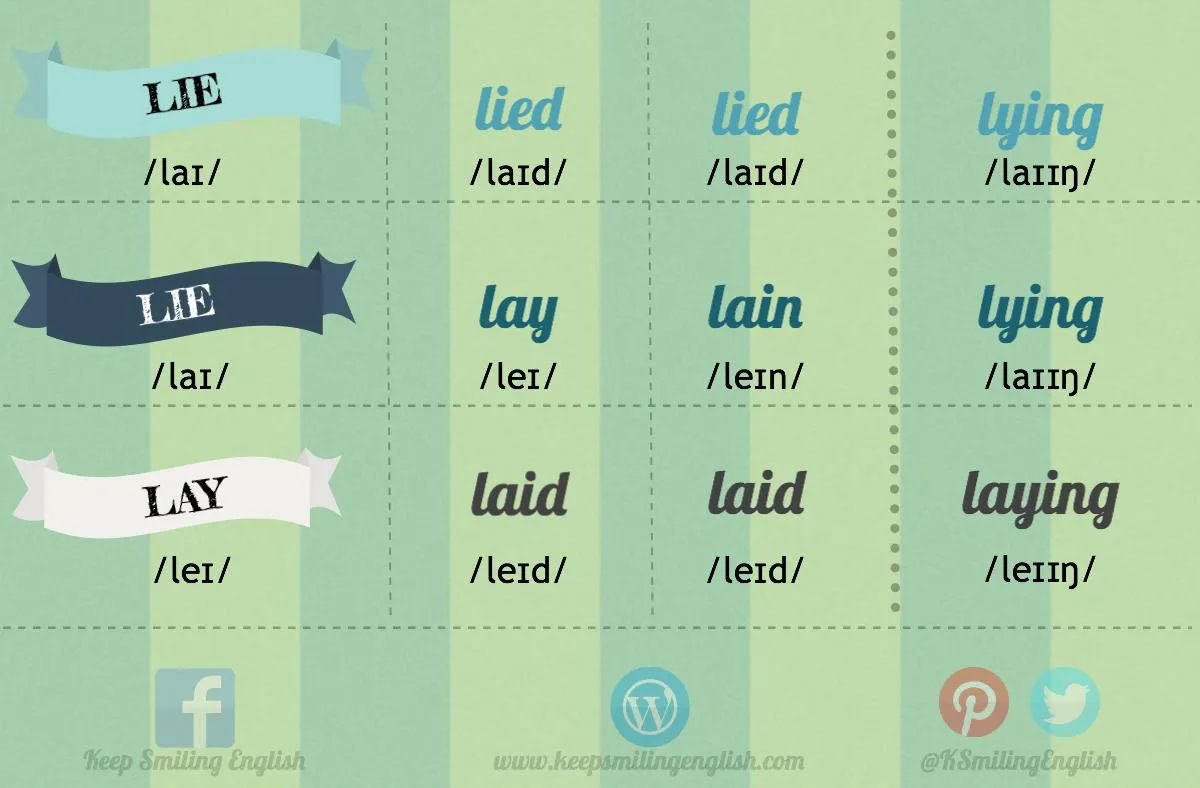
And here’s a superold table I made to illustrate this back in… 2017 or so, with the prounciation of each verb and verb form. Yeah, pretty old now but still useful! Don’t judge the design!
Final tips to remember:
- Ask yourself if there’s a direct object: If the answer is yes, use lay. If it’s no, use lie (to recline).
- Practise with real examples: When you watch Netflix, read a book, or browse the Internet, note down examples you find of these verbs. Exposure is the best way to internalise them.
- Don’t beat yourself up over mistakes: Even native speakers get confused with these verbs. What matters is that you keep practising and gradually they’ll come naturally.
- Use memory tricks: LAY = plAce. The sound will help you remember the meaning.
Mastering the difference between lie and lay is no easy task, but with practice and understanding the rules we’ve covered in this article, you’ll get there. Remember: what matters isn’t immediate perfection, but consistent progress.
And until the next article, don’t forget to keep smiling!