
Duolingo English Test (DET): Listening
Complete Guide to the Listening section of the Duolingo English Test 2026: strategies, tips and examples for Listen and Type and Interactive Listening.

Table of contents
If you are preparing for the Duolingo English Test, you probably already know that listening comprehension is one of the most important skills assessed. DET Listening not only measures your ability to understand spoken English, but also your ability to process information, participate in conversations, and summarise ideas in writing. In this article, I am going to explain absolutely everything you need to know about the DET Listening tasks: how they work, what strategies to use, how they are scored, and how to prepare effectively.
If you are looking for more general information about the exam, I recommend you take a look at our Duolingo English Test (DET) guide, where you will find complete information on all sections of the exam.
What does the DET Listening section assess?
The Listening section of the Duolingo English Test evaluates your ability to understand spoken English in different contexts and situations. But not only that: it also measures your ability to segment «connected speech», recall information accurately, participate in academic conversations, and synthesise information in writing.
Unlike other certification exams like IELTS or TOEFL, where Listening is an independent and clearly differentiated section, in the DET, listening comprehension tasks are integrated throughout the exam and, in many cases, combined with other skills such as Reading, Writing, or Speaking. This integration makes the exam more realistic, as in real communicative situations we rarely use a single skill in isolation.
Another fundamental characteristic of Listening in the DET is its adaptive nature. This means that the difficulty of the questions adjusts in real time based on your answers. If you answer correctly, the following questions will be more difficult; if you fail, they will be simpler. This system allows the exam to determine your level more accurately in less time.
The audios you will hear are always with American accents, so it is essential that you familiarise yourself with the characteristics of US pronunciation during your preparation.
Types of Listening tasks in the Duolingo English Test
The DET includes two main types of tasks that evaluate your listening comprehension:
- Listen and Type: a dictation task where you listen to a sentence and must transcribe it exactly. It appears between 6 and 9 times in the first half of the exam.
- Interactive Listening: a much more complex integrated task that includes three sequential parts based on the same conversational scenario. It appears twice in the middle part of the exam, after Interactive Reading.
Both tasks are adaptive, meaning your performance on the first questions will determine the difficulty of the following ones. Both contribute to your Listening subscore, although Interactive Listening also affects the Writing subscore in its third part.
Let’s now look at each type of task in detail.
Listen and Type: sentence transcription
What is Listen and Type?
Listen and Type is a direct dictation task. You listen to a sentence in English and must transcribe exactly what you hear, word for word, including correct punctuation and capitalisation.
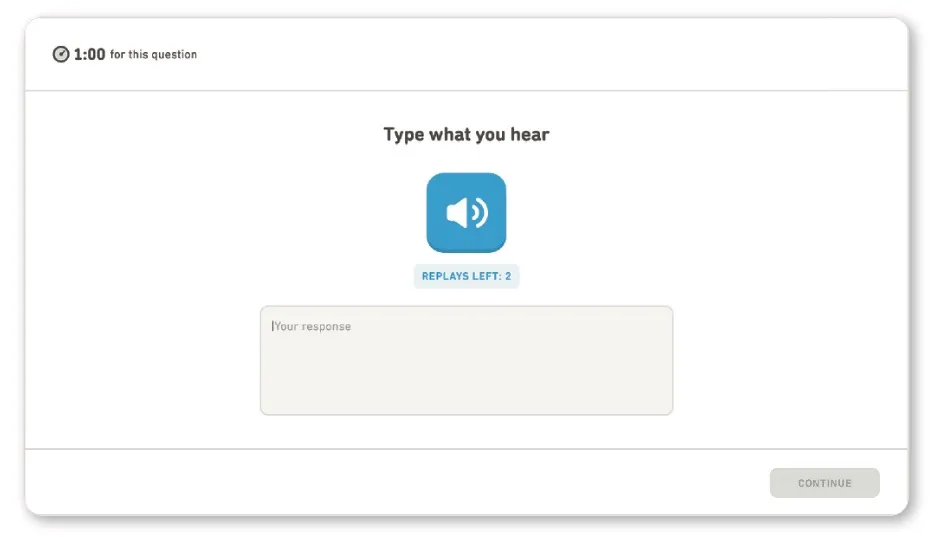
Technical characteristics:
- Time: 1 minute per sentence
- Frequency: 6-9 sentences in total
- Location: First half of the exam
- Adaptive: Yes
- Subscore affected: Listening
Sentences can be up to 20 words long and cover varied topics, from everyday situations to more academic or professional contexts.
Example:
Audio: «My artistic journey began when I was young.»
You must write: My artistic journey began when I was young.
Notice that the first letter is capitalised and the sentence ends with a full stop. These details are important.
How does Listen and Type work?
The process is simple but requires concentration:
- An audio sentence plays automatically as soon as the question appears.
- You can click the play button to listen to it up to 2 more times (3 plays in total).
- While listening or afterwards, you type what you hear into the text box.
- The counter indicates how many replays you have available («Replays left: 2»).
- When you finish, you click «Continue» to move on to the next question.
It is very important for you to know that the audio starts playing automatically, so you must be ready. This task appears in random order along with Read and Complete and Read Aloud in the first half of the exam, so you won’t know exactly when it will appear. Maintain concentration from the start.
The scoring system uses artificial intelligence that compares your answer with the correct answer, evaluates similarities and differences, and assigns you a score on a scale of 0 to 1. The closer your answer is to the correct one, the higher your score. An important fact: you will be penalised more for omitting a word than for misspelling it. That is, it is always better to try to write something than to leave blank spaces.
Essential strategies for Listen and Type
Here are the most effective strategies to maximise your score on this task:
Management of the three listens:
- First listen: Don’t try to write yet. Wait until the audio finishes playing. Focus on capturing the general meaning of the message and the main content words (nouns, verbs, adjectives). This will help you remember more than if you try to recall each word in isolation. If you can, mentally write or jot down (if you have paper) the key words you remember.
- Second listen: Now, start typing or complete your transcription. Add the functional words you were missing (articles like a, an, the; prepositions like in, on, at; conjunctions like and, but, or). Correct any errors you’ve detected and add the necessary punctuation.
- Third listen: Use this replay to verify your answer. Follow what you have written with your eyes while listening to the audio. Check that you haven’t missed any words, that the verb tenses are correct, and that the punctuation is right.
Attention to «connected speech»:
Connected speech is a phenomenon in spoken English where words join together, contract, or are pronounced differently from how they are written. Some common examples:
- «going to» sounds like «gonna», but you must write going to
- «want to» sounds like «wanna», but you must write want to
- «give me» sounds like «gimme», but you must write give me
- «let me» sounds like «lemme», but you must write let me
Familiarise yourself with these patterns during your preparation to be able to identify them correctly.
Beware of homophones:
Homophones are words that sound the same but are written differently and have different meanings. They are a common trap in Listen and Type. Some frequent examples:
- their / there / they’re
- your / you’re
- to / too / two
- its / it’s
- hear / here
- write / right
- knew / new
Use your grammatical knowledge to determine which one is correct based on the context of the sentence.
Punctuation and capitalisation:
Don’t forget these basic but essential aspects:
- The first word of the sentence is always capitalised
- Proper nouns are capitalised
- Affirmative and negative sentences end with a full stop (.)
- Questions end with a question mark (?)
- If there is a comma in the audio (a notable pause), include it
Review and use of time:
- Use all 3 plays if you need them; there is no penalty for listening several times
- Take advantage of the full minute you have available
- Always leave time at the end to check spelling, punctuation, and that you haven’t missed any words
- Use your grammatical knowledge: if the sentence doesn’t make grammatical sense, you’ve probably missed a word or a verb tense marker
- Do not add or omit words, no matter how small they are
Common errors in Listen and Type and how to avoid them
After analysing hundreds of cases of students preparing for the DET, these are the most frequent errors:
1. Omission of functional words:
Functional words (articles, prepositions, conjunctions, pronouns) are often pronounced weakly in English («weak forms») and it’s easy to miss them. For example, in the sentence «I went to the store», the words «to» and «the» are pronounced very quickly and with little emphasis. However, they are absolutely necessary in your transcription.
Solution: Know the patterns of sentence stress in English. Content words are stressed; functional ones are not. During your second listen, focus specifically on capturing these small words.
2. Spelling errors vs. missing words:
Remember that the system penalises an omitted word more than a misspelled word. If you are not 100% sure how to spell a word, write it as you think it sounds. It is better to have a spelling mistake than to leave an empty space.
Solution: Always try to write something. If you heard something but don’t know what it is, write what you think you heard.
3. Confusion with contracted forms:
Sometimes you will hear contractions (I’m, you’re, isn’t, haven’t) and other times full forms (I am, you are, is not, have not). You must write exactly what you hear. Both contracted and full forms are acceptable, but you have to transcribe the one used in the audio.
Solution: Pay specific attention to this on your second listen. If in doubt, listen a third time focusing on this aspect.
4. Not using all replays:
Some students get overconfident after the first listen and don’t use the two additional replays. This is a mistake. Take advantage of every opportunity you have to verify your answer.
Solution: Make it a rule to always use all 3 plays, each with a specific purpose (general meaning → functional words → verification).
Additional tips to improve in Listen and Type
Familiarisation with American accents:
All DET audios have American accents, so it is essential that you expose yourself to this type of pronunciation. The main features of the American accent include:
- The «r» is pronounced in all positions (car, water, better)
- The «t» between vowels sounds like a soft «d» (water sounds like «wader»)
- Vowels are different from the British accent (can’t, dance, path)
Practice with sentences of up to 20 words:
Sentences in Listen and Type can be quite long. During your preparation, practise specifically with sentences of 15-20 words to develop your auditory memory and segmentation ability.
Knowledge of sentence stress:
In English, not all words are pronounced with the same intensity. Content words (nouns, main verbs, adjectives, adverbs) are stressed, while functional words (articles, prepositions, pronouns, auxiliary verbs) generally are not. Knowing this pattern will help you not to miss the small words.
British and American spelling:
Good news: the DET accepts both British and American spelling. So you can write color or colour, organize or organise, center or centre. Choose the one that feels more natural to you and maintain consistency.
Interactive Listening: the most complete task
What is Interactive Listening?
Interactive Listening is the most complex and realistic task of the DET in terms of listening comprehension. It simulates a real communicative situation where you listen to a scenario or conversation and perform three sequential activities related to that audio. It is «interactive» because it requires you to actively participate in a conversation, not just listen passively.
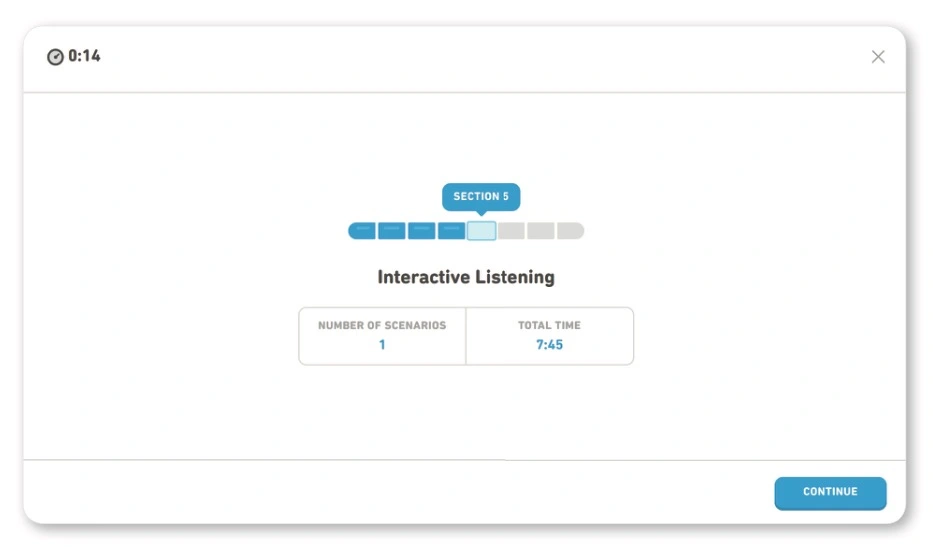
Technical characteristics:
- Time: 6 minutes 30 seconds for Parts 1-2 (Listen and Complete + Listen and Respond) + an additional 75 seconds for Part 3 (Summarize the Conversation)
- Frequency: 2 complete sets in the exam
- Location: In the middle part of the exam, after Interactive Reading
- Adaptive: Yes
- Subscores affected: Listening (Parts 1 and 2) + Listening and Writing (Part 3)
Each Interactive Listening includes three parts that you must complete sequentially based on the same scenario:
- Listen and Complete: You listen to a scenario and complete fill-in-the-blank questions
- Listen and Respond: You participate in a conversation by choosing appropriate responses
- Summarize the Conversation: You write a summary of the conversation you just had
Types of interactions:
Interactive Listening scenarios are always set in university or academic contexts. You will receive one of each type:
- Student-student conversation: focused on requests, seeking advice, planning academic activities, teamwork, etc.
- Student-professor conversation: focused on similar purposes, seeking information, clarifications on class content, requesting extensions, etc.
Let’s now look at each of the three parts in detail.
Part 1 – Listen and Complete
How does Listen and Complete work?
In this first part, you will hear an introduction to the scenario. This audio lasts approximately 30-45 seconds and sets the context of the situation. For example:
- «You are working on a research project with your professor. You are unsure about what to do next and are considering asking for help…»
- «You are talking with a classmate about an internship opportunity. You want to know more details about the application process…»
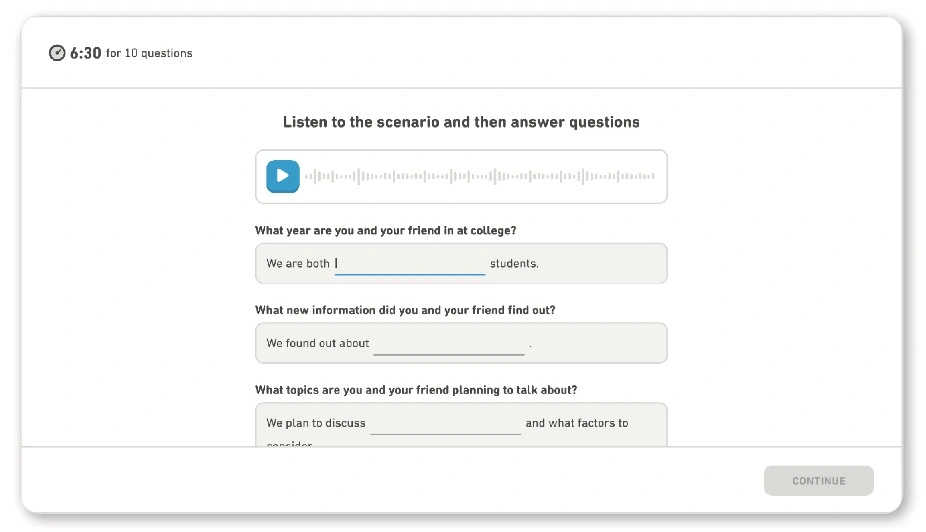
After listening to this introductory audio, you will see 3-4 questions with blank spaces that you must complete by writing specific information you heard. The questions usually follow this format:
- «Who are you completing the research project with?» → Answer: I’m completing it with my professor. (or simply: my professor)
- «What are you unsure about?» → Answer: I’m unsure about what to do. (or: what to do next)
- «Why don’t you ask your professor for help?» → Answer: Because I’m not sure they will be able to help.
As you can see, the questions extract key information from the scenario: who is involved, what problem there is, what the reason for a certain situation is, etc.
Strategies for Listen and Complete
Taking advantage of unlimited replays:
Unlike Listen and Type (where you have 3 replays) or Listen and Respond (where you can only listen once each turn), in Listen and Complete you can play the scenario audio as many times as you want. This is a great advantage. Use it:
- First listen: understand the general context, the characters involved, and the main problem
- Second listen: focus on answering the specific questions. You can pause after each play to write
- Additional listens: verify specific details or clarify doubts about individual questions
Additionally, you can continue to play the scenario audio even when you advance to the Listen and Respond part. To do so, simply scroll up the page. The timer will keep running, so use it strategically.
Concise and direct answers:
There is no minimum word limit for your answers. You only need to write enough to answer the question completely. Do not add extra information that is not requested. Examples:
- Question: «Who are you working with?» → Good: «my professor» / «I’m working with my professor» → Too much: «I’m working with my professor who is an expert in biology and has been teaching for 20 years»
Minor spelling, punctuation, or grammar errors are not a problem as long as they do not change the meaning of your answer. The important thing is to capture the correct information.
You can paraphrase the answer or use the exact words you heard in the audio. Both approaches are valid.
Management of shared time (6:30 minutes):
Remember that the 6 minutes and 30 seconds are to complete both Listen and Complete and Listen and Respond. This means you must manage your time carefully. Most candidates spend less time on Listen and Complete (2-3 minutes) and more time on Listen and Respond (3:30-4 minutes).
A good strategy is:
- Listen to the scenario 2-3 times
- Answer the questions concisely
- Quickly check your answers
- Advance to Listen and Respond leaving at least 4 minutes
Do not obsess over perfection in this part. It is better to move forward with correct but not perfect answers than to run out of time for Listen and Respond.
Part 2 – Listen and Respond
How does Listen and Respond work?
Now comes the truly interactive part. You will participate in a simulated conversation with a character (represented by an avatar and an audio). The character will talk to you, and you must select the best response from several options to keep the conversation natural and coherent.
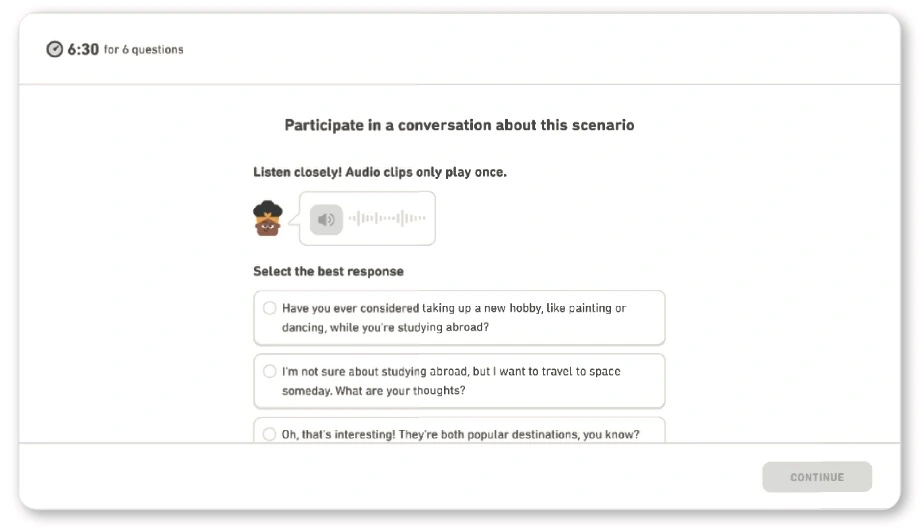
The conversation consists of 4-6 exchanges (turns). In each turn:
- The character speaks (you can see a counter indicating «Number of plays: 0»)
- You listen to what they say (you can only play it ONCE)
- You read the available answer options (usually 3 options)
- You select the response that best fits the conversation
- If you choose correctly, the box around the text turns green and you continue
- If you choose incorrectly, the box turns red and the system shows you the correct answer
An important point: if you make a mistake, don’t worry. The system immediately shows you which answer was correct. Pay attention to this correction because it will help you follow the thread of the conversation and choose better in the following turns.
Common topics in Listen and Respond
Interactive Listening conversations are always set in university contexts. The most frequent topics include:
- Asking for help or advice: «I’m struggling with this assignment. Do you have any suggestions?»
- Giving recommendations: «Have you considered talking to the professor about it?»
- Planning activities: «Should we meet tomorrow to work on the project?»
- Making requests: «Could you send me the notes from yesterday’s class?»
- Solving everyday problems: «I missed the deadline. What should I do?»
- Asking for clarifications: «I didn’t understand what the professor said about the final exam.»
- Seeking information: «Do you know where I can find information about internships?»
During your preparation, familiarise yourself with the vocabulary and typical phrases of these contexts.
Strategies for Listen and Respond
Attention to key words from the scenario:
Key words mentioned in the initial scenario (in Listen and Complete) usually repeat in the correct answer options at the beginning of the conversation. They can also serve as clues to eliminate incorrect options.
For example, if the scenario mentioned «research project» and «professor», the first correct answer is likely to include references to these elements.
Only one replay per turn:
This is a crucial difference from Listen and Complete. In Listen and Respond, each character turn can only be heard ONCE. There is no option to repeat. Therefore, it is fundamental to:
- Listen with maximum concentration
- Focus on capturing the general meaning, not every word
- Keep the information in your working memory while you read the options
Consideration of context and speaker relationship:
Think about the relationship between the speakers. Are they two students at the same level? Is it a conversation between a student and a professor? The register and tone of your answers must be appropriate:
- Student-student: more informal, colloquial language, casual tone
- Student-professor: more formal, polite, respectful
Incorrect answers often fail because the tone or register is not appropriate for the situation.
Process of elimination:
When you are not sure which answer is best, use the process of elimination focusing on three key elements:
- The topic: Does the answer talk about the same topic the character mentioned?
- The verb tense: Is the verb tense of the answer consistent with the temporal context of the conversation?
- The tone/mood: Is the emotional tone of the response appropriate? (agreement, disagreement, doubt, certainty, etc.)
Eliminate options that do not fit these three elements and choose the one that fits best.
Learning from mistakes (automatic correction):
If you choose an incorrect response, the system immediately shows you which one was correct. Don’t get discouraged. Instead, take advantage of this information:
- Read the correct answer carefully
- Understand why it was better than your choice
- Use this information to follow the thread of the conversation in subsequent turns
- Adjust your strategy for the following answers
Conversational coherence:
Real conversations have a logical flow. Each turn builds on the previous one. Think: what would YOU say in this real situation? The correct options are usually the ones that sound most natural and maintain conversational flow.
Incorrect options are often grammatically correct, but do not fit the conversation because:
- They change the subject abruptly
- They do not answer what the character said
- They use an inappropriate tone
- They include information that was not mentioned
Time management in Listen and Respond:
If you have time left at the end of Listen and Respond, use it to:
- Scroll up and re-read the entire conversation
- Try to remember as many details as possible
- Mentally prepare for the summary that follows
Once you advance to Summarize the Conversation, you will not be able to see the conversation again, so make the most of this moment.
Part 3 – Summarize the Conversation
The last part of Interactive Listening is a written summary of the conversation you just had. You have 75 seconds to write it.
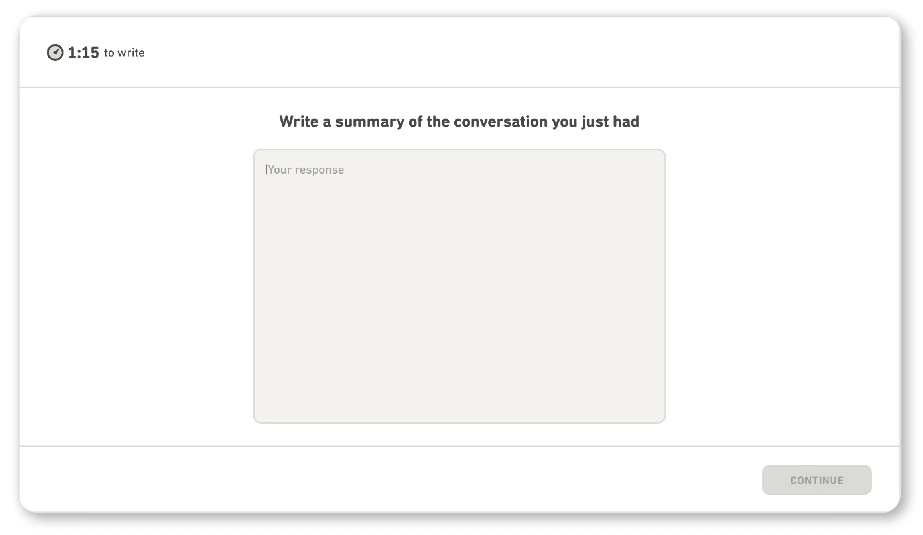
This part affects two subscores: Listening (because you need to have understood the conversation) and Writing (because you are producing written text). The system evaluates your summary according to several aspects: content, discourse coherence, vocabulary, and grammar.
What should you include in the summary?
Your summary should include the following essential elements:
- The main topic of the conversation: What was discussed? (research project, internships, exam, group work, etc.)
- The participants: Who was talking? (two students, student and professor, etc.) What was your role?
- The key problem or question: What was the problem to be solved or the main issue?
- The outcome or conclusion: What was decided? What actions were agreed upon? How did the conversation end?
Example of a good summary:
«I talked with my classmate about an upcoming research project. I was unsure about which topic to choose and asked for advice. My classmate suggested focusing on environmental issues and recommended talking to Professor Johnson, who is an expert in that area. We agreed to meet tomorrow to discuss it further and start planning our approach.»
This summary includes: the topic (research project), the participants (I and my classmate), the problem (unsure about topic), and the outcome (agreed to meet tomorrow, suggested talking to Professor Johnson).
Strategies for Summarize the Conversation
Managing the 75 seconds:
75 seconds is not much time, so you must be efficient. Here is the optimal strategy:
- First 50-60 seconds: Write your summary focusing first on the main facts (who, what, outcome) and then add secondary details if there is time
- Last 10-15 seconds: Check spelling and basic grammar, especially verb tenses and agreement
Do not try to write a perfectly elaborate summary. A complete and correct summary, even if simple, is better than an incomplete summary with very advanced vocabulary.
First person vs. third person:
You can write your summary in the first person (since you participated in the conversation) or in the third person (as an external observer). Both approaches are valid:
- First person: «I talked with my professor about extending the deadline for my assignment. I explained that I had been ill…»
- Third person: «A student talked with their professor about extending the deadline for an assignment. The student explained that they had been ill…»
Personally, I recommend the first person because it is more natural and faster to write when you have little time.
Structure: full paragraph, not bullet points:
Your summary should be a coherent paragraph with complete sentences, not a list of bullet points. Use connectors to link ideas:
- First, then, after that, finally (for temporal sequence)
- Because, since, as (for reasons)
- So, therefore (for results)
- However, but (for contrast)
Prioritisation of information (who, what, outcome):
If you are running out of time, make sure to include at least these three basic elements:
- Who: «I talked with my classmate»
- What: «about our group presentation»
- Outcome: «and we decided to meet on Friday to practise»
A simple but complete summary is better than a detailed but incomplete one.
No need to paraphrase:
Do not waste time trying to find synonyms or paraphrasing everything. You can use the same vocabulary that was used in the conversation. The important thing is to capture the information accurately, not to demonstrate lexical richness.
For example, if the conversation talked about a «research project», you can use «research project» in your summary. You don’t need to look for alternatives like «investigative study» or «academic inquiry».
Spelling and grammar check:
Leave 10-15 seconds at the end to quickly review:
- That all sentences have a subject and a verb
- That verb tenses are consistent (usually past tense)
- That the spelling of key words is correct
- That you have capitalised the beginning and used a full stop at the end
Useful phrases to start the summary
Having some phrases prepared will help you start quickly without wasting time thinking. Here are some options:
For student-student conversations:
- «I talked with my classmate about…»
- «I discussed with a friend from class…»
- «My classmate and I talked about…»
- «I had a conversation with another student about…»
For student-professor conversations:
- «I spoke to my professor about…»
- «I met with my professor to discuss…»
- «I asked my professor for…»
- «I requested help from my professor regarding…»
To mention the problem:
- «I was unsure about…»
- «I needed help with…»
- «I was concerned about…»
- «I wanted to know…»
To mention the outcome:
- «We decided to…»
- «We agreed that…»
- «My professor/classmate suggested…»
- «In the end, we…»
- «The conversation concluded with…»
Use of «reported speech»:
Since you are summarising a conversation that has already occurred, it is useful to know reported speech structures. Some examples:
- Direct: «I need help with this project» → Indirect: «I said that I needed help with the project»
- Direct: «Can you help me?» → Indirect: «I asked if they could help me»
- Direct: «You should talk to the professor» → Indirect: «They suggested that I talk to the professor»
However, it is not strictly necessary to use reported speech. You can simply summarise the main ideas in your own words.
Comparison between Listen and Type and Interactive Listening
So you can clearly see the differences between both types of tasks, here is a comparative table:
| Feature | Listen and Type | Interactive Listening |
|---|---|---|
| Format | Dictation of a sentence | Simulated conversation in 3 parts |
| Time | 1 minute per sentence | 6:30 (Parts 1-2) + 1:15 (Part 3) |
| Frequency | 6-9 times | 2 full conversations |
| Location | First half of the exam | Middle part (after Interactive Reading) |
| Replays | 3 times per sentence | Unlimited (Part 1), 1 time per turn (Part 2) |
| Type of response | Exact transcription | Short written answers, multiple choice, written summary |
| Skills assessed | Listening comprehension, speech segmentation, spelling | Listening comprehension, conversation comprehension, pragmatics, information synthesis, writing |
| Subscores affected | Listening | Listening + Listening and Writing (Part 3) |
| Main difficulty | Connected speech, homophones, functional words | Time management, contextual comprehension, quick written production |
| Adaptive | Yes | Yes |
Which is harder and why?
The answer depends on your profile as a student:
- Listen and Type may be harder if: you have problems with English spelling, are not familiar with American accents, or find it difficult to identify functional words in fast speech. The need to transcribe EXACTLY what you hear (without adding or omitting anything) can be stressful.
- Interactive Listening may be harder if: you struggle with time management, get nervous during long and complex tasks, or have difficulty writing quickly in English. Part 2 (where you can only listen once each turn) is particularly challenging if your working auditory memory is not very strong. Part 3 requires rapid synthesis and writing under time pressure.
In general, Interactive Listening is considered more challenging by most students because:
- It combines multiple skills (listening, reading, writing)
- It requires time management between several parts
- Information accumulates throughout the conversation
- You have to produce answers, not just transcribe
However, Interactive Listening also offers more opportunities to compensate: if you fail a response in Listen and Respond, you are shown the correct one and can continue; if you struggle with a question in Listen and Complete, you can spend more time on it because you have unlimited replays.
Scoring system of Listening in the DET
Understanding how the Listening tasks are scored will help you prioritise your efforts during preparation and the exam.
How Listen and Type is evaluated:
Listen and Type responses are evaluated by an artificial intelligence engine that uses comparison procedures between your response and the correct response. The system:
- Compares your transcription with the original text
- Evaluates similarities and differences
- Assigns a score on a scale of 0 to 1
The closer your answer is to the correct one, the higher your score. Important aspects:
- Omitted words are penalised more than misspelled words
- Added words that were not in the original also reduce your score
- Punctuation errors have less weight than word errors
- Capitalisation errors have less weight than word errors
How Interactive Listening is evaluated:
Interactive Listening has three parts and each is evaluated differently:
Part 1 – Listen and Complete:
- Similar to Listen and Type, your answers are compared with the correct ones
- Score on a scale of 0 to 1 per question
- Meaning is more important than exact form
- Minor errors in spelling, punctuation, or grammar do not affect much if the meaning is correct
Part 2 – Listen and Respond:
- Each response is evaluated as correct or incorrect (binary system)
- There are no partial scores
- There is only one completely correct answer in each turn
Part 3 – Summarize the Conversation:
- Holistic evaluation of multiple writing aspects
- Content: Have you included the main information? Is it accurate?
- Discourse coherence: Is your summary well organised? Do ideas connect logically?
- Vocabulary (lexical): Do you use appropriate and varied vocabulary?
- Grammar: Are your grammatical structures correct? Is there consistency in verb tenses?
Listening subscore vs. Listening and Writing subscore:
The DET not only gives you a global score; it also provides subscores in different areas. Listening tasks contribute to two different subscores:
- Listening subscore: includes Listen and Type + Interactive Listening (Parts 1 and 2)
- Listening and Writing subscore: includes Interactive Listening (Part 3) + other integrated tasks of the exam
This means that Interactive Listening is especially important because it contributes to TWO different subscores.
Relative importance of each task:
Although all tasks are important, by pure mathematics:
- Interactive Listening has more overall weight because it appears twice (although each lasts longer) and affects two subscores
- Listen and Type appears more frequently (6-9 times) but each individual instance has less weight
That said, you cannot neglect either of the two. The adaptive system means that your performance on Listen and Type will determine the difficulty of the following questions, which affects your overall score.
Preparation plan for DET Listening
Now that you know the Listening tasks in depth, let’s see how to prepare effectively according to your available time.
Long-term preparation (4-8 weeks)
If you have between 4 and 8 weeks to prepare, this is the ideal plan:
Daily exposure to American English:
The best way to improve your listening comprehension is to expose yourself to spoken English every day. Recommended resources:
- American Podcasts: choose topics that interest you (technology, culture, education, news). Some options: NPR, TED Talks Daily, The Daily (New York Times)
- American series and films: first with English subtitles, then without subtitles
- YouTube in American English: follow American content creators on topics you like
- Audiobooks: especially useful because speech is clear and well-articulated
Spend at least 20-30 minutes daily on this passive exposure, and another 15-20 minutes on active practice (see below).
Dictation practice:
To specifically prepare for Listen and Type:
- Search for sentences of 10-20 words in intermediate-advanced level texts
- Use text-to-speech tools with an American voice to convert them to audio
- Listen to them and transcribe them exactly
- Compare your transcription with the original
- Identify your recurring errors (Do you omit functional words? Do you confuse homophones?)
Do this 3-4 times per week with 5-10 sentences each time.
Academic and university vocabulary:
Given that Interactive Listening is always set in university contexts, familiarise yourself with vocabulary related to:
- University life (assignment, deadline, extension, syllabus, office hours, research, thesis, internship, grade, semester)
- Functional language to ask for help (I’m struggling with, Could you help me, I need advice on, I’m unsure about)
- Language to give advice (You should, Have you considered, Why don’t you, It might be helpful to)
- Language for planning (Let’s meet, How about, Would it work if, We could)
Simulated conversation practice:
To prepare for Listen and Respond:
- Read dialogues in university contexts
- Pay attention to the natural flow of conversations
- Identify typical phrases to start, maintain, and close conversations
- Mentally practise what you would say in those situations
Short-term preparation (1-2 weeks)
If you only have 1-2 weeks, focus on the essentials:
Familiarisation with the official practice platform:
The DET offers free practice at englishtest.duolingo.com/practice. This is your most valuable tool because:
- You familiarise yourself with the exact exam interface
- You practise with real examples of each task type
- You get used to the format and timings
Spend at least 45-60 minutes daily practising here, focusing especially on Listening tasks.
Timed mocks:
Do at least 2-3 full mocks timing yourself strictly:
- For Listen and Type: 1 exact minute per sentence
- For Interactive Listening: 6:30 for Parts 1-2, then 1:15 for Part 3
This will help you develop a sense of time and avoid running out of time in the real exam.
Review of «connected speech» and homophones:
Dedicate a specific session to review:
- Common patterns of connected speech (gonna, wanna, gotta, coulda, shoulda, woulda, etc.)
- Frequent homophones and how to distinguish them by context
- Weak forms of functional words
There are many free resources on YouTube on these topics.
Practising summaries in 75 seconds:
This is a specific skill that requires practice:
- Listen to or read a short conversation (1-2 minutes)
- Set a timer for 75 seconds
- Write a summary that includes: who, what, problem, outcome
- Review in the last 10-15 seconds
Repeat this 10-15 times during the week before the exam to develop speed and confidence.
The day before the exam
The day before the exam is NOT the time for intensive practice. Instead:
Review of key strategies:
- Mentally review the strategies for each task type
- Visualise yourself performing the exam calmly and confidently
- Remember the key points: use all replays in Listen and Type, manage time well in Interactive Listening, include the 4 essential elements in the summary
Avoid over-studying:
- Do no more than 30-45 minutes of light practice
- Avoid introducing new information; just review what you already know
- Spend time relaxing and resting
Technical preparation:
- Check that your headphones are working correctly
- Test your internet connection
- Ensure your exam space is prepared (quiet, well-lit, no distractions)
- Fully charge your computer
- Prepare your ID
Recommended resources for practising DET Listening
Here is a list of specific resources to help you in your preparation:
Official Duolingo practice platform:
- englishtest.duolingo.com/practice – This is the most important resource. It is free and gives you unlimited access to examples of all exam tasks, including Listen and Type and Interactive Listening.
Resources for American accents:
- Rachel’s English (YouTube): excellent channel for learning American pronunciation, «connected speech» and sound reduction
- VOA Learning English: audios with controlled speed and transcripts, ideal for beginners and intermediates
- NPR Podcasts: for more advanced levels, real American English in varied contexts
Online dictation tools:
- Listen and Write: website with free dictation exercises
- YouGlish: search for words and phrases in English and hear how they are pronounced in real YouTube videos; you can filter by American accent
- Natural Reader or similar: text-to-speech tools to create your own dictation exercises
Podcasts and listening materials:
- TED Talks: short talks (10-20 minutes) on varied topics, with transcripts available
- The Daily (New York Times): daily news podcast, excellent for context and vocabulary
- Stuff You Should Know: educational podcast on varied topics, clear and well-structured speech
- Elllo.org: website with hundreds of short listening comprehension audios with exercises
Frequently asked questions about DET Listening
How many times can I listen to the audio?
It depends on the type of task:
- Listen and Type: you can replay each sentence up to 3 times in total
- Interactive Listening – Part 1 (Listen and Complete): you can replay the scenario audio as many times as you want during the 6:30 minutes available
- Interactive Listening – Part 2 (Listen and Respond): each turn of the conversation can only be heard ONCE. However, you can listen to the initial scenario audio again by scrolling up
Is British and American spelling accepted?
Yes, the DET accepts both British and American spelling. You can write color or colour, organize or organise, center or centre, etc. Both are considered correct.
However, remember that the audios always have American accents, so it may feel more natural to use American spelling to maintain consistency.
What happens if I make a mistake in Listen and Respond?
If you choose an incorrect answer in Listen and Respond, the system immediately shows you which answer was correct. The box around the incorrect text turns red, and the correct answer appears highlighted.
This does NOT mean you have failed or that your score will be very low. The exam is adaptive, so an occasional error is normal. The important thing is to:
- Pay attention to the correct response to follow the thread of the conversation
- Use this information to improve your choices in subsequent turns
- Don’t let the error make you nervous; keep calm and continue
Can I go back in Interactive Listening?
Within each part of Interactive Listening, you can scroll up to review previous information:
- During Listen and Complete: you can re-read the previous questions
- During Listen and Respond: you can scroll up to listen to the initial scenario audio again or re-read previous turns of the conversation
However, once you advance from one part to the next (for example, from Listen and Complete to Listen and Respond, or from Listen and Respond to Summarize the Conversation), you CANNOT go back to the previous part.
How much weight does Listening have in the final score?
The DET does not publish the exact weight percentages for each task type, but we can make some important observations:
- Your global score (10-160) is calculated based on performance in ALL exam tasks
- Additionally, you receive 4 subscores (Literacy, Conversation, Comprehension, Production) that are calculated independently
- Listening tasks contribute mainly to the Comprehension subscore
- Interactive Listening also contributes to Conversation (via the Summarize the Conversation part)
The important thing is to understand that no single task will determine your final score. Listening is a significant part, but you cannot compensate for poor Listening with excellent Speaking, or vice versa. All skills are important.
Conclusion
Listening on the Duolingo English Test is a comprehensive and realistic assessment of your ability to understand spoken English in different contexts. From the direct dictation of Listen and Type to the integrated complexity of Interactive Listening, each task is designed to measure specific listening skills that you will need in real academic settings.
The keys to success in this section are:
- Familiarisation with the format: use the official practice platform until you feel completely comfortable with each task type
- Constant exposure: listen to American English every day, not just during formal study sessions
- Specific strategies: apply the techniques we have discussed for each task (managing replays, focusing on key words, process of elimination, etc.)
- Time management: practise by timing yourself to develop an internal sense of the available time
- Calm and confidence: mistakes are normal in an adaptive exam; don’t let them discourage you
Remember that the DET is different from other exams you may have taken before. Its adaptive format, integrated nature, and focus on realistic communicative situations make it unique. The good news is that with proper preparation and constant practice, you can achieve the score you need.
Take advantage of all the resources available to you, especially the official practice platform, and do not underestimate the importance of regularly exposing yourself to American English. Listening is not just an exam skill; it is a fundamental competency that you will use constantly in your academic and professional life.
And until the next article, don’t forget to keep smiling!