
How to Write a Review for Cambridge C2 Proficiency [2026 Guide]
Learn how to write a Review for C2 Proficiency (CPE) with real-life samples, a step-by-step structure, and useful expressions. Complete 2026 guide.

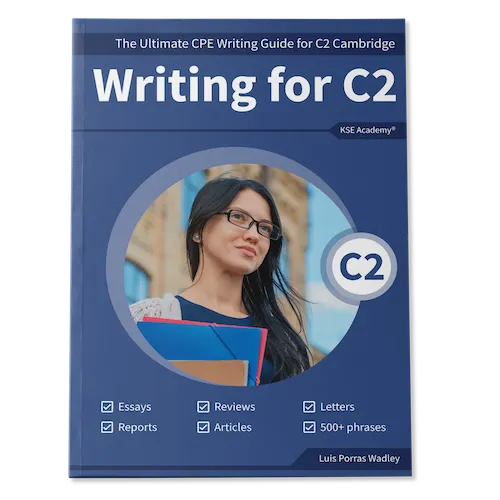
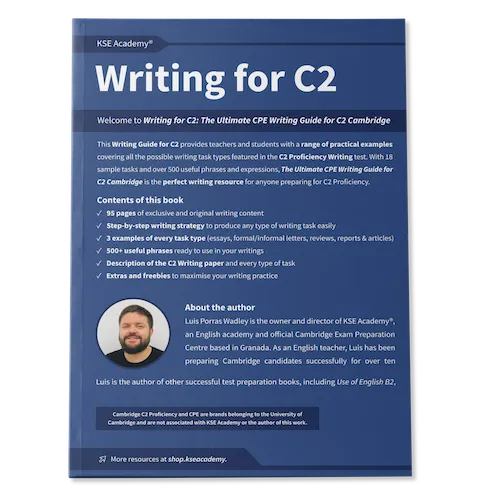
Table of contents
A review is one of the text types that may appear in Part 2 of the C2 Writing paper. Although you might already be familiar with this task from lower levels, at C2 Proficiency, examiners expect a level of linguistic sophistication, critical analysis, and natural expression that goes far beyond what is required for B2 or C1. In this article, I am going to explain exactly how to write a C2 Proficiency review step-by-step, featuring real C2-level samples and all the tips you need to achieve the highest possible mark in this part of the exam.
What are the parts of the Cambridge C2 Proficiency Writing paper?
The C2 Proficiency Writing paper consists of two parts, and you have a total of 1 hour and 30 minutes to complete both. Each part has its own specific characteristics and requirements:
- Writing Part 1: In this part, you must always write an essay. There are no options to choose from, making it absolutely essential to master this text type. If you want to learn more about how to dominate this section, I recommend reading my guide on how to write a C2 Essay. For this task, you are expected to write between 240 and 280 words.
- Writing Part 2: In this part, you have 3 options to choose from, and the possible text types are as follows:
- Letter/Email (formal or informal)
- Report
- Review
- Article
For Part 2, you must write between 280 and 320 words. As you can see, the review is one of the common options, so if you find this type of writing comfortable or engaging, it is vital to know exactly how to produce one at a C2 level.
What is a C2 review?
A review for C2 Proficiency is a text in which you critically evaluate something you have experienced, seen, read, or visited. It could be a book, a film, a concert, a play, a restaurant, a museum, an exhibition, a cultural event, or even a product or service. The primary objective of a review is not merely to describe, but to analyse, evaluate, and recommend (or discourage) in a well-founded and sophisticated manner.
At a C2 level, a review must demonstrate:
- Critical analysis skills: It is not enough to simply say «I liked it» or «it was good.» You must analyse why something works or fails, evaluating different aspects with depth and nuance.
- Mastery of the appropriate register: Reviews are usually aimed at the general public, so the register is normally standard, though it can be slightly informal depending on the context. However, even in a more relaxed tone, you must demonstrate complete control of the language at a C2 level.
- The ability to engage the reader: A good review does more than just inform: it should also entertain and hold the reader’s attention from beginning to end.
- A balance between description and evaluation: You must provide enough information for the reader to understand what you are talking about, but without spending too much time on pure description. The majority of your review should focus on your analysis and critical evaluation.
- Precise and sophisticated vocabulary: At C2, examiners expect a rich, varied, and precise vocabulary, featuring natural idiomatic expressions and the appropriate use of phrasal verbs where relevant.
It is important to note that, although the basic structure of a review is similar across all Cambridge levels, the linguistic and analytical expectations at C2 are significantly higher than at B2 or C1. Your writing is expected to be virtually indistinguishable from that of an educated native speaker.
How to write a review for the Cambridge CPE
Now that you know what a C2 review is, let’s look at the main characteristics your review should have to achieve the highest mark:
- Purpose: The main goal of a C2 review is to critically evaluate something you have experienced, giving the reader enough information to decide whether it is worth their time or money. It is not just about giving your personal opinion; it is about analysing in a reasoned way, considering multiple aspects and offering a balanced perspective. You must show the ability to identify both the strengths and weaknesses of what you are evaluating, clearly explaining why something works or fails.
- Tone and register: C2 Proficiency reviews are usually aimed at the general public (magazine readers, websites, cultural blogs, etc.), so the register is typically standard, although it can lean towards slightly informal depending on the context and target reader. Unlike an essay or a report, in a review, you can address the reader directly in the second person (you), ask rhetorical questions to engage them, and even use a touch of humour where appropriate. However, you should never slip into overly colloquial or slang language. Avoid excessive contractions or basic vocabulary. Your language must reflect sophistication even in a relaxed tone.
- Structure: A C2 review must have a clear and well-organised structure. The essential elements are: In total, your review should have between 4 and 5 distinct paragraphs, plus a title.
- Catchy title: It is absolutely essential to include a title that grabs the reader’s attention from the outset. The title should be witty, intriguing, or creatively descriptive. It can include a pun, a cultural reference, or simply summarise your evaluation in a memorable way.
- Engaging introduction: The first paragraph must immediately hook the reader. You could start with a rhetorical question, a provocative statement, a brief anecdote, or a vivid description that sets the tone for your review. In this paragraph, you must introduce what you are reviewing and give a general indication of your perspective.
- Body paragraphs (2-3): This is where you develop your analysis. Each paragraph should focus on a different aspect of what you are evaluating. For example, if you are reviewing a book, you might devote one paragraph to the plot, another to characters and style, and a third to themes and relevance. If you are reviewing a restaurant, you could discuss the food, the atmosphere, and the service in separate paragraphs. It is crucial that you do not just describe, but critically evaluate each aspect.
- Conclusion with recommendation: The final paragraph should summarise your overall evaluation and offer a clear, well-founded recommendation. You can state who the subject of the review is particularly suitable for, and leave the reader with a memorable final thought.
- Personal opinion: Unlike an essay, where you must maintain a certain level of objectivity, in a review, you are expected to express your personal opinion clearly and strongly. You can (and should) use the first person (I) freely throughout the text to share your impressions and reactions. However, your opinions must always be supported and justified with specific reasons. It is not enough to say «I loved it»: you must explain why, using concrete details and examples.
- Coherence and cohesion: As with any C2 writing task, coherence is fundamental. Your ideas should follow a logical and natural progression, linked by level-appropriate connectors. However, in a review, you can afford to use less formal connectors than in an essay. Expressions like what’s more, on top of that, having said that, all things considered, to be fair, etc., are perfectly appropriate and demonstrate naturalness. The reader should be able to follow your line of thought effortlessly.
- Engaging the reader: A distinctive feature of reviews is that they should be attractive and entertaining to read. To achieve this, you can:
- Address the reader directly: «Have you ever wondered…?», «If you’re looking for…», «You’ll be captivated by…»
- Use rhetorical questions to build interest.
- Include vivid and sensory descriptions that transport the reader.
- Use a touch of humour when appropriate (without overdoing it).
- Vary the structure and length of your sentences to create rhythm.
- Balance in evaluation: A convincing and credible review doesn’t just talk about positive or negative aspects: it offers a balanced evaluation. Even if your overall opinion is very positive, mentioning one area for improvement makes your review more credible and demonstrates critical analysis skills. Similarly, if your review is mostly negative, acknowledging one merit shows objectivity.
- C2-level language: Your review must demonstrate a sophisticated use of English. This includes:
- Advanced and precise vocabulary: Use varied and specific descriptive adjectives. Instead of «good» or «bad,» use compelling, riveting, underwhelming, mediocre, exceptional, or lacklustre. Show knowledge of topic-specific vocabulary (cinema, literature, gastronomy, art, etc.).
- Natural idiomatic expressions: Use appropriate phrasal verbs and idioms: falls short of expectations, lives up to the hype, stands out from the crowd, leaves much to be desired, etc.
- Varied grammatical structures: While you don’t need to use excessively complex structures in a review, you should show variety: occasional inversions, passive structures where appropriate, conditionals, relative clauses, etc.
- Total control of grammar: Errors should be practically non-existent. Any errors that do occur should be minor and not affect communication.
C2 Review Sample
Now that you are familiar with the main features of a C2 review, let’s look at a complete example. First, I’ll show you the task instructions and then a model answer with all its components.
Sample C2 Review Instructions
An international online magazine focused on environmental issues is inviting readers to submit reviews of books or documentaries that have significantly influenced their understanding of climate change and sustainability. The editors are particularly interested in works that challenge conventional thinking or offer innovative perspectives on environmental challenges.
Write a review of a book or documentary about environmental issues that you found particularly impactful, explaining what makes it stand out and whether you would recommend it to others interested in understanding climate challenges.
Write your answer in 280-320 words in an appropriate style.
Let’s analyse the main points of these instructions:
- Topic: A review of a book or documentary on environmental issues (climate change and sustainability).
- Target reader: Readers of an international online magazine focused on the environment.
- Points to cover:
- What makes the work stand out.
- Why you found it impactful.
- Whether you would recommend it to others interested in climate challenges.
- Important considerations:
- The editors are specifically looking for works that «challenge conventional thinking» or «offer innovative perspectives.»
- You must explain how the work influenced your understanding of the topic.
- The register must be appropriate for a serious international publication (standard).
- You must respect the word limit (280-320 words).
C2 Review Sample Answer
Now, let’s see how we would structure the answer to this task. The structure I will follow is as follows:
- Title: Catchy and intriguing.
- Introduction: Presenting the work and its general impact.
- Paragraph 2: What makes the work stand out (innovative approach).
- Paragraph 3: Specific aspects that were impactful.
- Paragraph 4: Balanced evaluation (strengths and potential limitations).
- Conclusion: Well-founded recommendation.
Braiding Sweetgrass: When Indigenous Wisdom Meets Climate Science
How often do we encounter a book that fundamentally reshapes our understanding of humanity’s relationship with nature? Robin Wall Kimmerer’s «Braiding Sweetgrass» achieves precisely this, weaving together indigenous wisdom, botanical science, and personal narrative to offer a profoundly transformative perspective on environmental stewardship.
What distinguishes Kimmerer’s work from the deluge of climate literature is its rejection of the conventional doom-and-gloom narrative. Rather than overwhelming readers with apocalyptic scenarios, she presents an alternative paradigm rooted in reciprocity and gratitude. As both a trained botanist and a member of the Potawatomi Nation, Kimmerer bridges two worlds that Western culture has artificially separated: scientific knowledge and indigenous ecological wisdom. This unique vantage point enables her to articulate what mainstream environmentalism often overlooks: that our ecological crisis stems not merely from carbon emissions or resource depletion, but from a fundamental rupture in our relationship with the living world.
The book’s most striking revelation lies in its reframing of nature from a collection of «resources» to a community of subjects deserving respect and reciprocity. Kimmerer’s concept of the «Honorable Harvest» (taking only what you need, using everything you take, and giving thanks) offers a practical ethical framework that feels simultaneously ancient and urgently contemporary. Her prose is luminous yet accessible, blending rigorous scientific observation with poetic sensibility in a manner that educates without patronising.
That said, readers seeking concrete policy recommendations or technological solutions may find the book’s philosophical approach somewhat indirect. Its power resides not in prescriptive activism but in its capacity to shift consciousness: arguably a more fundamental intervention.
For anyone seeking to move beyond the paralysing despair that often accompanies climate awareness, «Braiding Sweetgrass» offers something rare: genuine hope grounded in wisdom rather than wishful thinking. It’s essential reading for those ready to reimagine humanity’s place within, rather than above, the natural world.
Let’s see why this review is a great example of C2 Writing:
- Effective title: The title «Braiding Sweetgrass: When Indigenous Wisdom Meets Climate Science» is descriptive and intriguing, perfectly summarising the book’s unique essence and generating immediate interest.
- Hooking introduction: It begins with a rhetorical question that engages the reader and immediately establishes the work’s importance. The claim that the book «fundamentally reshapes our understanding» sets the stage for a significant evaluation.
- Deep analysis: The review does not just describe the book: it critically analyses what makes it unique. The second paragraph clearly explains why this work stands out: it rejects the conventional doom narrative and offers an alternative paradigm based on reciprocity.
- Specific details: The third paragraph provides concrete examples of the book’s ideas (the concept of the «Honorable Harvest»), proving that the writer has read and deeply understood the work.
- Balanced evaluation: The fourth paragraph acknowledges a potential limitation of the book (the lack of concrete policy recommendations) but does so constructively, explaining that its philosophical approach is actually its strength. This demonstrates critical thinking and analytical sophistication.
- C2-level vocabulary: The review is full of sophisticated and precise vocabulary: «deluge of climate literature, apocalyptic scenarios, alternative paradigm, artificial rupture, luminous prose, patronising, prescriptive activism, paralysing despair, wishful thinking,» etc. The expressions are natural and appropriate, never forced.
- Varied grammatical structures: The review includes advanced structures such as:
- Gerunds in subject position: «taking only what you need»
- Complex relative clauses: «what mainstream environmentalism often overlooks»
- Parallel structures: «educates without patronising»
- Elaborate appositions: «Kimmerer’s concept of the ‘Honorable Harvest’ (taking only what you need…»
- Sophisticated connectors: Level-appropriate connectors are used: «rather than, that said, arguably, for anyone seeking to,» etc.
- Engaging the reader: The review uses techniques to maintain interest: an initial rhetorical question, addressing the reader in the second person in the conclusion («For anyone seeking…»), and a tone that balances academic and accessible styles.
- Effective conclusion: The final paragraph offers a clear and well-founded recommendation, specifying who the book is especially suitable for («those ready to reimagine humanity’s place») and why («genuine hope grounded in wisdom rather than wishful thinking»).
- Coherence and cohesion: Ideas flow naturally and logically. Each paragraph links smoothly to the next, always maintaining the central thread of the evaluation.
- Word count: The review is 305 words, perfectly within the required range (280-320).
- Appropriate register: The tone is standard, suitable for a serious international publication on environmental issues. It is accessible yet sophisticated, informative yet engaging.
Another Sample C2 Review
So that you can practice and see different review styles, here is another complete example with instructions and a sample answer. This time, it’s about a different cultural event.
A cultural lifestyle magazine is compiling reviews of memorable live music experiences from around the world. They are particularly interested in concerts or performances that transcended mere entertainment to become transformative experiences, whether through innovative staging, exceptional artistry, or unique atmosphere.
Write a review of a live music event you attended that left a lasting impression on you. Evaluate what made the experience exceptional and whether it would appeal to others who appreciate live performance art.
Write your answer in 280-320 words in an appropriate style.
When Radiohead Silenced the Phones: A Masterclass in Presence
In an era where concert-goers seem more intent on filming experiences than living them, Radiohead’s recent performance at Prague’s O2 Arena offered a masterclass in what live music can achieve when an audience surrenders to the moment rather than documenting it.
From the opening ethereal notes of «Daydreaming,» it became evident this would be no ordinary stadium show. The band eschewed conventional rock spectacle in favour of something more radical: intimacy at scale. Thom Yorke’s voice, fragile yet commanding, filled the cavernous space with an intensity that sophisticated sound engineering alone cannot manufacture. What struck me most profoundly was the staging’s deliberate minimalism. Rather than overwhelming spectators with pyrotechnics, the visual design employed stark, geometric lighting that transformed throughout the evening, creating an almost hypnotic atmosphere that demanded complete attention.
The setlist proved equally revelatory, weaving together tracks spanning three decades with an arc that felt less like a greatest hits parade and more like a carefully curated emotional journey. Witnessing «Pyramid Song» performed live (with Jonny Greenwood’s ondes Martenot creating those otherworldly textures) exemplified why certain music simply cannot be replicated through headphones. The collective intake of breath as the song’s final notes dissolved into silence spoke volumes about the connection forged between performers and audience.
That said, Radiohead’s aesthetic austerity won’t resonate with everyone. Those seeking high-energy crowd interaction or between-song banter will find the band’s cerebral approach somewhat austere. The experience demands active engagement rather than passive consumption.
For discerning music lovers weary of manufactured spectacle, however, this performance demonstrated that true artistry requires no gimmicks. In deliberately stripping away distraction, Radiohead created space for something increasingly rare: genuine transcendence through sound. It’s an experience that lingers long after the final encore, precisely because it demanded to be fully lived rather than merely witnessed through a screen.
This second example shows how you can approach a completely different topic while maintaining the same quality and sophistication that characterises a C2 review. Notice how:
- The title is provocative and memorable: «When Radiohead Silenced the Phones: A Masterclass in Presence» immediately sets up a contrast between the modern culture of documenting experiences and the proposal of living fully in the moment.
- The introduction provides cultural context: It doesn’t just say «I went to a concert»: it places the experience within a broader cultural phenomenon (the obsession with filming instead of living experiences).
- The analysis is specific and technical: It mentions concrete details like Jonny Greenwood’s «ondes Martenot,» demonstrating musical knowledge and attention to detail. It doesn’t just say «it was amazing»: it explains why it was exceptional.
- The vocabulary is rich and varied: «eschewed, cavernous space, pyrotechnics, hypnotic atmosphere, revelatory, curated emotional journey, aesthetic austerity, cerebral approach, manufactured spectacle,» etc.
- It offers a balanced evaluation: It acknowledges that the band’s austere approach won’t be to everyone’s taste, specifying what kind of person might not enjoy it.
- The conclusion is reflective: It doesn’t just recommend the concert: it reflects on what this type of experience represents in today’s cultural context, elevating the review beyond a simple personal opinion.
- It maintains thematic coherence: The concept of «presence vs. documentation» introduced at the beginning is revisited in the conclusion, creating a satisfying narrative arc.
Common errors when writing a C2 Review
Even if you have studied English for years and have an advanced level, there are certain errors that frequently appear in C2 Proficiency reviews, even among very competent candidates. Knowing these errors will help you avoid them in your own writing:
- Limiting yourself to description without evaluation: This is probably the most common mistake. Many candidates spend entire paragraphs describing what the book, film, or event is about, but offer very little critical analysis. Remember: a review reader wants to know what you think and why, not just what happened or what the work is about. Description should be kept to a minimum: only what is necessary to contextualise your evaluation.
- Giving opinions without justifying them: Stating «it was amazing» or «I found it disappointing» without explaining specifically why does not demonstrate a C2 level. Your opinions must always be backed up by concrete reasons, specific examples, and detailed analysis. Instead of «the acting was brilliant,» write something like: «Emma Thompson’s performance was remarkable for its subtlety; she conveyed decades of suppressed resentment through the smallest facial expressions and the weight of her silences.»
- Using basic or repetitive vocabulary: Constantly repeating words like good, bad, nice, or interesting does not reflect a C2 level. You must demonstrate a rich and varied vocabulary. If you’ve used excellent once, next time use exceptional, outstanding, superb, remarkable, or exemplary. But be careful: variety must be natural, not forced. Use synonyms only when they have exactly the nuance you want to express, not just for the sake of variation.
- Forgetting to include a title: Although it seems obvious, many candidates forget to give their review a title. The title is fundamental to this text type, and its absence will negatively affect your «Communicative Achievement» score. Take the time to think of an attractive and clever title.
- Inappropriate register: Some candidates write reviews that are overly formal (like academic essays) or overly informal (using too much slang). A review’s register is normally standard. You can use first and second person, address the reader, and even include touches of humour, but the language must remains sophisticated and appropriate.
- Failing to offer a clear recommendation: A review must end with an unequivocal recommendation. It’s not enough to end by saying «Well, everyone has their own tastes.» You must take a clear stance: Do you recommend it or not? Who is it especially suitable for? A weak or ambiguous conclusion undermines the impact of your review.
- Unbalanced evaluation: Although your overall opinion may be clearly positive or negative, a convincing review acknowledges nuances. If you loved something, mention one aspect that could have been improved. If you were disappointed, acknowledge some merit or specify who it might work better for. This demonstrates analytical sophistication and makes your review more credible.
- Boring introduction: Starting your review with something like «In this review, I am going to talk about…» is terribly uninspired for a C2 level. Your introduction should immediately grab the reader’s attention with a rhetorical question, a provocative statement, a brief anecdote, or a vivid description.
- Excessive spoilers: Especially in book, film, or play reviews, be careful not to reveal too much of the plot, particularly major plot twists. Provide enough information for the reader to understand what the work is about, but preserve the elements of surprise.
- Lack of specificity: Vague statements like «the film was really well made» do not demonstrate a C2 level. Be specific: What exactly was well made? The cinematography? The script? The directing? Why? Provide concrete details to support your evaluations.
- Going over or staying under the word count: As I will explain below, while there is no automatic penalty for word count, writing significantly fewer than 280 or more than 320 words usually indicates issues with content or conciseness.
Am I penalised if I write fewer than 280 words or more than 320?
This is undoubtedly one of the most frequent questions students ask me, and the answer is: it depends. Examiners do not count words word-for-word to automatically penalise you if you go over or fall short. However, the recommended word count (280-320 for Part 2 of the C2 Proficiency) is carefully calculated so that you can fulfill all the task requirements completely and in a balanced way.
If you write fewer than 280 words, it is very likely that your review lacks the necessary depth. You may not have sufficiently developed your analysis, your evaluation may be too superficial, or you may not have covered all the aspects required in the instructions. All of this will negatively affect your score in the Content and Communicative Achievement criteria. A review that is too short often indicates a lack of idea development, superficial analysis, or an absence of specific details: all of which are serious issues at a C2 level.
On the other hand, if you go significantly over 320 words (say, 360, 380, or more), you are likely including irrelevant information, unnecessary repetition, excessive descriptions, or details that do not add value to your evaluation. This can cause your review to lose focus and clarity, which would also negatively affect your grade, particularly in Organisation. Remember that at C2, the ability to express complex ideas in a concise and effective manner is highly valued.
My recommendation is that you try to stay within the recommended range, though it’s perfectly fine if you go over by 10-15 words. The most important thing is that your review meets all task requirements, is well-organised, coherent, offers deep analysis and a clear recommendation, and demonstrates a C2 level of English. If you achieve all that and have 335 words instead of 320, don’t worry at all. But if you have 380 words, you should probably revise your text and remove redundant or less relevant information.
The key is conciseness: every word should contribute something meaningful to your review. If you can express the same idea in fewer words without losing nuance or impact, do so. Linguistic economy, whic means communicating a lot with precision and conciseness, is a hallmark of upper levels like C1 and C2.
The best guide for C2 Proficiency Writing with examples and useful expressions
If you have found this article useful and want to take your preparation to the next level, I highly recommend checking out my book «Writing for C2: The Ultimate CPE Writing Guide». This comprehensive guide has been specifically designed to help you master all C2 Writing tasks, not just reviews.
In this book, you will find:
- 3 complete Sample Reviews with detailed analysis across different types (cultural experiences, restaurants, art events, etc.).
- 3 samples of every Part 1 and Part 2 Writing type: Essays, Letters/Emails (formal and informal), Reports, and Articles.
- Over 500 useful expressions organised by task type, ready to use in your writing. For reviews, you’ll find specific vocabulary for discussing books, films, restaurants, concerts, works of art, and much more.
- A step-by-step strategy to tackle any writing task with confidence, from initial brainstorming to final proofreading.
- A full description of the Writing Paper and how it’s assessed, with a detailed breakdown of each of the four marking criteria.
- A sample mark sheet so you can self-assess your own writing or evaluate that of your study partners.
- Examiner tips on what markers are really looking for in each task type and how to maximise your score.
This book is perfect whether you are a student preparing independently or a teacher looking for high-quality materials for your C2 classes. You can get your copy at the best C2 Writing guide.
The samples in the book are written specifically to reflect an authentic C2 level, and the useful expressions are organised so you can quickly find the appropriate language for any communicative situation. Ideally, you should use these samples as models for your own writing tasks, making use of the expressions provided and adapting them to your own ideas and style.
I hope you found this article very helpful and that you now have a much clearer understanding of how to write a review for C2 Proficiency. Remember, the key is constant practice, reading high-quality reviews written by native speakers (in newspapers like The Guardian, magazines like The New Yorker, or specialised sites), and familiarising yourself with the type of vocabulary and structures expected at this level. With dedication and the right resources, you will achieve the grade you deserve.
Good luck with your preparation, and see you in the next article! Don’t forget to keep smiling! 🙂