
How to Write a Report for the C2 Proficiency Cambridge Exam
Learn how to write a report for the C2 Proficiency with examples, structure, useful expressions, and practical advice. Complete guide updated for 2026.

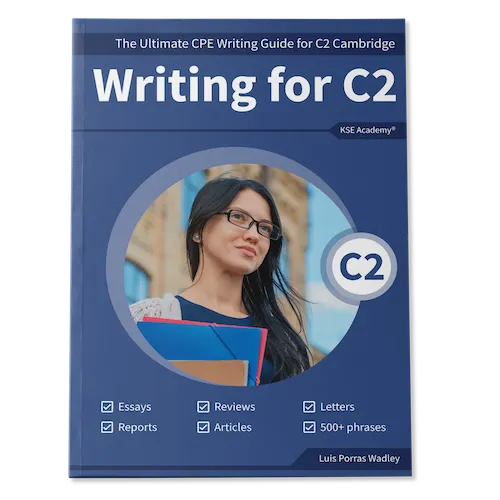
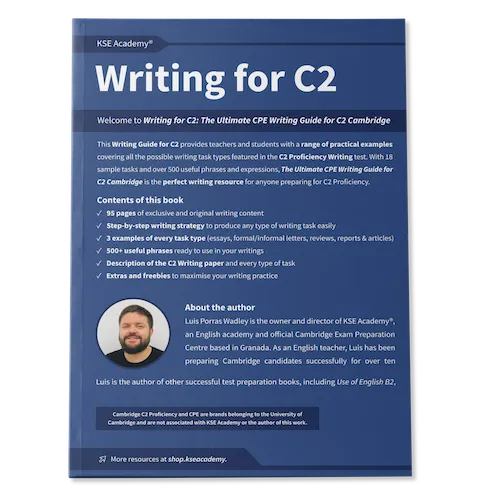
Table of contents
The C2 Proficiency (CPE) Writing paper includes various types of tasks, one of which is the report. As you’ll already know, the C2 Proficiency Writing paper is just one of the four parts of the exam, but it’s undoubtedly one of the most demanding. In Writing Part 2, candidates can choose between several types of text, and the report is one of the available options. Unlike other types of writing such as articles or reviews, the report has very specific characteristics that make it unique, particularly in terms of structure, register, and purpose. Therefore, in this article I’m going to explain exactly how to write a report for the C2 Proficiency Cambridge exam, with real examples, useful expressions, and practical advice so you can master this type of task. Let’s get started!
What is a C2 Proficiency report?
A report in C2 Proficiency is a formal and objective text that is normally written to analyse a previous experience or situation and offer recommendations for improvement. Unlike a review, which can be more subjective and personal, or an article, which seeks to inform or entertain, the report has a more technical and professional purpose.
In the context of C2 Proficiency Writing Part 2, you’ll be asked not only to describe a situation, but to evaluate to what extent a specific objective has been achieved or to suggest an alternative course of action. In other words, you go beyond simple description: you analyse, evaluate, and propose solutions.
Reports are usually addressed to superiors (such as a manager, director, or committee) or to a group of peers (such as club members or colleagues). For this reason, the language must be formal, objective, and professional, demonstrating a C2 level of linguistic sophistication.
Characteristics of a C2-level report
Below we’ll look at the main characteristics that define a C2-level report according to the Common European Framework:
- Purpose of a report: The main objective of a report is to analyse an experience, situation, or event that has already occurred. Normally, this includes evaluating which aspects worked well, which didn’t, and offering concrete recommendations for future improvement. Reports are informative and analytical texts that aid decision-making.
- Register and tone: A report must always be formal and objective. This means avoiding contractions (don’t, can’t), overly colloquial or informal words, and maintaining a neutral and professional tone. Although the content is based on your experience or analysis, you must present the information objectively, avoiding including yourself in most sentences. However, it’s important to give your opinion in the conclusion or recommendations section, where you can use expressions such as «I recommend…» or «It is advisable to…». At C2 level, you’re expected to use precise and sophisticated vocabulary, complex grammatical structures, and a polished style.
- Visual structure: One of the most distinctive characteristics of a report is its visual structure. Unlike other types of writing, a report must always have a main title and subheadings for each section. Each paragraph or section should be preceded by a subheading that clearly and concisely summarises its content. This structure facilitates reading and allows the reader to quickly locate relevant information. Subheadings are objective and descriptive (for example, «Current Facilities», «Recommendations», «Budget Considerations»), not creative or eye-catching as in an article or review.
- Common topics: Although topics can vary considerably, some recurring themes in C2 Proficiency reports include: evaluation of exchange programmes or work placements, analysis of events or festivals, assessment of community services or facilities (libraries, museums, sports centres), reports on educational or training initiatives, and analysis of proposals to improve the work or community environment.
Structure of a report for C2 Proficiency
The structure of a report is very specific and predictable, which is an advantage because you know exactly what’s expected of you. Below I’ll explain each element that your report should include:
- Title: Every report should begin with a clear and objective title that indicates what the report is about. The title should be descriptive and formal, not creative or eye-catching. For example: «Assessment of Local Library Facilities», «Report on Digital Literacy Workshop», «Analysis of Employee Wellbeing Programme». At C2 level, the title should reflect professionalism and precision.
- Introduction: This section, which is normally titled «Introduction», should briefly explain the purpose of the report and what aspects will be analysed. It’s important to be concise and direct. For example: «The aim of this report is to analyse…», «This report provides an evaluation of…», «The purpose of this document is to assess…». The introduction establishes the context and prepares the reader for what follows.
- Development sections (with subheadings): The main body of the report is divided into several sections, each with its own subheading. The number of sections will depend on the points you need to address according to the task instructions, but generally you’ll have between 2 and 4 development sections. Each section should focus on a specific aspect of the analysis. For example, if you’re evaluating an event, you might have sections titled «Organisation and Planning», «Participant Feedback», «Budget Management». Subheadings should be objective and descriptive, clearly summarising the content of each section.
- Conclusion or recommendations: The final section of the report can be approached in two ways: as recommendations (titled «Recommendations» or «Suggestions for Improvement») or as a conclusion (titled «Conclusion»). If you haven’t included specific recommendations in the development sections, this is the time to do so. Here you can be more explicit in your proposals and use expressions such as «It is recommended that…», «I would strongly suggest…», «The following measures should be implemented…». If you’ve already included recommendations in each section, you can use this final part as a general summary and closure of the report. At C2 level, your recommendations must be specific, practical, and well-founded.
In general, a C2 Proficiency report will have between 4 and 6 sections in total (title, introduction, 2-3 development sections, and conclusion/recommendations), all within 280-320 words.
Example of a C2 Proficiency report
Now that we know the characteristics and structure of a report for C2 Proficiency, let’s look at a complete example. First, we’ll analyse the instructions and then we’ll see a sample answer with its corresponding analysis.
Sample instructions
Your company has recently implemented a flexible working policy allowing employees to work remotely up to three days per week. As part of the Human Resources team, you have been asked to evaluate the first six months of this initiative and produce a report for senior management.
Your report should assess employee satisfaction with the policy, analyse its impact on productivity and team collaboration, and recommend any adjustments that might improve the scheme.
Write your report.
Write your answer in 280-320 words in an appropriate style.
If we analyse these instructions, we can extract the following:
- Type of writing: Report
- Target reader: Senior management
- Topic: Flexible working policy evaluation
- Points to address:
- Employee satisfaction with the policy
- Impact on productivity
- Impact on team collaboration
- Recommendations for adjustments
Sample answer
Evaluation of Flexible Working Policy Implementation
Introduction
This report evaluates the flexible working policy introduced six months ago, examining employee satisfaction levels, productivity metrics, and collaborative dynamics. The findings presented herein will inform potential refinements to the scheme going forward.
Employee Satisfaction
Survey data indicates overwhelmingly positive reception of the flexible working arrangement, with 87% of respondents expressing satisfaction with the policy. Employees particularly value the reduced commuting time and enhanced work-life balance. However, a minority have raised concerns about feeling isolated on remote working days and experiencing difficulty separating professional responsibilities from personal life.
Productivity Assessment
Contrary to initial apprehensions, productivity has remained stable and, in some departments, has demonstrably increased. Project completion rates have not declined, and several teams report improved focus during remote working periods. Nonetheless, managers have noted occasional delays in obtaining urgent approvals when key personnel are working remotely.
Impact on Collaboration
The policy has had mixed effects on team collaboration. Whilst scheduled meetings continue to function effectively via video conferencing, spontaneous knowledge-sharing and informal problem-solving conversations have diminished. Junior staff members, in particular, report missing the mentoring opportunities that arise from daily office presence.
Recommendations
To optimise the flexible working scheme, I recommend implementing mandatory in-office days for entire teams to facilitate collaboration and mentoring. Additionally, establishing clear protocols for urgent approvals during remote working would address the delays identified. Finally, providing guidance on maintaining work-life boundaries when working from home would support those struggling with this aspect.
Overall, the policy has proven successful and should be continued with these refinements.
Analysis of the example
This example clearly demonstrates what a C2-level report should look like. Let’s look at the key elements that make it excellent:
- Impeccable visual structure: The text includes a main title («Evaluation of Flexible Working Policy Implementation») and five clearly differentiated subheadings («Introduction», «Employee Satisfaction», «Productivity Assessment», «Impact on Collaboration», «Recommendations»). This structure greatly facilitates reading and allows the reader to quickly locate the information they’re looking for.
- Formal and objective register: The text maintains a formal tone throughout. There are no contractions, the vocabulary is precise and sophisticated, and the style is neutral and professional. Expressions such as «evaluates the flexible working policy», «the findings presented herein», «overwhelmingly positive reception», «contrary to initial apprehensions» demonstrate a C2 level of linguistic competence.
- Complete coverage of all points: The report meticulously addresses all aspects requested in the instructions: employee satisfaction (second section), impact on productivity (third section), impact on collaboration (fourth section), and adjustment recommendations (fifth section). Each point is developed with appropriate depth.
- Sophisticated and precise vocabulary: The text uses advanced vocabulary that demonstrates a C2 level: «overwhelmingly positive reception», «enhanced work-life balance», «separating professional responsibilities from personal life», «contrary to initial apprehensions», «demonstrably increased», «spontaneous knowledge-sharing», «mentoring opportunities that arise from daily office presence», «to optimise the flexible working scheme», «mandatory in-office days», «establishing clear protocols», «maintaining work-life boundaries», «proven successful».
- Complex grammatical structures: The text includes advanced grammatical structures typical of C2 level. For example: gerund constructions («examining employee satisfaction levels», «experiencing difficulty separating», «obtaining urgent approvals»), passive voice («survey data indicates», «have been noted»), and complex comparative structures («Whilst scheduled meetings continue to function effectively»).
- Cohesion and coherence: The text flows naturally thanks to the appropriate use of connectors and references: «However», «Nonetheless», «Whilst», «Additionally», «Finally», «Overall». The progression of ideas is logical and easy to follow.
- Well-founded recommendations: The recommendations section doesn’t simply list generic proposals, but offers specific solutions directly related to the problems identified in previous sections: mandatory office days to address the collaboration problem, clear protocols for urgent approvals, and guidance on work-life boundaries.
- Balance between objectivity and opinion: Although most of the report presents data objectively, in the recommendations section the author appropriately uses the first person («I recommend») to introduce their proposals, which is perfectly suitable in this context.
- Appropriate length: The text is approximately 295 words, within the required range of 280-320 words.
In summary, this report meets all the requirements of a C2-level text: clear structure, formal register, sophisticated vocabulary, complex grammar, impeccable cohesion, and complete development of all required points.
Another example of a C2-level report
To show you another perspective and approach to a C2 Proficiency report, here’s a second complete example with different instructions and topic:
Instructions:
You are a member of your town’s environmental committee. Following a recent initiative to encourage cycling in the town centre, you have been asked to write a report for the local council assessing the effectiveness of the scheme.
Your report should describe the measures that were introduced, evaluate their success in promoting cycling, and suggest improvements to make the initiative more effective.
Write your report.
Write your answer in 280-320 words in an appropriate style.
Assessment of Town Centre Cycling Initiative
Introduction
This report examines the cycling promotion initiative implemented in our town centre eighteen months ago, evaluating its effectiveness in encouraging bicycle usage and proposing enhancements to maximise its impact on sustainable urban mobility.
Measures Implemented
The initiative encompassed several key interventions: the installation of thirty new bicycle parking stations at strategic locations throughout the town centre, the creation of dedicated cycle lanes on three major thoroughfares, and the introduction of a subsidised bicycle rental scheme. Additionally, cycling proficiency courses were offered to residents at reduced rates.
Effectiveness in Promoting Cycling
Bicycle usage has increased by approximately 40% since the scheme’s inception, suggesting considerable success. The parking stations are consistently well-utilised, and the rental scheme has attracted both residents and visitors. However, the dedicated cycle lanes remain underused on certain routes, particularly those requiring cyclists to navigate busy junctions where perceived safety concerns persist. Furthermore, uptake of the proficiency courses has been disappointingly low.
Challenges Identified
Several obstacles to greater cycling adoption have emerged. The cycle lane network remains fragmented, forcing cyclists onto busy roads between designated sections. Moreover, inadequate signage leaves some visitors unaware of the cycling infrastructure available. The proficiency courses, whilst valuable, have suffered from insufficient publicity.
Recommendations
To enhance the initiative’s effectiveness, I recommend extending the cycle lane network to create continuous routes across the town centre, with particular attention to junction safety. Comprehensive signage and mapping would raise awareness of available facilities. Finally, promoting the proficiency courses through schools and community centres would likely increase participation.
With these improvements, the initiative could achieve its full potential in establishing cycling as a mainstream transport option.
This second example also demonstrates a solid C2 level, with sophisticated vocabulary («encompassed several key interventions», «at strategic locations», «considerable success», «consistently well-utilised», «perceived safety concerns persist», «obstacles to greater cycling adoption», «fragmented network», «inadequate signage», «insufficient publicity», «achieve its full potential»), complex grammatical structures, and an impeccable visual structure with clear title and subheadings. Furthermore, it covers all required points: description of the measures introduced, evaluation of their success in promoting cycling, and suggestions for improvement.
Language and useful expressions for C2 reports
Below I’m providing you with a comprehensive list of useful expressions you can employ in your C2 Proficiency reports. These expressions are organised by communicative function to make them easier to locate and use.
Expressions for beginning a report
- The aim of this report is to…
- As requested, I am writing this report to…
- This report aims to outline/assess…
- The purpose behind this report is to…
- The purpose of this report is to examine…
- The goal of this document is to present…
- This report provides a comprehensive overview of…
- This report analyses the role played by…
- This report provides an evaluation of…
- The objective of this report is to…
Expressions for presenting information
- The data shows/suggests that…
- From the information gathered, it is clear that…
- The findings indicate that…
- Based on the evidence provided, we can infer…
- The analysis reveals that…
- After thorough examination, it can be concluded that…
- In light of the information presented, it is clear that…
- The evidence presented points towards…
- Drawn from the findings, it is clear that…
- The significance of… cannot be overstated
- … plays a pivotal role in…
- … serves as a hub for…
- … is equipped with a wide array of…
- … spans across all age groups/sectors
Expressions for making recommendations
- To address this issue, it is recommended that…
- A possible solution to this problem would be to…
- It is suggested that future efforts should focus on…
- For better results, it is advisable that…
- Given the findings, it would be beneficial to…
- I therefore suggest…
- I believe it would be beneficial…
- It would be advisable to…
- You may wish/want to consider…
- In light of the above,…
- Taking all this into consideration/account,…
- Bearing all of the above in mind,…
- I would strongly recommend that…
- The following measures should be implemented…
- I would advise against/for…
- I feel it would be to our advantage if…
- In order to improve… it is necessary to…
- There’s scope to make it an even more… experience
- Areas for improvement to further enhance…
Expressions for concluding
- In summary, the report has established that…
- In conclusion, it is vital to reinforce that…
- This report has provided a comprehensive overview of…
- I hope that the recommendations presented will be…
- This concludes the examination/review/analysis into…
- The crucial role of… cannot be overstated
- … serves as a significant contribution to…
- Ensuring… meet the ever-evolving needs of…
- By adopting the proposed suggestions,…
- Looking forward, it is clear that…
Common mistakes in C2 reports
Although writing a report for C2 Proficiency may seem relatively straightforward thanks to its predictable structure, there are several common mistakes that candidates make which can cost them valuable marks. Below I’ll show you the most frequent ones:
- Forgetting subheadings: One of the most serious errors is writing a report without subheadings for each section. Subheadings are a defining characteristic of this type of text, and their absence demonstrates that you don’t understand the conventions of the genre. Make sure to include a main title and subheadings for each section.
- Using an informal register: Some candidates use contractions, colloquial vocabulary, or an overly personal tone. Remember that a report must be formal and objective. Avoid contractions such as «don’t» or «can’t», and maintain a professional tone throughout.
- Being too subjective: Although you should give your opinion, especially in the recommendations, the bulk of the report should present information objectively. Avoid phrases such as «I think», «I feel», or «In my opinion» in the descriptive or analytical sections. Reserve your explicit opinion for the recommendations or conclusion section.
- Creative or eye-catching subheadings: Unlike an article or a review, where you can be creative with titles, in a report the subheadings should be objective, descriptive, and direct. For example, instead of «A Feast for the Senses», use «Festival Description» or «Event Overview».
- Not including recommendations: The instructions almost always ask you to include recommendations or suggestions for improvement. Forgetting this point is a critical error that will affect your mark in the Content criterion. Make sure to include specific and practical recommendations.
- Vague or generic recommendations: It’s not enough to say «Things should be improved». Your recommendations must be specific, practical, and grounded in the previous analysis. For example, instead of «The event should be better», say «To enhance visitor engagement, organisers should incorporate interactive cooking demonstrations and live competitions».
- Repetitive or basic vocabulary: At C2 level, you’re expected to demonstrate a wide range of sophisticated vocabulary. Avoid repeating the same basic words («good», «bad», «nice», «important») and use more precise and advanced synonyms («commendable», «inadequate», «exemplary», «pivotal»).
- Lack of cohesion between sections: Although each section has its own subheading, the text should flow naturally. Use appropriate connectors and references to link ideas between sections and within each paragraph.
- Not covering all required points: Read the instructions carefully and make sure to address all requested aspects. If you’re asked to analyse three specific aspects, your report should have three development sections, one for each aspect.
- Inappropriate length: Although you’re not automatically penalised for word count, writing significantly less than 280 or more than 320 words may indicate that you haven’t developed the ideas sufficiently or that you’ve included irrelevant information.
Self-assessment checklist for your report
Before you finish your report, whether during practice or in the actual exam, use this checklist to ensure you’ve covered all essential aspects:
Structure and format:
- ☐ Have I included a clear and objective main title?
- ☐ Does each section have its own descriptive subheading?
- ☐ Have I included an introduction that explains the purpose of the report?
- ☐ Do I have 2-3 development sections that address the required points?
- ☐ Have I included a conclusion or recommendations section?
- ☐ Is the visual structure clear and does it facilitate reading?
Content:
- ☐ Have I covered all the specific points mentioned in the instructions?
- ☐ Have I included specific and practical recommendations?
- ☐ Have I analysed the situation rather than just describing it?
- ☐ Is the content relevant and appropriate for the purpose of the report?
- ☐ Have I provided sufficient detail in each section?
Register and tone:
- ☐ Have I maintained a formal register throughout the text?
- ☐ Have I avoided contractions and colloquial language?
- ☐ Is the tone objective and professional?
- ☐ Have I avoided being too personal in the descriptive/analytical sections?
- ☐ Have I given my opinion appropriately in the recommendations section?
Language:
- ☐ Have I used sophisticated and precise vocabulary appropriate for C2?
- ☐ Have I included complex grammatical structures?
- ☐ Have I varied my vocabulary avoiding repetitions?
- ☐ Have I used appropriate connectors to link ideas?
- ☐ Have I checked spelling and punctuation?
Length:
- ☐ Is my report between 280 and 320 words approximately?
- ☐ If I’ve gone outside the range, is it because I’ve included relevant information (more words) or because development is lacking (fewer words)?
If you can confidently tick all these boxes, your report is well on its way to achieving a good mark in C2 Proficiency.
Tips for writing an excellent C2 report
To finish with the practical part of this article, here are some final tips that will help you write excellent reports for C2 Proficiency:
- Plan before writing: Spend 3-5 minutes planning your report before you start writing. Identify the points you need to cover according to the instructions and decide how you’re going to structure your sections. Write down the subheadings you’ll use and note the main ideas for each section. This initial planning will save you time and help you maintain focus.
- Read the instructions twice: Make sure you understand exactly what’s being asked of you. Underline or note the specific points you need to address. It’s easy to forget a point in the heat of the exam, and this can cost you valuable marks in the Content criterion.
- Use subheadings to your advantage: Subheadings don’t just provide visual structure; they also help you organise your ideas and ensure you’re covering all points. If a section becomes too long, consider dividing it into two subsections with more specific subheadings.
- Be specific in your recommendations: The best recommendations are those that are concrete, practical, and directly related to the problems or areas for improvement you’ve identified. Instead of saying «Things should be improved», say «To address the lack of digital resources, the library should invest in expanding its e-book collection and providing tablet devices for public use».
- Maintain a balance between objectivity and opinion: Although the report should be objective, don’t be afraid to include your perspective, especially in the recommendations section. Use expressions such as «It is recommended that…», «I would suggest…», «Given the findings, it would be advisable to…» to introduce your proposals.
- Demonstrate your C2 level: Don’t settle for vocabulary and grammar from lower levels. Take the opportunity to demonstrate your command of English by using precise and sophisticated vocabulary, complex grammatical structures (passives, inversion, cleft sentences, advanced modals), and varied connectors. However, don’t force the language; it should sound natural.
- Review your work: Set aside 3-5 minutes at the end to review your report. Look for spelling, punctuation, agreement, and verb tense errors. Also check that you’ve included all required points and that the structure is clear.
- Practise with different topics: Reports can deal with very varied topics. Practise writing reports on different contexts (work, education, community, cultural) so you feel comfortable with any topic that might appear in the exam.
- Read examples of real reports: Look for examples of professional reports in English (corporate reports, non-profit organisation reports, government reports) to familiarise yourself with the style, register, and conventions of this type of text.
- Manage your time well: In the exam you have 90 minutes to complete two writing tasks. If you choose to do a report in Part 2, you should dedicate approximately 40-45 minutes to it (including planning, writing, and review), leaving the rest of the time for Part 1.
Will I be penalised if I write more than 320 words?
This is one of the most frequent questions amongst C2 Proficiency candidates, and the answer is: not directly, but indirectly yes.
Cambridge examiners don’t count the words in your report and deduct marks automatically if you exceed the limit. There’s no explicit penalty for writing 330 or 340 words. However, the 280-320 word range is established for a reason: it’s the optimal length to fully develop the task without including irrelevant or repetitive information.
If you write significantly more than 320 words (for example, 380 or 400 words), you’re probably:
- Including irrelevant information that doesn’t contribute to the report’s objectives
- Being repetitive and not sufficiently concise
- Developing aspects that you haven’t been asked for in the instructions
And these problems are indeed penalisable in the criteria of Content (relevant content) and Communicative Achievement (appropriateness to purpose).
Similarly, if you write significantly less than 280 words (for example, 240 or 250), you’re probably:
- Not developing ideas sufficiently
- Missing coverage of some required point
- Not providing the expected level of detail
And this will also negatively affect your mark in Content.
My recommendation is that you try to stay within the 280-320 word range, or at most exceed it by 20-30 words. This way, you’ll have sufficient margin to fully develop the task without risking including irrelevant information that might harm your mark.
Guide to C2 Proficiency Writing with examples in PDF
If you want to take your C2 Proficiency Writing preparation to the next level and master not only reports but all types of tasks, I strongly recommend my book Writing C2: The Ultimate CPE Writing Guide for C2 Cambridge.
This book of over 90 pages is a complete and comprehensive guide that covers all types of C2 Proficiency writing: essays, formal/informal letters, reviews, reports, and articles. In it you’ll find:
- 3 complete examples of each type of task, all written at an authentic C2 level, so you can see exactly what each text should look like.
- Over 500 useful expressions organised by task type and communicative function, ready to use in your own writing.
- Complete description of each type of writing, with its specific characteristics, recommended structure, and practical tips.
- A step-by-step strategy for developing any writing task with confidence, from planning to final review.
- Explanation of how writing is assessed and a sample mark sheet that you can photocopy and use to assess your own writing or that of your peers.
- Extras and additional resources to maximise your writing practice.
This guide is designed for both students preparing independently and English teachers looking for quality materials for their C2 students. All examples are original, authentic, and faithfully represent the level of sophistication expected in C2 Proficiency.
With regular practice using this guide, you’ll be much better prepared to tackle any C2 Proficiency writing task with confidence and achieve the mark you need. Get your copy here and take your writing to the next level.
I hope you’ve found this article on how to write a report for C2 Proficiency very useful. If so, don’t forget to share it with your friends and family who are also preparing for this exam.
See you in the next article and until then, don’t forget to keep smiling!