
How to Write a Proposal for the C1 Advanced (CAE) [Guide 2026]
As we have seen on numerous occasions, and will continue to do so, the C1 Advanced (CAE) is divided into components, one of which is Writing. The CAE Writing paper has two parts. In Writing Part 1, as we already saw, you always have to write an Essay. However, in C1 Writing Part 2, we […]

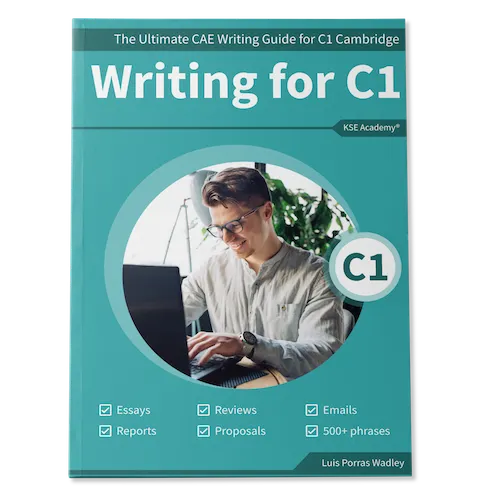
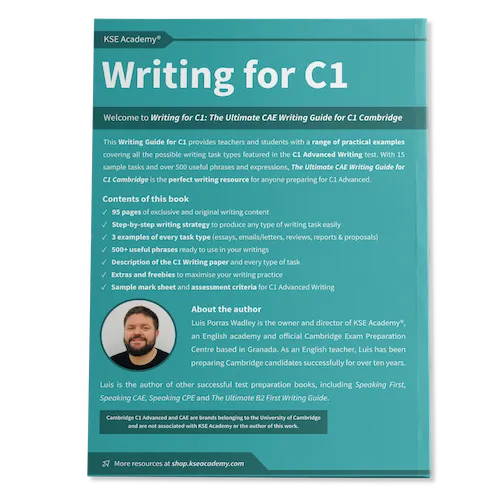
Table of contents
As we have seen on numerous occasions, and will continue to do so, the C1 Advanced (CAE) is divided into components, one of which is Writing. The CAE Writing paper has two parts. In Writing Part 1, as we already saw, you always have to write an Essay. However, in C1 Writing Part 2, we will have the option to choose between several types of tasks, one of which may be a proposal. Therefore, in this article, I am going to explain exactly how to write a Proposal for the CAE.
Keep reading, because what follows is pure gold… 😂
What are the parts of the C1 Writing paper?
The C1 Advanced (CAE) Writing paper, as mentioned above, is composed of two parts, and for each of them, you must write a text according to the instructions provided. Let’s see how the tasks are distributed:
Writing Part 1: Here, you will always be asked to write an essay. You will not be able to choose another option. If you are interested in essays, click here to learn how to write an essay for the CAE.
Writing Part 2: In this part, you will have to choose from three options. For these options, the types of Writing that may appear are as follows:
- Formal letter/email
- Informal letter/email
- Review
- Report
- Proposal
Each writing task you complete should be between 220 and 260 words, approximately. As they are different types of writing, you must take into account the peculiarities of each one in terms of structure, register, grammar, and vocabulary, etc.
So, let’s start with the one that concerns us in this article: Proposals!
What is a C1 proposal?
In the C1 Writing Part 2 exam, a proposal refers to a type of formal writing whose objective is to suggest ideas or recommendations so that a specific action is taken in a given context, which is usually professional or academic. You are expected to make one or more suggestions, supported by factual information and your evaluation, in order to persuade the reader to take a particular course of action.
Unlike other types of writing, a proposal always deals with the future. Your objective is not simply to inform, but to convince the reader that your proposal is viable, beneficial, and should be implemented.
In short, a proposal for the CAE is a formal and persuasive form of writing that requires candidates to present suggestions in a clear and organised manner, using appropriate language and demonstrating analysis and evaluation skills oriented towards the future.
Difference between a Report and a Proposal for C1 Advanced
This is probably one of the most frequent questions I receive from my students: what is the difference between a report and a proposal? It is understandable, as both types of writing share many similarities in terms of structure and formal register. However, there is a fundamental difference that you must be very clear about:
| Aspect | Report | Proposal |
|---|---|---|
| Time orientation | Past/Present | Future |
| Main purpose | Analyse and evaluate something that has already happened | Persuade and suggest future actions |
| Function | Inform about a past situation or experience | Propose solutions or ideas for the future |
| Verb tenses | Mainly past and present | Future, conditionals and modals |
| Tone | Objective and descriptive | Persuasive and convincing |
| Example | Evaluate an event that took place | Suggest how to celebrate an anniversary |
The key is to remember this:
- Reports → are always written about something that has already happened in the past (for example, a survey you conducted, an excursion you went on, or an event that took place).
- Proposals → always deal with something in the present/future. The focus of a proposal is always on evaluating a situation and making suggestions or recommendations for the future.
If you want to learn more about how to write a report for the CAE, click here to see our full article on reports.
How to write a Proposal for the CAE Writing paper
Below we will see the main characteristics of a C1 level proposal for you to take into account when writing:
Purpose and objective
The objective of a proposal is to suggest ideas or recommendations to take action in a given context, which is generally professional or academic. You will not only be asked to describe a situation, but to make one or more suggestions backed by factual information and your own evaluation, in order to persuade the reader to take a particular course of action. Remember: your mission is to convince.
Tone and register
A proposal may be written for a peer (such as work colleagues or other club members) or for a superior (such as a manager or a committee). For this reason, the language of a proposal is expected to be formal. Additionally, since the point of a proposal is to persuade the reader to do something, you should use polite and convincing language when making recommendations and suggestions.
You should avoid including yourself or your opinions in a very personal way in most of your sentences to make them sound more objective and professional. However, you must give your opinion and make clear recommendations, especially in the concluding paragraph.
Structure
Just like reports, proposals also have a title and subheadings. Each paragraph should have a subheading that summarises its main topic. Usually, the title of the introduction can be «Introduction» and the title of the conclusion can be «Conclusion», «Recommendations» or «Final recommendations». However, this is not always the case in proposals and will depend on the details of each specific task.
Visual structure is very important in a proposal. Subheadings help the reader (in this case, the examiner) follow your ideas clearly and demonstrate that you have organised your writing professionally.
Persuasive language
Unlike reports, where your opinion is mainly expected at the end, in a proposal you are expected to express your main point at the beginning, in the introduction. The rest of the sections will then serve to support that idea with arguments, data (which you can invent), and logical reasoning.
You should use persuasive language throughout your proposal. This includes:
- Modal verbs: would, could, should, might
- Conditionals: If we implemented this…, we would see…
- Passives: It is recommended that…, It would be advisable to…
- Persuasive expressions: I strongly believe…, It is vital that…, There is no doubt that…
Common topics for proposals
Some common topics for proposals are usually:
- Suggesting how to spend funds or a budget
- Proposing how to celebrate an important event or anniversary
- Recommending improvements for facilities (gym, library, student centre, etc.)
- Suggesting new activities or services for a community or institution
- Proposing how to honour a distinguished person
- Recommending changes in work or study policies
They are almost always presented as opportunities to present innovative ideas that will benefit a group of people in the future.
Example of a CAE Writing Proposal
Now that we have seen the main characteristics of a proposal for the Cambridge Advanced (CAE) Writing paper, let’s look at a good example of a C1 proposal, seeing both the sample instructions and a possible response with detailed analysis.
Instructions for a C1 Proposal
In the text box below, you can see an example of instructions for a proposal:
Your company is considering introducing a flexible working policy to improve work-life balance for employees. The HR department has asked all staff members to submit proposals outlining how such a policy could work, what benefits it might bring, and any potential challenges that should be addressed.
Write your proposal. Write your answer in 220–260 words in an appropriate style.
From these instructions, we must always extract the essentials:
- Topic: Flexible working policy → work-life balance for employees
- Target reader: HR department (formal)
- Points to cover:
- How such a policy could work
- What benefits it might bring
- Potential challenges that should be addressed
- Essential instructions:
- Choose only one of the Writing Part 2 tasks
- Write the proposal using approximately 220-260 words
- Use an appropriate style (formal)
Sample C1 Proposal answer with detailed analysis
According to the task model proposed above, we can plan the C1 proposal as follows:
- Introduction
- How the policy could operate
- Benefits for employees and the company
- Potential challenges and solutions
- Recommendations
Although it is not set in stone, it is most common for us to have 4-5 sections. So, let’s see an example of a Proposal for the CAE Writing paper:
Flexible working policy: a proposal
Introduction
The purpose of this proposal is to outline a practical framework for implementing flexible working arrangements within our company. Based on consultation with colleagues across various departments, I am confident that such a policy would significantly enhance employee wellbeing while maintaining operational efficiency.
How the policy could operate
The flexible working system could be structured as follows: employees would be required to complete their contracted hours each week but would have autonomy over when and where they work, subject to certain conditions. Core working hours could be established between 11:00 and 15:00 on weekdays, during which all team members must be available for meetings and collaboration. Outside these hours, staff could choose to work remotely or adjust their schedules to accommodate personal commitments. A digital time-management system would ensure transparency and accountability.
Benefits for employees and the company
Implementing this policy would yield numerous advantages. Employees would enjoy improved work-life balance, reduced commuting stress, and greater control over their schedules, all of which contribute to enhanced job satisfaction. From the company’s perspective, flexible working has been shown to increase productivity by up to 25%, reduce absenteeism, and improve staff retention rates. Furthermore, it would demonstrate our commitment to employee welfare, thereby strengthening our reputation as a progressive employer.
Potential challenges and solutions
Admittedly, some challenges may arise. Coordinating team meetings could become more complex; however, this could be addressed through shared calendar software that identifies optimal meeting times. Additionally, some managers might be concerned about monitoring productivity. Nevertheless, establishing clear performance indicators and regular check-ins would ensure that work quality remains consistently high.
Recommendations
In conclusion, I strongly recommend that this flexible working proposal be implemented on a trial basis initially, with a comprehensive review after six months. The potential benefits far outweigh any challenges, which can be effectively managed with appropriate systems in place. Should you require further clarification, I would be delighted to discuss this matter in more detail.
(309 words)
Note: This example slightly exceeds the 260-word limit. In the real exam, you should shorten some sections to fit within the requested range. However, we include it in full here to show all the essential features.
With a quick glance, we can see that this C1 Proposal has a title and five clearly differentiated sections. Let’s look at this in more detail:
Title: The title generally encompasses the theme of the proposal. As it is a formal proposal, we do not need to be very creative with the title, as it is something objective. A simple and descriptive title like «Flexible working policy: a proposal» is perfectly appropriate.
Sections: Each section is introduced by a subheading that summarises the content. In general, as the word count is limited, each section will have one or two paragraphs at most. In this case, one paragraph has been enough for each section. Based on the example above, let’s see what function each section has:
- Introduction: Here we establish the purpose of the proposal («The purpose of this proposal is to outline») and mention that we have consulted with colleagues, which adds credibility («Based on consultation with colleagues across various departments»). We also express our confidence in the proposal («I am confident that such a policy would…»). This section prepares the reader for the specific ideas that follow.
- How the policy could operate: Here we address the first point of the instructions. We explain how the system would work in practice («employees would be required to complete their contracted hours each week but would have autonomy»), provide specific details («Core working hours could be established between 11:00 and 15:00»), and mention specific tools that would facilitate implementation («A digital time-management system would ensure transparency»). The use of conditionals (could, would) is appropriate for a future-oriented proposal.
- Benefits for employees and the company: This section addresses the second point of the instructions. We present benefits from two perspectives: that of the employees («improved work-life balance, reduced commuting stress») and that of the company («increase productivity by up to 25%, reduce absenteeism»). We include a specific invented but realistic figure («up to 25%») that reinforces the argument. The language is clearly persuasive («numerous advantages», «demonstrate our commitment»).
- Potential challenges and solutions: Here we address the third point of the instructions intelligently. We recognise possible challenges («Coordinating team meetings could become more complex», «some managers might be concerned») but immediately offer practical solutions («this could be addressed through shared calendar software», «establishing clear performance indicators»). This shows that we have thought critically about the proposal and that it is viable. The use of «Admittedly» and «Nevertheless» shows a balanced approach.
- Recommendations: In this final section, we make a clear and strong final recommendation («I strongly recommend that this flexible working proposal be implemented»). We suggest a cautious approach («on a trial basis initially, with a comprehensive review after six months»), which makes the proposal more realistic and persuasive. We summarise why it is worth it («The potential benefits far outweigh any challenges») and offer our availability («I would be delighted to discuss this matter in more detail»), which is professional and polite.
Connectors: Throughout the proposal, we have used connectors that help the text have a clear progression and good coherence: Based on…, subject to…, Outside these hours…, From the company’s perspective…, Furthermore…, Admittedly…, however…, Additionally…, Nevertheless…, In conclusion… These connectors are appropriate for a C1 level and give the text fluidity without sounding forced.
Language:
- We do not use contractions or filler words (e.g. things, stuff, nice).
- We use terms and expressions suitable for a C1 level:
- The purpose of this proposal is to outline
- A practical framework for implementing
- Based on consultation with colleagues
- I am confident that
- Significantly enhance employee wellbeing
- Maintaining operational efficiency
- Would have autonomy over
- Subject to certain conditions
- Accommodate personal commitments
- Ensure transparency and accountability
- Would yield numerous advantages
- Reduced commuting stress
- Contribute to enhanced job satisfaction
- Has been shown to increase productivity
- Improve staff retention rates
- Demonstrate our commitment to employee welfare
- Thereby strengthening our reputation
- A progressive employer
- Admittedly, some challenges may arise
- Could be addressed through
- Establishing clear performance indicators
- Work quality remains consistently high
- Be implemented on a trial basis
- A comprehensive review
- The potential benefits far outweigh any challenges
- Should you require further clarification
- The language is persuasive without being aggressive: we use expressions such as «I am confident», «significantly enhance», «numerous advantages», «I strongly recommend».
- We use advanced grammatical structures:
- Participles: «Based on consultation with colleagues»
- Conditionals and modals: «would be required», «could be established», «could choose», «would ensure», «would yield», «would enjoy»
- Passive voice: «has been shown to increase», «could be addressed», «be implemented»
- Structures with thereby: «thereby strengthening our reputation»
- Inversion with should: «Should you require further clarification»
- We include specific data which, although invented, sounds realistic and professional: «between 11:00 and 15:00», «up to 25%», «trial basis initially, with a comprehensive review after six months».
- We use the conditional and modals appropriately to speak about the future, which is characteristic of proposals: would be, could be, would have, could choose, would ensure, would yield, may arise, could become, might be.
In short, this is a good example of a Proposal for the CAE Writing paper, with all the characteristics that a good proposal should have: clear structure with a title and subheadings, persuasive and formal language, concrete data that support the argument, recognition of possible challenges with proposed solutions, and a professional and convincing tone throughout the text.
More examples of C1 Proposals
Below I present two more examples of proposals for C1 Advanced, with different themes. Study these examples well to familiarise yourself with the style, structure, and type of language expected in this type of task.
Example 2 of a C1 Proposal
Instructions:
Your university is planning to improve facilities for international students. The International Office has asked students to submit proposals suggesting what improvements could be made and how these would benefit overseas students.
Write your proposal. Write your answer in 220–260 words in an appropriate style.
Answer:
Proposal for improving facilities for international students
Introduction
The aim of this proposal is to suggest practical improvements to university facilities that would significantly enhance the experience of international students. Based on feedback from overseas students currently studying here, I have identified two key areas that require attention.
Multilingual support services
Firstly, it would be highly beneficial to establish a comprehensive multilingual support centre. While many international students possess strong English skills, they occasionally encounter difficulties when dealing with complex administrative procedures or medical emergencies. A dedicated team of multilingual advisors could provide assistance in the most commonly spoken languages among our student population, including Mandarin, Spanish and Arabic. This would not only reduce anxiety for overseas students but would also improve efficiency in resolving their concerns.
Cultural integration programmes
Secondly, I propose the creation of structured cultural integration programmes that would facilitate meaningful connections between international and domestic students. These could take the form of language exchange partnerships, cultural celebration events, or guided city tours organised monthly. Such initiatives would help international students feel more welcomed and integrated into campus life, while simultaneously enriching the cultural awareness of all students. Research indicates that students who participate in integration activities are 40% more likely to complete their studies successfully.
Conclusion
In conclusion, implementing these recommendations would demonstrate the university’s genuine commitment to supporting its international community. I am confident that these relatively modest investments would yield substantial improvements in student satisfaction and retention rates.
(248 words)
Example 3 of a C1 Proposal
Instructions:
Your local council has announced plans to create a new public space in the city centre and has invited residents to submit proposals. Write a proposal suggesting what type of space should be created, explaining how it would be used and what benefits it would bring to the local community.
Write your proposal. Write your answer in 220–260 words in an appropriate style.
Answer:
Community garden and recreational space: a proposal
Introduction
This proposal aims to present a compelling case for transforming the available city centre plot into a multifunctional community garden and recreational area. Having spoken with numerous local residents, I believe this concept would address several pressing community needs while promoting environmental sustainability.
Proposed features
The space could be divided into three distinct zones. The first would consist of raised garden beds where residents could grow vegetables and flowers, fostering a sense of community ownership. The second zone would feature a children’s natural play area with wooden structures and native plants, providing a safe environment for families. Finally, the third section could house an outdoor performance space with seating, suitable for small concerts, theatre productions and community gatherings. All materials used would be sustainably sourced, and solar-powered lighting would ensure the space remains accessible during evening hours.
Community benefits
Such a development would bring numerous advantages to our neighbourhood. It would promote physical and mental wellbeing through gardening activities, strengthen social bonds among residents, and provide much-needed green space in an increasingly urbanised area. Furthermore, the performance area would support local artists and cultural initiatives, thereby enriching our community’s cultural life.
Final recommendations
Given the multiple benefits outlined above, I strongly urge the council to give this proposal serious consideration. Should you require additional information or wish to discuss implementation details, I would welcome the opportunity to elaborate further.
(257 words)
Step-by-step structure for a C1 Proposal
Now that you have seen several examples of proposals for the C1 Advanced, let’s break down step-by-step how you should approach this type of task in the exam. By following these steps, you will be able to write an effective, well-structured, and persuasive proposal.
Step 1: Analyse the task (topic, target reader, key points)
The first and most important thing is to analyse the task carefully. Never start writing without first having clearly identified these elements:
1. The topic: What is the proposal about? Identify the main theme clearly. This will help you think of the specific vocabulary you will need.
2. The target reader: Who is your proposal addressed to? Your boss? The director of your university? A committee? Your work or club colleagues? This will determine the register and tone you should use. In general, it will be formal, but the degree of formality can vary slightly.
3. The key points: What specific points should you address in your proposal? Usually, the instructions will give you 2-3 points to cover. Underline or mark them clearly. Each of these points will become a section of your proposal.
Example analysis:
«Your company is planning to introduce flexible working hours. The HR manager has asked you to write a proposal suggesting how this could work, what benefits it would bring, and any potential problems that might arise.»
Topic: Flexible working hours
Target reader: HR manager (formal)
Key points:
- How flexible working hours could work
- Benefits it would bring
- Potential problems that might arise
Once you have identified these elements, you are ready to plan your structure.
Step 2: Write the title and introduction
The title:
The title of your proposal should be clear, descriptive, and formal. It doesn’t need to be very creative. Some formulas that work well are:
- Proposal for + [topic]
- Example: «Proposal for Flexible Working Hours»
- [Topic] + : A Proposal
- Example: «Flexible Working Hours: A Proposal»
- Proposal to + [verb + complement]
- Example: «Proposal to Improve College Facilities»
The introduction:
The introduction of a proposal should include three main elements:
1. The purpose: Explain why you are writing the proposal. Some useful phrases are:
- The aim of this proposal is to…
- The purpose of this proposal is to…
- This proposal aims to…
- In response to [X’s] request, I am writing to…
- As requested, this proposal outlines…
2. The context: Briefly mention the topic or situation.
3. Preview of the points: Briefly mention the points you are going to cover in the following sections.
Example introduction:
Introduction
The aim of this proposal is to suggest how flexible working hours could be implemented in our company. I will outline how this system could operate, the benefits it would bring to both employees and the company, and potential challenges that may need to be addressed.
As you can see, this introduction is clear, direct, and professional. It establishes the purpose and prepares the reader for what is to come.
Step 3: Develop body paragraphs
The body paragraphs of your proposal are where you will develop your ideas and arguments. Each of the key points you identified in Step 1 will become a section with its own subheading.
Characteristics of the main paragraphs:
1. Each section must have a clear subheading: The subheading should summarise the content of the paragraph concisely. For example:
- How the system could work
- Benefits for employees and the company
- Potential challenges
2. Provide details and examples: Do not limit yourself to vague statements. Support your suggestions with specific details, concrete examples, or data (which you can invent, but should sound realistic).
3. Use persuasive language: Remember that your objective is to convince the reader. Use:
- Modal verbs: would, could, should, might
- Conditionals: If we implemented…, we would see…
- Passives and impersonal structures: It is recommended that…, It would be advisable to…
- Persuasive expressions: There is no doubt that…, It is clear that…, Undoubtedly…
4. Connect your ideas: Use appropriate connectors and discourse markers to give coherence to your text:
- To add information: Furthermore, Moreover, In addition, Besides
- To contrast: However, Nevertheless, On the other hand
- To give examples: For instance, To illustrate, For example
- To show cause-effect: Therefore, Consequently, As a result, Thus
Example body paragraph:
How the system could work
The flexible working hours system could operate as follows: employees would be required to work a set number of hours per week (for example, 40 hours) but would have the freedom to choose when they start and finish, within certain parameters. For instance, core hours could be established from 10:00 to 15:00, during which all staff must be present. Outside these hours, employees would have flexibility. This system could be managed through a digital time-tracking platform, which would ensure transparency and accountability.
Important tip: In proposals, it is often useful to acknowledge possible drawbacks or challenges, but always presenting them in a way that can be overcome. This shows that you have thought of all aspects and makes your proposal more convincing.
Example:
Potential challenges
Admittedly, there are some challenges that may arise with this system. For instance, coordinating meetings could become more complicated if employees are working different hours. However, this could be addressed by using scheduling software that identifies optimal meeting times. Another potential issue is that some managers may be concerned about monitoring productivity. Nevertheless, research has shown that flexible working often leads to increased productivity, as employees feel more trusted and motivated.
Step 4: Write final recommendations
The conclusion of your proposal is crucial because it is your last chance to persuade the reader. This section is usually titled «Conclusion», «Recommendations» or «Final recommendations».
What your conclusion should include:
1. A summary of the main benefits: Briefly remind the reader why your proposal is valuable.
2. A clear recommendation: Make it clear that you recommend your proposal be implemented.
3. A persuasive but polite tone: Do not be aggressive, but be firm and convincing.
4. (Optional) Availability for further information: You can mention that you are willing to provide more details if necessary.
Useful phrases for conclusions:
- In conclusion, I strongly recommend that…
- To sum up, implementing these suggestions would…
- Given the benefits outlined above, I urge you to consider…
- I am confident that these proposals would…
- All things considered, it is clear that…
- I truly hope that this proposal will be taken into consideration.
- Should you require any further information, I would be delighted to…
Conclusion example:
Conclusion
In conclusion, implementing flexible working hours would bring significant benefits to both employees and the company. Staff would enjoy a better work-life balance, leading to increased job satisfaction and productivity, while the company would benefit from reduced absenteeism and higher retention rates. I strongly recommend that this proposal be given serious consideration. Should you require any further details or clarification, I would be more than happy to discuss this matter further.
Complete visual structure of a Proposal:
TITLE OF THE PROPOSAL
Introduction
Purpose + context + preview of points
Subheading 1
First key point with details, examples and persuasive language
Subheading 2
Second key point with details, examples and persuasive language
Subheading 3 (if necessary)
Third key point with details, examples and persuasive language
Conclusion / Recommendations
Summary of benefits + clear recommendation + persuasive tone
Will I be penalised for writing fewer than 220 or more than 260 words?
This is the most common question in this part of the exam, and the answer is as follows: yes and no. Let me explain. Examiners do not count the words and penalise you solely based on the number of words. There is a rumour among candidates and teachers that for every 10 words points are taken off, but that is not true. However, think about it: if you have exceeded the limit by 50 or 100 words, or more, you are probably including information that is not very relevant to the task, and that is penalised. Similarly, if you write fewer than 220 words, you are probably missing important information or not covering it with the requested detail.
For this reason, I always recommend exceeding the limit by at most 20 words. That way, you probably won’t lose points unnecessarily if the task covers the aspects requested. 🙂
Also, remember that in the exam you have 90 minutes to complete both parts of the Writing. For Part 2 (where proposals appear), I recommend that you dedicate approximately 45 minutes distributed as follows:
- 5-8 minutes: Read the three options, choose one, analyse the task and plan your structure
- 30-35 minutes: Write your proposal
- 5 minutes: Review, correct errors and count words approximately
Common errors when writing a CAE Proposal
Throughout my experience as a teacher and Cambridge examiner, I have seen certain errors that are repeated over and over again in C1 level proposals. Here I present the most common ones so that you can avoid them:
1. Confusing a proposal with a report
This is probably the most frequent error. Many students write about the past instead of the future, using inappropriate verb tenses.
❌ Incorrect: «The event was very successful and many people attended.»
✅ Correct: «The event would be very successful and would attract many attendees.»
Remember: A proposal always looks towards the future and suggests what could or should be done, not what was already done.
2. Lack of persuasive language
A proposal is not simply informative; it must be persuasive. Many students present their ideas without trying to convince the reader that they are good options.
❌ Incorrect: «We could have a party.»
✅ Correct: «I strongly believe that hosting a celebratory event would be an excellent way to boost staff morale and strengthen team bonds.»
3. Absence of title and subheadings
Proposals (just like reports) must have a clear title and subheadings. If you do not include them, you are losing points in organisation.
❌ Incorrect: Writing the proposal as a continuous essay without sections.
✅ Correct: Including a descriptive title and clear subheadings for each section (Introduction, Benefits, Implementation, Conclusion, etc.).
4. Too informal register
C1 Advanced proposals are formal documents. Using contractions, colloquial language, or overly personal expressions is inappropriate.
❌ Incorrect: «I think it’d be cool if we did this. It’s gonna be awesome!»
✅ Correct: «I am confident that implementing this initiative would yield significant benefits for all stakeholders involved.»
Avoid:
- Contractions (don’t, can’t, it’s)
- Informal phrasal verbs when formal alternatives exist (get rid of → eliminate)
- Filler words (things, stuff, nice, good)
- Colloquial expressions (cool, awesome, loads of)
5. Not covering all the points in the instructions
Task instructions usually ask you to address 2-3 specific points. If you forget any, you will lose points in Content.
Tip: Before starting to write, underline or clearly mark all the points you must include. Then, as you write, cross them off as you cover them.
6. Lack of specific details
Many proposals are too vague and general. To get good marks, you need to provide specific details, concrete examples, and, when appropriate, data or figures (which you can invent, but should sound realistic).
❌ Incorrect: «This would save money.»
✅ Correct: «According to preliminary estimates, this initiative could reduce operational costs by approximately 15-20% within the first year of implementation.»
7. Weak or non-existent conclusion
The conclusion of your proposal is your last chance to persuade the reader. Do not waste it with a weak or generic phrase.
❌ Incorrect: «That’s all. Thanks for reading.»
✅ Correct: «Given the substantial benefits outlined above, I strongly urge you to give this proposal serious consideration. I am confident that its implementation would prove invaluable to our organisation.»
8. Grammatical and spelling errors
Although this may seem obvious, many students lose points unnecessarily due to oversights that could have been avoided with careful review.
Typical errors in proposals:
- Confusing would with will
- Spelling errors in key words such as recommendation, benefit, implementation
- Incorrect subject-verb agreement in long sentences
- Incorrect use of prepositions after certain verbs and adjectives
Tip: Always leave 5 minutes at the end to review your proposal carefully.
Checklist for reviewing your C1 Proposal
Before finishing your proposal, use this checklist to make sure you have covered all the important aspects. In the exam, spend the last 5 minutes reviewing your work following these points:
Review Checklist for C1 Proposal
✓ CONTENT
- ☐ Have I covered all the points mentioned in the instructions?
- ☐ Have I written only information relevant to the task?
- ☐ Have I developed the basic points with my own ideas and details?
- ☐ Have I included specific examples, data, or figures when appropriate?
✓ COMMUNICATIVE ACHIEVEMENT
- ☐ Have I achieved the main purpose (persuading and suggesting)?
- ☐ Have I used appropriate persuasive language?
- ☐ Have I used a style and formal register suitable for the reader?
- ☐ Have I used an appropriate mix of factual information and opinion?
- ☐ Is my proposal oriented towards the future (not the past)?
✓ ORGANISATION
- ☐ Have I included a clear and descriptive title?
- ☐ Have I used appropriate subheadings for each section?
- ☐ Have I organised my ideas into logical paragraphs?
- ☐ Is the connection between my ideas clear and easy to follow?
- ☐ Have I used appropriate connectors and discourse markers?
- ☐ Do I have a clear introduction that establishes the purpose?
- ☐ Do I have a persuasive conclusion with clear recommendations?
✓ LANGUAGE
- ☐ Have I used a wide variety of C1 level vocabulary?
- ☐ Have I avoided repeating the same words and phrases?
- ☐ Have I used a variety of simple and complex grammatical structures?
- ☐ Have I avoided contractions and informal language?
- ☐ Have I correctly used common phrases relevant to proposals?
- ☐ Is my grammar accurate?
- ☐ Is my spelling accurate?
- ☐ Have I used appropriate verb tenses (future, conditional, modals)?
✓ TECHNICAL ASPECTS
- ☐ Have I written between 220 and 260 words (maximum 280)?
- ☐ Is my handwriting legible?
- ☐ Have I checked for obvious spelling and grammar errors?
Practical tip: If you are preparing for the exam, print this checklist and use it every time you practise writing a proposal. Over time, these points will become automatic and you won’t need to consult it.
Useful expressions for C1 Proposals
Below I present a selection of expressions and useful phrases specifically for C1 Advanced proposals. These expressions will help you structure your text professionally and use appropriate persuasive language for this level.
Important note: Do not try to memorise all these expressions. Instead, select 5-10 from each category that seem most useful and natural to you, and practise them until you can use them with confidence in different contexts.
To start a proposal
- The aim of this proposal is to…
- The purpose of this proposal is to…
- This proposal aims to…
- As requested, I am writing this proposal to…
- In response to [X’s] request, this proposal outlines…
- The objective of this proposal is to examine/evaluate/suggest…
- The goal of this document is to propose…
- This proposal is intended to outline…
- The following proposal presents…
- I am writing to put forward a proposal for…
Persuasive language
To express conviction:
- I firmly believe that…
- I am confident that…
- I am certain that…
- There is no doubt that…
- It is clear that…
- Undoubtedly, …
- Without a doubt, …
- It goes without saying that…
To emphasise importance:
- It is vital that…
- It is essential that…
- It is crucial that…
- It is imperative that…
- It is of utmost importance that…
- There is a pressing need for…
- There has been a real need for…
- This is precisely where…
- It is incumbent upon us to…
To show agreement/understanding:
- As I am sure you will agree…
- As I am sure you understand…
- As you are surely aware, …
- As you may know, …
- It is well known that…
- It is widely recognised that…
To describe benefits and advantages:
- This would provide a magnificent opportunity to…
- This would allow us to…
- This would enable us to…
- One of the key benefits would be…
- A major advantage of this approach is…
- This initiative would yield significant benefits…
- This would prove invaluable in…
- This would be well worth it if…
- The potential benefits are considerable…
- This would undoubtedly result in…
- This has the potential to…
- This could bring about substantial improvements in…
To recognise challenges (but in a positive way):
- Admittedly, there are some challenges…
- While there may be some initial difficulties…
- Although this is no mean feat…
- Despite potential obstacles…
- It must be acknowledged that…
- This may present some challenges, but…
- One potential drawback is… However, this could be addressed by…
To make recommendations
Using passives (formal):
- It is recommended that…
- It is advisable to…
- It would be advisable to…
- It is strongly recommended that…
- It is proposed that…
- It is suggested that…
- Consideration should be given to…
- Steps should be taken to…
- Measures should be implemented to…
- A working group should be set up to…
- Further research should be conducted into…
Using modals:
- We could consider…
- We should look into…
- One option would be to…
- An alternative approach would be to…
- Our first proposal is to…
- I would like to propose that…
- I would suggest that…
- My recommendation would be to…
Using conditionals:
- If we were to implement this, we would see…
- Should we move forward with this proposal, …
- Were this proposal to be accepted, …
- If the following suggestions were taken, there would be…
- If we were fortunate enough to…
- Should you decide to…
To conclude
Summarising:
- In conclusion, …
- To sum up, …
- To conclude, …
- All things considered, …
- On the whole, …
- Taking everything into account, …
- Given the benefits outlined above, …
- Considering all of the above, …
Making a strong final recommendation:
- I strongly urge you to consider this proposal.
- I strongly recommend that this proposal be implemented.
- I am confident that these proposals would prove highly beneficial.
- Implementation of these suggestions would undoubtedly lead to…
- I truly hope that this proposal will be taken into consideration.
- I sincerely hope that these ideas come to fruition.
- These recommendations would make a significant difference to…
- On behalf of [X], I would like to thank you for considering this proposal.
Offering availability:
- Should you require further information, I would be delighted to…
- Should you need any clarification, please do not hesitate to contact me.
- I would be more than happy to discuss this matter further.
- I would be pleased to go into further detail in a meeting.
- Further details can be provided upon request.
Useful connectors and discourse markers:
To add information:
- Furthermore, …
- Moreover, …
- In addition, …
- Additionally, …
- Besides, …
- What is more, …
- Not only… but also…
- Apart from this, …
- Added to that, …
To contrast:
- However, …
- Nevertheless, …
- On the other hand, …
- Despite this, …
- In spite of this, …
- While it is true that…
- Although/Though…
- Whereas…
To give examples:
- For instance, …
- For example, …
- To illustrate, …
- By way of example, …
- A case in point is…
- This can be seen in…
To show cause and effect:
- Therefore, …
- Consequently, …
- As a result, …
- Thus, …
- Hence, …
- For this reason, …
- This would lead to…
- This would result in…
C1 Advanced Writing Guide with examples and useful expressions
I hope you have found this article on the C1 Writing Proposal very useful and that it has given you all the tools necessary to write C1 proposals with confidence. We have looked at the structure, examples, useful expressions, and common errors to avoid.
However, the proposal is only one of the five types of writing that can appear in the C1 Advanced exam. If you want to master all the types of CAE Writing tasks and have access to even more examples, useful expressions, and step-by-step strategies, I strongly recommend my comprehensive guide Writing C1: The Ultimate CAE Writing Guide for C1 Cambridge.
In this guide, you will find:
- 3 complete examples of each type of writing (essays, emails/letters, reviews, reports and proposals) – 15 examples in total!
- More than 500 useful expressions ready to use in your writings, organised by task type
- Full description of Writing Part 1 and Part 2 with all the official information about the exam
- Step-by-step writing strategy that you can apply to any task
- Explanation of how writing is assessed and a sample mark sheet to assess yourself
- 90+ pages of exclusive and original content created specifically for students preparing for C1 Advanced
This guide is designed both for students preparing independently and for teachers looking for quality support materials for their CAE preparation classes.
You can purchase the guide on Amazon or directly from our KSE Academy website. With this guide in your hands, you will have everything you need to successfully pass the C1 Advanced Writing paper.
And until the next article, don’t forget to keep smiling! 🙂