
How to Write a Formal Letter for the C1 Advanced (CAE) [2026 Guide]
Complete guide to writing formal emails for the C1 Advanced. Structure, real examples and useful phrases.

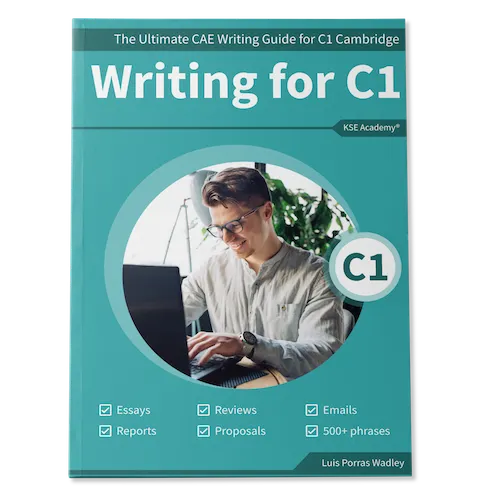
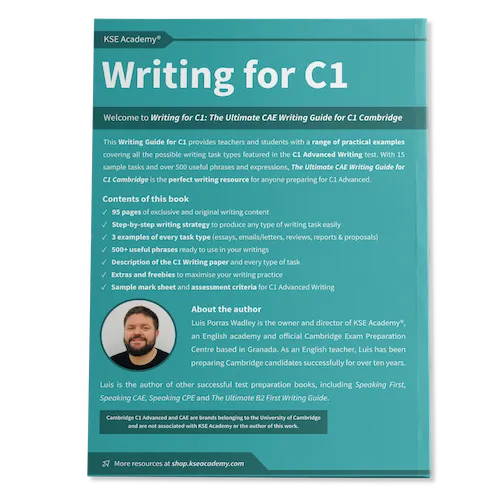
Table of contents
If you are preparing for the Cambridge C1 Advanced exam, you will know that the Writing part can be one of the most feared, but also one where it is easiest to secure marks if you know the rules of the game well. In this article, we are going to focus on one of the most common options for Part 2 of the C1 Writing: the formal letter (or also formal email).
Unlike the informal email, where you can be close and expressive, the C1 formal email or letter requires distance, courtesy, and sophisticated language. It is the type of text you would write to a company director, a newspaper editor, or an academic institution. Ready to master this format? Let’s get on with it!
What is a Formal Email or Letter in the C1 Advanced?
In the C1 Advanced exam, a formal email or letter is a text addressed to a person or institution with whom you do not have a close personal relationship. The objective is usually to request information, lodge a complaint, apply for a job, or respond to an article published in the media.
For the purposes of the exam, an email and a letter are exactly the same. There is no difference in format or content. Cambridge uses both terms interchangeably in this part, so the rules we will see here apply to both formats.
When Will You Be Asked to Write a Formal Letter in the CAE?
As you already know, the CAE Writing has two parts. Part 1 is compulsory (it is always an essay), but in Part 2 you have to choose one task from three options. These options can include: review, report, proposal, formal email/letter or informal email/letter.
Therefore, the formal letter option will not always appear, but it is just as likely to appear as the other options. And if it does, it is fundamental that you know how to distinguish it from an informal one and apply the appropriate register from the very first word.
Main Characteristics of a Formal Letter for C1
To achieve the maximum score, your text must meet certain level and style expectations:
- Purpose and context: You will normally have to request information, complain about a service, apply for a job, or respond formally to an article or situation. The recipient will always be someone you are not familiar with: a director, an editor, or an institution.
- Formal tone and register: This is where you must demonstrate professional distance and courtesy. You must sound polite, objective, and respectful. No emotional closeness or colloquial expressions.
- Differences between formal and informal letters: Unlike the informal email, here you must avoid contractions, phrasal verbs, colloquial idioms, and emotive language. Instead, you will use sophisticated vocabulary, complex structures, and an impersonal tone.
Structure of a Formal Email or Letter for the C1 Advanced
Even though it is formal, the text must be perfectly organised. Clarity is fundamental in this register. This is the ideal structure:
- Formal greeting: An appropriate opening formula depending on whether you know the recipient’s name or not.
- Introductory paragraph: You explain the reason you are writing in a clear and concise manner.
- Main paragraphs (body of the email): Here you develop the points requested by the task. Each main idea should go in a separate paragraph, and you must be specific and objective.
- Closing paragraph: You summarise your request or expectation and thank the recipient for their time or attention.
- Sign-off and signature: An appropriate final formula according to the degree of formality.
How to Write a Formal Email Letter Step by Step
Let’s break down the process so you know exactly what to do in the exam:
- Step 1: Analyse the task and extract the key information. Underline who the recipient is, what relationship you have with that person/institution and, above all, the 3 points (there are usually 3) that you must address mandatorily.
- Step 2: Plan your response. Decide what you are going to say in each point. Think of solid and specific arguments. Do not improvise.
- Step 3: Write the appropriate greeting. If you know the name: «Dear Mr/Ms [Surname]». If you do not know it: «Dear Sir or Madam» or «To whom it may concern».
- Step 4: Draft the introduction. You must immediately explain why you are writing. Use formulas like «I am writing with regard to…» or «I am writing to enquire about…».
- Step 5: Develop the main points. One paragraph for each point of the task. Use formal connectors («Firstly», «Furthermore», «In addition») and make sure to be specific.
- Step 6: Close the email appropriately. Thank the reader for their attention and express your expectation of a response: «I look forward to hearing from you».
- Step 7: Choose the right sign-off. «Yours faithfully» if you do not know the name; «Yours sincerely» if you do know it. Sign with your full name.
Full Example of a Formal Email for the CAE
The theory is all well and good, but let’s see how it applies in practice with an original example created specifically for this guide.
Task instructions
You have read the following announcement from a local environmental organisation:
«GREEN FUTURE INITIATIVE: We are seeking volunteers to help coordinate our annual environmental awareness campaign in schools across the region. Successful candidates will be responsible for organising workshops, liaising with teachers, and presenting environmental topics to students aged 12-16. We are looking for enthusiastic individuals with strong communication skills and a genuine passion for environmental issues.»
Write a formal letter of application. In your letter you should:
- Explain why you are interested in this volunteering opportunity
- Describe your relevant skills and experience
- Suggest what specific contribution you could make to the campaign
Write your answer in 220 – 260 words in an appropriate style.
Task Analysis
In this task, we must write a formal letter of application covering these three points:
- Explain our interest in the volunteering opportunity.
- Describe our relevant skills and experience.
- Suggest what specific contribution we could make to the campaign.
Model Answer + Comments
Dear Sir or Madam,
I am writing to express my strong interest in the volunteering position advertised for your annual environmental awareness campaign. As a qualified secondary school teacher with a longstanding commitment to environmental conservation, I believe I would be an ideal candidate for this role.
My interest in this opportunity stems from my conviction that environmental education is crucial for the younger generation. Having witnessed the devastating effects of climate change firsthand during my travels to coastal regions, I am firmly convinced that raising awareness among adolescents is one of the most effective ways to secure a sustainable future. Furthermore, working with schools would allow me to combine my two greatest passions: education and environmental protection.
As regards my qualifications, I have been teaching Science at a local secondary school for the past five years, during which time I have developed strong presentation and communication skills. Additionally, I hold a degree in Environmental Science and have recently completed a postgraduate course in Environmental Policy. I am therefore well-equipped to explain complex environmental issues in an accessible and engaging manner to young audiences.
In terms of specific contributions, I would be particularly keen to develop interactive workshops focusing on practical solutions that students can implement in their daily lives. I could also establish connections with my current school and other educational institutions in the area, thereby expanding the reach of your campaign significantly.
I would be grateful if you could consider my application. Should you require any further information, please do not hesitate to contact me.
I look forward to hearing from you at your earliest convenience.
Yours faithfully,
Catherine Morrison
Why does this formal email work well for C1? I will explain briefly below:
- Consistently formal register: There is not a single contraction in the entire text. Formal verbs are used instead of phrasal verbs («express» instead of «show», «establish» instead of «set up»).
- Sophisticated vocabulary (C1/C2): Expressions like «longstanding commitment», «stems from my conviction», «witnessed firsthand», «firmly convinced», «well-equipped», «accessible and engaging manner».
- Advanced grammatical structures: Use of present continuous in its full form («I am writing»), complex subordinate clauses, and formal connectors («Furthermore», «As regards», «Additionally», «In terms of», «thereby»).
- Distant and professional tone: The text maintains an appropriate distance without being cold. It shows enthusiasm but in a restrained and professional way.
- Clear structure: Each paragraph addresses a specific point of the task, and the logical progression is evident from beginning to end.
Language and Expressions for C1 Level Formal Letters and Emails
To achieve a truly formal register, you need to master certain linguistic elements that are characteristic of this type of writing:
Avoid contractions and colloquial language
Do not write «I’m writing» or «I’d like». In formal emails, contractions are never used. You must always write the full form: «I am writing», «I would like», «do not», «cannot».
Also avoid colloquial words like «stuff», «things», «get», «lots of». Instead, use more precise and formal vocabulary.
Formal verbs vs phrasal verbs
One of the most obvious characteristics of the formal register is the preference for verbs of Latin origin instead of phrasal verbs. Here are some examples of transformation:
| Informal (Phrasal Verb) | Formal (Simple verb) |
|---|---|
| find out | discover, ascertain |
| put off | postpone, delay |
| set up | establish, arrange |
| look into | investigate, examine |
| go on | continue, proceed |
| show | demonstrate, illustrate |
| get in touch | contact, reach out |
| ask for | request, enquire about |
Advanced grammatical structures
The formal register favours more complex structures. Some of the most useful are:
- Passive voice: Helps create distance and a more impersonal tone. E.g.: «I was informed that…», «It has been brought to my attention that…»
- Formal conditionals: «Should you require further information…», «Were I to be selected…»
- Inversions: «Not only did I complete the course, but I also…», «Under no circumstances would I…»
- Complex noun phrases: «My extensive experience in project management» instead of «I have worked a lot in project management»
Formal connectors
Connectors are essential for providing coherence to your text. In formal emails, you should use sophisticated connectors:
- To add information: Furthermore, Moreover, In addition, Additionally, What is more
- To contrast: However, Nevertheless, Nonetheless, On the other hand
- To sequence: Firstly, Secondly, Finally, In the first place, Subsequently
- To conclude: Therefore, Consequently, Thus, Hence, As a result
- To specify: As regards, With regard to, Concerning, In terms of
Useful Phrases for Each Part of the Formal Email or Letter
Formal Greetings
- Dear Mr/Ms [Surname], (when you know the name)
- Dear Sir or Madam, (when you do not know the name)
- To whom it may concern, (very formal, when there is no specific recipient)
- Dear Editor, (for letters to newspapers or magazines)
Introductory Paragraph
- I am writing with regard to…
- I am writing in response to your advertisement…
- I am writing to express my interest in…
- I am writing to enquire about…
- I am writing to complain about…
- I am writing to apply for the position of…
- I recently came across your article regarding… and I would like to…
Formal Requests
- I would be grateful if you could…
- I would appreciate it if you would…
- Could you please provide me with information regarding…?
- I wonder if you would be kind enough to…
- I should be obliged if you could…
- Would it be possible for you to…?
Complaints and Claims
- I am writing to express my dissatisfaction with…
- I am afraid I must complain about…
- I regret to inform you that…
- I was extremely disappointed to discover that…
- It has been brought to my attention that…
- I feel compelled to point out that…
Providing Information
- I should like to inform you that…
- Please note that…
- I wish to draw your attention to…
- Please find attached…
- As regards your enquiry about…
- With reference to your letter of…
Formal Sign-offs
- I look forward to hearing from you.
- I look forward to receiving your reply.
- I look forward to hearing from you at your earliest convenience.
- Thank you in advance for your time and consideration.
- Should you require any further information, please do not hesitate to contact me.
- I would be grateful for your prompt response.
- Yours faithfully, (if you do not know the recipient’s name)
- Yours sincerely, (if you do know the recipient’s name)
Additional Examples of Formal Letter or Email Tasks
To provide you with more references, here are two more complete examples with their respective model answers, covering different typical exam themes.
Example 2: Letter of Complaint to a Company
Task instructions:
You recently purchased a high-end laptop from an online retailer for your university studies. However, when the laptop arrived, you discovered that it had several defects: the screen had dead pixels, the battery life was significantly shorter than advertised, and some of the pre-installed software was not functioning properly.
Write a formal letter of complaint to the customer service department. In your letter you should:
- Explain what problems you encountered with the laptop
- Describe how these issues have affected your studies
- State what you expect the company to do to resolve the situation
Write your answer in 220 – 260 words.
Model Answer:
Dear Sir or Madam,
I am writing to express my profound disappointment with a laptop I purchased from your online store on 15th January 2026 (Order Reference: LP-2026-4873). I regret to inform you that the product delivered was significantly defective and has failed to meet the standards one would expect from such a reputable company.
Upon receiving the laptop, I immediately noticed several serious defects. Firstly, the screen displays multiple dead pixels, which is particularly problematic when working with detailed graphics and documents. Secondly, the battery life is considerably shorter than the eight hours advertised on your website; in reality, it barely lasts three hours. Finally, several pre-installed applications, including the word processing software essential for my coursework, are not functioning properly and crash frequently.
As a postgraduate student conducting research for my dissertation, I rely heavily on having a dependable laptop. These defects have severely disrupted my academic work. I have been unable to complete assignments on time and have missed important deadlines as a result. Furthermore, I have had to resort to using the university library computers, which has proven highly inconvenient given their limited availability.
In light of these circumstances, I would like to request either a full replacement with a functioning device or a complete refund. Additionally, I believe some form of compensation would be appropriate given the considerable inconvenience I have experienced.
I trust you will treat this matter with the urgency it deserves and look forward to receiving your response within seven working days.
Yours faithfully,
Thomas Bennett
Example 3: Response to a Newspaper Article
Task instructions:
You have read the following extract in a national newspaper:
«Public libraries have become obsolete in the digital age. With unlimited information available online, maintaining physical libraries is an unnecessary expense for local councils. The buildings should be converted into more practical facilities such as community centres or commercial spaces.»
Write a letter to the newspaper editor. In your letter you should:
- Explain why you disagree with the article’s viewpoint
- Provide specific reasons why libraries remain important
- Suggest what role libraries could play in modern society
Write your answer in 220 – 260 words.
Model Answer:
Dear Editor,
I am writing in response to the article published in your newspaper on 20th January regarding the alleged obsolescence of public libraries. I am afraid I must strongly disagree with the assertions made in the piece, as I believe the author has fundamentally misunderstood the role libraries play in contemporary society.
Firstly, whilst it is true that information is readily available online, access to digital resources is far from universal. According to recent statistics, approximately 15% of households in the UK lack reliable internet connectivity. For these individuals, particularly those from disadvantaged backgrounds, libraries provide essential access to information and educational resources. Without them, we would be exacerbating existing social inequalities rather than addressing them.
Moreover, libraries serve functions that extend far beyond merely housing books. They provide quiet spaces for study, which is invaluable for students who may not have suitable environments at home. Furthermore, they offer free computer access, job-seeking support, and literacy programmes for all age groups. Many elderly citizens, for instance, rely on library staff to assist them with digital technology and online government services.
Rather than closing libraries, we should be reimagining them as dynamic community hubs. They could host workshops, cultural events, and provide meeting spaces for local groups. In doing so, they would continue to fulfil their traditional role of democratising knowledge whilst adapting to the needs of modern communities.
I sincerely hope you will consider publishing this alternative perspective on such an important matter.
Yours faithfully,
Dr Eleanor Whitfield
Common Errors When Writing Formal Emails (and How to Avoid Them)
- Using contractions: This is the most common error and the easiest to avoid. Remember: try not to use «I’m», «don’t», «can’t» in a formal text. Always write the full form.
- Being too personal or emotive: Do not use expressions like «I’m really excited» or «It would be amazing if…». Maintain professional distance with expressions like «I would be delighted» or «It would be beneficial if…»
- Mixing registers: If you start with a formal tone, you must maintain it until the end. Do not mix colloquial vocabulary with formal vocabulary.
- Not covering all points: Make sure you have responded to the 3 things requested by the task. It is a mistake that costs dearly in the final grade.
- Using phrasal verbs unnecessarily: Although some neutral phrasal verbs are acceptable, you should prioritise simple verbs of Latin origin to sound more formal.
- Incorrect sign-offs: Remember the rule: «Yours faithfully» if you do not know the name (you started with «Dear Sir or Madam»), «Yours sincerely» if you do know it (you started with «Dear Mr/Ms…»).
Differences Between Formal and Informal Emails
It is vital not to confuse these two types of writing. Confusing the register is one of the most serious errors you can make in the exam. If you want to delve deeper into the other type of email, take a look at our guide on the informal email. Here is a detailed comparison so you do not make register errors:
| Aspect | Formal Email/Letter (Boss/Institution) | Informal Email/Letter (Friend/Relative) |
|---|---|---|
| Tone objective | Distant, objective, polite and professional. You seek to inform, request or complain in a polite manner. | Close, emotional, subjective and relaxed. You seek to connect and maintain the relationship. |
| Initial Greeting | Dear Mr/Ms [Surname], Dear Sir or Madam, To whom it may concern | Hi, Hey, Dear [First name] |
| Contractions | Forbidden: Always use the full form (I am, do not, will not, cannot). | Essential: I’m, don’t, won’t, can’t, it’s. |
| Vocab and Verbs | Preference for verbs of Latin origin and sophisticated vocabulary (enquire, ascertain, establish, contact, request). | Frequent use of Phrasal Verbs (find out, set up, get in touch, ask for) and colloquial words. |
| Grammatical Structures | Passive voice (to be impersonal), long complex sentences, indirect questions (I wonder if you could…). | Active voice, shorter sentences, direct questions (Can you…?), exclamations (!). |
| Connectors | Furthermore, Moreover, However, Nevertheless, Consequently, Therefore. | Anyway, Besides, Plus, So, But. |
| Idiomatic Expressions | Colloquial idioms are avoided. Language should be literal, precise and objective. | The use of Idioms is highly valued (over the moon, give a hand, keep in touch). |
| Level of Personalisation | Impersonal. You avoid talking too much about yourself. You focus on the topic or problem. | Personal. You talk about your experiences, emotions and opinions freely. |
| Sign-off | Yours faithfully (if you do not know the name), Yours sincerely (if you do know it). | Best wishes, Take care, Hugs, All the best, Lots of love. |
Important note on transformation examples: Notice how the tone changes completely according to the register:
Example of informal → formal transformation:
| Informal | Formal |
|---|---|
| Hi John! | Dear Mr Thompson, |
| I’m writing because I want to know more about the job. | I am writing to enquire about the position advertised. |
| I’d really love to get this job! | I would be extremely interested in securing this position. |
| Can you tell me when I’ll hear back? | I would be grateful if you could inform me of your decision timeframe. |
| Looking forward to hearing from you soon! | I look forward to hearing from you at your earliest convenience. |
| Cheers, Sarah | Yours sincerely, Sarah Mitchell |
Checklist: Review Your Formal Letter/Email Before Handing It In
Before considering your email finished, pass it through this filter. We have adapted the official Cambridge checklist for C1 specifically for the Formal Letter task. If you tick all the boxes, your pass is much closer.
1. Content
- ✅ Have I covered the 3 points of the task? (Make sure you have not forgotten any requested aspect).
- ✅ Have I added specific and relevant details? (Do not respond in a vague manner; be concrete and precise).
- ✅ Is it the appropriate length? (The text should be between 220 and 260 words).
2. Purpose and register (Communicative Achievement)
- ✅ Is the tone consistently formal? (It must be polite, distant and professional at all times).
- ✅ Have I avoided emotive or personal language? (Maintain objectivity and do not use overly emotional expressions).
- ✅ Have I fulfilled the communicative function? (If they ask to request, have I requested? If they ask to complain, have I complained appropriately?).
3. Organisation
- ✅ Are there clear and logical paragraphs? (Greeting + Introduction + Paragraph per idea + Closing + Sign-off).
- ✅ Have I used formal connectors? (Use «Furthermore», «Moreover», «However», «In addition» instead of informal connectors).
- ✅ Is the progression of ideas clear? (Each paragraph must have a clear purpose and follow a logical sequence).
4. Language
- ✅ Have I avoided all contractions? (Essential: I am, do not, cannot, will not instead of I’m, don’t, can’t, won’t).
- ✅ Have I prioritised formal verbs over phrasal verbs? (Use enquire, establish, contact instead of ask about, set up, get in touch).
- ✅ Have I used sophisticated vocabulary? (Avoid simple words like get, do, make; use more precise synonyms).
- ✅ Is there grammatical variety? (Include advanced structures like passive voice, formal conditionals, complex subordinate clauses).
- ✅ Have I used the correct greeting and sign-off? (Dear Sir or Madam / Yours faithfully or Dear Mr/Ms X / Yours sincerely).
Complete Writing Guide for the C1 Advanced
Do you want to secure a pass in the C1 Writing? If you liked this explanation, you will love my complete guide for the C1 Writing: Writing C1: The Ultimate CAE Writing Guide for C1 Cambridge. This is the best resource you will find for sale with examples of all types of texts, lists of advanced vocabulary, error correction exercises, and step-by-step templates so you do not have to improvise on exam day. It is the tool thousands of people use to succeed in the C1 Advanced Writing.
👉🏻 Get the best Writing book for C1 here
I hope this guide has been useful to you in knowing how to write a formal letter or a formal email. Remember that you can download this article in PDF by clicking the button at the top of the page to review it whenever you want.
And until the next article, don’t forget to keep smiling!