English Grammar
Oh, my God, no! English grammar, no! Let's run away! I'm sorry, but this is what we've got today: loads of English grammar and the best tips on how to learn English grammar. Hold on tight, my friend, because there are some very, very interesting twists and turns ahead.
Verb tenses in English


Elementary Grammar (A2 - B1)

Intermediate Grammar (B1 - B2)

Advanced Grammar (C1 - C2)
What is grammar, my precious?
English grammar is brilliant. Why? Because I say so and that's that.  No, seriously, English grammar is the easiest thing about this language. I mean it.
Most students throw their hands up in despair when I say in class "Now we're going to do a bit of grammar", but honestly, I absolutely love it, and you can see it on my face. 
But, what is grammar? The grammar of a language is the system of elements and structures by which a language works. It's like the glue that holds all the words together and allows us to construct sentences. That's why I love it. And I love explaining how words work in English and how they interact with each other to create messages. It's beautiful.
Why it's important to study grammar
In case it wasn't clear in the previous paragraph, grammar allows us to play with language to express different things, which is why it's so important.
All right, Luis, but nowadays there are loads of people who say it's not worth studying grammar, that what you need to do is speak the language from day one and that's that. Less grammar and more speaking.
Well, I'll eat those people for breakfast. Look, I'm all for starting to produce (speaking and writing) from day one. Not everyone agrees, but I do. And I also believe that one of the biggest problems with English learning in our education system has been an excessive focus on grammar and vocabulary translated in lists, with very little communicative approach. There's no doubt about that. But you can't be such a dimwit as to claim that grammar shouldn't be studied.
English grammar (and that of any language) must be studied, without question, but it's true that it can be done in many ways, some more explicit and others less so. I'm in favour of a middle ground: understanding how a particular grammatical function works and when it occurs, and then practising it to death in conversation and in writing. My students can confirm this for you.  Moreover, nowadays there are countless English grammar resources online that can help you, starting with the tips I'm going to give you in this post. So let's get down to it.
How to study English grammar without dying in the attempt
The lovely thing about learning a language is that there isn't just one way to learn it. Each person must develop their own learning method. And the curious thing is that whoever doesn't develop their own method usually doesn't learn well or quickly. I've seen this time and time again.
With English grammar, being part of a language, it's the same: we don't all study or learn English grammar in the same way, and it's essential that you develop your own method. And that's something you need to understand from now. Moreover, you have to be very consistent, otherwise you'll forget everything or almost everything you've learnt.
So, without further ado, let's move on to the best tips for learning English grammar ever told (by me).
Start from the bottom
In a way, English grammar is like maths. In maths, you need to know how to add to understand multiplication and to subsequently solve problems. In English, as in any language, grammar works like this: if you don't master the basic principles, you won't be able to progress.
To give you a very obvious example: if you don't master the verb to be, forget about constructing passive sentences.
So, however advanced you think your English is, if you notice that you're making a recurring mistake and don't really know why, don't hesitate to go back and consult your basic grammar notes to fix that error and prevent it from becoming ingrained and turning into a bad habit.
Understand how verbs work in English
Following on from the previous point, you need to know that understanding how verbs work in English is absolutely essential. Moreover, it's very easy. Here's a deadly useful table:
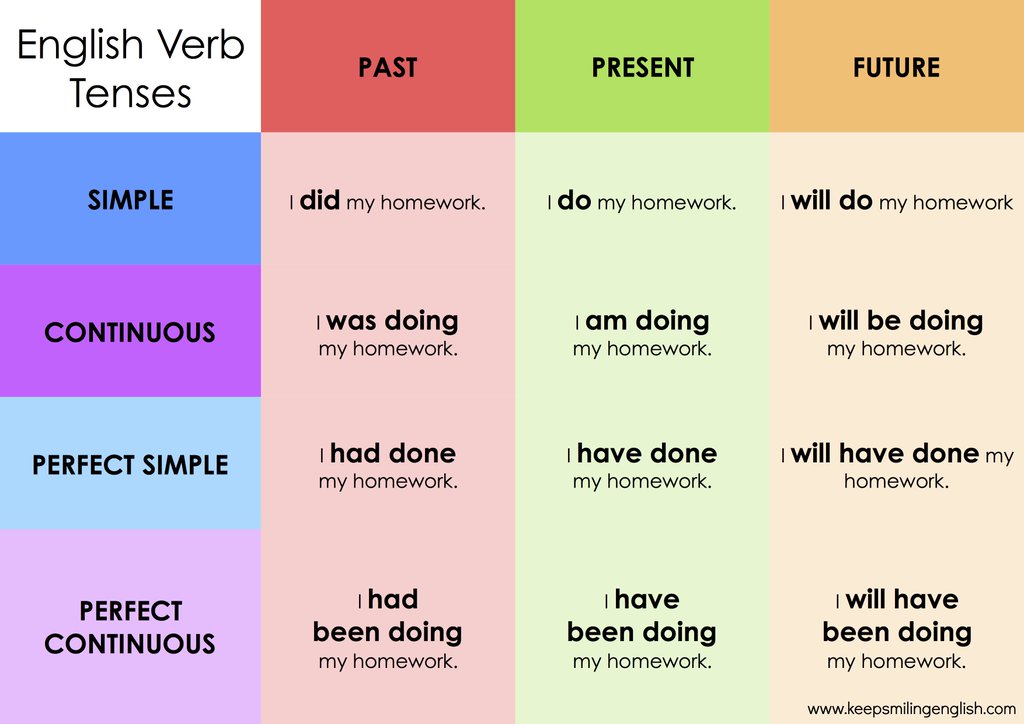
I'm going to give you some tips off the cuff that will help you a lot if you're still not clear on how to make compound verb constructions in English:
- There are three tenses we can talk about: past, present and future. (What a surprise!)
- Within past, present and future, there are simple, perfect, continuous and perfect continuous verb tenses.
- The simple verb tenses are the most basic form of each tense (past, present and future).
- All the perfect tenses have have and a past participle. Have is conjugated in the corresponding tense (past, present or future).
- All the continuous tenses have be and a present participle (-ing). Be is conjugated in the corresponding tense (past, present or future).
- The perfect continuous tenses have have been and a present participle (-ing). Have is conjugated in the corresponding tense (past, present or future).
- The future tenses have will followed by an infinitive.
- The passive verb tenses are constructed with be and a past participle. Be is conjugated in the corresponding tense (past, present or future).
Understanding these premises, and knowing the verb forms, obviously, you can now identify and construct the different verb tenses:
- Present perfect of the verb work: have/has worked.
- as it's perfect, it has have
- as it's present, have is in the present (have/has)
- we add the past participle of work: worked
- RESULT: have/has worked
- Past continuous of study: was/were studying
- as it's continuous, it has be and a present participle
- as it's past, be is in the past (was/were)
- we add the present participle of study: studying
- RESULT: was/were studying
- Future perfect continuous of write: will have been writing
- as it's future, it has will and an infinitive
- as it's perfect, it has have (in the infinitive) and a participle
- as it's continuous, it has the verb be (in the participle) and a present participle
- we add the present participle of write: writing
- RESULT: will have been studying
Knowing and understanding these universal truths of English verb tenses, you won't have problems identifying them and knowing how to construct them. It's another matter to know what they're used for and how to use them properly, but at least you'll know how to construct them. It's something. 
So, my recommendation is that, if you're interested in learning English well, try to understand how verbs work from the beginning, as this way you'll avoid knowledge gaps that will be an obstacle in the future to keep progressing. And, obviously, telling you that verbs are essential in grammar is stating the blindingly obvious.
Be versatile
Let's change the subject a bit, I got a bit carried away and got too excited in the previous point.
To master English grammar you have to be versatile. You're on the wrong track if you think that by reading the previous point and doing exercises from a textbook you're going to use grammar like an English lord. No freaking way, mate.
And how can I be versatile, Luis? HOWWWWW?! Well, very easy: immerse yourself in everything and use what you learn as much as you can. For this reason, I always recommend my students read a lot, watch lots of films and series, and write and speak as much as possible in any context. Everything counts and the more the better.
What will we achieve by being versatile in our learning style? Well, for starters exposing ourselves to as much grammar as possible and, above all, practising it. This way you'll be "putting a face" to the different grammatical points of English, so to speak. That is, maybe you've studied passives in class, but you really haven't got the foggiest idea of where the hell passives actually appear apart from in unit 8 of your English book. That's why my advice is: get reading, champion, you'll see how you'll come across more than one passive. Pick up a newspaper article and immerse yourself, you'll see how you'll find the odd passive or two.
That's what I mean when I say you'll put a face to the English grammar you've studied. And the more versatile and varied your study is, the more grammar you'll identify around you.
Use books for practice, without fear
We all have that typical silly mate who's been to England and thinks he's brilliant because he says gonna all the time, even though his grammar is dreadful and his vocabulary sadly poor. This is the one who tells you, constantly, that "what you need to do is speak and go abroad"; that "a language isn't studied, it's lived". Pfffff! That cracks me up.
Going abroad to learn English is great, but it's not necessary to learn a language. I really mean it. And one of the resources we can and should use to learn English grammar are textbooks. Nowadays there's an infinite variety and some very good ones that can help you understand and practise grammar.
And don't be afraid to use them to death. The important thing, as I've said before, is that the grammar textbook is part of your study method, not the only thing you do. If you combine it with reading, writing and oral practice of Speaking and Listening, the textbook will be one of your best allies. Believe me!
Don't miss opportunities to put it into practice
In this sense I don't think I need to add much more, do I? The grammarian is made, not born, young grasshopper. And they're made properly, by grafting and practising. So everything you learn, start putting it into practice at every opportunity you can. If not, this knowledge and these new skills will fall into disuse and, unfortunately, into oblivion. Into your oblivion, more specifically, and you'll be unable to use it when you really need it. What a waste of time and effort it is to study something only to forget it later, don't you think? So there you go, practise lots!
Open your mind, my young padawan
One of the biggest problems that some English students have in learning the language is that they're very closed-minded when it comes to languages. If you really want to master a foreign language, you have to understand that the world doesn't revolve around your mother tongue.
No two languages are the same and no language is a translation of another. Why should you understand this? Because many people don't understand, for example, why in Spanish we say tener 31 años but in English you say be 31 years old (be instead of have). And what's the answer to that why?, well just because and that's that. That's how it is and don't overthink it.
Each language has evolved alongside its speakers, in a social, historical and cultural context that's impossible to understand one hundred per cent. And if a language has evolved like that, who are you to question why it works one way or another? And English grammar is simply another example of this. And besides, it's much less complex than Spanish grammar, so be thankful and don't complain too much. 
Once you understand that English isn't a translation of Spanish, it'll be easier for you to assimilate its grammar and its peculiarities.
Talk to yourself
Talking to yourself is another of the techniques I most recommend to my students, especially the more beginner ones. And when I say talk to yourself I don't mean mumble as if you were running out of breath, no. What I mean is that you talk to yourself in English, and even vocalise. And if you're alone, take the opportunity to deliver a monologue.
Seriously, this works. In fact I've read more than once that this is recommended to people who stammer to improve their speech, so it must be effective. As for English grammar, imagine you've studied reported speech and the reporting verbs and you're finding it hard to memorise them because, bloody hell, they're really tricky. Well, a brilliant way to start internalising how they work is by talking "in your mind" or in a low voice. This way when you really need them it won't be the first time your mind has made the effort to use them, so it'll be easier for you to put them into practice and use them correctly.
Be consistent
This is, without doubt, the most boring tip. But it's also, probably, the most crucial. If you intend to learn English and its grammar by cramming just before your exam... stop reading now because you're a lost cause.
A language, let this be clear, isn't a school subject, although unfortunately it's treated as such. A language isn't memorised and "regurgitated" in an exam. If you intend to learn English and master English grammar, you must be very consistent. Think that learning English is like training at the gym. Are you going to get fit in one weekend? No. Well, the same goes for a language. It's a long-distance race that only those who work hardest complete. You have to be consistent to keep progressing.
Consult your pharmacist
Right, maybe your pharmacist doesn't know English. What I mean by this is that you should rely on the experience and support of an expert. And by this I don't mean "any old foreigner who speaks English". Curiously, foreigners who haven't studied linguistics at university haven't got a clue about grammar, to the point of not knowing what a passive is or reported speech, however much they use it correctly.
For that reason, I recommend you rely on the help of an English teacher who understands grammar well and, above all, knows how to explain it in a simple way so that you understand it. This will help you enormously; much more than any English grammar book.
Which is the best English grammar book
Probably the best English grammar book that exists is English Grammar in Use by Raymond Murphy, intermediate level. Well, actually, I don't think there's a single book that's the best, as each student may find one book works better or worse for them. But at the moment, I think that's the one that works best for the vast majority of English students.
Why choose English Grammar in Use
Well, for starters, it has all the grammatical points necessary to master English. Starting from scratch and reaching a good upper-intermediate level for each grammatical point. Moreover, the explanations are very clear and the book's design is very good, especially since the fourth edition.
Furthermore, and this is what really interests me, it emphasises the in Use bit. That is, everything that's explained and practised is done in context and in the most natural way possible, bearing in mind that it's still a grammar book.
Moreover, with this book you don't only learn grammar, you'll also learn lots of vocabulary. This happens because, curiously, to solve many of the exercises you'll also need to know the meaning of many words, so you've got no choice but to learn them along the way.
That's why, if your English level is between mediocre and not so mediocre, and you're thinking about buying an English grammar book, you should consider buying English Grammar in Use by Raymond Murphy. It won't disappoint you.
Conclusion
English is cool, and so is its grammar. And if you want to study English grammar properly and make it worthwhile, don't forget the tips I've given you for studying it. I assure you that the difference between a good learner and a bad one lies in this kind of trick and behaviour. And I suppose if you're reading this you won't want to be one of the latter, will you?
So there you go. And don't forget to keep smiling! Even when English and its grammar put you through the wringer.